THE DEAL BENCH
Who advised, and who did what
Tap a team to see what it does in a deal like this.
BUYER SIDE
Simpson Thacher & Bartlett
Legal adviser to Blackstone Digital Infrastructure Trust and Blackstone
Select a team above.
On 16 November 2026, Blackstone Digital Infrastructure Trust, a newly listed company run by Blackstone, announced that it will buy 75% of two joint ventures that own 13 brand new Amazon Web Services data centres. Amazon keeps the other 25%. The two campuses are valued at $5.0bn in total, and the price reflects an initial capitalisation rate of 7.0%. The agreement itself was signed on 11 November, according to the trust's filing with the US Securities and Exchange Commission.
The 13 buildings are powered shells (finished data centre buildings with power connected, into which the tenant installs its own servers and computing equipment). Nine sit on a campus in northern Indiana, in the greater Chicago market, and four on a campus in Mississippi. Together they have 647 megawatts of IT power capacity. Amazon will rent back every building on long leases, so in practice nothing changes for how the buildings are used. What changes is who owns most of the walls and who collects most of the rent.
This is BXDC's first ever investment. The trust listed on the New York Stock Exchange in May 2026, and Simpson Thacher says its IPO was the largest blind pool REIT IPO on record. The deal is expected to close in the fourth quarter of 2026.
The Parties
Blackstone Digital Infrastructure Trust (BXDC) is a real estate investment trust, or REIT. It describes its strategy as buying newly built, fully leased data centres rented to large cloud companies on long contracts. It does not employ its own management team. It is externally managed (run under contract by an outside manager, here an affiliate of Blackstone).
Blackstone is the world's largest alternative asset manager, with nearly $1.4 trillion of assets under management. Bloomberg, as published by the Irish Times, reports that Blackstone has built a $200bn data centre portfolio that includes QTS Realty Trust, one of the biggest builders and operators of data centres.
Amazon Web Services (AWS) is Amazon's cloud computing arm, which rents computing power and storage to businesses and governments. The legal counterparties are two affiliates of Amazon Data Services, Inc., a subsidiary of Amazon.com, Inc. Amazon.com itself will guarantee the rent. Bloomberg reports that AWS's backlog of cloud orders not yet delivered stood at $578bn, according to Amazon chief executive Andy Jassy after the third quarter results.
Structure & Process
The deal is done through a contribution agreement rather than an ordinary sale contract. At closing, the Amazon affiliates will contribute the two campuses into two new joint venture companies. In return, they receive a 24.9% stake in each venture plus a cash payment from it. BXDC's subsidiaries put in $1.9bn of cash for a 75.1% controlling interest in each venture. The filing describes a minimum cash distribution that must be paid to the Amazon side at closing.
Once the deal closes, the two sides sign a limited liability company operating agreement for each venture. BXDC's subsidiary will be the managing member (the owner that runs the venture day to day). Amazon keeps approval rights over certain "major decisions and fundamental decisions", which means BXDC cannot take those steps without Amazon's agreement. The operating agreements will also restrict how either side can sell its stake.
Each campus will be 100% leased back to Amazon Data Services on triple net leases. The leases have a weighted average initial term of 12 years, which can be extended to 32 years, and the rent rises by 2.75% every year. Amazon.com, Inc. guarantees the tenant's payments.
The process is short. The deal was signed on 11 November and is expected to close before the end of 2026. Either side can terminate if it has not closed by 31 December 2026, or by a later date if extended under the agreement. If one side walks away because the other failed to close when it was supposed to, the innocent party receives a termination fee of $150.0m, which is its "sole and exclusive remedy" (so it cannot also sue for more). The public filing does not list any shareholder vote or named regulatory approval, only "certain closing conditions", and the full agreement has redacted parts.
The Financing Angle
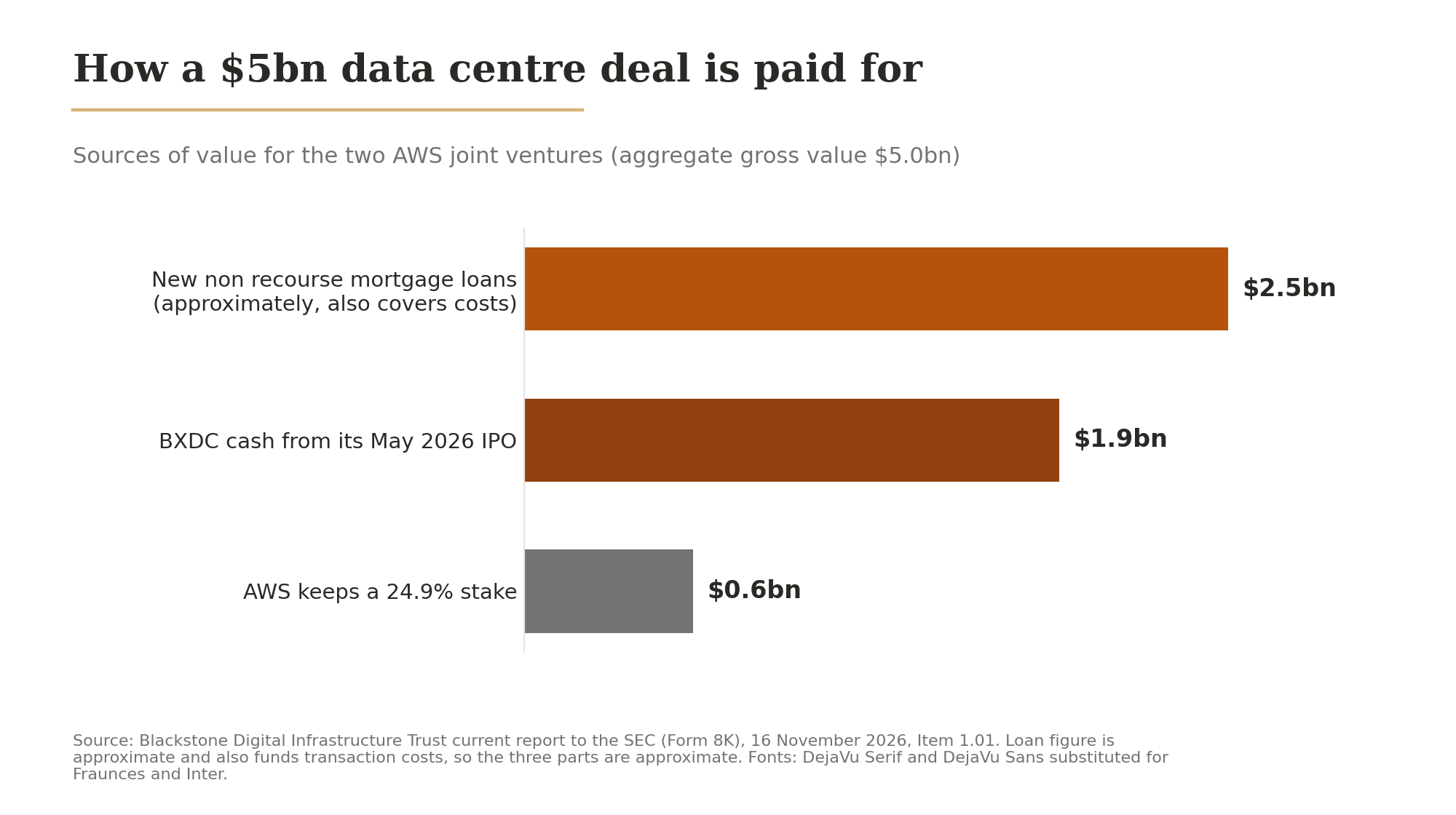
The $5.0bn value is made up of three pieces, all taken from BXDC's filing. BXDC contributes $1.9bn of cash raised in its IPO. The joint ventures' own subsidiaries borrow about $2.5bn through new non recourse mortgage loans. Amazon's retained 24.9% stake accounts for the remaining $0.6bn. The loans also cover transaction costs, so the split is approximate.
The loans equal about 50% of the $5.0bn value. That matches what BXDC chief executive Nick Pell told Bloomberg; namely, that the joint venture has a debt commitment to borrow 50% of the purchase price at close. The filing confirms BXDC has signed a debt commitment letter for each loan, but it does not name the lenders.
Also by my own calculation, a 7.0% capitalisation rate on $5.0bn implies roughly $350m of first year net rental income across the two campuses, before the annual 2.75% increases. Because Amazon pays the running costs under the triple net leases, most of that is income the owners keep.
Why it Matters
First, this is a clear example of capital recycling in the AI boom. Cloud companies are spending heavily on data centres. Pell told Bloomberg that many developers and closed ended funds are looking to exit and recycle their capital, and that BXDC is "finding a home for them with the public investor capital." The deal turns $5.0bn of completed Amazon buildings into a mix of public equity and mortgage debt, and Amazon gets cash back to build more.
Second, it shows how AI infrastructure is being opened up to ordinary investors. Data centre ownership has mostly sat in private funds. A listed REIT lets anyone with a brokerage account buy a slice of Amazon leased buildings and receive a share of the rent as dividends. Bloomberg reports that BXDC targets stabilised data centres worth $250m to $1.5bn each and estimates its addressable market at $1 trillion over the next five years.
Third, the structure is a legal template. A contribution agreement, a joint venture operating agreement with approval rights for the tenant, triple net leases with a parent guarantee and non recourse mortgage debt are the building blocks of most large sale and leaseback deals. Commercial law students will see these documents again and again.
Finally, it raises real questions about concentration. As BXDC itself notes, after completion it will depend on a single tenant and two properties. Investors are betting on Amazon's credit and on continued demand for AI computing.
Real World Impact
You probably use these buildings without knowing it. Every time you stream a show, store photos in the cloud or use an AI chatbot, the request may run through data centres like the 13 in Indiana and Mississippi. This deal does not change how those buildings work. It changes who owns most of them and who collects the rent.
If you own a pension or an index fund, the link could be closer than you think. Listed REITs like BXDC are the kind of investment pension funds and ordinary savers can buy, so part of the rent Amazon pays could, in time, end up as dividends in everyday portfolios. The flip side is risk. If AI demand cooled or Amazon's plans changed, a trust that depends on one tenant would feel it.
For people living near data centres, the bigger story is the boom this deal helps pay for. Amazon gets cash back to build more, and data centres use large amounts of electricity, land and sometimes water. Bloomberg reports that the Democratic sweep in the midterm elections is set to give momentum to the party's drive to put guardrails (legal limits) on data centre growth, and that development has met organised community opposition. AWS said it wants to keep "communities at the center of how we build." Whether that means lower or higher local power bills, more or fewer local jobs, is worth watching as more of these deals happen.
Why they did it this way
- 1AWS kept 24.9%, so it frees up cash while staying invested in, and keeping a say over, buildings it still uses.Could have: Sell 100% of the buildings outright
- 2A contribution into a joint venture splits ownership neatly and can let the contributor defer tax on the part it keeps.Could have: A straight sale of the buildings
- 3Non recourse mortgages at venture level limit the lenders to these buildings, protecting the rest of BXDC.Could have: Borrowing at trust level
- 4A matching $150m fee as the only remedy sets a clear price for failing to close and avoids long lawsuits.