THE DEAL BENCH
Who advised, and who did what
Tap a team to see what it does in a deal like this.
BUYER SIDE
Matheson
Legal adviser to Barings and BidCo
TARGET SIDE
McCann FitzGerald
Legal adviser to IRES
Select a team above.
On 9 November 2026 Irish Residential Properties REIT plc, known as IRES, agreed to be bought by a newly formed company backed by Barings, the US investment manager owned by the insurer MassMutual. IRES owns 3,611 rented homes, mostly apartments in the greater Dublin area, valued at €1,277m at 30 June 2026. RTÉ and the Irish Examiner both describe it as the country's largest private landlord.
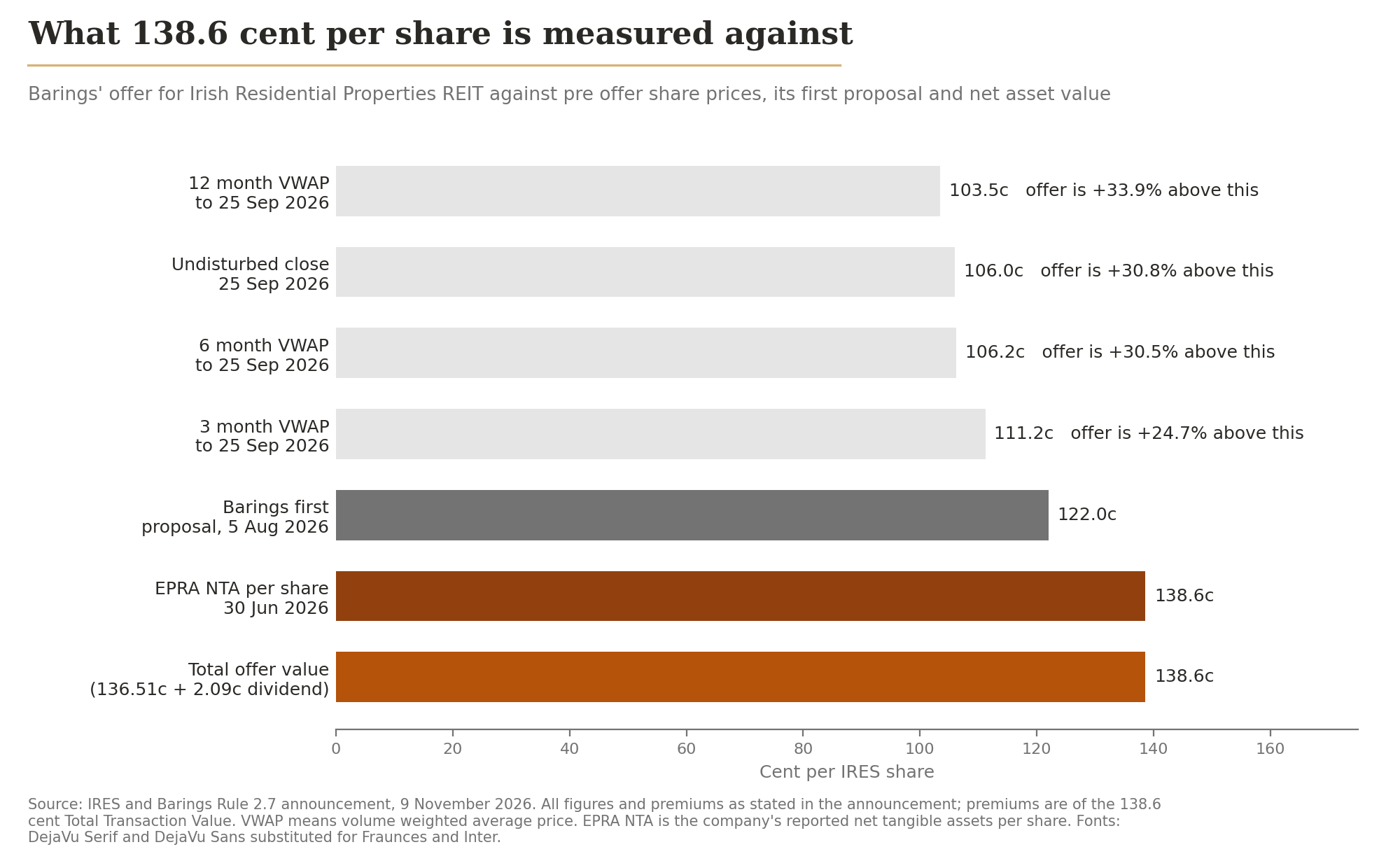
Shareholders will receive 138.6 cent per share in total. Most of that (136.51 cent) is paid by the buyer when the deal completes. The rest (2.09 cent) is a dividend paid by IRES itself before completion. Together they value IRES's shares at about €731m. The price is 30.8% above where the shares closed on 25 September 2026, the last trading day before the bid became public, and higher than any price the shares have traded at since August 2022.
The headline number exactly matches IRES's EPRA NTA (a standard measure of a property company's net asset value per share, meaning roughly what the buildings are worth minus the debt) of 138.6 cent. Put simply, Barings is paying full book value for a company the stock market had been valuing at a 23.5% discount to that figure just before the bid.
The Parties
The buyer. BidCo is Ireland Residential Holdings Limited, a company set up in Jersey purely to make this acquisition. It is owned by funds and accounts that Barings manages or advises, and its ultimate controlling owner is Massachusetts Mutual Life Insurance Company. Barings describes itself as a $502bn global alternative asset manager. Its real estate arm managed about $39bn of property equity globally at 30 September 2026, around $7bn of it in Europe.
The target. IRES is a REIT. It has been internally managed since January 2022, faced an activist campaign by shareholder Vision Capital from 2023, and appointed Eddie Byrne as CEO in May 2024. In the first half of 2026 it reported occupancy of 99.4% and net loan to value of 42.6%, and it estimates its homes are about 20% "under rented" compared with market rents.
The advisers. Matheson acts for Barings and BidCo, and McCann FitzGerald acts for IRES. On the banking side, BofA Securities advises Barings, while Rothschild & Co, Barclays and Davy advise the IRES board.
Structure & Process
The deal will be carried out through a scheme of arrangement. The scheme needs approval from holders of at least 75% in value of the shares voted at a court convened scheme meeting, followed by resolutions at a separate EGM, then sanction (formal approval) by the High Court.
The process started informally. Barings made an unsolicited proposal of 122.0 cent on 5 August 2026, which the board rejected. Over about five weeks it made four further proposals, ending at 138.6 cent. On 20 September the board said it would be "minded to recommend" that price and opened its books for confirmatory due diligence. The approach became public on 28 September, which started the offer period (the formal phase in which the Irish Takeover Rules apply in full). The firm offer followed on 9 November, after Barings asked for a short extension to its PUSU deadline.
Alongside the announcement, BidCo and IRES signed a Transaction Agreement. Key terms disclosed so far:
Conditions: shareholder approvals, High Court sanction, clearance by the CCPC to the extent its merger rules apply, and approval or non objection from the Central Bank of Ireland for the indirect change in control of a regulated entity in the IRES group under the Central Bank's AIF Rulebook.
Matching right: if the board decides a rival bid is superior, Barings gets seven business days to improve its offer.
Expenses reimbursement: in certain cases, such as the board withdrawing its recommendation, IRES must repay Barings' documented deal costs, capped at 1% of the offer value.
Irrevocables: the five directors who own shares (about 0.24% of the company in total) have irrevocably committed to vote in favour, and those commitments stay binding even if a higher rival offer appears.
After completion IRES will leave Euronext Dublin within two business days, stop being a REIT and be registered as a private company.
The Financing Angle
Barings is paying with a mix of equity and committed debt financing from third party lenders. The announcement does not name the lenders or the split between debt and equity; that detail is due in the scheme document.
Two financing points matter legally. First, there is no financing condition. Barings cannot walk away because its loans fall through. Second, under Rule 2.7(d) of the Irish Takeover Rules, BofA Securities has confirmed that BidCo has enough resources to pay the cash in full. This cash confirmation puts the bank's own reputation on the line, which is why bidders arrange certain funds financing (loans with very limited conditions) before announcing.
The dividend element is also a financing detail. The 2.09 cent comes out of IRES's own cash, not BidCo's. The announcement also gives BidCo the right to cut its 136.51 cent by the amount of any further dividend IRES pays before completion, including any extra payout needed to keep its REIT status. Shareholders would keep that dividend, so the total they receive stays the same.
Why it Matters
For law students, this is a clean case study in how an Irish public takeover works from start to finish: a series of private proposals, a board saying it is "minded to recommend", a PUSU deadline, a Rule 2.7 announcement with a cash confirmation, independent Rule 3 advice and a court approved scheme. It also shows deal protection in the Irish style, where the target's exposure is limited to reimbursing costs up to 1%.
For the market, it continues a trend: listed European property companies trading below their net asset value become targets for private capital. The IRES board explicitly says its small size, concentrated shareholder base and persistent discount made raising new equity hard, so selling to a private owner with long term capital became the better option. For Ireland, it means another large portfolio of rental homes moving from public markets into private institutional ownership at a time when housing is the country's most sensitive political issue.
Real World Impact
If you rent one of IRES's 3,600 or so Dublin homes, your lease does not change on the day the deal completes, because Barings is buying the company, not the individual flats. The bigger factor for tenants is Ireland's rental law. For tenancies starting on or after 1 March 2026, rent rises are capped at the lower of inflation (CPI) or 2% a year, and a large landlord such as IRES cannot end a tenancy simply because it wants to sell, renovate or change the use of a property.
Where it could matter is what happens when people move out. IRES estimates its rents are about 20% below market. Under the new rules, a landlord can generally reset the rent to market when a tenant leaves voluntarily, so new tenants moving into IRES homes could pay noticeably more than the people who left. That would be true whoever owns the company, but a private owner focused on returns might pursue it more actively. On the upside, Barings says it plans to invest in refurbishing the existing homes, which could improve the buildings.
There are a couple of other knock on effects. Barings expects to cut "a limited number of roles", mainly in corporate functions that exist only because IRES is listed. Pension funds and savers who held IRES shares get cash at a 30.8% premium to the pre bid price. And the wider trend is worth watching: RTB figures reported by the Irish Examiner show landlords with 100 or more tenancies now provide almost 30% of private tenancies in Dublin, as smaller landlords sell up.
Why they did it this way
- 1Five private bids won the board's backing, which opened up due diligence and made a scheme possible.Could have: A hostile offer made straight to shareholders
- 2A scheme delivers 100% ownership once 75% by value of votes approve, which Barings needs to delist and end REIT status.Could have: A takeover offer needing 80% acceptances
- 3Paying exactly net asset value lets the board say shareholders get full value for the homes.
- 4A regulated entity in the IRES group means the Central Bank must approve the change of control.