THE DEAL BENCH
Who advised, and who did what
Tap a team to see what it does in a deal like this.
BUYER SIDE
Paul, Weiss, Rifkind, Wharton & Garrison
Legal counsel to KPS Capital Partners
BUYER SIDE
Schönherr
Legal counsel to KPS Capital Partners
TARGET SIDE
Linklaters
Legal counsel to MM Group
TARGET SIDE
Binder Grösswang
Legal counsel to MM Group
Select a team above.
On 9 November 2026 MM Group, the Vienna listed maker of cartonboard and folding cartons, signed a binding agreement to sell its Packaging business to a newly created holding company controlled by KPS Capital Partners, a New York private equity firm. After completion KPS will own 70% of that holding company and MM Group will own the other 30%. The deal values the Packaging business at an enterprise value of €2.4bn. MM Group says that is about 9 times the business's expected 2026 adjusted EBITDA (a common measure of operating profit before interest, tax and accounting write downs).
MM Packaging makes folding cartons, labels and leaflets for food and drink, medicines, beauty products and household goods. It runs more than 50 production sites in 19 countries and employs about 8,500 people. KPS says it is the world's largest producer of secondary pharmaceutical packaging (the printed box and the folded leaflet around a medicine, as opposed to the blister pack that touches the pill). MM Group keeps its Board & Paper division, the mills that make the cartonboard itself.
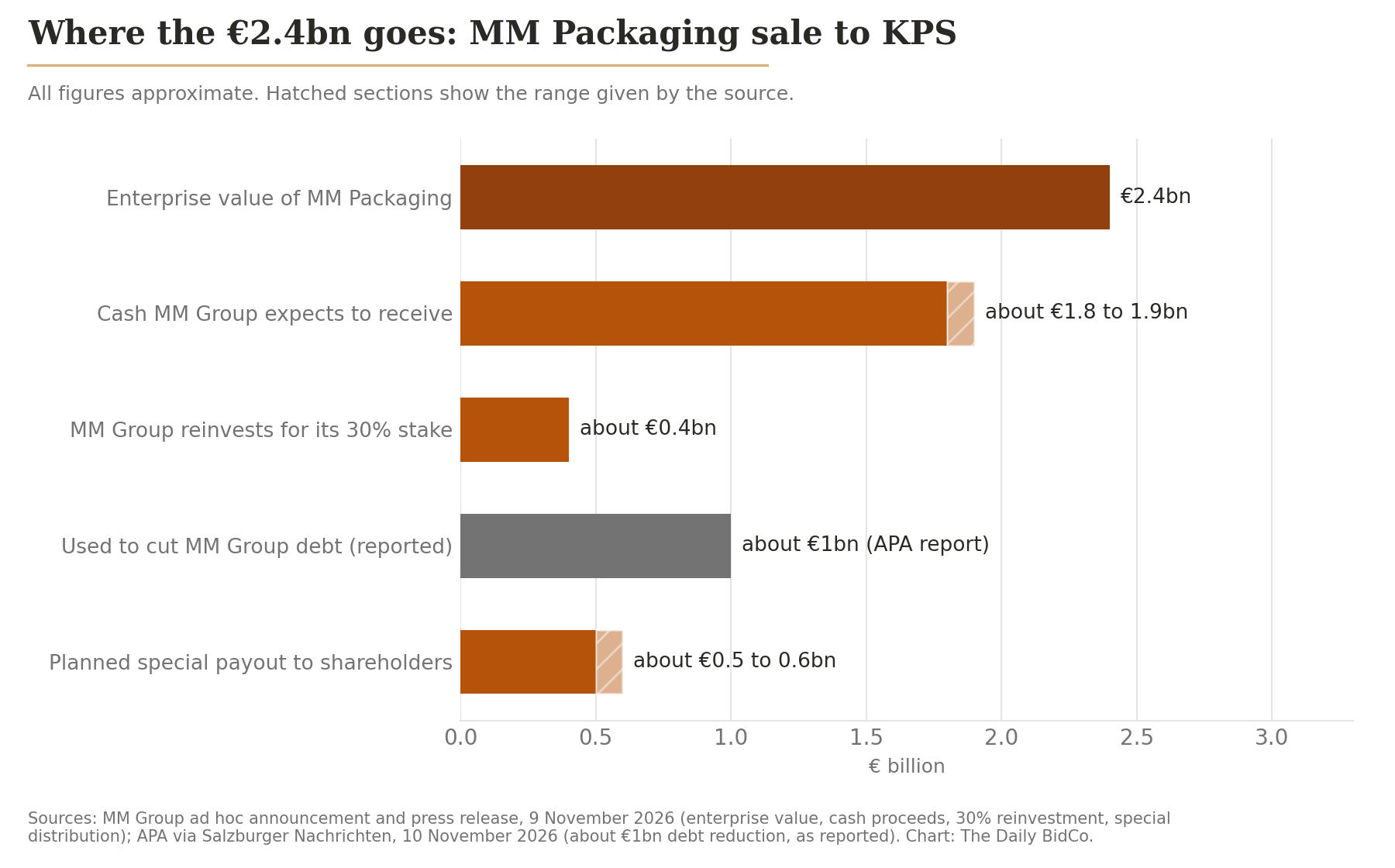
MM Group expects to receive about €1.8 to 1.9bn in cash when the deal completes. That figure is net of about €0.4bn it will put back in for its 30% stake. The final number will move with tax, standard purchase price adjustments and the completion date. MM Group plans to use the money to repay debt, pursue strategic opportunities and pay a special distribution of €0.5 to 0.6bn to its own shareholders. Completion is expected in the first half of 2027.
The Parties
MM Group (Mayr Melnhof Karton AG) is an Austrian company listed in Vienna and a member of the ATX, the Vienna Stock Exchange's main index. It describes itself as a global leader in fibre based consumer packaging. The founding family holds about 60% of the company, according to the Austria Press Agency (APA). APA also reports that the Packaging division, with a little over €2bn of annual sales, makes up slightly more than half of group revenue. Its board and paper business has had a hard year. MM Group's latest trading update, as reported by Packaging Dive, pointed to persistent market overcapacity and sharply rising energy costs.
KPS Capital Partners manages the KPS Special Situations Funds, with about $19.1bn of assets under management as at 30 June 2026. It specialises in buying control of manufacturing and industrial companies. Its portfolio companies have combined annual revenues of about $26.1bn, 277 factories in 25 countries and about 62,000 employees. KPS knows this industry well. In 2021 it bought Crown Holdings' European food and aerosol can business, with Crown keeping 20%, and the business was later renamed Eviosys. In 2024 KPS agreed to sell Eviosys to Sonoco for €3.615bn. It also owned Anchor Glass from 2014 to 2016.
Structure & Process
This is a carve out. MM Group is not selling shares in itself, and its own shareholders keep their MM Group shares. Instead, the Packaging business is sold into a new holding company owned 70% by KPS and 30% by MM Group. MM Group says the business "already operates largely independently". The press releases do not say whether this happens through a sale of shares in the packaging subsidiaries or a transfer of assets, so that detail is unconfirmed.
Two features stand out. First, MM Group's 30% is not fixed. If the business misses certain EBITDA targets for 2027, MM Group's stake can be cut to as little as 20%, with no money changing hands either way. This works like a reverse3 earn out. Instead of the buyer paying more if the business does well, the seller gives up part of its stake if the business does badly. Second, the two businesses stay linked commercially. A long term supply agreement will keep Board & Paper supplying cartonboard to MM Packaging after completion.
The process has three main conditions:
"Required corporate approvals". MM Group's Supervisory Board (in Austria's two tier board system, the board that oversees management and signs off major decisions) has already approved the deal.
Regulatory approvals, which the releases do not list.
A consultation with workers' representatives for the French part of the business.
Completion is expected in the first half of 2027, and the business will keep the MM Packaging name.
The Financing Angle
Neither side has published how KPS is paying for its share, and no acquisition debt package has been announced. There is a strong clue, though. APA reports that MM Group's chief executive, Peter Oswald, explained why the retained 30% stake is worth only about €0.4bn. KPS is putting additional debt onto the business. The new MM Packaging will therefore carry more debt than the division does today. Oswald referred questions on the details to KPS.
A rough calculation shows why:
If 30% of the equity is worth about €0.4bn, all of the equity in the new holding company is worth about €1.3bn (my own calculation, approximate).
Take that from the €2.4bn enterprise value and roughly €1.1bn would be debt sitting in the new company (my own calculation, approximate, and dependent on how cash and other items are treated).
That pattern is typical of a leveraged buyout. Interestingly, KPS's standard description of itself says it aims to make money by improving businesses "rather than primarily relying on financial leverage".
On the seller side, the money is going in three directions:
Net cash position: after completion, MM Group expects net cash of about €0.8 to 0.9bn, meaning it will hold more cash than debt.
Debt reduction: APA reports that about €1bn of the proceeds will go to cutting debt.
Special distribution: a payout of €0.5 to 0.6bn to shareholders is planned, subject to corporate approvals and business conditions at the time. Extrajournal notes that it will also need approval from shareholders at a general meeting.
Why it Matters
For law students, this deal shows several features in one place: a carve out, a retained minority stake that can shrink, a seller using the proceeds to pay down debt and return cash to shareholders, and an employee consultation condition. It is also a clean case study in how a listed group can unlock value. The market valued the whole of MM Group at less than the packaging arm alone, and selling a majority of that arm puts a price on it.
It also fits a clear trend. Packaging Dive notes that this is the latest of several spin offs and private equity partnerships in packaging in 2026. It points to Silgan's transaction with American Industrial Partners to combine its metal containers business with Trivium Packaging (covered in Issue 80). Large industrial groups are splitting themselves up, and private equity firms with deep sector experience are buying the pieces.
Real World Impact
Look at the cardboard box around your next packet of paracetamol or your breakfast cereal. That box, or one like it, may have came from a business like MM Packaging. A change of owner will not change what you pay for medicine or cereal next week. Over time, though, a private equity owner focused on growth and efficiency could reshape which factories make what. Packaging is a small part of a product's price, but it is a cost that brands pass on somewhere.
For workers, the early signals are steady but not expansive. APA reports Oswald saying that nothing changes for employees, that the Austrian plants stay open and that KPS will keep MM Packaging's headquarters in Vienna. He also said the deal will not create extra jobs for now, because the focus is on using existing capacity better. Higher debt in the new company could make cost control a priority later. That is worth watching, not a prediction.
There is a bigger backdrop too. The EU's new Packaging and Packaging Waste Regulation has applied since 12 August 2026 and aims to make all packaging on the EU market recyclable by 2030. Paper and cardboard made up 40.8% of all EU packaging waste in 2024, according to the European Commission. Packaging Dive also notes that demand for medicine packaging is growing, helped by weight loss drugs known as GLP 1s. If those trends continue, fibre packaging could be one of the quieter winners from greener rules and new medicines.
Why they did it this way
- 1Selling a majority gives the packaging arm growth capital that MM Group says it could not provide itself.Could have: Keep the business and fund growth alone
- 2Keeping 30% lets MM Group share in any upside under KPS while taking most of the cash now.Could have: Sell 100% for cash
- 3The stake can drop to 20% if 2027 targets are missed, protecting KPS if the business underperforms.Could have: A conventional cash earn out
- 4French law requires workers' representatives to be consulted first, so that is a separate condition.