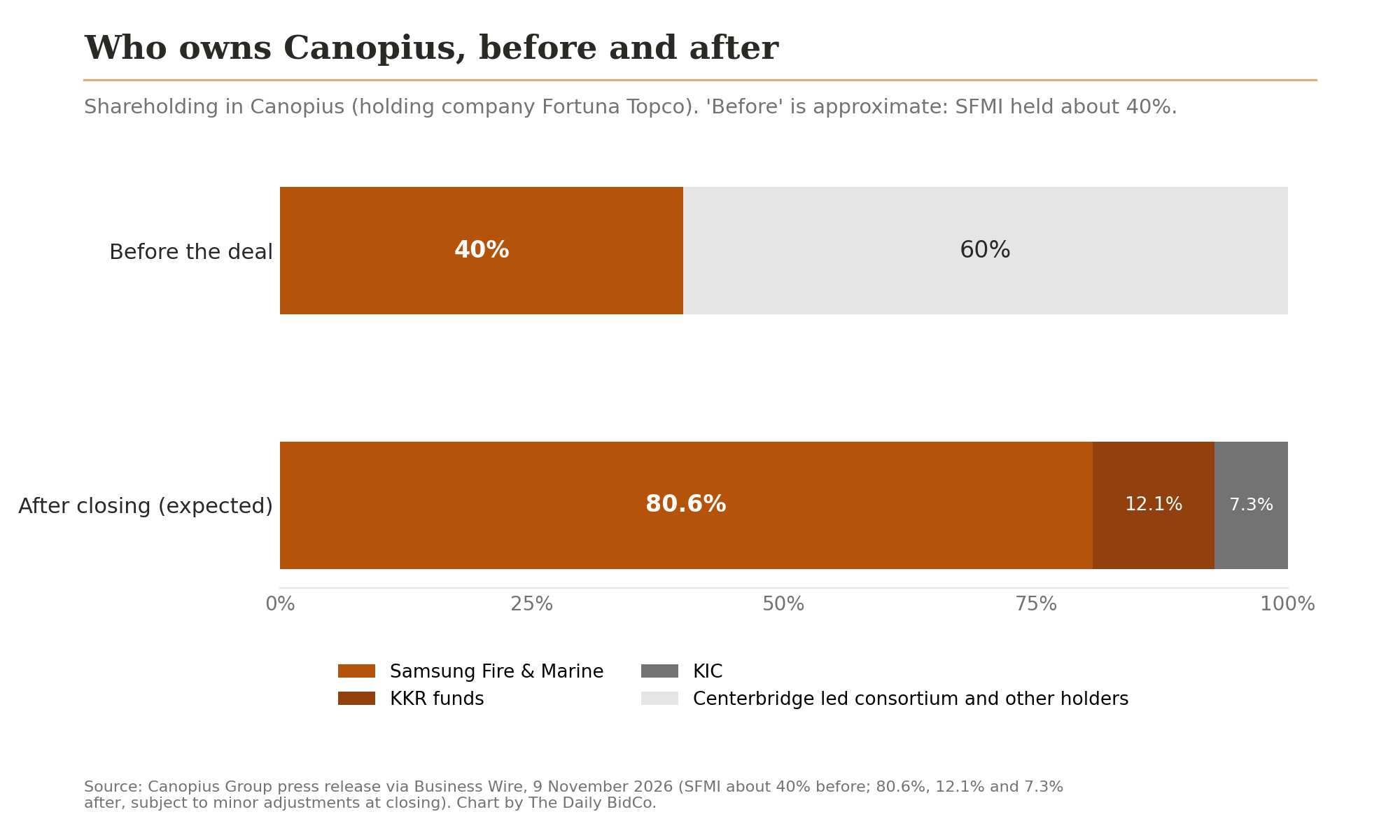
On Monday 9 November 2026, South Korea's largest non life insurer, Samsung Fire & Marine Insurance, signed an agreement to take control of Canopius, a London headquartered specialist insurer that underwrites at Lloyd's of London. SFMI already owned about 40% of Canopius. Together with funds managed by the US investment firm KKR and Korea Investment Corporation, Korea's sovereign wealth fund, it is buying the remaining 60% from Canopius' other shareholders. The biggest of those sellers is Fidentia Fortuna Holdings, the consortium led by US private investment firm Centerbridge Partners that has controlled Canopius since buying it from Japan's Sompo.
When the deal closes, SFMI will own 80.6% of Canopius, KKR's funds 12.1% and KIC 7.3%, with the final numbers subject to small adjustments at closing. Canopius did not publish a price. SFMI's own regulatory filing in Korea puts its share of the bill at about 2.26 trillion won, which the Korea Herald converts to about $1.68bn. Industry sources quoted by Korea JoongAng Daily value the whole 60% purchase at about 3 trillion won, or roughly $2.2bn, although that figure has not been confirmed by the companies. The deal is expected to complete on 31 March 2027, once regulators approve.
The Parties
Samsung Fire & Marine Insurance is Korea's leading non life insurer and is listed on the Korea Exchange. Alongside property and casualty insurance (often shortened to P&C: cover for things like homes, cars, buildings and legal liability), it sells pensions, annuities and health insurance. S&P rates it AA and A.M. Best rates it A++, among the strongest ratings an insurer can have. Its home market is slowing, Korea JoongAng Daily notes that Korea's low birth rate and ageing population are shrinking the pool of customers, which is why SFMI has been looking abroad. Its chief executive, Lee Mun hwa, said in his New Year's address last year that the company aimed to make half of its profit overseas by 2030.
Canopius is an international specialty insurer and reinsurer. It writes business through Lloyd's Syndicate 4444 (a syndicate is a group of underwriting capital at Lloyd's that takes on risks, run by a managing agent, here Canopius Managing Agents Limited), through a US surplus lines insurer called Canopius US Insurance, Inc., and through Canopius Reinsurance Ltd, a Bermuda based Class 4 reinsurer. It has offices in Australia, Bermuda, Singapore, the UK and the US and says it works across more than 130 countries. It covers ships, aircraft, energy sites and cyber attacks, and also more unusual risks such as terrorism, kidnap and the loss of artwork. Canopius wrote $4.48bn of premiums last year, up 27% on 2024, and made $553m of pre tax profit.
Centerbridge Partners is a New York and London based private investment firm with about $46bn of assets under management. A Centerbridge led consortium, including Gallatin Point Capital, agreed to buy Canopius from Sompo in September 2017.
KKR is one of the world's largest investment firms. Its involvement here comes from its Credit & Markets business, and it owns its own insurance group, Global Atlantic.
KIC manages public money entrusted to it by the Korean government and the Bank of Korea.
Structure & Process
This is a private share purchase. Here the shares being bought are in Fortuna Topco, the holding company at the top of the Canopius group. Because Canopius is not listed on a stock exchange, there is no public offer, no Takeover Code and no shareholder vote at Canopius. Instead, the deal is a negotiated contract between the buyers and the selling shareholders, signed on 9 November and due to complete once conditions are met.
The deal is the last step in a step acquisition. SFMI first invested in Canopius in 2019, invested again in 2020, and in June 2025 paid $570m for a further 21% to reach 40%, making it the second largest shareholder. At that point, Reinsurance News reported that the two main shareholders planned a joint management system, with SFMI gaining more board seats. This deal turns that partnership into control.
Three investors are buying together rather than SFMI buying all 60% alone. SFMI takes most of it (about 40.6 percentage points), while KKR's funds and KIC take minority stakes as co investors. The Korea Herald reports that under a shareholder agreement, SFMI also has an option to buy its partners' stakes over time, subject to agreed conditions. The exact terms of that option have not been published.
The main remaining condition is regulatory approval. None of the press releases lists the specific regulators, but because Canopius runs a Lloyd's managing agent in London, a US insurer and a Bermuda reinsurer, a change of controlling shareholder normally needs approval from the insurance supervisors in each of those places. The Korean filing reportedly points to completion on 31 March 2027.
The Financing Angle
None of the parties has said how SFMI is paying, and no acquisition loans or bond issues have been announced, so whether the money comes from existing resources or new borrowing is not disclosed. For context, 2.26 trillion won is a large cheque, but SFMI is a heavily capitalised, AA rated insurer, and insurers of that size commonly fund deals like this from their balance sheet rather than from debt.
The more interesting financing feature is the shape of the buying group. Rather than borrowing to buy all 60%, SFMI has brought in two partners who contribute about a third of the money between them (based on the stated percentages, 19.4 of the 60 points come from KKR and KIC). KKR's Michael Small framed his firm's role as providing "flexible, long term capital", and KIC said it joined as part of a strategy to back Korean companies expanding abroad. Canopius' chief executive Neil Robertson described the result as "permanent capital and an owner with a long term view", which is a contrast with a private equity owner like Centerbridge that typically plans to sell within a set period.
Reports from September 2026, referenced by Reinsurance News, had suggested that Samsung Fire and its sister company Samsung Life would buy a further 50% for more than 2 trillion won. The final deal instead pairs SFMI with KKR and KIC, and Samsung Life is not named as a party.
Why it Matters
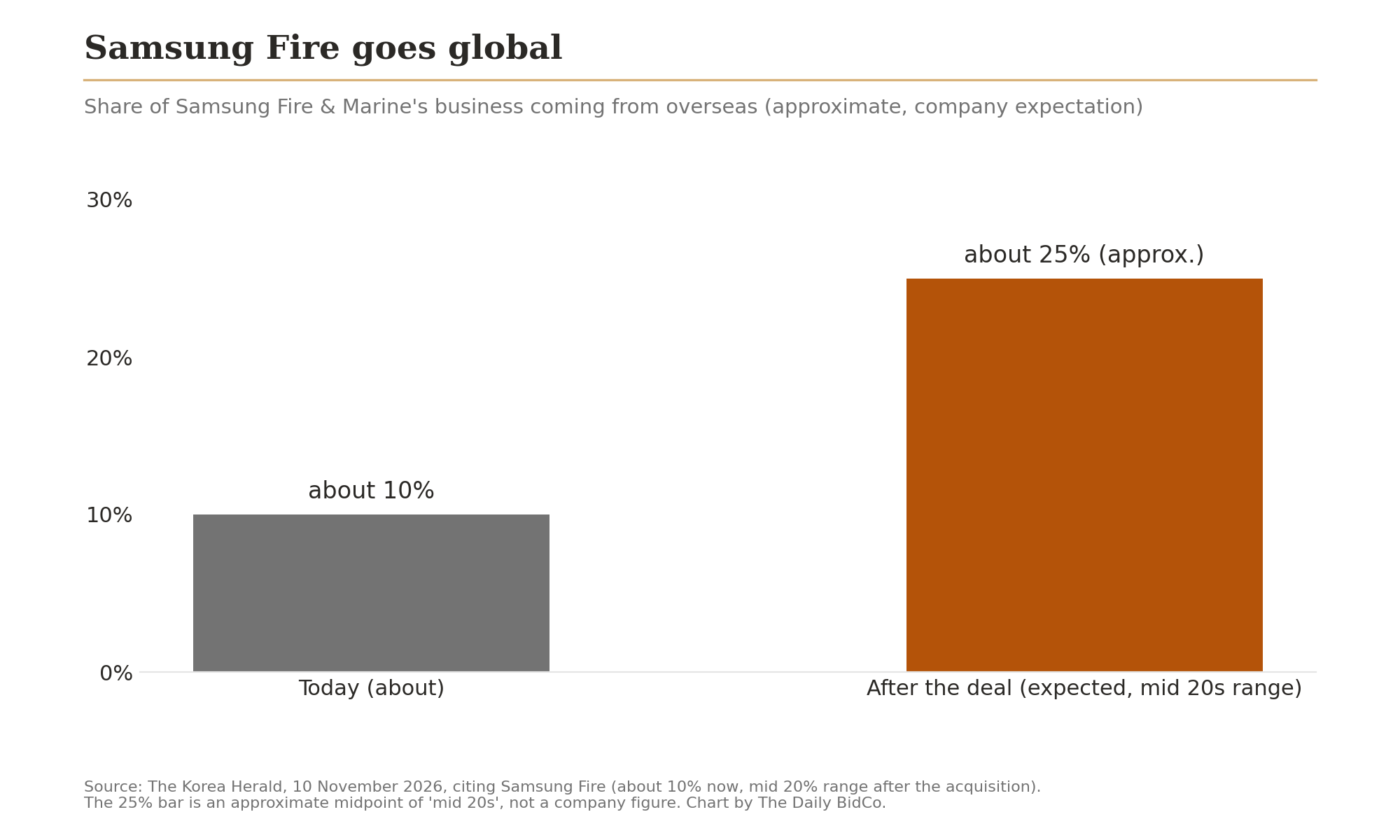
For SFMI, its chief executive calls this "a pivotal step in our journey towards becoming a truly global insurer". SFMI expects the share of its business coming from overseas to rise from about 10% to the mid 20% range after the deal, and it has said it wants to use Canopius to grow in the US and Asia Pacific as well as at Lloyd's.
For the wider market, the deal shows two trends at once. The first is Asian insurers buying into London's specialist market, using long partnerships rather than a single big bid. The second is private equity firms like Centerbridge exiting insurance investments by selling to strategic buyers (companies in the same industry buying for long term business reasons rather than for a resale profit). It also arrives at a moment when insurance pricing is softening. JP Morgan expects double digit falls in property catastrophe reinsurance prices to continue into 2027 because of strong profits, relatively few big disasters and new capital entering the market. Buyers committing billions now are betting that specialist expertise, rather than high prices, will drive returns.
For law students, the deal is an example of how a private share purchase works, how co investors and option rights are used in a consortium, and why regulatory approvals, rather than shareholder votes, are the main thing standing between signing and closing in a regulated industry.
Real World Impact
Most people have never heard of Canopius, but its work sits behind everyday life. Specialist insurers are the ones who cover the cargo ships carrying your online orders, the planes you fly on, the energy sites that keep the lights on, and the companies hit by cyber attacks. When that kind of cover becomes scarce or expensive, the cost can eventually filter through into the prices of goods and services.
A large, long term owner with deep pockets could make Canopius more willing to keep offering cover for difficult risks, which would be good news for businesses and, indirectly, their customers. On the other hand, a bigger group might choose to focus on its most profitable lines and pull back from others, so it is worth watching whether Canopius' appetite for unusual risks changes after the deal. Canopius' chief executive has said it will keep "the same appetite, the same discipline and the same people".
For people in Korea, the story is about an ageing country's companies going abroad to find growth. If Samsung Fire earns more overseas, that could support its profits and dividends at a time when its home market is shrinking. For people working in the London insurance market, a committed owner could mean stability, but integration with a much larger parent is always worth watching.
Why they did it this way
- 1Buying the holding company's shares keeps every licence, policy and contract in place, so clients see no break in cover.Could have: Buying the insurance business asset by asset
- 2Samsung Fire built its stake over seven years to learn the business from the inside before taking control.Could have: One full takeover at the start
- 3Sharing the 60% purchase with KKR and KIC cuts how much capital Samsung Fire must commit at once.Could have: Samsung Fire buying all 60% alone
- 4Insurance regulators must approve a new controlling owner, so completion waits until around March 2027.