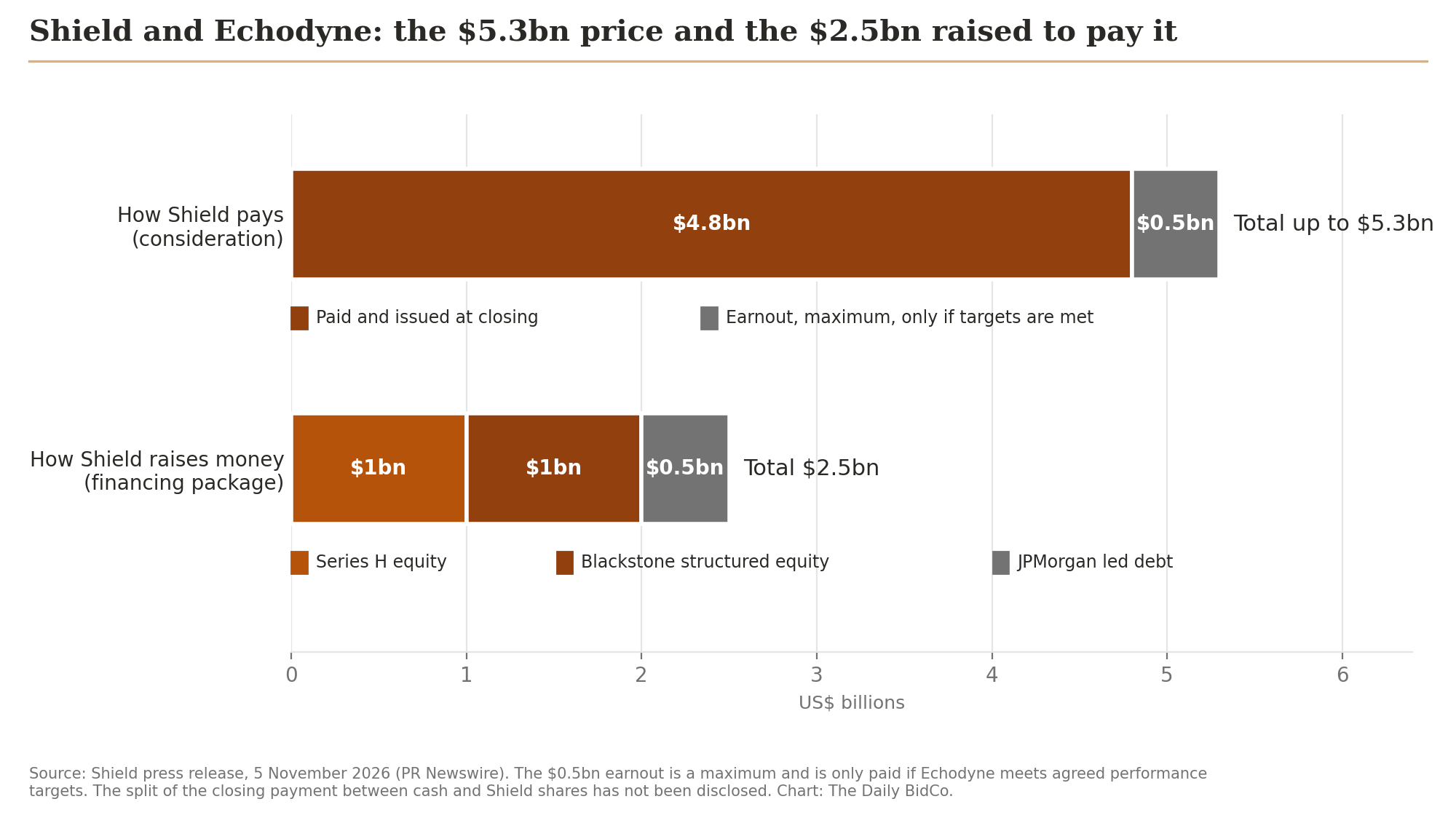
On 5 November 2026 Shield, a defence technology company based in Kirkland, Washington, announced a definitive agreement to acquire Echodyne Corp., a radar maker headquartered in the same town, in a transaction valued at $5.3bn. Of that figure, $4.8bn will be "paid and issued at closing", and up to a further $500m is contingent on Echodyne meeting agreed performance targets1. That second slice is an earnout. Madrona, one of Echodyne's earliest investors, says the consideration includes Shield stock and a substantial amount of cash. The exact split has not been disclosed.
At the same time Shield is raising $2.5bn2 "to support the transaction". That is made up of $1bn of new shares in a Series H round at a $28.8bn post money valuation, a $1bn structured equity investment from funds managed by Blackstone, and $500m of debt. The Series H is co led by Disruptive and Innovation X Capital, with Advent, the Strategic Investment Group of JPMorganChase's Security and Resiliency Initiative, Snowpoint Ventures, Apandion, Center15 Capital and others taking part. Shield says the Series H proceeds "will be used principally to fund the acquisition". The deal is expected to close in early 2027.
This is a large deal by the standards of private technology companies. Madrona believes it is the second largest acquisition of a private venture backed company in Washington state history, behind Okta's $6.5bn purchase of Auth0 in 2021. It is also Shield's third acquisition since April 2025, after an autonomy software business bought from Crowdbotics and Aechelon Technology, a simulation company, in March 2026, according to Washington Technology.
The Parties
Shield was founded in 2015 and describes itself as a defence technology company "with the mission of protecting service members and civilians with intelligent systems". It makes Hivemind, software that acts as an AI pilot for drones and other unmanned vehicles; the V BAT, a drone that takes off and lands vertically; the X BAT, an autonomous jet still in development; and Aechelon simulation tools for training and testing. Military Times reports that the V BAT has helped the US Coast Guard with reconnaissance on drug trafficking at sea. Shield is run by chief executive Gary Steele and has offices across the US, Europe, the Middle East and Asia Pacific. In September it named Washington state as the production home for the X BAT. Its existing investors include a16z and Point72, according to Madrona.
Echodyne was spun out of the Seattle invention company Intellectual Ventures in 2014 by Eben Frankenberg, now its chief executive, and Tom Driscoll. Madrona says the first round was $15m at a $24m pre money valuation, led by Madrona and Gates Ventures, with Vulcan and IQT also taking part; later backers include NEA, Vanedge Capital and Gates Frontier. Echodyne's radars use its patented MESA technology (metamaterials electronically scanned array, a way of steering a radar beam electronically with no moving parts), which makes them small, light and much cheaper than traditional military radars. Its radars are built into hundreds of counter drone and security systems used in more than 40 countries, and in September it won a contract with a $250m ceiling from Joint Interagency Task Force 401, the Pentagon's counter drone task force. It recently opened an 86,350 square foot, $40m factory in Kirkland able to make about 30,000 radars a year. Both companies say they expect "triple digit revenue growth this fiscal year".
Structure & Process
Because Echodyne is a private company, there is no stock exchange takeover, no tender offer and no public shareholder vote. Instead, Shield and Echodyne have signed a negotiated purchase contract3. The press release does not say whether the legal mechanism is a reverse triangular merger (a Shield subsidiary merges into Echodyne, which survives as a wholly owned subsidiary) or a direct share purchase from Echodyne's investors. Both are common for private US targets; a merger has the advantage that it binds every shareholder once the required approvals are given, which matters when a company has many venture investors and employee shareholders.
Echodyne's shareholders will receive a mix of cash and newly issued Shield shares4, plus the right to the earnout. Because Shield is private, those shares cannot be sold on a stock market. Their value is anchored to the $28.8bn valuation that new investors are paying in the Series H.
After closing, Echodyne will keep its brand and team. Shield says Echodyne's "team will remain in place, with MESA radars remaining available as standalone products", and that Frankenberg "will report directly to Steele and remain responsible for Echodyne's products, manufacturing operations, and partner and customer engagement". Madrona adds that Echodyne will anchor a new Mission Systems unit and continue to build all its radars at its Kirkland facility.
Completion is "subject to receipt of applicable regulatory approvals and satisfaction of other customary closing conditions". The release does not list which approvals. For a US deal of this size, the usual starting point is a merger control filing with the Federal Trade Commission and the Department of Justice under the Hart Scott Rodino Act. Whether any defence specific approvals also apply has not been disclosed.
The Financing Angle
Shield is paying for a $4.8bn closing price with three different kinds of money, raised alongside the acquisition.
$1bn of Series H equity from venture and growth investors, at a $28.8bn post money valuation. Shield says this money is principally to fund the acquisition.
$1bn of structured equity from funds managed by Blackstone. Structured equity is an investment that sits between ordinary shares and debt, usually with extra protections for the investor such as a guaranteed minimum return or priority if the company is sold. Shield has not disclosed the terms.
$500m of debt, with JPMorgan Chase Bank as sole arranger.
The $2.5bn raised is less than the $4.8bn due at closing. The release does not explain the gap, but part of the closing consideration is paid in Shield shares rather than cash, so the cash Shield needs at closing is smaller than the headline figure. The exact cash amount has not been disclosed.
One detail worth noticing is how many hats JPMorgan wears. J.P. Morgan Securities is Shield's exclusive financial adviser, JPMorgan Chase Bank arranges the debt, and the Strategic Investment Group of JPMorganChase's Security and Resiliency Initiative takes part in the Series H. These are separate businesses within the same group, and banks normally manage this kind of overlap with internal information barriers and disclosure to the client.
Why it Matters
First, it shows the new shape of defence dealmaking. Venture backed defence companies are no longer just targets for traditional defence contractors; they are becoming buyers, using high private valuations and fresh funding rounds to buy their suppliers. Shield's $28.8bn valuation is effectively the currency for this deal.
Second, it reflects how fast government spending on counter drone technology is growing. On 29 September 2026 the US Army issued ten IDIQ contracts with a combined ceiling of $4.15bn for counter drone systems, according to Defense One. Echodyne received one of two $250m awards. The task force's acquisition lead told reporters that more than $5bn had been awarded so far, against a $7bn ceiling. Frankenberg told Defense News in July that demand for counter drone radar is "red hot" and could grow tenfold by 2030, as reported by Military Times.
Third, for law students it packs several useful concepts into one announcement: a private company acquisition, a mixed cash and stock price, an earnout, a financing package with three layers, and one banking group acting in several roles at once.
Real World Impact
Drones are no longer just a battlefield story. Madrona says Echodyne's radars have spotted drones over stadiums, borders, prison walls and data centres, and provided real time drone detection at US stadiums during last summer's FIFA World Cup. Shield's own announcement says police and fire departments use the same radars to fly their drones safely in shared airspace.
If the combined company can make and sell more of these radars, you might see more drone detection at big events, airports and public buildings, which could mean fewer disruptions like flights halted because of a drone sighting. On the other hand, it also means fewer independent suppliers of a technology governments increasingly depend on, and more of it controlled by one fast growing private company. Locally, Madrona says all Echodyne radars will continue to be built in Kirkland, which could support manufacturing jobs in the Seattle area, although no job commitments have been published.
Why they did it this way
- 1The earnout pays the extra $500m only if Echodyne hits its targets, so Shield carries less risk if growth slows.Could have: Pay the full $5.3bn upfront
- 2Raising mostly equity, with only $500m of debt, suits a fast growing company without steady profits to repay loans.Could have: Borrow most of the price
- 3Echodyne is privately owned, so a negotiated contract with its owners was the natural route to buy it.
- 4Paying partly in Shield shares cuts the cash Shield needs and lets sellers share in future growth.Could have: Pay entirely in cash