THE DEAL BENCH
Who advised, and who did what
Tap a team to see what it does in a deal like this.
BUYER SIDE
Morrison Foerster
Legal adviser to SoftBank on the acquisition and its financing
TARGET SIDE
Freshfields
Legal adviser to ABB
TARGET SIDE
Homburger
Swiss counsel to ABB
OTHER SIDE
Linklaters
Legal adviser to the arrangers and underwriters of SoftBank's acquisition loans
Select a team above.
On 5 November 2026 the Financial Times reported that Chinese regulators had told SoftBank they would not allow its purchase of ABB's robotics division. Within hours ABB published a short statement confirming that it had been told by SoftBank that the Office of the Working Mechanism for Foreign Investment Security Review in China "has prohibited the acquisition of the ABB Robotics business in China". That office runs China's foreign investment security review. The FT named the National Development and Reform Commission, China's top economic planner, as the body that delivered the message; the review office sits under the NDRC's purview, according to Norton Rose Fulbright's guide to the rules.
The deal itself was signed on 8 October 2025. SoftBank agreed to buy ABB's robotics business for an enterprise value of $5.375bn. ABB expected to complete in mid to late 2026 once approvals arrived in the EU, China and the United States. The European Commission cleared it under its simplified procedure on 12 March 2026. According to BigGo Finance, relaying the FT, the deal had also cleared China's ordinary competition review in February 2026 before running into the separate security review.
ABB's statement is notably careful. It says only that the China part has been prohibited, that "ABB and SoftBank are in close dialogue and are working constructively on the transaction", and that "the process to obtain the regulatory approvals is managed by SoftBank". It does not say whether the deal is terminated, whether the rest of the business can be sold without China, or whether there is any break fee. SoftBank is reportedly working out what went wrong and whether it can apply again. SoftBank shares fell about 5% in Tokyo, though press reports also blame a slide in Arm and a wider selloff in AI stocks after the US midterm elections.
The Parties
ABB is a Swiss engineering group with around 110,000 employees, listed on the SIX Swiss Exchange and Nasdaq Stockholm, that focuses on electrification and automation. Its robotics division makes industrial robots, the arms that weld, paint and assemble products in car, electronics and other factories. The division has about 7,000 staff and made $2.3bn of revenue in 2024, about 7% of ABB's total, with an operational EBITA margin of 12.1%. Linklaters describes it as the world's second largest industrial robotics manufacturer, with more than 430,000 robots installed across 44 countries. China is its biggest market. According to Swissinfo, more than 90% of the robots it sells to Chinese customers are made locally, including at a Shanghai factory that opened in 2022 at a cost of $150m.
SoftBank Group is the Tokyo listed technology investor led by Masayoshi Son, best known for its Vision Funds, its ownership of chip designer Arm and its large investment in OpenAI. Son has made physical AI (artificial intelligence built into machines that act in the real world, such as robots) the group's next big bet. In its announcement SoftBank listed its existing robotics holdings, including SoftBank Robotics, Berkshire Grey, AutoStore, Agile Robots and Skild AI, which ABB's robotics platform was meant to complement.
The decision maker on the other side is the Chinese state. Under China's Measures on Security Review of Foreign Investment, which took effect on 18 January 2021, the NDRC and the Ministry of Commerce jointly oversee a standing working mechanism office that decides whether a foreign investment affects national security.
Structure & Process
This is a carve out. According to SoftBank's announcement, ABB will move its robotics business into a newly created holding company based in Zurich1, and a SoftBank subsidiary will then buy 100% of that company's shares. Freshfields and Homburger both describe the carve out as a "multi jurisdictional reorganisation" that must be completed before closing. ABB estimated about $200m of separation costs and $400m to $500m of cash tax arising from the local carve out steps.
Because SoftBank buys the shares of one holding company rather than thousands of individual assets, this is in substance a share purchase, preceded by internal transfers inside ABB to put the right assets into that company. The headline price is subject to completion adjustments, which SoftBank says will be calculated by reference to net working capital and net debt2.
Completion was conditional on regulatory approvals "including in the European Union, China and the United States". The EU box is ticked. China has now said no to the China business. The status of any US review was not public in the sources reviewed, and press reports in late October described US approval as still pending.
The Financing Angle
SoftBank is funding the purchase partly with bank debt. Morrison Foerster says it advised SoftBank on about $1.8bn equivalent of senior facilities. Facility B term loans split into an €825m tranche and a US$800m tranche, plus a €293m revolving credit facility. Linklaters, acting for the banks that arranged and underwrote the loans, describes the term loan financing as $1.75bn equivalent. Neither firm named the banks, and SoftBank has not said how it will fund the rest of the $5.375bn.
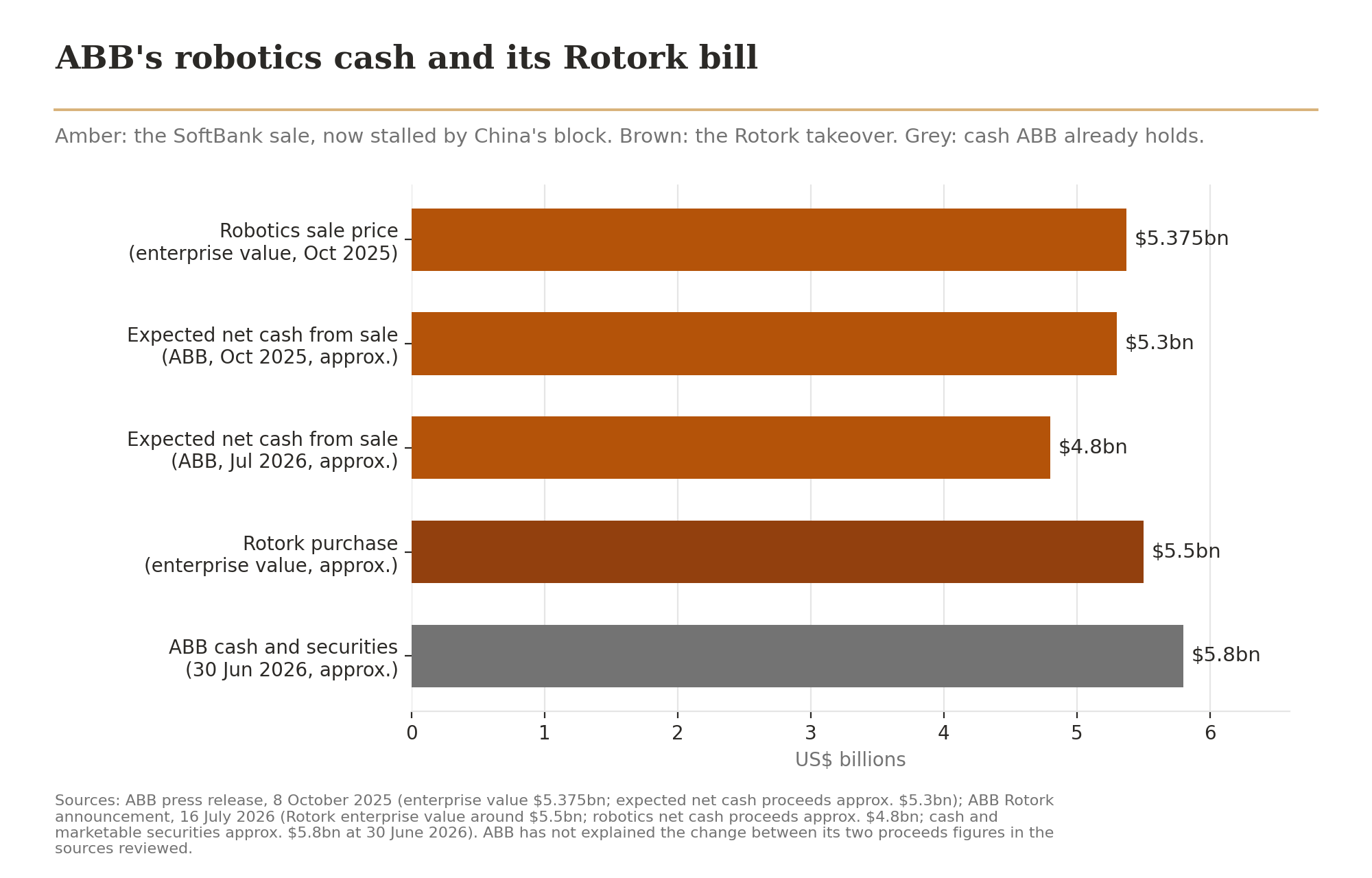
For ABB, the money matters because it has already earmarked it. In July 2026 ABB agreed to buy UK listed Rotork for an enterprise value of around $5.5bn. ABB said it would pay for Rotork from existing cash (about $5.8bn of cash and marketable securities at 30 June 2026) and committed bank facilities, adding that the robotics sale was expected to deliver about $4.8bn of net cash proceeds, "further strengthening ABB's liquidity". In October 2025 ABB had put expected net proceeds at about $5.3bn; it has not explained the change in the sources reviewed. Because ABB said it would fund Rotork from cash and bank facilities rather than from the robotics proceeds, it can still pay for Rotork, but with less spare cash than planned if the robotics money is delayed or cut.
Why it Matters
For law students, this is a clean example of two separate regulatory gates. Passing merger control does not mean passing a national security review. According to BigGo Finance, relaying the FT, the deal cleared China's competition review in February and then failed the security review nine months later. The FT reported that officials worried data from robot production could flow overseas and be used to train AI models, and that they looked at whether intellectual property developed in China had to stay there.
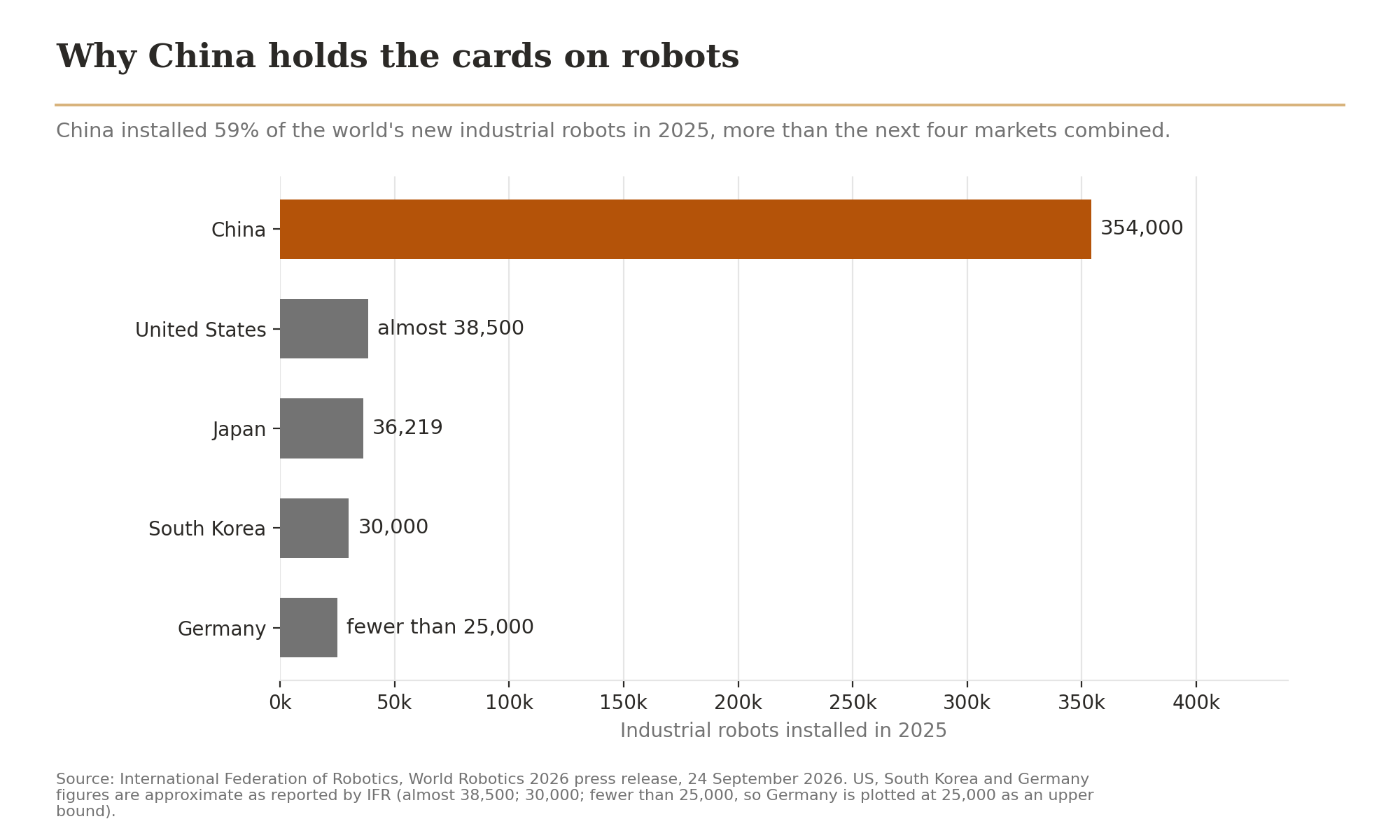
It also shows how leverage works in cross border deals. China installed 354,000 industrial robots in 2025, 59% of the world's total and more than the next four markets combined, according to the International Federation of Robotics. When the target's largest market is also the regulator that can say no, that regulator effectively holds a veto over the whole sale. The IFR also reports that Chinese robot makers now supply 55% of their home market, so a foreign owner of a major China robot business is a sensitive proposition at a time when Chinese suppliers are taking a growing share at home.
Finally, it is a warning about deal certainty for sellers. ABB had already planned its next move around the proceeds, and a seller usually bears the business risk of a failed deal even when the buyer controls the approvals. The parties' public statements leave open whether the remainder of the business can still be sold.
Real World Impact
The robots in this story build the cars, phones and household goods many of us buy. When governments start deciding who may own the factories that make those robots, and who may see the data they produce, the price and pace of automation can be shaped by politics as much as by engineering.
In the short term, little may change for ordinary people. ABB keeps running the business, and its roughly 7,000 robotics staff stay with a familiar owner for now. Over time, though, this could push global companies to split their China operations from the rest of the world, which might mean duplicated costs that eventually show up in prices. It could equally accelerate the rise of Chinese robot makers at home, which could make automation cheaper for Chinese factories. Either way, the "made in China" products on our shelves may increasingly be built with robots that never leave China's regulatory orbit. These are possibilities worth watching rather than certainties.
Why they did it this way
- 1Putting the business into one new holding company lets SoftBank buy a single set of shares and take everything at once.Could have: Buy each country's assets separately
- 2Adjusting the price at completion means SoftBank pays for the business as it actually stands on the closing day.Could have: Fix the price on an earlier balance sheet
- 3ABB chose a cash sale over a spin off because it gave a certain price and immediate value to its shareholders.Could have: Spin off as a separately listed company
- 4SoftBank ran the approvals because security reviews focus on the buyer, and that is exactly where this deal failed.