THE DEAL BENCH
Who advised, and who did what
Tap a team to see what it does in a deal like this.
BUYER SIDE
Vinson & Elkins
CVR Energy
BUYER SIDE
Proskauer Rose
CVR Energy
TARGET SIDE
Jones Day
Marathon Petroleum
OTHER SIDE
Latham & Watkins
MPLX Conflicts Committee
Select a team above.
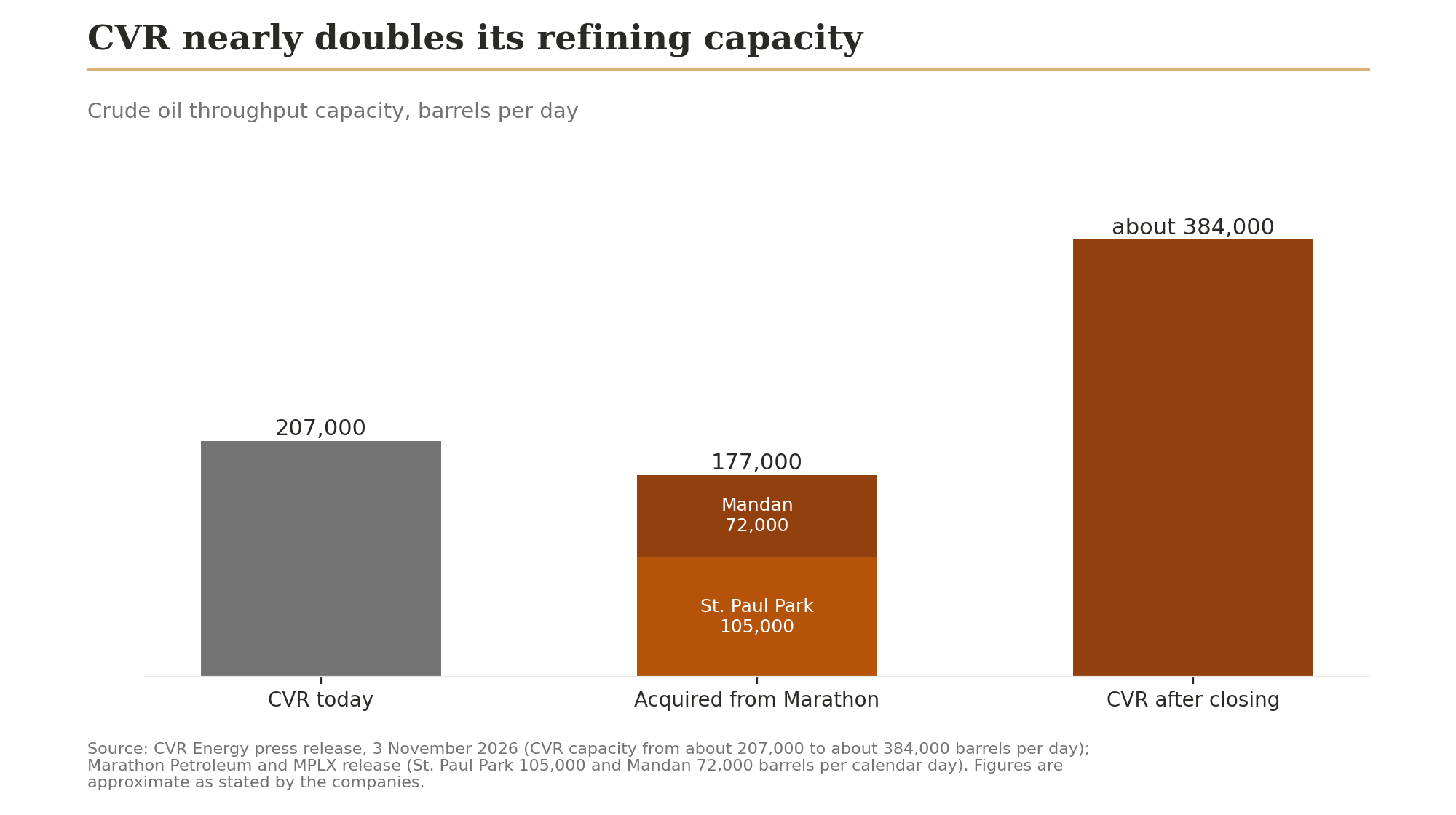
On 2 November 2026, CVR Energy signed an Equity and Asset Purchase Agreement with subsidiaries of Marathon Petroleum and MPLX. The two sides announced it the next morning. CVR is buying two refineries: St. Paul Park on the Mississippi River in Minnesota, which can process 105,000 barrels of crude oil a day, and Mandan in North Dakota, which can process 72,000. It is also buying a 17% stake in each of Minnesota Pipe Line Company and MPL Investments, three terminals and storage that serve the refineries, and a marketing business that supplies fuel to up to 590 branded sites across the Upper Midwest and Northern Great Plains.
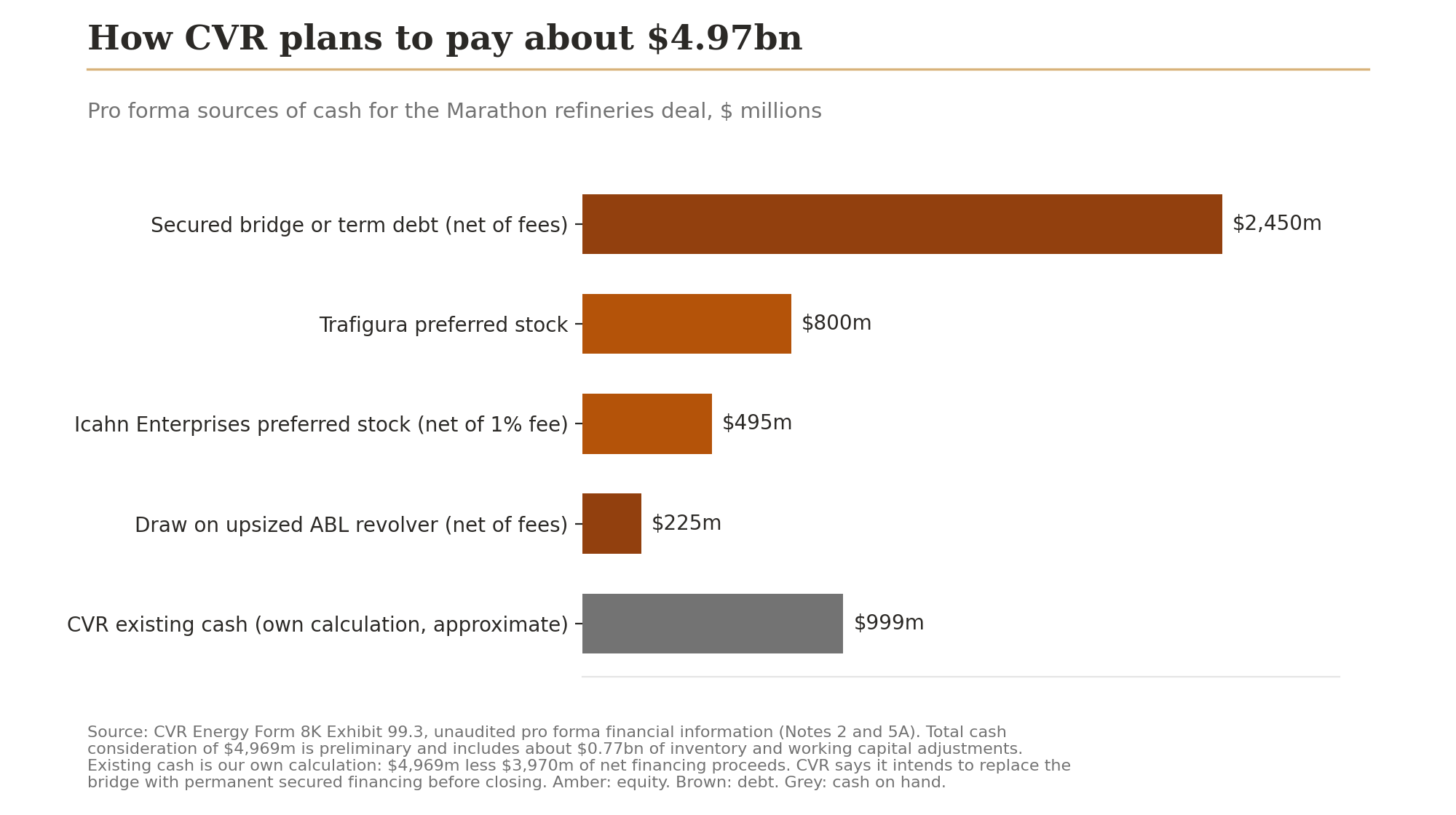
The headline price is about $4.2bn in cash. Marathon gets $3.45bn for the refining and marketing side and MPLX gets $750m for the pipes and terminals. On top of that, CVR pays for the crude and fuel sitting in the tanks on the day it takes over, plus other working capital. CVR's own pro forma filing puts the preliminary total at $4,969m, of which about $740m is hydrocarbon inventory. CVR says the business it is buying made about $1.2bn of EBITDA in the 12 months to 30 September 2026, "reflecting current favorable market conditions." On those numbers CVR is paying roughly 3.5 times one year of earnings for the base price, which is very cheap by M&A standards and tells you the market expects today's high refining profits to fall.
The Parties
CVR Energy is a refiner based in Sugar Land, Texas. Before this deal it ran refineries with total capacity of about 207,000 barrels a day, and it also has a fertiliser business. It is controlled by Icahn Enterprises, the listed holding company of the activist investor Carl Icahn, which CVR's filing describes as its "controlling stockholder." The deal takes CVR to about 384,000 barrels a day and into a new region.
Marathon Petroleum is based in Findlay, Ohio, and says it operates the largest refining system in the United States. After this sale it will still have about 2.8 million barrels a day of capacity, so it is giving up only a small part of its system. MPLX is a separate listed partnership that owns Marathon's pipelines and terminals. Marathon owns its general partner and a majority of its units, so MPLX is listed but Marathon controls it.
Two other parties matter. Trafigura, one of the world's largest commodity traders, is investing $800m of equity in CVR and signing long term commercial arrangements with it. Barclays, Wells Fargo and Mizuho have committed $2.5bn of secured debt.
Structure & Process
The structure is a split purchase. CVR's pro forma filing says it is buying the membership interest (the LLC equivalent of shares) in St. Paul Park Refining Co. LLC, which Marathon holds through a Western Refining subsidiary. That is a share purchase: CVR becomes owner of the company, and the company keeps owning the refinery, its permits and its contracts. Mandan works differently. CVR is buying the Mandan refining assets directly out of Tesoro Refining & Marketing Company LLC, a Marathon subsidiary, together with terminals, pipelines, racks, tanks, catalyst, contracts, permits, real property and intellectual property. That is an asset purchase. The 17% pipeline interests are again bought as equity.
The contract also divides the risk. Cash, receivables, trademarks and pre closing RINs stay with Marathon. CVR takes the liabilities attached to what it buys. The sellers keep certain specified employment, environmental, tax and debt liabilities.
On process, this is a negotiated private sale between two companies, so there is no takeover offer, no target shareholder vote and no court. CVR's board approved it unanimously. Marathon's board approved it unanimously too, and because MPLX is selling assets as part of a deal its controlling owner is running, the board of MPLX's general partner approved it only after special approval from an independent conflicts committee. The only regulatory condition named is the Hart Scott Rodino waiting period.
The Financing Angle
CVR is paying cash, but it does not have $5bn on its balance sheet. Its 8K filing sets out four sources:
Secured debt of $2.5bn. Barclays and other banks have signed a debt commitment letter for a 364 day bridge loan. CVR says it does not intend to draw the bridge and expects to replace it with permanent secured financing before closing. The filing assumes about 8.0% interest on the bridge.
$800m of equity from Trafigura. It takes the form of about 14.97 million preferred shares (counted on an as converted basis) at an estimated $53.43, which is a 10% discount to CVR's 20 day VWAP. The filing says fees and discounts were "considered as part of" a long term commercial agreement with the same partner, and that this partner will buy certain crude inventory at closing, which reduces the cash CVR itself needs.
Up to $500m of equity from Icahn Enterprises. This is a backstop. It falls away if CVR raises at least $500m through a separate equity offering, so Icahn is guaranteeing the money rather than necessarily providing it.
An upsized revolving credit facility and cash on hand. CVR is adding $550m of commitments to its asset based lending (ABL) facility, taking it to $1.1bn, and expects to draw about $225m at closing.
Two less obvious changes come with the new debt. CVR's existing 7.500% notes due 2031 and 7.875% notes due 2034 will become secured on an equal and ratable basis with the new debt (they share the same security, in proportion), and the 5.750% notes due 2028 ($183m) will be redeemed. Pro forma, CVR's long term debt rises from $1,769m to $4,261m, and its cash falls from $1,278m to $96m.
Why it Matters
For students, this is a clear example of the share deal versus asset deal choice inside one contract, a conflicts committee at work, and acquisition finance that mixes bank debt, preferred equity from a commercial partner and a shareholder backstop.
For the market, it is part of a broader rethink of US refining. Forbes, citing the US Energy Information Administration (EIA), reports that US operable refining capacity fell by more than 250,000 barrels a day in 2025 to about 18.2 million, with 130 refineries left, two fewer than a year earlier. Valero has just agreed to buy LyondellBasell's closed Houston refinery for $320.5m and plans to restart 165,000 barrels a day of processing by the end of 2027. Energy Secretary Chris Wright said in late October that the administration is exploring whether shuttered refineries can reopen to ease fuel prices, with Argus linking the push to high prices driven by war related supply disruption ahead of the midterms. Against that backdrop, Marathon is selling smaller inland plants to focus on the Gulf Coast, and a smaller refiner is betting that scale and a regional fuel network will make its earnings steadier.
Real World Impact
If you live in Minnesota or North Dakota, there is a good chance the petrol in your car started out at one of these two refineries. The EIA's weekly survey put Minnesota's average price for regular petrol at $4.017 a gallon on 2 November 2026. A new owner does not change that price overnight. What could change over time is how the refineries are run, how much they invest and how the 590 branded sites are supplied. CVR says it expects about $70m a year of savings, mostly from overheads and "commercial and operational" improvements, so refinery and office workers will be watching where those savings come from.
There is a big advantage and disadvantage. The upside is a buyer that sees these plants as the centre of its business, rather than a small corner of a much larger system, may be more committed to keeping them running at a time when refineries elsewhere have been closing. The downside is CVR is taking on far more debt, so if refining profits drop sharply it will have less room to invest or absorb shocks. Either way, whether these plants keep running matters to local fuel supply, to jobs, and to the national debate about having enough refining capacity.
Why they did it this way
A negotiated sale, not a takeover. CVR is buying two plants and a fuel network, not a listed company, so there are no public shareholders to persuade and no Takeover Code or tender offer rules to follow. When the target is a division, the seller simply chooses its buyer through a private process and the terms are set in a contract. That is why the agreement could be signed on Monday 2 November and announced the next morning.
Shares for St. Paul Park, assets for Mandan. Buying shares is usually the cleanest route when a business already sits in its own company, because the refinery's permits, contracts and employees stay where they are and do not need to be transferred one by one. St. Paul Park is held in its own LLC, so buying that LLC works neatly. Mandan sits inside a larger Marathon subsidiary that owns other things too, so the practical route is to lift out the specific Mandan assets. The general trade off is this: an asset purchase lets a buyer leave unwanted liabilities behind, while a share purchase brings the company's whole history with it. The contract therefore lists which liabilities Marathon keeps, whichever route was used for each asset.
A conflicts committee for MPLX. Marathon is effectively on both sides of MPLX's part of the deal, because it controls MPLX and is also deciding how the $4.2bn is split between itself and MPLX. In that situation the standard protection is to have independent directors, with their own bankers and lawyers, approve the terms on behalf of MPLX's other unitholders. That is why RBC and Latham were hired separately, and why Marathon's release points out that MPLX's midstream sale is at 9x forecast 2027 EBITDA.
Debt plus partner equity, rather than all debt. Funding roughly $5bn entirely with debt would have taken CVR's borrowing very high against earnings that it itself says come from "current favorable market conditions." Bringing in equity from a trading partner, with a controlling shareholder backstop, lowers that risk and gives lenders more cushion. CVR says it expects the business "to continue to generate substantial cash flows over at least the next twelve months," which is the window in which this kind of capital structure normally gets refinanced and paid down.
Antitrust only, and a quick timetable. A sale between two US companies of plants that only one of them currently owns in the region would not usually raise foreign investment questions. The main legal hurdle is therefore the Hart Scott Rodino review. Unless the agencies ask for more information, that review can finish within weeks, which explains the target of closing by the end of 2026.