THE DEAL BENCH
Who advised, and who did what
Tap a team to see what it does in a deal like this.
BUYER SIDE
Wilson Sonsini Goodrich & Rosati
Marvell
TARGET SIDE
Davis Polk & Wardwell
Lumentum
Select a team above.
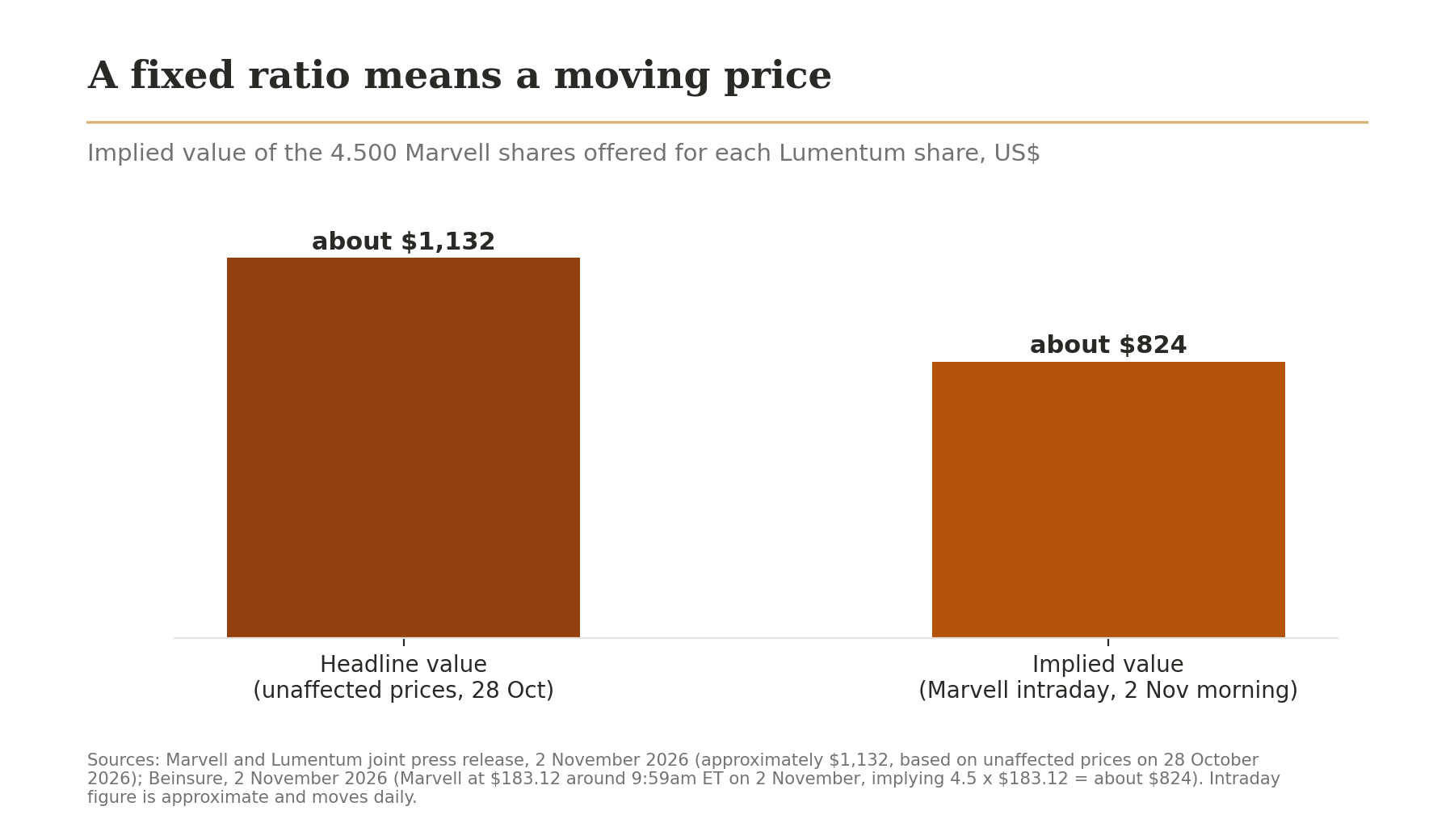
On 1 November 2026, Marvell Technology signed an Agreement and Plan of Merger to buy Lumentum Holdings, and the two companies announced it the next morning. Lumentum shareholders will not receive any cash. Instead, each Lumentum share will be swapped for 4.500 new Marvell shares. Based on both companies' share prices on 28 October 2026, the last trading day before rumours of the deal began, that worked out at about $1,132 per Lumentum share, a premium of about 23.9%, and an enterprise value of about $115bn.
Because the payment is in shares at a fixed exchange ratio, the real value Lumentum shareholders receive moves every day with Marvell's share price. That point bit immediately. Beinsure reports that Marvell was trading at $183.12 on the morning of the announcement, which on its calculation made the offer worth about $824 per Lumentum share, well below the $1,132 headline. Investing.com's market data showed Marvell down about 12.7% and Lumentum down about 18.6% at the time Bank of America downgraded Marvell the following morning.
Both boards approved the deal unanimously. Marvell's chairman and CEO Matt Murphy will lead the combined company, and three Lumentum directors, including Lumentum CEO Michael Hurlston, will join Marvell's board, which currently has seven members. The companies expect to close in the first half of calendar 2028.
The Parties
Marvell Technology designs semiconductors that move, store and process data inside data centres: networking chips, the electrical and optical "interconnect" chips that link servers together, and custom AI chips built to order for large cloud companies. Its 8K filing shows it is a Delaware corporation with its principal executive office in Wilmington, Delaware. Reuters describes it as a custom chipmaker trying to challenge its larger rival Broadcom, and Beinsure notes that Marvell already bought the optical start up Celestial AI for $3.5bn earlier in 2026.
Lumentum is a San Jose based maker of lasers, optical transceivers and optical circuit switches: the components that turn electrical signals into light and send them down fibre between machines. It also has specialist compound semiconductor (chips made from materials such as indium phosphide rather than ordinary silicon, which are needed to make lasers) manufacturing. Lumentum has been growing fast on AI demand. Beinsure reports fiscal Q1 2027 revenue of $1.263bn, up 136.5% year on year. In March 2026 NVIDIA agreed a strategic partnership with Lumentum that included a $2bn equity investment, according to Wilson Sonsini's announcement of that deal.
Structure & Process
Legally, this is a statutory merger. The 8K filing describes a two step structure:
First Merger. "Java Merger Sub, Inc.", a newly created Marvell subsidiary, merges into Lumentum. Lumentum survives as a wholly owned subsidiary of Marvell, and at that moment every Lumentum share converts into the right to 4.500 Marvell shares. This is known as a reverse triangular merger.
Second Merger. Promptly afterwards, Lumentum merges into a second shell, "Java Merger Sub II, Inc.", which survives.
The deal needs two shareholder votes. Lumentum's shareholders must adopt the merger agreement. Marvell's shareholders must approve both the share issuance (the creation of the new Marvell shares) and a charter amendment (a change to Marvell's certificate of incorporation, its constitutional document) to increase the number of shares Marvell is allowed to issue. Both votes will be sought through a single joint proxy statement/prospectus contained in a Form S4 registration statement.
Other conditions include expiry of the US HSR waiting period and "certain other required regulatory approvals", no blocking order from relevant governments, the S4 becoming effective, Nasdaq listing of the new shares, and no material adverse effect on either company.
Both sides have agreed a no shop, with limited exceptions that let a board accept an unsolicited superior proposal if it pays the termination fee. Lumentum's equity awards (options and restricted stock units) roll over into equivalent Marvell awards, with performance units converted into time based units.
The Financing Angle
There is no cash consideration, so there is no acquisition loan, bond issue or financing condition. The summary of closing conditions in Marvell's 8K contains no financing condition. Marvell's "currency" is its own shares, which is why its shareholders must vote to increase the authorised share count.
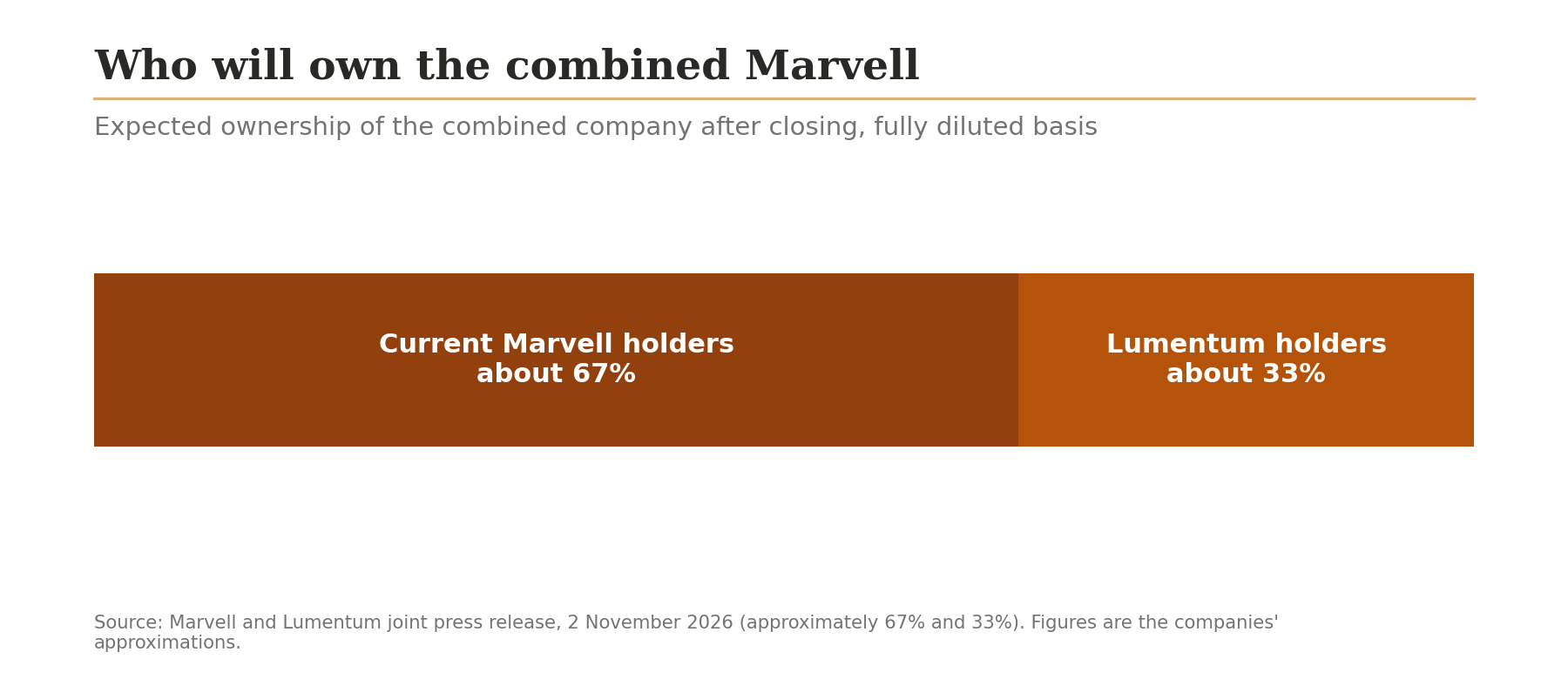
The cost is paid in dilution. After closing, Lumentum holders will own about 33% of Marvell. Bank of America estimates the deal increases Marvell's share count by roughly 50% and argues the $1bn of promised annual cost savings will not be enough to offset that, leaving limited earnings per share accretion. The companies disagree, saying the deal will add to Marvell's adjusted (non GAAP) earnings per share in its first year after closing.
The headline enterprise value of $115bn includes Lumentum's debt, which Reuters describes as a deal "including debt". Lumentum's Series A convertible preferred stock is dealt with separately: holders can take Marvell common stock or elect a matching Marvell Series B preferred stock, which keeps their existing rights intact. The 8K summary does not name who holds that preferred stock.
Why it Matters
This is one of the largest technology deals of 2026, and it is a bet that the next bottleneck in AI is not the chips that do the thinking, but the connections between them. Marvell says AI infrastructure is moving from copper wiring to light based connections, and wants to own both the electrical chips and the lasers that make that work. If it succeeds, Marvell becomes a much more direct rival to Broadcom in selling complete networking systems to the biggest cloud companies.
It is also a live test of investor confidence in AI spending. Both share prices fell sharply on announcement, the semiconductor index had dropped about 19% in the previous month according to Investing.com's summary of Bank of America's note, and analysts are split. For law students, the deal is a textbook example of how a stock for stock merger allocates risk: the fixed ratio puts market risk on the target's shareholders, while the regulatory termination fee puts approval risk on the buyer.
Finally, the deal raises a classic vertical merger question. Bank of America points out that Marvell sells chips to optical module makers that compete with Lumentum. Competition regulators will want to know whether Lumentum's lasers would stay available to Marvell's rivals on fair terms.
Real World Impact
Every time you ask an AI chatbot a question, stream a film or back up your photos, your data travels through cables inside a data centre. More and more of those cables carry light rather than electricity, and the lasers that create that light are what Lumentum makes. This deal is about who controls that plumbing.
If Marvell is right, combining the chips and the lasers could make data centres faster and use less power, which might eventually help keep AI services cheaper and reduce the strain data centres put on electricity grids. The worry is the opposite: if one company controls more of a scarce component, rivals could find it harder or more expensive to get lasers, and those costs could filter through to cloud prices. It is also worth watching whether China's regulators use their approval as leverage in the wider US and China technology dispute, which could delay or reshape the deal.
Why they did it this way
A recommended deal, not a hostile one. Marvell and Lumentum negotiated privately and signed a merger agreement approved unanimously by both boards. For a US listed target, a negotiated merger agreement is the standard route: a Delaware statutory merger needs the target board to approve the agreement before it goes to shareholders, so a hostile bidder would have to fight through a tender offer or proxy contest instead. A friendly deal also lets the buyer carry out due diligence and lock in deal protections such as the no shop and termination fees.
A two step merger rather than one. In stock deals, the double merger structure is commonly used so the transaction can qualify as a tax free reorganisation under the US Internal Revenue Code, meaning Lumentum shareholders would generally not pay tax on receiving Marvell shares until they later sell them. The companies' own risk disclosures refer to "the anticipated tax treatment of the transaction", which signals tax treatment is a design point. The first step (a reverse triangular merger) keeps Lumentum alive as a subsidiary for a moment, so its contracts, permits and licences are not disturbed at the point of change of control. The second step then folds it into a Marvell subsidiary.
Paying in shares at a fixed ratio. At about $115bn, paying in cash would have required borrowing on a scale few companies could manage. Paying in shares avoids that and shares the risk: if Marvell's price rises before closing, Lumentum holders benefit; if it falls, as it did on announcement day, they bear the loss. A fixed ratio also fixes the ownership split at roughly 67/33 regardless of market moves, which gives Marvell certainty about how much of the company it is giving away.
Two shareholder votes. Lumentum's vote is required because Delaware law requires target shareholders to adopt a merger agreement. Marvell's vote is required for two reasons stated in the filing: the charter amendment to create enough authorised shares, and the share issuance itself. Under Nasdaq listing rules, a listed company generally needs shareholder approval before issuing shares equal to 20% or more of its existing shares as consideration in an acquisition, and here the issuance is far larger than that.
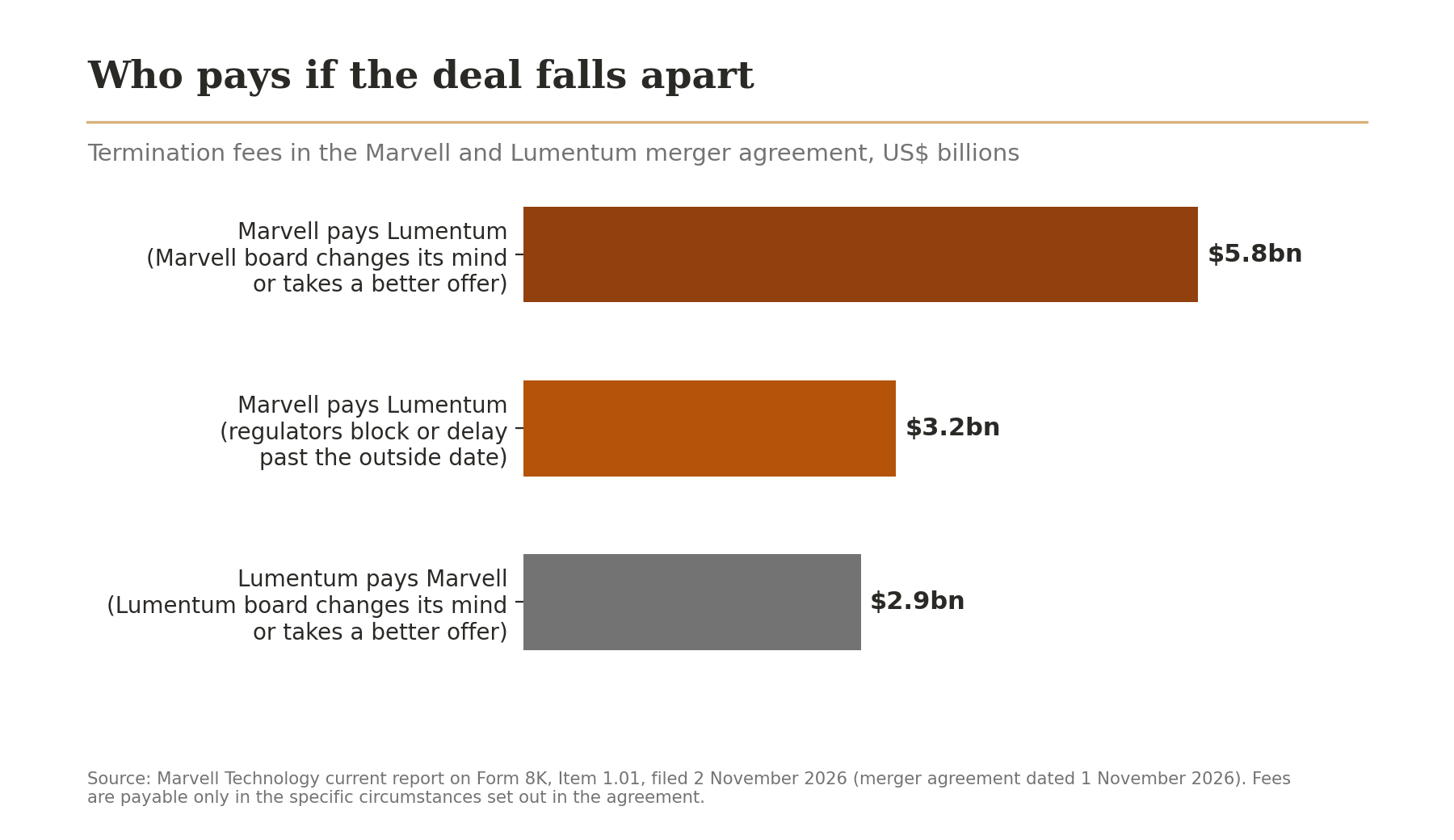
Asymmetric termination fees. Marvell would pay $5.8bn if its board changes its recommendation or it walks away for a better offer, while Lumentum would pay $2.9bn in the mirror situations. Fees in reciprocal stock mergers are usually sized as a percentage of each company's own value, so the larger party carries the larger fee. Marvell also pays a separate $3.2bn regulatory termination fee (sometimes called a reverse termination fee) if antitrust or foreign investment regulators block the deal, or it runs past the outside date, while everything else is ready. That fee puts the regulatory risk squarely on the buyer, which is the usual bargain when the target's board is being asked to accept a long, uncertain timetable.
The long timetable. The outside date of 1 November 2027 can be extended three times, to 1 August 2028, if regulatory approvals are still pending. Analysts expect the review to extend beyond the US: Bank of America's downgrade cites "review in China", and Wedbush has questioned whether regulators will worry about Lumentum's other chip customers losing access to its lasers. There is precedent for Marvell going through this process: its 2018 acquisition of Cavium needed both CFIUS clearance and approval from China's State Administration for Market Regulation, which Marvell announced on 28 June 2018. The agreement's reference to "foreign investment laws" in the regulatory fee shows the parties have planned for that type of review.