EQT to buy Range Resources in all stock merger worth $12.83bn
Hussain Jeddy · 28 October 2026
Share on LinkedIn- Target
- Range Resources Corporation
- Buyer
- EQT
- Deal value
- US$12.83bn
- Price/share
- 0.987 EQT shares for each Range share
On Monday 26 October 2026 EQT, one of the largest natural gas producers in the United States, announced that it will buy its Appalachian neighbour Range Resources in an all stock merger. Each Range share will turn into 0.987 EQT shares. Reuters values that at US$54.91 per Range share and about US$12.83bn in total, a premium of 20.6% to Friday's close. EQT itself puts no dollar figure on the price and talks instead about the combined business, which it says will have an enterprise value above US$50bn, more than 9 billion cubic feet equivalent of gas production a day, nearly 3 million net acres, more than 30 years of drilling inventory and about 3,700 miles of pipeline and related midstream assets. EQT describes the result as the largest vertically integrated natural gas producer in the United States. Reuters notes this is larger than Expand Energy, at about 7.2 billion cubic feet equivalent a day in 2025.
The market reaction showed how an exchange ratio works. Range shares jumped (reports range from about 11% to 16% depending on the time of day) while EQT shares fell (about 3% to 8%). Because the price is a fixed number of EQT shares, not a fixed dollar amount, the value Range holders receive moves with EQT's share price. Yahoo Finance observed that EQT's fall erased roughly half of Range's headline premium.
The Parties
EQT is based in Canonsburg, Pennsylvania, and Toby Z. Rice is its president and chief executive. The combined company will keep its headquarters there and EQT's management team will run it.
Range Resources is a Marcellus Shale gas producer led by Dennis L. Degner, president and chief executive, who will join EQT's board. I could not confirm stand alone production, acreage or market capitalisation for either company from the sources read, so those are left out. Yahoo Finance reports Range trading at about 12 times forward earnings before the deal and EQT at about 19 times, which helps explain why Range holders were attracted to swapping into the higher rated stock.
Structure & Process
This is a merger agreement. It is done in two steps. First a newly formed EQT subsidiary merges into Range, and then Range itself merges into a limited liability company that EQT owns, so that Range ends up as a wholly owned EQT subsidiary. Employees' share awards convert into EQT awards at the same ratio, and performance awards are treated as earned at the greater of actual performance or target (8K).
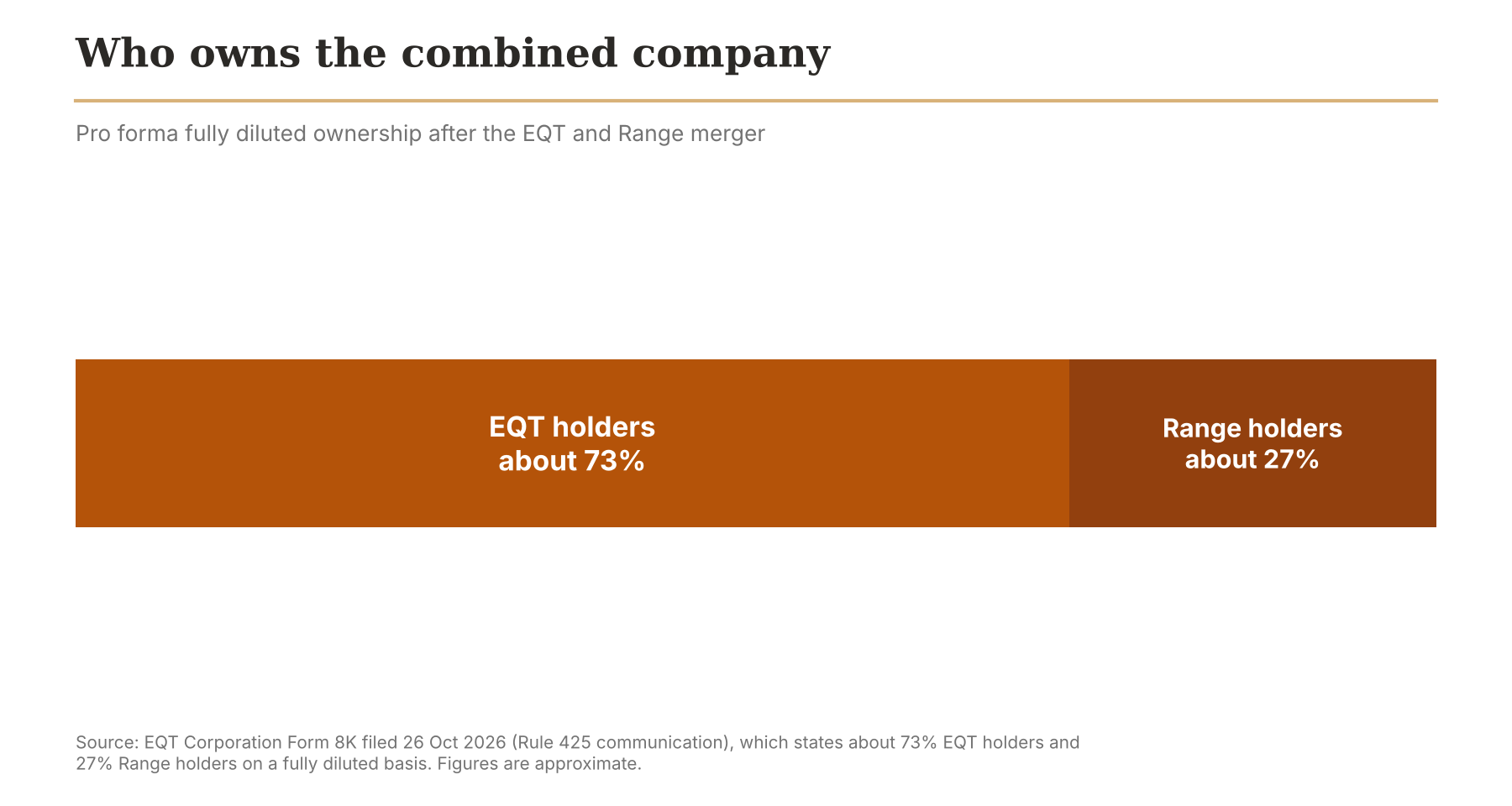
Both sides need a shareholder vote. Range needs a majority of the voting power of its outstanding shares. EQT needs a majority of the votes cast to approve issuing the new shares, because it is creating a large block of stock (about 27% of the combined company on a fully diluted basis goes to Range holders, so EQT holders keep about 73%). The other conditions are NYSE listing of the new EQT shares, an effective registration statement on Form S4 (the US document that registers shares issued in a merger and doubles as the joint proxy statement), expiry of the HSR waiting period, no injunction or illegal bar, no material adverse effect, and the usual accuracy of warranties and performance of covenants.
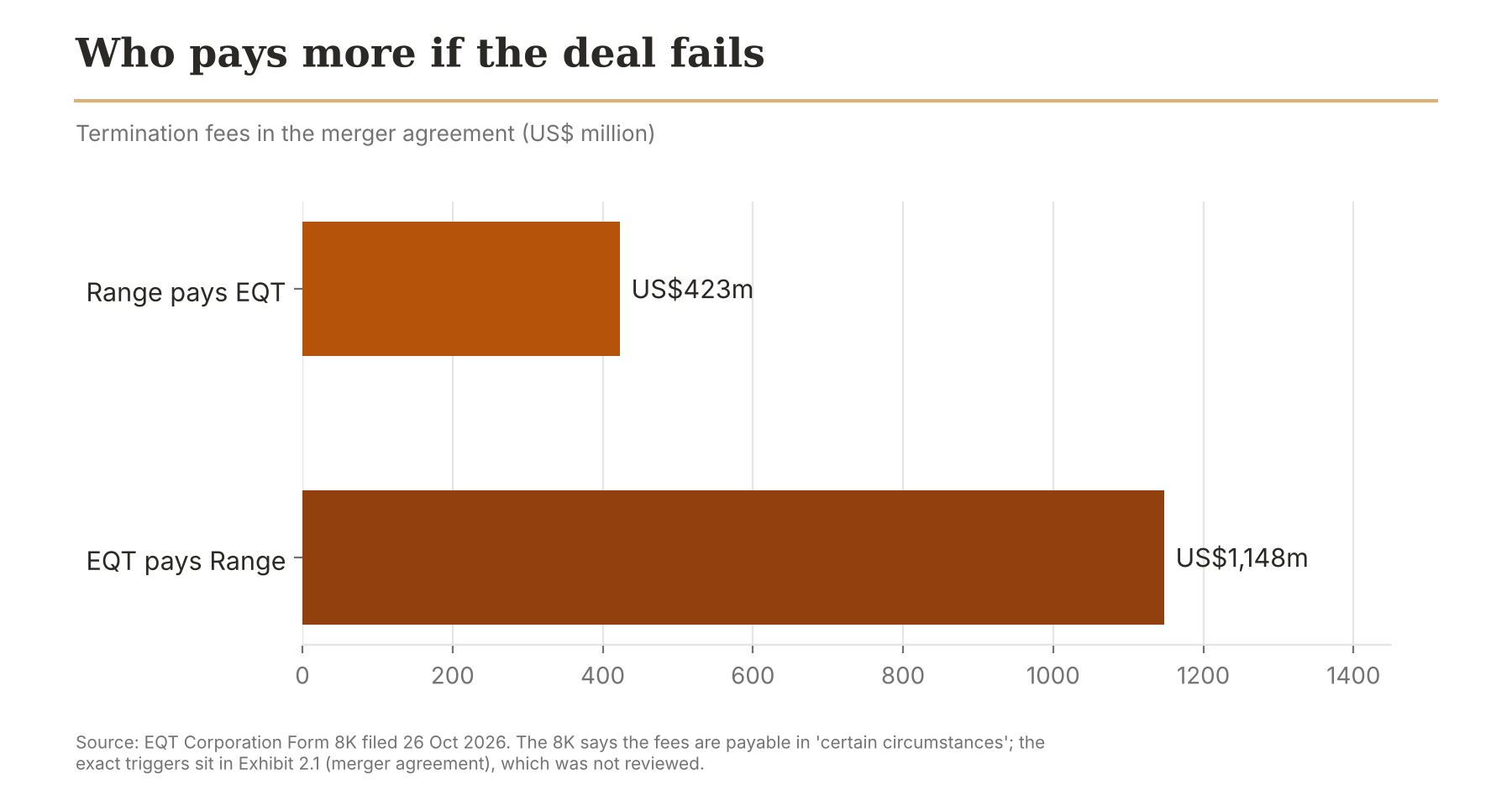
Both companies agreed not to go looking for rival bids (a no shop clause). Before its own shareholder vote, a board may still respond to an unsolicited written proposal that it concludes in good faith could lead to a superior offer, and either side can terminate if the other's board changes its recommendation. The merger agreement itself (Exhibit 2.1) was not reviewed, so the exact triggers for the termination fees and the limits on antitrust remedies are not confirmed.
The Financing Angle
There is no acquisition financing because the price is paid in EQT shares. The 8K describes none, and EQT says it expects "BBB quality" credit metrics at closing, which is a company statement and not a rating agency decision. The company gives its own projections of about US$325m of base annual synergies within two years, with a path to more than US$600m over the longer term, an unlevered free cash flow breakeven below US$2 per million British thermal units of gas, and about US$20bn of cumulative free cash flow over five years at recent futures prices. These are company figures and should be treated as projections. UBS estimates the deal will dilute EQT's 2027 and 2028 earnings by 4% to 7% (Yahoo Finance).
Why it Matters
This is the second largest oil and gas deal of 2026 after Devon and Coterra in February (about US$26bn per Enverus, via Rigzone), according to Fortune. It also fits a pattern, as Chesapeake and Southwestern combined in 2024 as an all stock US$7.4bn deal to form Expand Energy, and Fortune calls that the only comparable recent gas deal. Enverus says US upstream M&A hit about US$38bn in Q1 2026 before falling to US$9.1bn in Q2 amid crude price volatility (Enverus Q1, Enverus Q2), so this deal is a sign that large gas consolidation is back on after that pause.
Analysts were mostly positive. Fortune quotes Bert Donnes of William Blair, Kevin MacCurdy of Pickering and Andrew Dittmar of Enverus broadly welcoming the deal. Scotiabank cut its target to US$53 and asked why EQT is paying for assets at current commodity prices, and Patrick Harris of Infralogic flagged risks including a Russia Ukraine peace deal, Middle East LNG supply returning and weaker data centre demand.
Real World Impact
Natural gas heats a lot of homes and produces a large share of US electricity, so what happens to who produces it can filter through to bills. The US Energy Information Administration expects US gas consumption to rise from about 91.9 to 94.3 billion cubic feet a day between 2025 and 2027, and LNG exports to reach a record 17.4 billion cubic feet a day in 2026 (EIA, via Reuters).
Power demand is a big part of the story. Global Energy Monitor counts about 378 gigawatts of gas power capacity in development, roughly half of it tied to data centres (via Reuters and OilPrice). A bigger producer sitting close to Northeast demand could plan supply more efficiently, and that might help to keep prices steadier. It could also mean one fewer independent seller in a region, which is why competition regulators may look closely. Whether any of this shows up on a household bill is speculative, and gas prices are driven far more by weather, exports and global events than by one merger. One more thing worth watching. If more of the US gas is controlled by fewer, larger firms, they may have more say over how much is sold abroad versus kept for home use.
Why they did it this way
Recommended, not hostile. Both boards approved the deal unanimously, and EQT's release presents it as a joint plan with Range's chief executive joining EQT's board plus one other Range director. In a stock for stock merger of two US listed companies, a friendly negotiated deal is the normal route, because the buyer needs Range's cooperation to prepare the joint proxy and to avoid a fight over a share price that moves every day.
A merger, not a tender offer or asset purchase. Range is a Delaware corporation, so a statutory merger approved by shareholder vote is the standard way to take 100% of a US listed company, including holders who vote against. An asset purchase would force the transfer of thousands of wells, leases and pipeline contracts one by one, which is slow and risks consents being withheld. Using a subsidiary merger followed by an upstream merger into an LLC is a common technique to give the buyer a clean wholly owned subsidiary, and it is typically chosen with tax treatment in mind. The sources read do not state a tax reason, so none is attributed to the parties.
All stock, with a fixed exchange ratio. Paying in shares means no bridge loan and no cash leaving the business, and the Range holders keep exposure to the combined gas assets. For a buyer with a stock that is already trading at a premium to its target, as the valuation multiples above suggest, shares are an attractive currency. The cost is that the headline price floats with EQT's share price, as Monday's trading showed.
Two shareholder votes. Under NYSE rules a company issuing a large percentage of its existing share count generally needs its own holders to approve, which is why EQT holders vote as well as Range holders. Range's vote is required by Delaware law.
Regulatory conditions. The only condition identified is HSR clearance. Both parties have assets in the Appalachian Basin, so a merger of neighbouring producers is the kind of transaction that can draw antitrust scrutiny. For context, the FTC issued a second request on EQT's 2022 Tug Hill and XcL Midstream acquisition (World Oil) and in 2023 issued an order over EQT's arrangements with Quantum Energy (FTC). The deal coverage read does not mention either, and I found no HSR filing, FTC comment or market share data for the deal.
Fees and timeline. The large reverse fee payable by EQT (US$1,148m against US$423m the other way) is a typical way for a seller to be compensated for antitrust or deal certainty risk when the buyer is the larger party, though the filing does not say what triggers each fee. EQT's Q1 2027 target looks ambitious given that it still has to file and clear an S4 and hold two votes, and the outside date of 25 Oct 2027, extendable to 25 Apr 2028 if only antitrust remains, gives room if clearance takes longer.