Bolt Biotherapeutics acquires Prana Therapies in reverse merger backed by $120m financing
Jason Lin · 23 October 2026
Share on LinkedIn- Target
- Prana Therapies, Inc.
- Buyer
- Bolt Biotherapeutics, Inc.
- Deal value
- About $293m
- Price/share
- $8.5743 per share
THE DEAL BENCH
Who advised, and who did what
Tap a team to see what it does in a deal like this.
BUYER SIDE
Sidley Austin LLP
Bolt Biotherapeutics, Inc.
TARGET SIDE
Cooley LLP
Prana Therapies, Inc.
OTHER SIDE
Gibson, Dunn & Crutcher LLP
Placement Agents (Jefferies, TD Cowen, Stifel, LifeSci Capital)
Select a team above.
On 23 October 2026, Nasdaq-listed Bolt Biotherapeutics announced that it had completed its acquisition of privately held Prana Therapies through a stock-for-stock reverse merger. The transaction combines Bolt's public-market listing with Prana's clinical-stage drug development pipeline, while bringing in substantial new financing from institutional healthcare investors.
Under the merger agreement, Prana shareholders exchanged their equity for a combination of Bolt common shares and non-voting convertible preferred shares. On a fully diluted, as-converted basis, former Prana shareholders will hold approximately 51.7% of the combined company, new financing investors approximately 41.4%, and existing Bolt shareholders just 6.9%.
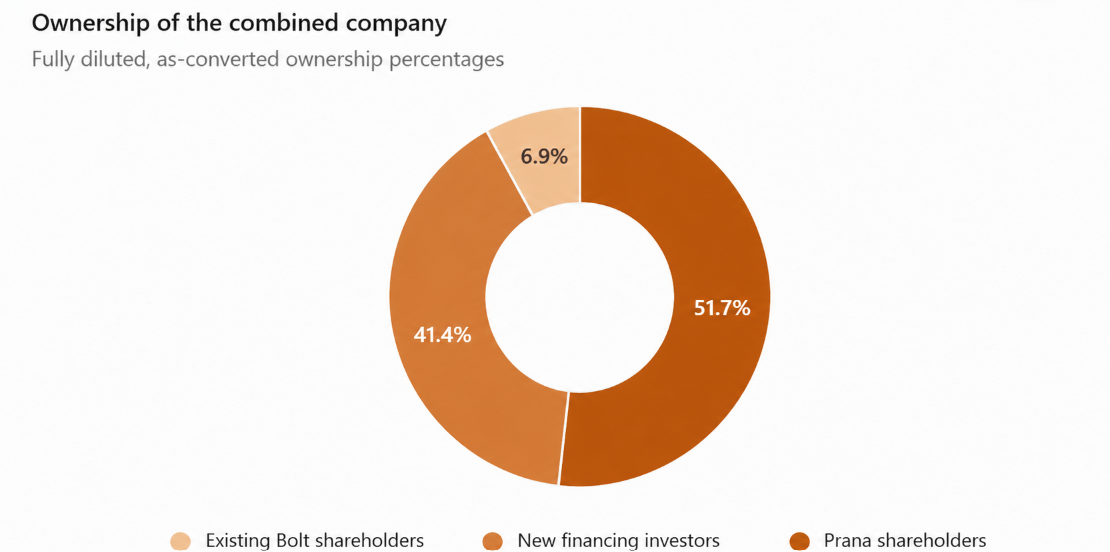
The transaction is therefore more than a conventional acquisition. Although Bolt is legally the buyer, Prana's shareholders emerge with majority economic ownership, and Prana's drug candidates become the principal focus of the business.
Alongside the merger, Bolt secured commitments for a $120 million private placement, with the potential for another $60 million if investors exercise warrants. The financing is expected to provide operating funds into 2028, covering several important clinical milestones. The private placement itself is expected to close on 26 October 2026.
The Parties
Bolt Biotherapeutics is a California-based biotechnology company listed on Nasdaq under the ticker BOLT. Its research has historically centred on immunotherapies designed to use the body's immune system to fight disease.
Prana Therapies is a clinical-stage biotechnology business developing next-generation multispecific antibodies. These medicines are engineered to target more than one biological pathway involved in disease.
Prana's lead candidate, PRA-216, is a bispecific antibody targeting IL-4Rα and TSLP, two signalling pathways involved in Type 2 inflammation. It is being developed for asthma, chronic obstructive pulmonary disease (COPD), atopic dermatitis and eosinophilic oesophagitis.
Prana's proprietary INSPIRE platform is designed to produce antibodies with extended half-lives, potentially allowing patients to receive treatment less frequently. The company is exploring dosing intervals of eight to twelve weeks, although clinical effectiveness and the eventual dosing schedule remain to be established.
For Bolt, the acquisition provides access to a more advanced clinical pipeline. For Prana, it offers a public corporate structure and financing that can support the next phase of drug development.
Structure & Process
The acquisition was completed through a sign-and-close reverse merger. Rather than signing an agreement and waiting months for completion, the parties signed and completed the business combination on the same day.
The legal transaction used two wholly owned Bolt subsidiaries. The first merged into Prana, leaving Prana as the surviving entity, before Prana merged into the second subsidiary. The structure was intended to qualify as a tax-free reorganisation for US federal income tax purposes.
Prana's equity holders received 430,746 Bolt common shares and 16,360.929 Series D non-voting convertible preferred shares. Those preferred shares represent approximately 16.36 million common shares on conversion.
The preferred shares are an important part of the structure. Their conversion requires approval from Bolt shareholders under Nasdaq listing rules, allowing the merger itself to close without waiting for that subsequent shareholder vote.
The merger was approved by Bolt's board and by Prana's board and shareholders. Existing Bolt shareholders did not have to approve the acquisition before completion, although they will be asked to approve the preferred-share conversion.
The Financing Angle
The $120 million financing is structured as a private investment in public equity, commonly known as a PIPE.
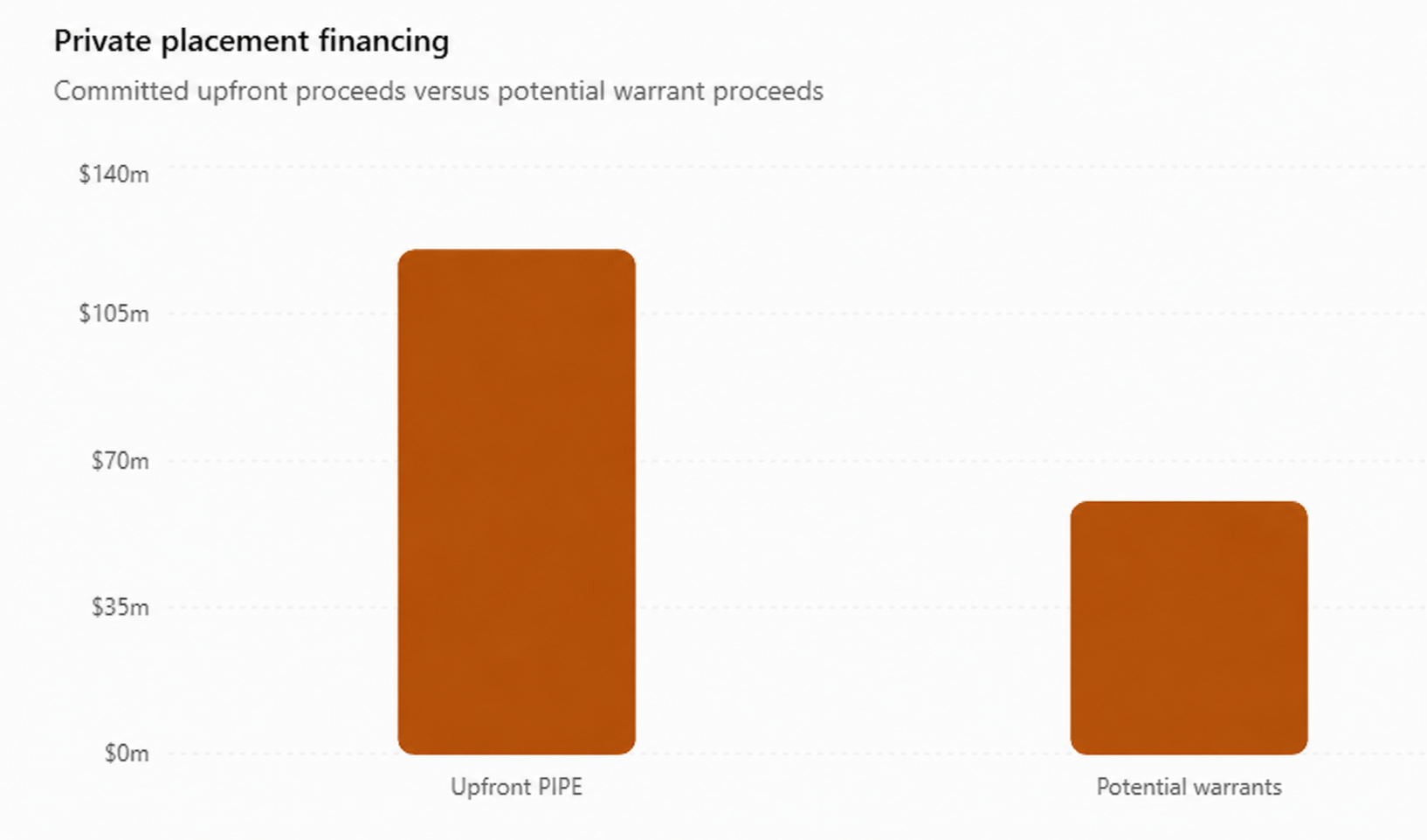
Investors agreed to purchase Series D non-voting convertible preferred stock at $8,574.30 per preferred share, equivalent to $8.5743 per underlying common share. The transaction also includes warrants that could provide up to $60 million in additional funding.
The investors include Deep Track Capital, ADAR1 Capital, Andreessen Horowitz, LYFE Capital, Casdin Capital and other healthcare-focused institutional investors.
The warrants are particularly interesting. Their expiry is linked partly to the disclosure of clinical data from Prana's second development programme, an IL-31 bispecific antibody. This connects the potential additional financing to the company's progress in developing its pipeline.
The $120 million should not be confused with the purchase price for Prana. It represents new capital being raised by the combined company, rather than cash paid to Prana's shareholders.
From a legal perspective, the financing involves several overlapping workstreams: private-placement documentation, preferred-share rights, warrants, Nasdaq shareholder-approval requirements and securities-law compliance.
Why It Matters
First, the transaction demonstrates how reverse mergers can provide biotechnology businesses with an alternative route to public markets. Rather than conducting a traditional IPO, Prana gains access to Bolt's existing Nasdaq listing through a negotiated business combination.
Second, the ownership split illustrates how substantially an existing public company's shareholder base can be diluted when a private biotechnology business becomes the dominant economic owner. Existing Bolt shareholders retain only 6.9% on the stated fully diluted basis.
Third, the financing provides capital for a series of clinical trials rather than for a mature commercial business. Prana expects patient data from four PRA-216 Phase 2 studies beginning in the second quarter of 2027 and continuing through the end of that year.
For M&A advisers, this is a useful example of the intersection between corporate acquisitions and equity capital markets. The merger, PIPE financing, preferred-share conversion and warrants all need to operate together.
Real World Impact
The immediate effect on patients is limited because PRA-216 remains investigational and is not an approved treatment.
If the clinical programme succeeds, the medicine could eventually offer another treatment option for people with chronic inflammatory conditions such as asthma, COPD and atopic dermatitis. Its proposed longer dosing interval could also reduce the frequency of injections for some patients.
However, these potential benefits depend on successful clinical trials, regulatory approval and eventual commercial availability.
The more immediate impact is financial: the transaction gives Prana's research programmes access to substantial new funding and allows development to continue through several expected clinical readouts.
Why They Did It This Way
A reverse merger instead of an IPO. Prana gains a public-market platform without following the conventional IPO route. This can be attractive for clinical-stage companies that need capital but face uncertain public-market conditions.
Stock rather than cash consideration. Paying Prana shareholders in Bolt equity preserves cash for drug development. It also means Prana's existing investors retain exposure to the future performance of the combined business.
Preferred shares instead of immediate common-share issuance. The non-voting preferred-share structure enables the transaction to close while leaving the required Nasdaq conversion approval to a subsequent shareholder meeting.
A PIPE alongside the merger. Securing financing at the same time as the acquisition helps ensure that the combined company has capital to execute its clinical strategy. Without sufficient funding, obtaining a public listing would provide limited practical benefit.
Milestone-sensitive warrants. The additional $60 million creates a possible future source of capital, but the company cannot assume that investors will exercise their warrants. The financing therefore combines committed initial proceeds with contingent additional funding.
The central commercial logic is that Prana contributes the clinical assets and development strategy, Bolt contributes its public-company platform, and institutional investors provide the capital required to pursue the next stage of clinical development.
Why they did it this way
A reverse merger instead of an IPO? Prana gains a public-market platform without following the conventional IPO route. This can be attractive for clinical-stage companies that need capital but face uncertain public-market conditions.
Stock rather than cash consideration? Paying Prana shareholders in Bolt equity preserves cash for drug development. It also means Prana's existing investors retain exposure to the future performance of the combined business.
Preferred shares instead of immediate common-share issuance? The non-voting preferred-share structure enables the transaction to close while leaving the required Nasdaq conversion approval to a subsequent shareholder meeting.
A PIPE alongside the merger? Securing financing at the same time as the acquisition helps ensure that the combined company has capital to execute its clinical strategy. Without sufficient funding, obtaining a public listing would provide limited practical benefit.
Milestone-sensitive warrants? The additional $60 million creates a possible future source of capital, but the company cannot assume that investors will exercise their warrants. The financing therefore combines committed initial proceeds with contingent additional funding.
The central commercial logic is that Prana contributes the clinical assets and development strategy, Bolt contributes its public-company platform, and institutional investors provide the capital required to pursue the next stage of clinical development.