QIAGEN taken private by EQT for about $10.8bn
Hussain Jeddy · 22 October 2026
Share on LinkedIn- Target
- QIAGEN
- Buyer
- EQT
- Deal value
- About €10.8bn EV
- Price/share
- €46.50 per share in cash
THE DEAL BENCH
Who advised, and who did what
Tap a team to see what it does in a deal like this.
BUYER SIDE
Milbank
EQT
BUYER SIDE
Stibbe
EQT (Dutch Law)
BUYER SIDE
Paul Weiss
EQT (Private Equity)
BUYER SIDE
Freshfields
CPP Investments
TARGET SIDE
De Brauw Blackstone Westbroek
QIAGEN
TARGET SIDE
Linklaters
QIAGEN
TARGET SIDE
Davis Polk & Wardwell
Select a team above.
On 21 October 2026, QIAGEN, the Dutch company whose kits and machines pull DNA, RNA and proteins out of blood and tissue samples, agreed to be taken private by Swedish investor EQT. The two sides signed a Business Combination Agreement. Under it, Crown NL Bidco B.V., a company set up for the deal and controlled by EQT's newest flagship fund, EQT XI, will offer €46.50 in cash for every QIAGEN share.
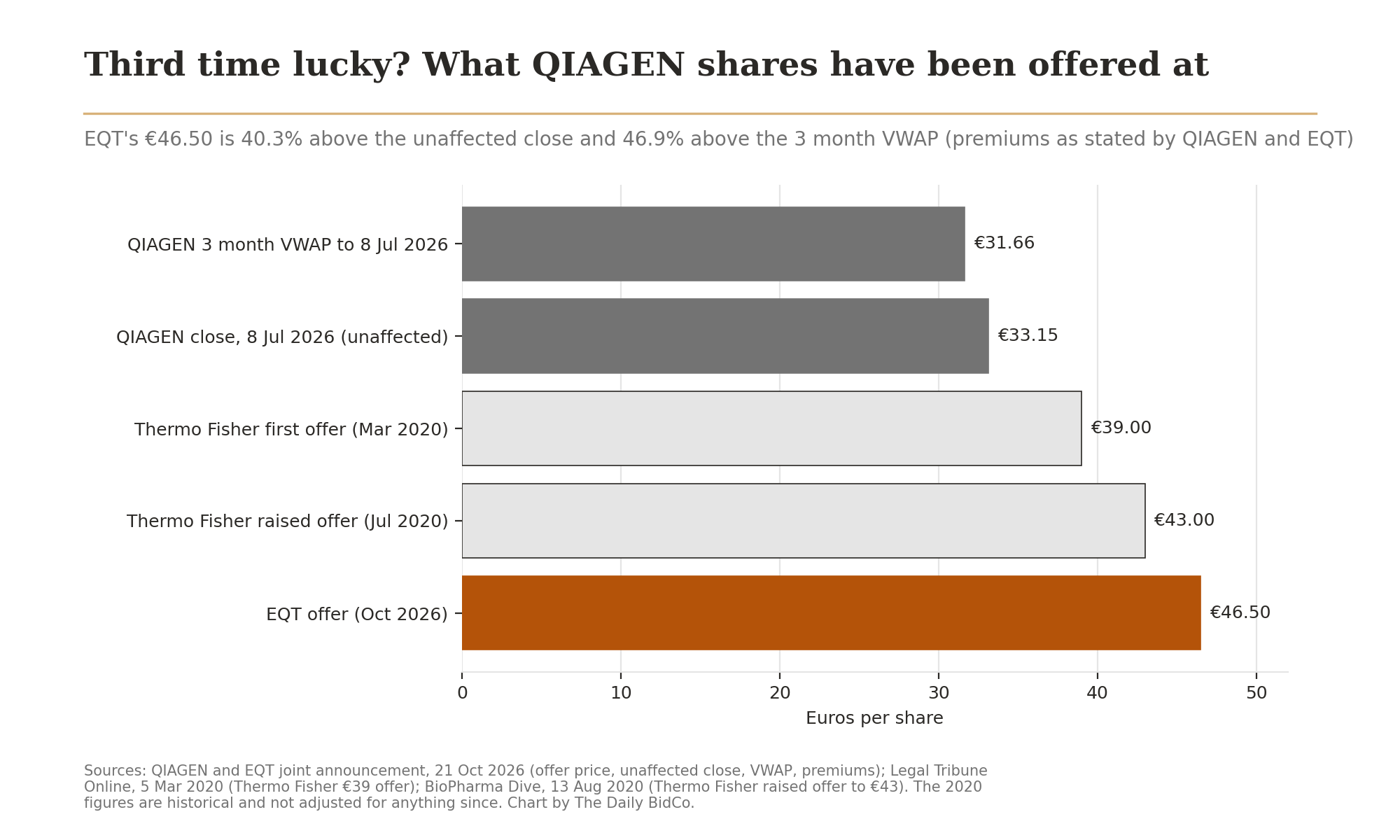
That price is 40.3% above where QIAGEN traded on 8 July 2026, the last day before the press reported that private equity firms were circling, and 46.9% above its three month average. The deal values the whole business at about €10.8bn, or roughly $12.1bn including about $1.1bn of net debt. Both of QIAGEN's boards back it unanimously.
According to Milbank, EQT's lead lawyers, this is the largest public to private deal EQT Private Equity has done in Germany, Austria and Switzerland, EQT XI's first ever investment, and the first time a private equity investor has taken a DAX company private. Closing is expected in mid 2027.
The Parties
QIAGEN was founded in 1984 and has been listed in Frankfurt and on the NYSE since 1996. It sells "Sample to Insight" products. This is the first step in most molecular testing is extracting genetic material from a sample, and QIAGEN pioneered how that is done. It serves more than 500,000 customers, from university labs and drug developers to hospital diagnostics and forensic labs, and employed about 5,400 people at 30 September 2026. Milbank reports FY25 revenue of $2.1bn and adjusted EBITDA of about $750m.
EQT is a Stockholm based investment group with €354bn of assets under management. It says it has invested over €30bn in more than 210 healthcare companies, including Galderma, Parexel and Dako. The legal buyer is a BidCo, indirectly controlled by the EQT XI fund.
The co investors are two of the world's largest long term investors. ADIA invests on behalf of the Government of Abu Dhabi and joins through its Luxembourg subsidiary Luxinva S.A. CPP Investments manages the Canada Pension Plan Fund (C$863.6bn at 30 June 2026) for more than 22 million Canadians. Each takes an indirect minority stake.
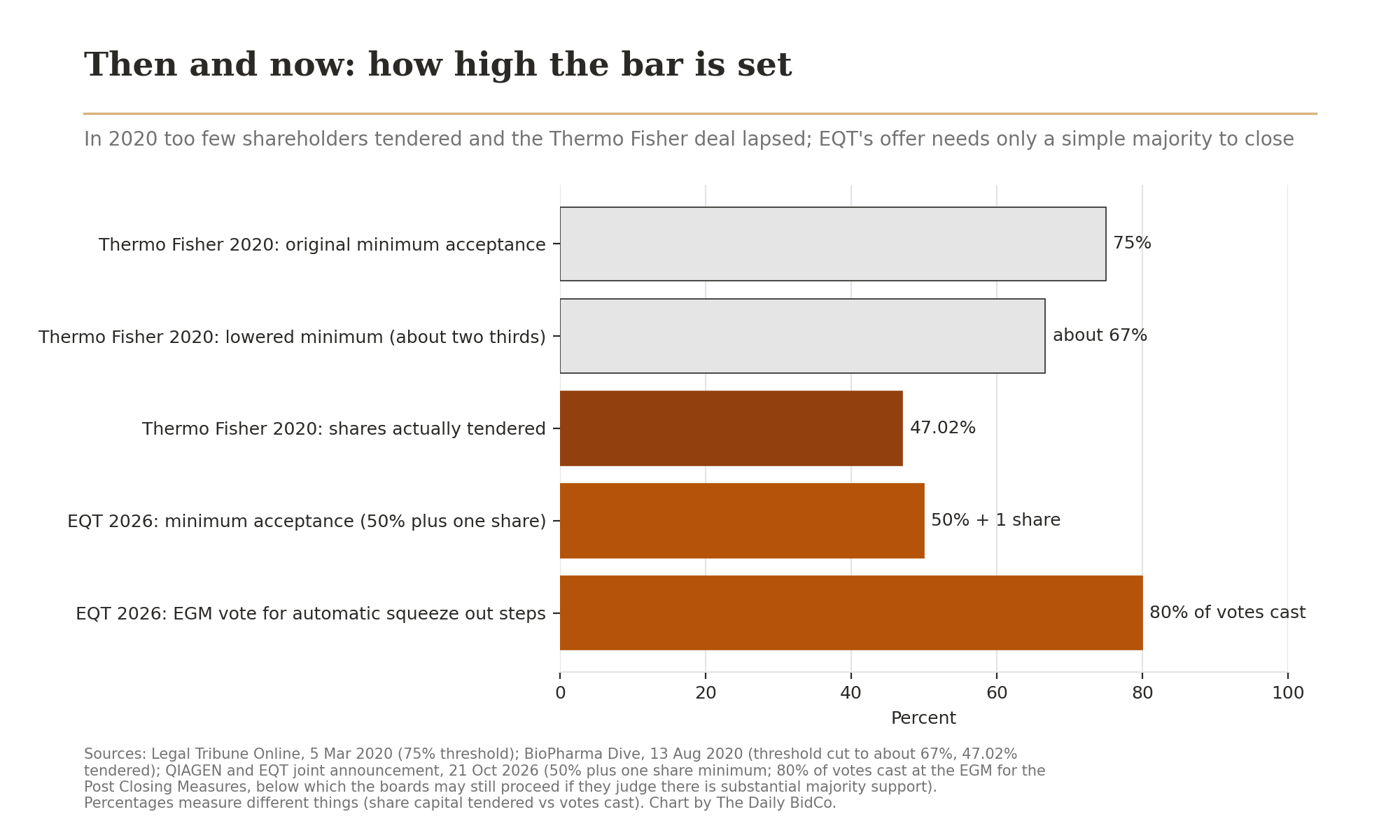
This is not the first attempt to buy QIAGEN. In March 2020 Thermo Fisher offered €39 a share, later raised it to €43 and cut its minimum acceptance level from 75% to about two thirds. The offer still failed in August 2020 when only 47.02% of shares were tendered, after hedge fund Davidson Kempner argued QIAGEN was worth more and refused to sell.
Structure & Process
The offer runs under German takeover law, the WpÜG, because QIAGEN's main listing is in Frankfurt, even though it is a Dutch company. EQT will first publish an offer document once BaFin approves it. The acceptance period starts that day, and EQT will launch a matching tender offer in the US for American holders. QIAGEN's boards will then publish a combined German recommendation and Dutch position statement.
The offer has four main conditions:
Acceptances of at least 50% of QIAGEN's share capital plus one share.
Shareholder approval at an extraordinary general meeting of the Post Closing Measures, held during the acceptance period.
A separate decision by the QIAGEN boards to carry out those measures.
Merger control and foreign investment clearances.
The Post Closing Measures are how EQT gets to 100%. Shareholders who do not tender receive a cash payment equal to the offer price, but less any withholding taxes, so they may end up with less than if they had accepted. QIAGEN's listings in Frankfurt and New York will then end.
There is a carefully drafted safety valve. If at least 80% of votes cast at the EGM approve the Post Closing Measures, the boards must implement them. If support is lower, the boards may still go ahead if they judge, under their fiduciary duties, that a "substantial majority" of the shareholder base supports the deal. In making that call they may weigh votes from longer term shareholders against those of investors who bought after the announcement "with the aim of frustrating the transaction or pursuing event driven hedge fund strategies".
Finally, timing protection. If closing has not happened within 10 months because regulators are still reviewing it, QIAGEN may pay an interim dividend of up to $0.47 per share, on top of the offer price.
The Financing Angle
EQT says it has committed equity and debt financing covering the full offer price and transaction costs, and the offer has no financing condition. Six banks, Morgan Stanley, Jefferies, Deutsche Bank, SMBC, Crédit Agricole and UniCredit, are bookrunners and mandated lead arrangers. The size, pricing and split between loans and bonds have not been disclosed, and neither has how the equity cheque is shared between EQT XI, ADIA and CPP Investments.
Two general points help explain the shape. First, German takeover law requires a bidder to have the cash in place before it publishes its offer, backed by a confirmation from an independent investment services firm, which is why "certain funds" language appears so prominently. Second, QIAGEN itself has debt that may be affected. Clifford Chance's website records a $750m QIAGEN convertible bond issued in September 2025. Convertible bonds commonly contain change of control terms that give holders extra rights when a company is bought, so that instrument is something the financing teams will need to address, although the parties have not said how.
Why it Matters
First, it is a record for German speaking Europe. Milbank describes it as the first private equity take private of a DAX company ever. For scale, White & Case calculates that the total volume of all public takeover offers in Germany in 2025 was just €8.79bn, and that strategic buyers, not private equity, did every German public takeover above €500m that year (with two exceptions it names). This single deal is bigger than that whole year's total, although the two figures are measured differently (enterprise value versus maximum offer consideration).
Second, it is a test of how far a bidder can go to stop arbitrage funds from holding a deal hostage. The structure openly anticipates the kind of holdout that sank the 2020 bid, and how the boards use their discretion below the 80% vote is likely to be watched by advisers on future European take privates.
Third, it fits a pattern we have been tracking. Very large take privates funded by private equity alongside sovereign wealth and pension money. EQT also agreed this month to buy Cleanaway in Australia (Issue 79), and in June partnered with ADIA on Intertek. Healthcare tools and diagnostics, with steady demand from labs and hospitals, are exactly the kind of cash generative business that suits that model.
Real World Impact
If you have ever had a blood test, a PCR swab or a genetic screening, there is a fair chance the sample went through a kit or machine built on QIAGEN's technology. This deal does not change anything you will notice tomorrow. QIAGEN keeps its name and brand, and EQT has signed commitments on R&D, sites and staff.
Over the longer term, the effect could go either way. A private owner free from quarterly reporting could invest more aggressively in new testing technology, which might mean faster or cheaper diagnostics reaching hospitals. On the other hand, a business carrying new acquisition debt may push harder on prices when hospital and lab supply contracts come up for renewal, and those costs can eventually flow into healthcare budgets. There is also a quieter link to ordinary savers, as CPP Investments manages retirement money for more than 22 million Canadians, so a share of QIAGEN's future profits will help pay their pensions. None of this is certain, which makes it a deal worth watching rather than worrying about.
Why they did it this way
Recommended, not hostile. QIAGEN's boards say they reached this deal after a review of strategic options that included discussions with both strategic and financial parties, and concluded private ownership gives QIAGEN "greater flexibility to invest for the long term". For a private equity buyer borrowing heavily, a friendly route is the norm in any case: lenders want full due diligence before they commit, and a target's board can only open its books and agree long term commitments, here on strategy, brands, R&D, sites, employees and "prudent financing", if it is a party to the deal.
A German offer for a Dutch company. The offer is governed by the WpÜG with certain Dutch and US rules layered on top, which is why the deal has German, Dutch and US counsel on both sides. The trickier problem is getting from majority control to 100%. Dutch law only allows a statutory squeeze out (a court process forcing remaining minority shareholders to sell) once a bidder holds 95%, a very high bar for a widely held company with many index funds and arbitrage traders on its register. That is why Dutch public deals typically use a pre agreed "back end" instead: shareholders vote in advance on post closing steps, often an asset sale followed by liquidation, that let the bidder take the whole business while paying the remaining holders the same price in cash.
The 50% threshold and the 80% vote. History explains why this is the most interesting feature. In 2020 Thermo Fisher needed first 75% and then about two thirds of shares to be tendered, and fell short at 47.02% after a hedge fund publicly opposed it. A simple majority threshold makes it much harder for a minority of holders to block the offer simply by not tendering. The 80% EGM vote, the board's discretion below it, and the express reference to event driven hedge funds are the counterweight: they give the boards a mechanism to proceed if long term shareholders clearly back the deal, while still requiring the boards to act in line with their fiduciary duties rather than automatically.
A fund plus two sovereign and pension co investors. At over €10bn, this is a very large single cheque for one fund, and EQT XI is making its first investment. Bringing in co investors is the standard way to spread the equity commitment while keeping control with the lead sponsor. EQT says it is investing alongside ADIA and CPP Investments because of their "long term perspective and experience with large scale transactions". The same pairing of EQT and ADIA appeared earlier this year on EQT's £10.9bn takeover of Intertek.
Regulatory conditions and the timeline. Any deal of this size needs competition clearances in several jurisdictions. Diagnostics and life sciences tools are also areas many governments now screen for foreign investment, and the buyer group includes a Gulf sovereign wealth fund and a Canadian state pension investor, so foreign investment reviews are expected. That explains a closing date around eight months away, and the interim dividend after 10 months shifts some of the cost of a slow review onto the buyer side, which gives shareholders a reason to tender early rather than wait.