Salesforce to buy Braze for about $5.66bn
Hussain Jeddy · 21 October 2026
Share on LinkedIn- Target
- Braze, Inc. (Nasdaq: BRZE)
- Buyer
- Salesforce, Inc. (NYSE: CRM)
- Deal value
- About $5.66bn EV
- Price/share
- $47.50 in cash per Braze Class A share
THE DEAL BENCH
Who advised, and who did what
Tap a team to see what it does in a deal like this.
BUYER SIDE
Wachtell, Lipton, Rosen & Katz
Salesforce
BUYER SIDE
Covington & Burling
Salesforce
TARGET SIDE
Davis Polk & Wardwell
Braze
Select a team above.
On 19 October 2026, Salesforce signed an Agreement and Plan of Merger to buy Braze, and the two companies announced it the next morning. Every Braze Class A share will be converted into the right to receive $47.50 in cash. Salesforce puts the deal at about $5.66bn in enterprise value.
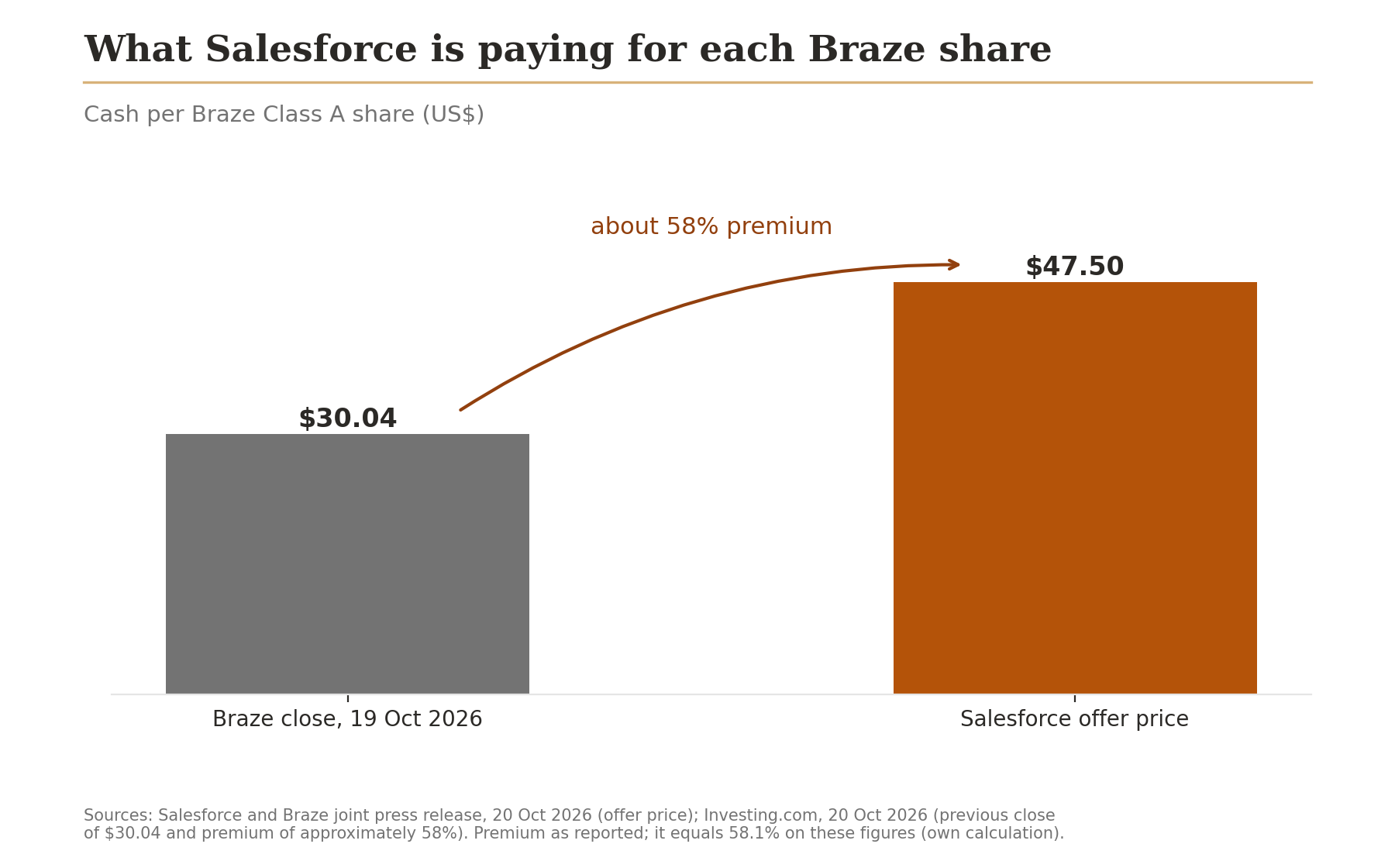
The market reaction showed how big the price jump was. Braze had closed at $30.04 the day before, so the offer is a premium of about 58%, and Braze's shares rose by about 52% on the day, according to Investing.com. The shares trading a little below $47.50 is normal, as investors charge a small discount for the time and the risk until the deal closes. Salesforce's own shares slipped, which is a common reaction from buyer shareholders when a large cash acquisition is announced.
The Parties
Salesforce is the San Francisco software company that popularised selling business software as an online subscription, and it calls itself "the world's #1 AI CRM". CRM (customer relationship management) software is where companies record everything about their customers, from sales calls to complaints. Its marketing products sit in Marketing Cloud, and its newer AI products include Agentforce, its platform for AI "agents" that can carry out tasks on their own.
Braze is a New York company founded about fifteen years ago by Bill Magnuson (now chairman and chief executive) and Jon Hyman (chief technology officer). It sells a customer engagement platform. The software brands use to send app notifications, in app messages, emails, SMS and WhatsApp messages that respond to what each customer is doing. Braze says it serves about 2,770 customers, including Canva, Dairy Queen, Equinox, Instacart, Urban Outfitters and Venmo. In a LinkedIn post filed with the SEC, Hyman said Braze engages 9 billion monthly active users across its customers and sent about 4.5 trillion messages and other actions last year. Braze's Class A shares trade on Nasdaq.
Structure & Process
The deal is a reverse triangular merger. Here, Banff Acquisition Sub Inc. merges into Braze under the Delaware General Corporation Law. Braze becomes a subsidiary of Salesforce, its shares are cancelled in exchange for cash, and it delists from Nasdaq.
The key approval is a vote of Braze's shareholders. Under the merger agreement, the deal needs a majority of the outstanding Class A shares to vote in favour. Braze will first file a proxy statement with the SEC (the disclosure document sent to shareholders before a vote, explaining the deal, the background to the negotiations and the board's reasons). Braze's board unanimously decided that the deal is fair to and in the best interests of the company and its shareholders. Certain shareholders, called the "Company Support Parties", have signed a voting and support agreement at the same time as the merger agreement.
The main regulatory condition is US merger control under the Hart Scott Rodino Act, plus any other approvals under applicable "Regulatory Laws". Several outlets, citing a summary of Braze's filing, report two termination fees. Salesforce would pay about $300m if the deal fails for regulatory reasons, and Braze would pay about $191.4m in situations such as taking a better offer. I could not check those figures against the termination section of the agreement, so treat them as reported.
The parties expect to close in fiscal year 2028, which starts on 1 February 2027 and runs to 31 January 2028. Braze told staff that "nothing changes today" and that the announcement is "the first step in a longer process".
The Financing Angle
This is an all cash deal paid from Salesforce's balance sheet. In its investor presentation filed with the SEC, Salesforce says it expects to "fund transaction via cash" and describes the payment as a "non dilutive form of consideration", meaning no new Salesforce shares are being issued that would shrink existing shareholders' ownership. Neither company has announced any acquisition loans or bond issues for this deal, and the merger agreement does not make the deal depend on Salesforce raising money.
That is different from Salesforce's last big purchase. For the roughly $8bn Informatica deal, Salesforce signed $6bn of unsecured term loans in June 2025, a $4bn facility with a 364 day maturity and a $2bn facility with a three year maturity, with Wachtell advising (per Wachtell's transaction page). Salesforce also says the Braze deal does not change its fiscal 2027 guidance or its longer term "FY30 framework". Its presentation describes the deal as "growth accretion balanced by near term profitability dilution". Braze should increase Salesforce's revenue growth while reducing profit margins for a while.
Why it Matters
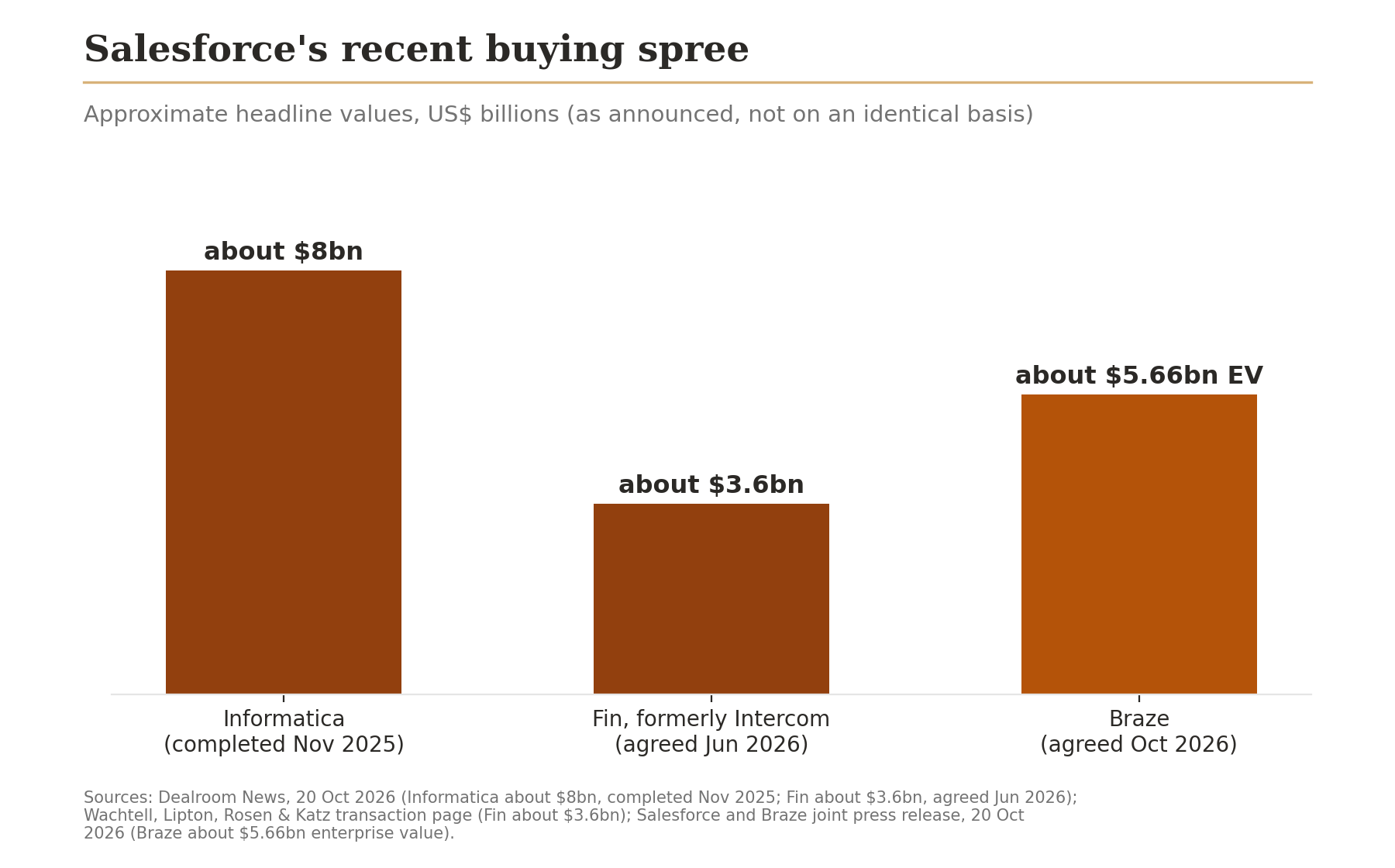
This is the third major AI driven software deal Salesforce has agreed in about a year, after Informatica (data management, completed in November 2025) and Fin, formerly Intercom (AI customer service agents, about $3.6bn, agreed in June 2026). The pattern is clear. Salesforce is buying the data layer, the AI agent layer and now the "last mile" layer, which is the software that actually sends the message to the customer. Dealroom calls it "a significant bet on tying customer data, AI agents and personalized outreach into a single Salesforce platform."
For students, the deal is an example of a US strategic public acquisition. One cash price, a Delaware reverse triangular merger, a proxy and shareholder vote, HSR review, a voting agreement, and termination fees on both sides. It fits alongside recent issues on Schneider/PTC (Issue 65) and Proofpoint/Varonis (Issue 77).
Real World Impact
If you have ever had a notification telling you your basket is waiting, your order is on the way, or your streak is about to end, there is a decent chance software like Braze sent it. After this deal, that software would belong to the company that already holds the customer records of many of the world's biggest brands.
That could work in your favour, as messages might become better timed and more relevant, with fewer pointless ones. It could also mean brands get better at knowing exactly when you are most likely to spend, and nudging you at that moment. Privacy is the other thing to watch. Twenty four US states have now passed comprehensive privacy laws (per Husch Blackwell's tracker, June 2026), but there is still no federal one, so how your data moves between brands' marketing tools is still decided largely state by state.
Why they did it this way
Recommended, not hostile. Braze's board unanimously backs the deal, and Salesforce had a signed contract and a voting agreement before going public. Agreed deals are the norm in US technology M&A. A friendly approach gives the buyer access to the target's confidential information during due diligence, lets both sides control the announcement, and avoids a public fight that could unsettle the target's customers and engineers. That matters here because those customers and engineers are much of what Salesforce is paying for. Salesforce frames the deal against its own "Responsible M&A Framework", which it says covers customer success, strategic fit, innovation and long term value.
A one step merger rather than a tender offer. A US buyer of a listed company can either make a tender offer (an offer made directly to shareholders to buy their shares) or sign a merger agreement and hold a shareholder vote. When regulatory review is expected to take months, a merger with a vote is the usual choice. The vote can be held while the antitrust review runs, and the tender offer's main advantage, speed, is lost if the regulators are the real bottleneck. Expecting to close sometime in fiscal 2028 suggests both sides are planning for a review measured in quarters rather than weeks.
Delaware mechanics and a single class vote. Both companies are Delaware corporations, so the Delaware merger statute gives a well tested route in which a majority vote binds every shareholder. Braze used to have two classes of shares. In 2024, Class B shares carried ten votes each and gave the founders much more voting power than their economic stake (per a 2024 SEC filing by Magnuson). The merger agreement records that no Class B shares were outstanding by October 2026. As a result, the only vote needed is a simple majority of Class A shares, which makes the outcome more predictable. The voting and support agreement makes it more predictable still.
Cash from the balance sheet. Paying cash rather than shares gives Braze shareholders a certain price, with no exposure to movements in Salesforce's share price. It also avoids diluting Salesforce's shareholders. For a buyer of Salesforce's size, a deal of this value can be funded from existing resources, and Salesforce says that is what it expects to do.
Termination fees and regulatory risk. Fees on both sides are standard in US public deals. A target fee in the low single digits as a percentage of deal value compensates the buyer if a rival takes the target away, without deterring a genuine better offer. A larger reverse termination fee (one the buyer pays the target) for regulatory failure shows that the buyer is taking on the antitrust risk. If the reported figures are right, Braze's fee is roughly 3.4% of the $5.66bn enterprise value, which is within the range commonly seen.
Keeping the Braze brand. Magnuson told customers that "Braze will continue building as Braze" and that he will remain chief executive. Salesforce and Braze both stress an "open, composable approach". Keeping a familiar brand and leadership is a common way to protect customer relationships when a large company buys a smaller one, particularly when many of the target's customers may also use competitors' tools.