Silgan and AIP buy Trivium Packaging for $3.4bn
Hussain Jeddy · 20 October 2026
Share on LinkedIn- Target
- Trivium Packaging B.V.
- Buyer
- Silgan MCC
- Deal value
- $3.4bn EV
THE DEAL BENCH
Who advised, and who did what
Tap a team to see what it does in a deal like this.
BUYER SIDE
Jenner & Block
Silgan Holdings
BUYER SIDE
Sidley Austin
Silgan MCC
BUYER SIDE
Ropes & Gray
Financing counsel to Silgan MCC
BUYER SIDE
Simpson Thacher & Bartlett
AIP
TARGET SIDE
Weil Gotshal & Manges
Trivium and shareholders
TARGET SIDE
Paul, Weiss, Rifkind, Wharton & Garrison
Trivium and Shareholders
Select a team above.
On 19 October 2026, Silgan Holdings, the Connecticut packaging group that describes itself as a principal supplier of metal containers in North America and Europe, announced that it will buy Trivium Packaging, a European metal packaging business, in an all cash deal valuing Trivium at about $3.4bn. Trivium is currently owned by Ontario Teachers' Pension Plan, which holds the majority and will fully exit, and by Ardagh Group, which holds about 42%.
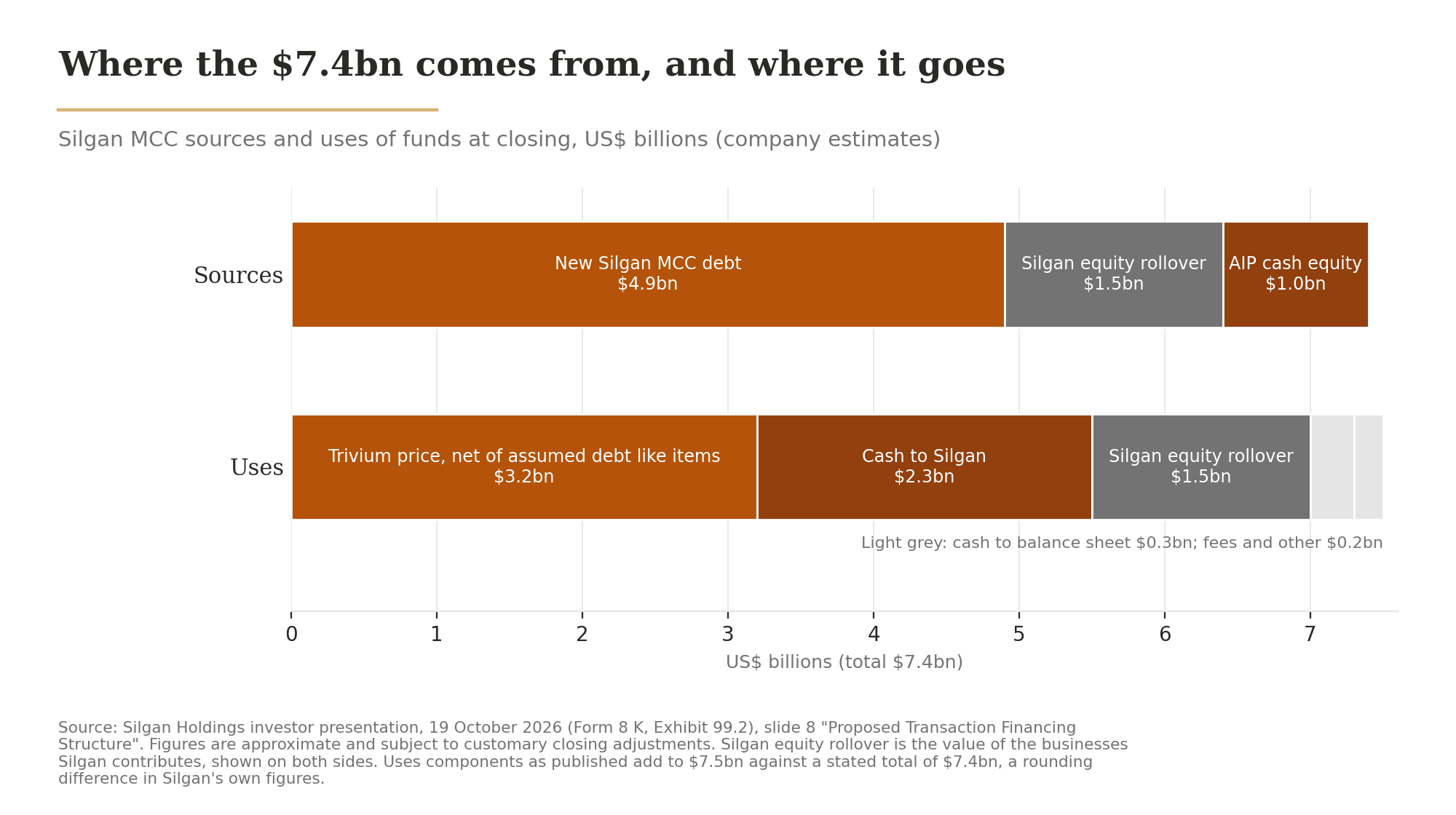
The headline makes it sound like a simple acquisition, but it is not. Silgan is not buying Trivium itself. Instead, Silgan will take its own Metal Containers business and its food and beverage Flat Cap Closures business and put them into a brand new company called Silgan Metal Containers and Closures ("Silgan MCC"). The private equity firm American Industrial Partners (AIP) will put about $1.0bn of cash into that new company in exchange for 40% of it, and Silgan MCC will borrow the rest. Silgan MCC then buys Trivium.
The result is a combined metal packaging business that Silgan values at about $7.3bn, with around $7.3bn of annual net sales, more than 100 plants and over 12,000 employees, according to Silgan's investor presentation. Silgan keeps 60% and control. On the day, Silgan walks away with about $2.3bn of cash, which it says it will use to pay down existing debt. The deal is expected to close in mid 2027.
The Parties
Silgan Holdings is a New York Stock Exchange listed packaging supplier with about $6.5bn of net sales in 2025 and 120 manufacturing plants across the Americas, Europe and Asia. It has two very different halves. One makes dispensing products and specialty closures (the pumps, sprayers and caps on beauty, food and home care products), which Silgan presents as its faster growing, higher margin business. The other makes metal food cans and flat metal closures, a steady, cash generative but slower growing business. This deal is about the second half.
Trivium Packaging was formed in 2019 by merging Exal (a business Ontario Teachers' first invested in in 2010) with Ardagh's food and specialty metal packaging business. It serves over 800 customers from 57 locations in 18 countries, employs about 7,200 people and had net sales of about $3bn in 2025. Its products include food cans, aerosol cans and aluminium beverage bottles.
American Industrial Partners is an industrial private equity firm with about $18bn of assets under management. It describes itself as "operational and engineering focused", and says it has completed over 145 platform and add on acquisitions. Earlier in 2026 it bought International Paper's global cellulose fibres business, according to Packaging Dive.
The sellers. Ontario Teachers' Pension Plan is a Canadian defined benefit pension plan that reports net assets of $303.2bn. It says it has been an investor in Trivium (and its predecessor Exal) for 16 years.
Ardagh Group is a metal beverage and glass container packaging group that held its Trivium stake as a minority joint venture partner. Ardagh expects only about $90m of net cash for its 42% stake, and says the sale simplifies its structure by disposing of a non core investment.
Structure & Process
There are three linked transactions present here:
The carve out and contribution. Silgan separates its Metal Containers segment and its food and beverage Flat Cap Closures businesses from the rest of the group and contributes them into Silgan MCC. A carve out is the legal and operational process of pulling one division out of a company so that it can stand on its own, which means splitting contracts, employees, IP, systems and sites. Silgan's presentation values these contributed businesses at $3.8bn.
The joint venture. AIP subscribes about $1.0bn of cash for 40% of Silgan MCC, and Silgan keeps 60%. A joint venture is a business owned by two or more investors who agree, in a shareholders' or LLC agreement, how it will be governed. Here, Silgan nominates three of the five board seats (Anthony Allott, Adam Greenlee and Shawn Fabry) and AIP nominates two. Because Silgan controls it, Silgan MCC will be fully consolidated into Silgan's accounts.
The acquisition of Trivium. Silgan MCC then buys Trivium from Ontario Teachers' and Ardagh. Ontario Teachers' and Ardagh both describe themselves as selling their stakes in Trivium Packaging B.V., which is a share purchase rather than an asset purchase. Silgan's 8 K describes the signing of a material definitive agreement.
Closing is conditional on "required regulatory approvals", the completion of "applicable works council consultation processes" and other customary conditions. Works councils are elected employee bodies, common in the Netherlands, Germany, France and elsewhere in Europe, that must be consulted on major corporate changes before a deal is finalised.
The Financing Angle
This is the interesting part of the deal. Silgan's sources and uses table shows roughly $7.4bn of total funding for Silgan MCC. The equity rollover is the value Silgan keeps invested in the new company through the businesses it contributes, rather than cash.
The debt comes from a bank group of Wells Fargo, Goldman Sachs, RBC Capital Markets, Deutsche Bank Securities and BofA Securities, who have provided fully committed financing. Ropes & Gray, financing counsel to Silgan MCC, describes the financing package as $5.88bn. That is larger than the $4.9bn of new debt in Silgan's sources and uses, and the sources reviewed do not explain the difference (it may include facilities that are not drawn at closing, but that is not confirmed).
The significance is where the debt sits. It is borrowed by Silgan MCC on its own independent balance sheet, not by Silgan itself. Silgan estimates Silgan MCC's pro forma net leverage at about 4.0x, including expected synergies. Meanwhile Silgan's wholly owned dispensing business ends up at about 1.8x, and Silgan says total group leverage stays at about 3.4x, the same as at the end of 2025. Alex Hutter, Silgan's senior vice president for strategy and investor relations, told investors the partnership means "we're not deploying a meaningful amount of shareholder capital" (Packaging Dive).
Why it Matters
For students, this deal packs almost every structural tool into one transaction. It includes a carve out, a joint venture with a private equity partner, ring fenced acquisition financing, a share purchase from two sellers, European employee consultation and a planned tax free spin off. It shows that "Company A buys Company B" headlines often hide much more interesting mechanics.
It also reflects a wider trend. Silgan CEO Adam Greenlee told investors that tariffs have changed competitive dynamics in the US can market, and that about 80% of the tinplate steel used in the United States is imported (Packaging Dive). Scale in both Europe and North America gives a can maker more flexibility on where to source and produce. Investors appear to have liked the deal, as Silgan's shares rose about 6% on the day (Investing.com).
Real World Impact
If you have bought a tin of soup, cat food or a can of spray deodorant, there is a good chance it came from Silgan or Trivium. After this deal, many of those cans will come from one bigger company. The upside Silgan points to is efficiency $225m a year of savings, cheaper buying of steel and aluminium, and shared factories. Whether any of that shows up on supermarket shelves is a different question.
Canned food prices are already under pressure from US metal tariffs (the Can Manufacturers Institute said in early 2026 that it expected bigger price rises this year than last), and a larger, more efficient can maker could either soften that or, with fewer competitors, keep more of the savings for itself. It is worth watching how competition regulators view it.
Why they did it this way
A negotiated private sale, not a takeover bid. Trivium is a private company owned by two shareholders, so there was no public offer and no takeover rules to follow. Deals like this are agreed directly with the owners in a share purchase agreement. With a pension fund wanting a full exit and a minority partner wanting to sell a non core holding, a clean cash sale to a single buyer is the natural outcome. Ontario Teachers' says it "will fully exit the business", and Ardagh says the sale "helps simplify" its structure.
Why a partnership rather than a straight purchase. Silgan says the partnership lets it realise "significant value today, while retaining future upside without further investment", with AIP providing about $1bn of equity capital. Bringing in a financial partner is the standard way for a listed company to do a large acquisition without issuing lots of new shares (which dilutes existing shareholders) or piling debt onto its own balance sheet. Silgan describes the result as leverage neutral for the group.
Why 60/40 and three board seats to two. Holding more than half of the equity and a board majority gives Silgan control, which in turn lets it consolidate Silgan MCC in its accounts and steer integration. Silgan says this structure lets it "maintain control to capture upside while reducing execution risk". A 40% stake with two board seats is a typical package for a significant minority investor, giving AIP real influence without control.
Why put the debt in Silgan MCC. Ring fencing the acquisition debt in the joint venture means Silgan's lenders and shareholders do not carry it directly, and Silgan's dispensing business is left with low leverage. Silgan says this "redistributes balance sheet capacity" and frees its dispensing business to invest and make acquisitions.
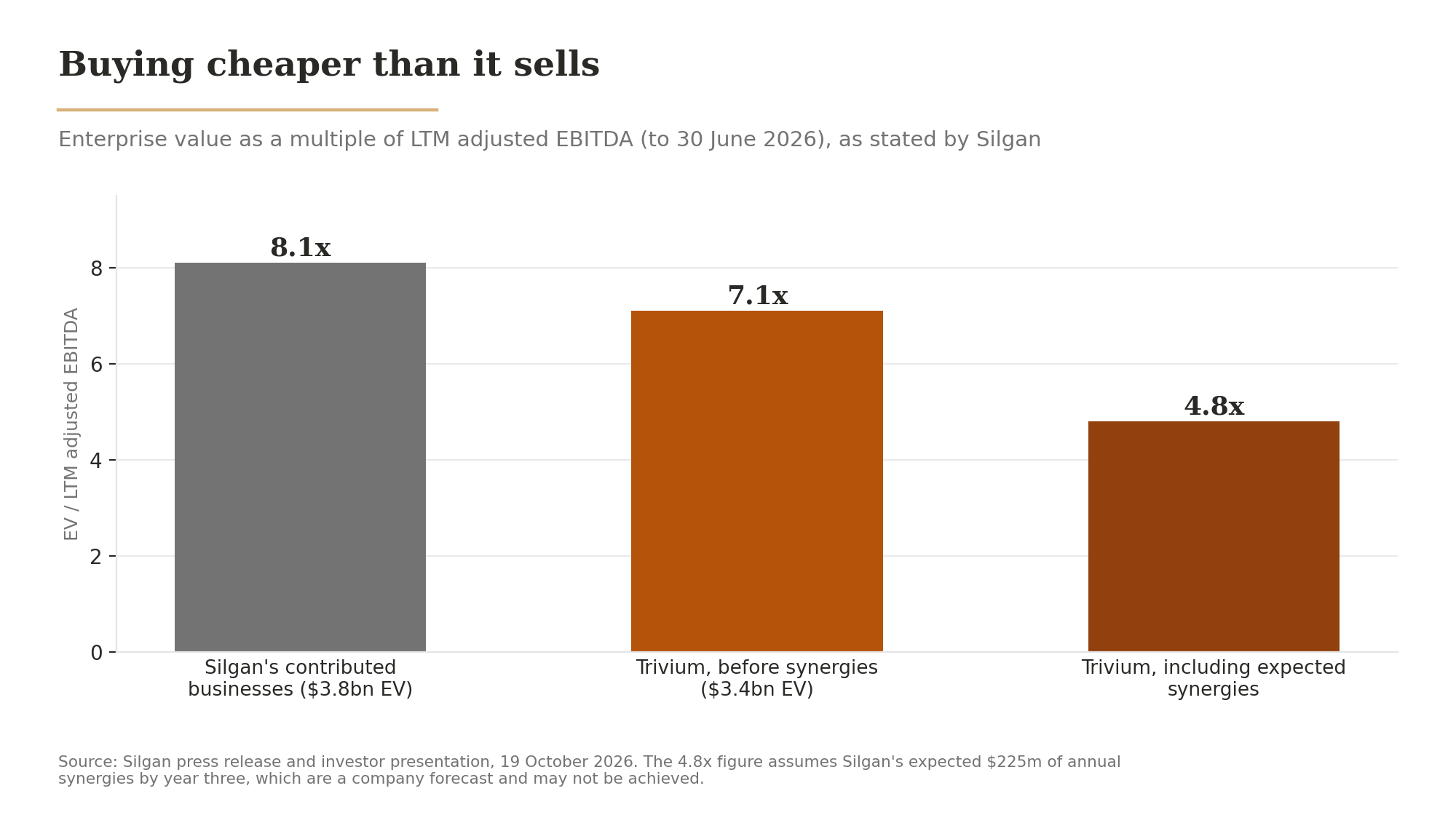
Why value Silgan's businesses at 8.1x and Trivium at 7.1x. Silgan presents the deal as contributing its own businesses at a higher multiple than it pays for Trivium, with the gap widening to 4.8x once its expected $225m of synergies are counted. Those synergies are a company forecast. Silgan says it expects about $75m in year one, $150m in year two and $225m by year three, from procurement, operational and overhead (SG&A) savings.
Why the path to a spin off. Silgan says it intends, over time, to establish Silgan MCC as an independent public company through a tax free spin (distributing the shares in Silgan MCC directly to Silgan's own shareholders without triggering tax for the company or its shareholders), with timing depending on integration, synergy delivery and market conditions. Under US tax rules a spin off can only be tax free if strict conditions are met, which is one reason companies set out the route early but leave the timing open.
Why works councils and regulatory approvals. Trivium is a Dutch company with operations across Europe, so European employee consultation rules apply. In the Netherlands and much of Europe, employers must consult works councils before a change of control is finalised, so these processes are written in as closing conditions. Combining two large food can makers will also normally require merger control clearance in each country where both have meaningful sales.
Why mid 2027. An eight to nine month gap between signing and closing is typical for a multi country deal that needs several merger control clearances and works council processes, and that involves carving out businesses from a listed group.