EQT Infrastructure VI sign Scheme Implementation Deed to buy Cleanaway Waste Management for A$9.3bn
Hussain Jeddy · 19 October 2026
Share on LinkedIn- Target
- Cleanaway Waste Management Limited
- Buyer
- EQT Infrastructure VI
- Deal value
- About A$9.3bn EV
- Price/share
- A$3.095 cash per share**
THE DEAL BENCH
Who advised, and who did what
Tap a team to see what it does in a deal like this.
BUYER SIDE
Allens
EQT
TARGET SIDE
Ashurst Perkins Coie
Cleanaway
Select a team above.
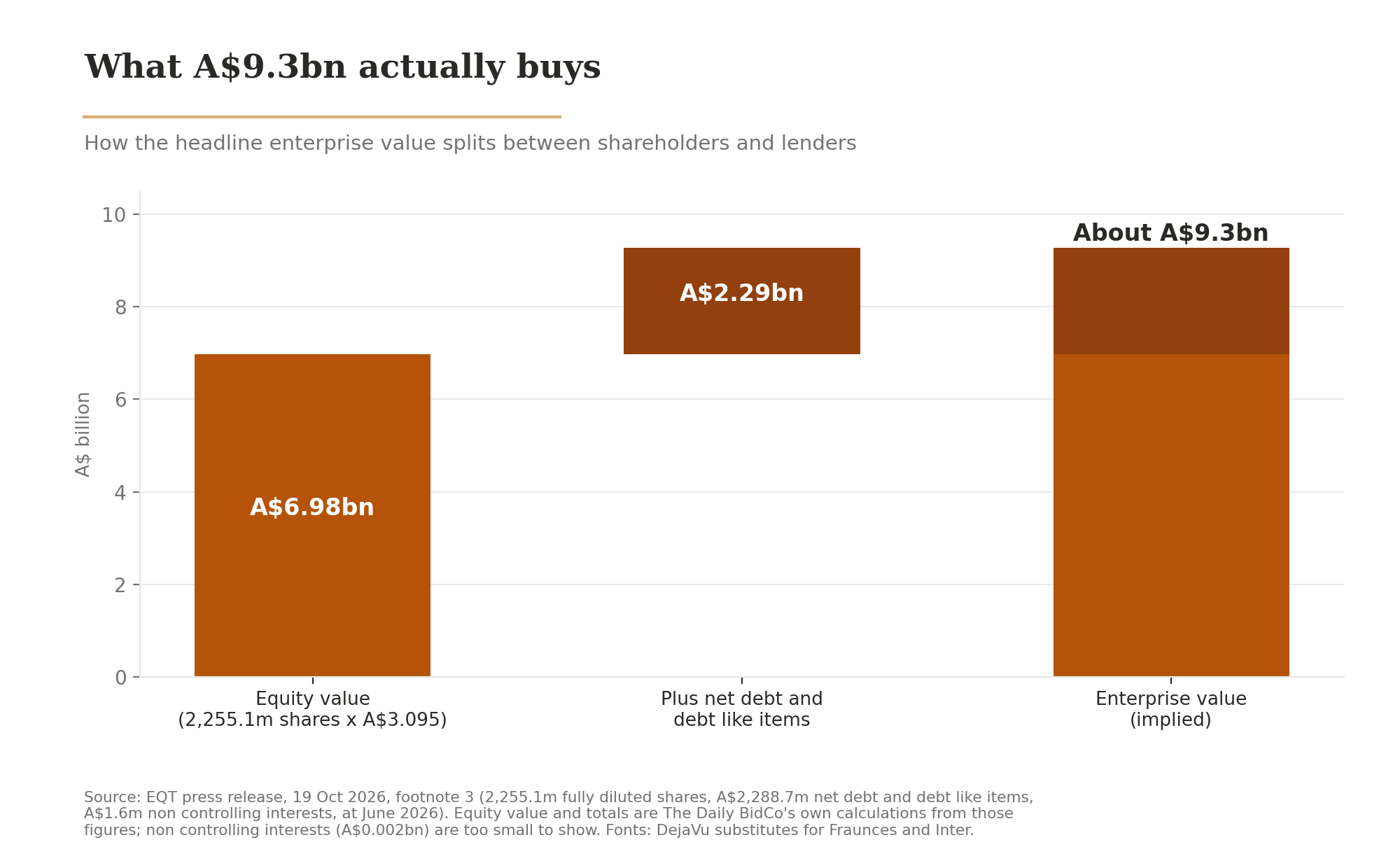
On 19 October 2026, EQT Infrastructure VI signed a binding Scheme Implementation Deed to buy every share in Cleanaway Waste Management, Australia's largest waste company. Shareholders will receive A$3.095 in cash per share. EQT says this implies an enterprise value of about A$9.3bn and a 32.1% premium to Cleanaway's A$2.37 share price on 12 August, the last full day of trading before news of the approach. The enterprise value splits into roughly A$6.98bn for shareholders and A$2.29bn of net debt, using EQT's figures.
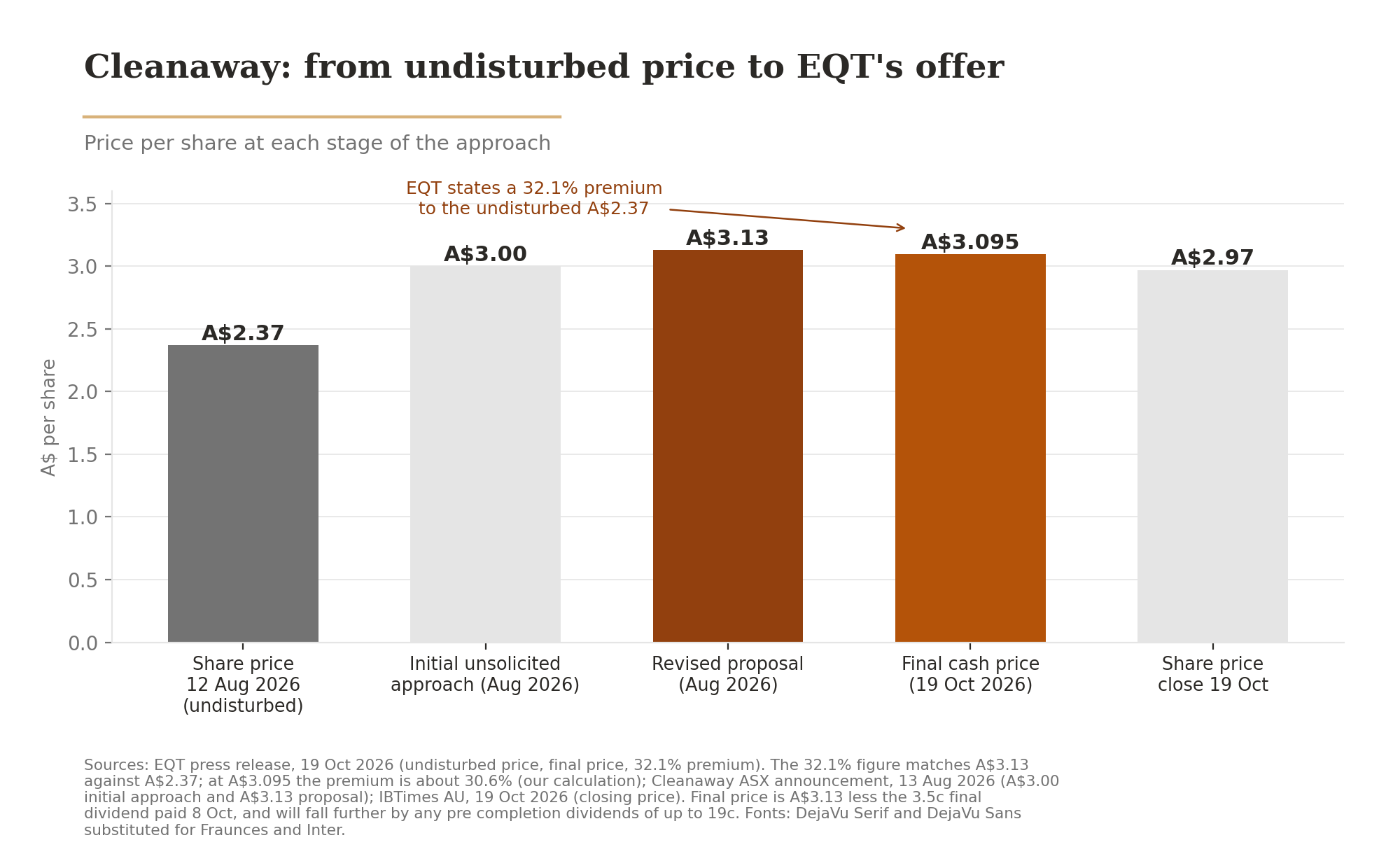
Cleanaway's board unanimously recommends the deal, subject to no better offer emerging and an independent expert agreeing. Cleanaway's shares jumped 20.24% to close at A$2.97, still a little below the cash price.
The Parties
Cleanaway collects, recycles, treats and disposes of waste for households, councils and businesses across Australia. In FY26 (the year to 30 June 2026) it reported gross revenue of A$4.37bn, up 13.5%, and underlying EBIT of A$470.2m, helped by its purchases of Contract Resources and Citywide Waste. It says it runs Australia's largest waste and industrial services fleet, about 6,200 vehicles.
EQT is a Swedish investment group with €354bn of assets under management. Its infrastructure arm already owns waste and environmental businesses including Urbaser, ReWorld, Encyclis and Arcwood. The buyer is EQT Infrastructure VI, EQT's current flagship infrastructure fund, which EQT says will be 85 to 90% invested after this deal. The legal buyer is Sedum Group Pty Ltd, a BidCo (a company set up purely to make and hold the acquisition).
Structure & Process
The deal runs as a scheme of arrangement under Part 5.1 of the Corporations Act 2001 (Cth). It needs two court hearings in the Federal Court of Australia. The first approves the scheme booklet and calls the shareholder meeting. The second approves the scheme once shareholders have voted. At the meeting the scheme needs 75% of votes cast and a majority in number of the shareholders voting. Once approved by the court, it binds every shareholder, including those who voted against.
The process went in stages. Cleanaway disclosed on 13 August that it had received an unsolicited A$3.00 proposal, followed by a revised A$3.13 proposal. It granted EQT up to nine weeks of exclusive due diligence under a Transaction Process Deed (a preliminary contract setting the rules for exclusivity and information access). Exclusivity was extended to 7am on 19 October, and the binding deed was signed that morning. EQT first cleared due diligence in September and confirmed in writing that nothing it found would stop the deal.
Two features of the price matter. First, Cleanaway may pay up to 19c per share of dividends before completion, possibly including a fully franked special dividend. Any such payment is deducted from the A$3.095. Second, a ticking fee (extra money that builds up if completion is delayed) of A$0.0002 per share per day starts on 1 June 2027 if the deal has not completed by 31 May 2027. That works out to about 7.3c per share for a full year of delay.
The Financing Angle
This is a leveraged infrastructure buyout. The equity comes from EQT Infrastructure VI. On the debt side, press reports in early October said around 15 lenders, including Australia's major banks and Japanese, French and Canadian lenders, were competing to underwrite an acquisition debt package of more than A$5.5bn. The final lender group, pricing and terms have not been confirmed in public sources, so treat these figures as reported rather than confirmed.
From my calculation, this gives an equity value of about A$6.98bn, as 2,255.1m fully diluted shares times A$3.095. EQT is also taking on about A$2.29bn of existing net debt and debt like items, which will most likely be refinanced as part of the new debt package. Neither party has published how the purchase splits between new equity and new debt.
Why it Matters
First, this is one of the largest ASX take privates of 2026. It continues a run of big Australian deals backed by private capital that we have covered, including the A$7.7bn Steadfast take private (Issue 31) and DigitalBridge's PLUS ES deal (Issue 36). On the same day, Challenger received a separate A$7.9bn proposal from TAL Daiichi Life.
Second, it shows infrastructure investors treating waste like a utility. Collection contracts, landfills and recycling plants produce long term, contracted and hard to copy cash flows, which is exactly what infrastructure funds look for. EQT's existing global waste portfolio suggests a deliberate strategy.
Third, the price is being debated. Commentator Robert Gottliebsen has argued in The Australian that Cleanaway's core operations could be worth closer to A$4 a share, based on how US waste companies are valued. The independent expert's report will be a document to watch. It is also an early high profile test of the ACCC's new compulsory merger regime on a large private equity deal.
Real World Impact
If you live in Australia, there is a good chance a Cleanaway truck empties your bins or your workplace's skip. Nothing changes the day this deal is signed and your council's contract stays the same, and your bin still gets collected on the same day.
Over time, though, who owns the bin truck can matter. A new owner that wants to grow could invest more in recycling plants and cleaner trucks. Australia's national target is to recover 80% of waste by 2030, and industry figures in recent years put recovery at only around 60 to 62%. On the other hand, a buyer that has borrowed heavily may also push harder on prices when council and business contracts come up for renewal. Those costs could end up in council rates or business costs. Neither outcome is certain, and both will be shaped by council tenders and state landfill levies, which have risen sharply in some states. That makes it a deal worth watching, not one to worry about.
Why they did it this way
Recommended, not hostile. An infrastructure fund paying around 20 times earnings with a large debt package needs deep due diligence on things like landfill liabilities, council contracts and regulatory exposure. Lenders also expect that diligence before they commit. A friendly process, with a board that says early on it is willing to recommend a price, is the usual way to get that access. That is why the deal moved through a non binding proposal, then exclusivity, then a binding deed, rather than going straight to shareholders. Cleanaway's chair, Samantha Hogg, says the board weighed EQT's price against the value of Cleanaway on its own, including its Blueprint 2030 2.0 plan, and concluded the scheme offers "strong and certain cash value."
A scheme rather than a takeover bid. In Australia a bidder can either make a takeover bid under Chapter 6 of the Corporations Act or use a scheme. A takeover bid only gives 100% ownership if the bidder reaches 90% and can then compulsorily buy out the rest. A scheme gives an all or nothing result at 75% of votes cast. For a leveraged buyer this certainty matters. Lenders normally want the bidder to own the whole company so they can take security over its assets and cash flows, so recommended private equity take privates on the ASX almost always use schemes.
Ownership through a single fund vehicle. The buyer is one EQT fund acting through a dedicated BidCo, so there is no consortium to manage. EQT's statement that the fund will be 85 to 90% invested "less any anticipated syndication" suggests some of the equity may later be offered to co investors, which is common for a cheque of this size.
Regulatory conditions. EQT is a foreign buyer, so the deal needs approval from the Foreign Investment Review Board (FIRB, which advises the Treasurer on whether foreign acquisitions are in the national interest). It also needs ACCC clearance (Australia's competition regulator). Since 1 January 2026, ACCC clearance has been compulsory for deals above certain thresholds, and a deal cannot complete until it is cleared. This is one of the largest private equity take privates to go through the new regime. Press reports note that EQT does not own any Australian waste assets, which should make the competition review simpler. Filings in Kuwait and Saudi Arabia are reported. Merger filings like these are usually triggered by the countries where the parties' businesses or portfolio companies have sales.
Timeline and risk sharing. A scheme meeting in February and completion by the end of March 2027 leaves time for the scheme booklet, the independent expert's report, both court hearings and the regulatory reviews. The ticking fee only starts on 1 June 2027, two months after the target date. This puts the cost of a long regulatory delay on the buyer, which gives shareholders some comfort that the cash will arrive on time. The option of a franked special dividend is a familiar Australian feature: it lets the company pass on franking credits (credits for tax the company has already paid, which Australian shareholders can use to reduce their own tax), so local shareholders get more after tax value from the same headline price.