Penske Corporation and Mitsui take Penske Automotive Group private for $16.3bn
Hussain Jeddy · 17 October 2026
Share on LinkedIn- Target
- Penske Automotive Group, Inc.
- Buyer
- Penske Corporation and Mitsui & Co., Ltd.
- Deal value
- $16.3bn
- Price/share
- $212.00 per share in cash for holders other than the investor group
On 15 October 2026, Penske Automotive Group, one of the world's biggest car and commercial truck dealership groups, signed an agreement to be taken private by its two largest shareholders, Penske Corporation and the Japanese trading house Mitsui. The buyers will use a jointly owned company, Motown Acquisition Corp., which will merge into PAG. Every shareholder outside the buying group will receive $212 in cash per share, and the deal values PAG at about $16.3bn including debt. Once it closes, which the parties expect in the first quarter of 2027, PAG will leave the New York Stock Exchange and be owned roughly 64% by Penske Corporation and 36% by Mitsui.
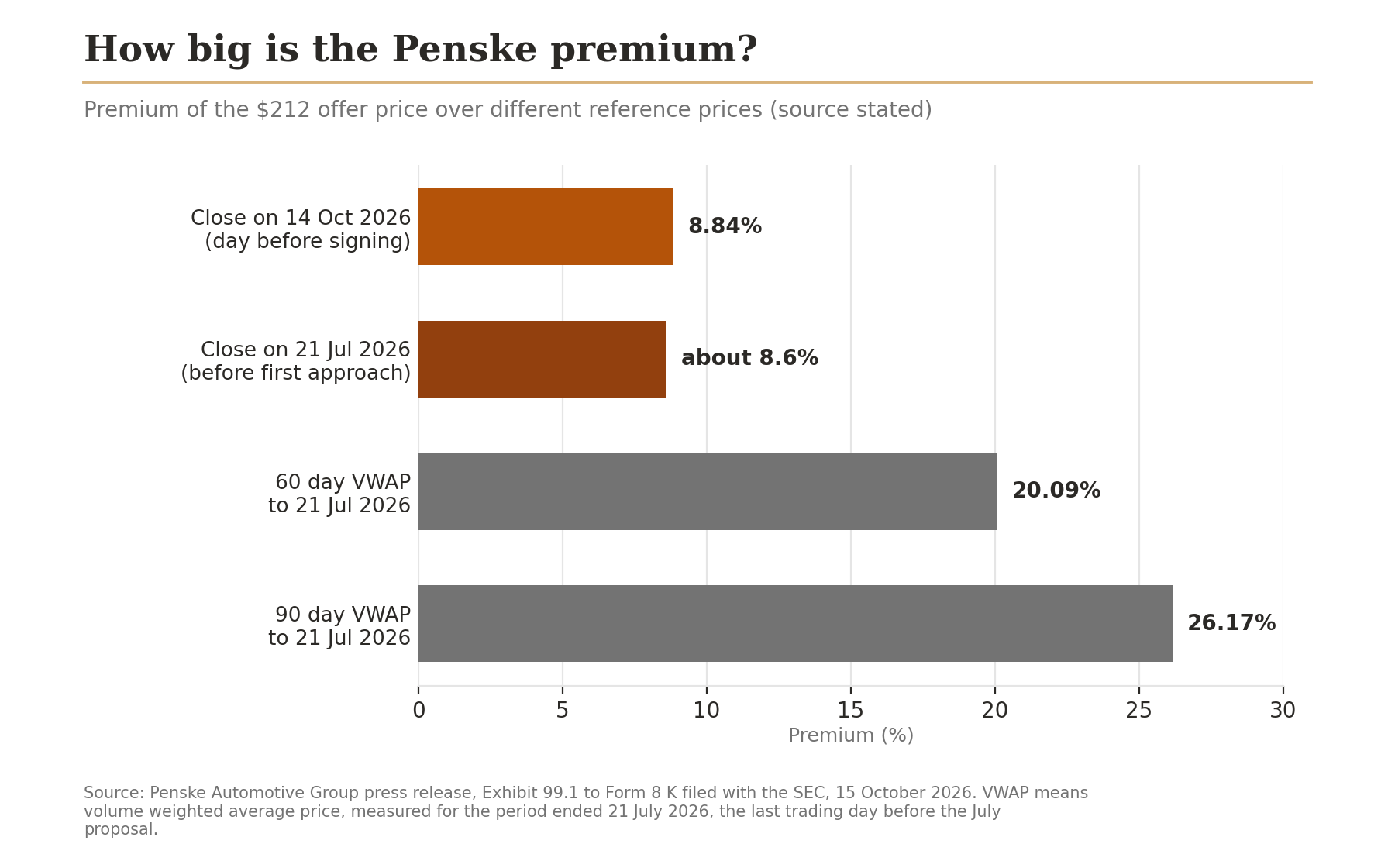
What makes this deal unusual is that the buyers already control the company. According to the 8 K, the investor group and its affiliates own about 72.6% of PAG's shares, so the deal is really about buying out the remaining public minority of roughly 27%. That is why the headline premium is so small. $212 is only 8.84% above PAG's closing price the day before signing, compared with the 30% to 50% premiums that are common when an outsider buys a company. The buyers first offered $210 in July, and the special committee negotiated that up by $2.
The Parties
Penske Automotive Group sells and services cars and commercial trucks. It runs dealerships in the United States, the United Kingdom, Canada, Germany, Italy, Japan and Australia, is one of North America's largest Freightliner truck retailers, and employs over 28,900 people. It also owns 28.9% of Penske Transportation Solutions, the truck leasing business with over 373,600 trucks, tractors and trailers under contract. In the UK, its best known business is the Sytner dealer group.
Penske Corporation (buyer, about 64% after closing) is the private holding company of Roger Penske, who is also PAG's chair and chief executive. Roger Penske is famous in motorsport, but Team Penske and his racing businesses are not part of this deal.
Mitsui & Co. (buyer, about 36% after closing) is one of Japan's largest sogo shosha. Roger Penske says in the press release that Mitsui has been a PAG shareholder for 25 years.
The Special Committee is a group of independent and disinterested PAG directors, chaired by David Hoogendoorn, formed to evaluate the proposal on behalf of the minority shareholders. It hired its own bankers (Moelis) and lawyers (Paul, Weiss).
Structure & Process
The deal uses a merger . Here Motown Acquisition Corp. merges into PAG, PAG survives, and every public share is automatically cancelled and turned into the right to receive $212 in cash. Shares held by the investor group are carved out as Excluded Shares, so the buyers simply keep their existing stake. Shareholders who think $212 is too low can instead seek appraisal rights.
The approval requirements are the heart of the deal. Two votes are needed. The first is a majority of all outstanding shares, which is effectively guaranteed because shareholders owning about 72.6% have signed voting and support agreements. The second, and the one that actually matters, is a majority of the minority vote (the deal must win a majority of the votes cast by "disinterested stockholders" as defined in Section 144 of the Delaware General Corporation Law), which excludes the investor group, its directors and officers, PAG's own officers, and board members outside the special committee.
The rest of the process is standard for a US public deal. PAG will file a proxy statement (the document sent to shareholders before a vote, explaining the deal and recommending how to vote) and, jointly with the buyer, a Schedule 13E 3 (an extra SEC disclosure required in going private deals where insiders are buyers, setting out why they think the price is fair). The deal also needs the Hart Scott Rodino waiting period (the US antitrust pre clearance regime) to expire, plus "certain other specified regulatory approvals" that the 8 K does not list by name. PAG can still respond to a better unsolicited offer through a fiduciary out (a clause letting the board change its recommendation or terminate for a superior proposal), but the buyer gets five business days to match. In practice, with the buyers holding 72.6%, a rival bid is very unlikely.
The Financing Angle
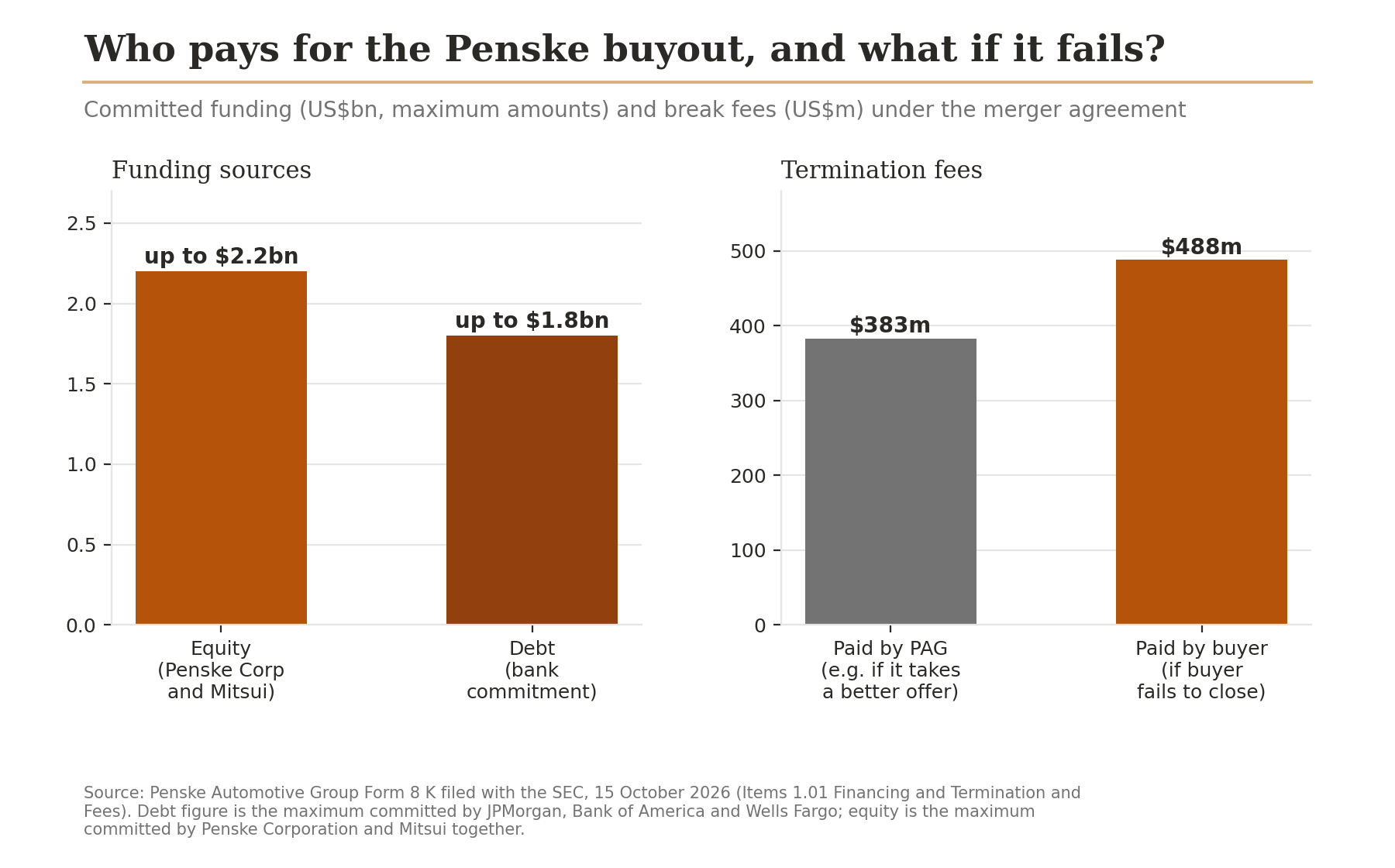
The buyers expect to fund the purchase with up to $2.2bn of equity (the buyers' own money, committed through equity commitment letters from Penske Corporation and Mitsui) and up to $1.8bn of debt (borrowed money) under a commitment letter from JPMorgan, Bank of America and Wells Fargo. Together that is up to about $4.0bn (my own calculation), which lines up with the roughly $3.8bn cost of buying out the minority that CDG News reported when the $210 offer was first made. The deal has no financing condition, so the buyers cannot walk away simply because they fail to raise the money.
There is a neat twist in how the debt can be raised. The bank commitment is a backstop. It can be reduced if Motown issues up to $1.8bn of senior subordinated notes (bonds that rank behind bank loans if the company runs into trouble) or if PAG draws up to $1.1bn more under its existing US credit agreement. PAG signed an amendment to that credit agreement on the same day. The lenders are not ordinary banks but the finance arms of the car and truck makers whose vehicles PAG sells, such as Mercedes Benz Financial Services, Toyota Motor Credit and Daimler Truck Financial Services. The amendment allows a one time increase in the revolving facility from $1.5bn to up to $2.4bn, including up to $400m that can be borrowed above the usual asset based limit, and it permits up to $1.8bn of new debt in the form of a 364 day bridge loan and/or subordinated notes.
The break fees show who bears which risk. PAG must pay $383m if, for example, it takes a better offer. The buyer must pay a reverse termination fee (a fee paid by the buyer if it breaches the agreement or fails to close) of $488m. The reverse fee is about 27% larger than the target's fee (my own calculation). Because the minority stake is worth only around $3.8bn, PAG's $383m fee is roughly 10% of the cash going to public shareholders (my own calculation, approximate), which is high by that measure, though only about 2.3% of the $16.3bn enterprise value (also my own calculation).
Why It Matters
For students, this is a model controller buyout under Delaware's new rules. It shows the full route. A special committee with independent advisers, a fairness opinion, a majority of the minority vote defined by statute, support agreements, appraisal rights, a fiduciary out and a two way break fee structure. It is also one of the first big US going private deals since the Delaware Supreme Court confirmed the Section 144 safe harbors in February 2026, so it is a live example of how practitioners are applying the statute.
For markets, it shrinks the already small club of listed US dealer groups. CDG News described PAG as one of just six publicly traded auto retail groups. It also fits a wider pattern of consolidation in car retail. Haig Partners reports that the number of US dealerships acquired rose 14.3% in the first half of 2026, with the largest groups increasingly focused on premium luxury and import brands. Finally, the tiny premium is worth discussing critically. The buyers argue that $210 was already higher than PAG had ever traded and Stephens warned the shares could fall to around $160 if the deal failed, but minority holders have little leverage when the buyers already own nearly three quarters of the company.
Real World Impact
If you buy a car from a Penske dealer, nothing changes and the name above the door will stay the same. What will change is who the business answers to. Today it answers partly to stock market investors who look at results every quarter. After the deal, it will answer only to Roger Penske's company and Mitsui, two owners who say they are in it for the long term.
That could cut both ways. A private owner may find it easier to spend money on things that take years to pay off, such as new showrooms, service centres, electric vehicle charging or technology for booking repairs online. On the other hand, the buyout is partly funded with borrowed money, and the owners will want a return on it, so it is worth watching whether that shows up in service prices, add on products or staffing. All of this comes at a time when the average new car in the US already costs $50,562 (Kelley Blue Book, September 2026), close to an all time high, so how big dealer groups price and finance cars matters to ordinary buyers.
Why they did it this way
Friendly, but negotiated at arm's length. The buyers approached the board with a non binding proposal rather than going straight to shareholders. A controller cannot sensibly launch a "hostile" bid against a company it already controls, and in Delaware a controller deal is judged by how fairly it treats the minority. Handing the negotiation to an independent special committee with its own advisers is how boards show that the minority had a genuine bargaining agent. The buyers said in their July letter that PAG "would be best positioned" to keep growing as a private company and that the offer gave shareholders "immediate liquidity" and "certainty of value", according to CDG News. Special Committee chair David Hoogendoorn says the committee "considered the benefits of the transaction as compared to continuing as a public company" and concluded that this deal "provided the greatest value for the Company's minority shareholders."
Why a merger rather than a tender offer. For a buyer that already owns over 70% and wants 100% in a single step, a one step merger with a shareholder vote is the standard US route. It also fits naturally with the two layer vote and the proxy and Schedule 13E 3 disclosure that a controller deal needs, and it gives the lenders a clear closing date to fund against.
Why both a special committee and a majority of the minority vote. This is where Delaware law drives the design. PAG is a Delaware corporation, and in 2025 Delaware amended Section 144 of its corporate statute to create safe harbors (statutory routes that protect a transaction from being challenged for breach of fiduciary duty if set procedures are followed). For most conflicted transactions, approval by either an independent committee or a disinterested shareholder vote is enough. For a going private transaction by a controller, the safe harbor requires both. Without them, the deal would face entire fairness review (the strictest test in Delaware, where the defendants must prove both a fair process and a fair price). The Delaware Supreme Court upheld these amendments in February 2026 in Rutledge v. Clearway Energy Group. The merger agreement defines the minority vote by express reference to Section 144, tying the deal's approval mechanics directly to the statute. It is also notable that the special committee hired Andre Bouchard, a former Chancellor of the Delaware Court of Chancery, and Blake Rohrbacher, a leading Chancery litigator.
Why the 64/36 ownership split. Penske Corporation will keep majority control, and Mitsui, a 25 year partner, will hold a large minority. Splitting the equity this way means neither buyer has to fund the whole minority buyout alone, while control stays with the founder's holding company. Large minority co investment alongside an operating partner is a familiar model for Japanese trading houses, and Mitsui already partners with Penske in the truck leasing business (Debevoise's own deal list shows it advised Mitsui on acquiring interests in Penske Truck Leasing).
Why these conditions and fees. HSR clearance is required because of the deal's size. The larger reverse termination fee and the target's right to force the buyer to close through specific performance (a court order compelling a party to carry out the contract) give the minority comfort that a buyer with no financing condition will actually pay. The fiduciary out and $383m fee are the standard trade: the board keeps the legal ability to take a better offer, and the buyer is compensated if it does.
Why this timeline. Signing in mid October, filing a proxy and Schedule 13E 3, clearing SEC review, holding a special meeting and obtaining antitrust clearance typically takes a few months, which is why the parties point to the first quarter of 2027. The 15 October 2027 outside date gives a full year of headroom if any regulatory approval drags.