Lufthansa chosen to buy 49.9% of TAP Air Portugal for €1.201 billion
Hussain Jeddy · 15 October 2026
Share on LinkedIn- Target
- TAP Air Portugal
- Buyer
- Deutsche Lufthansa
- Deal value
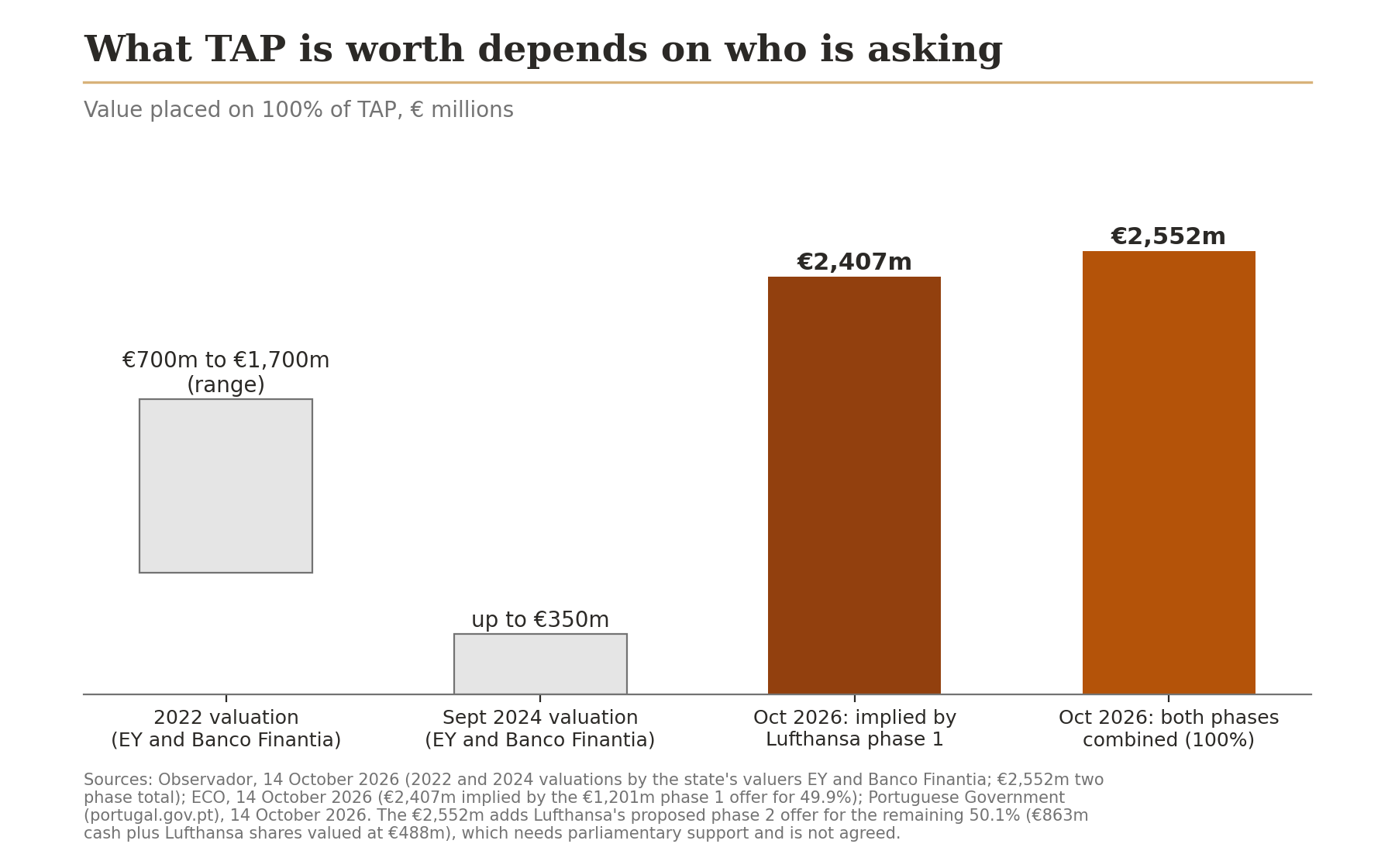
- €2,407m for 100% of TAP implied by the phase 1 offer (ECO)
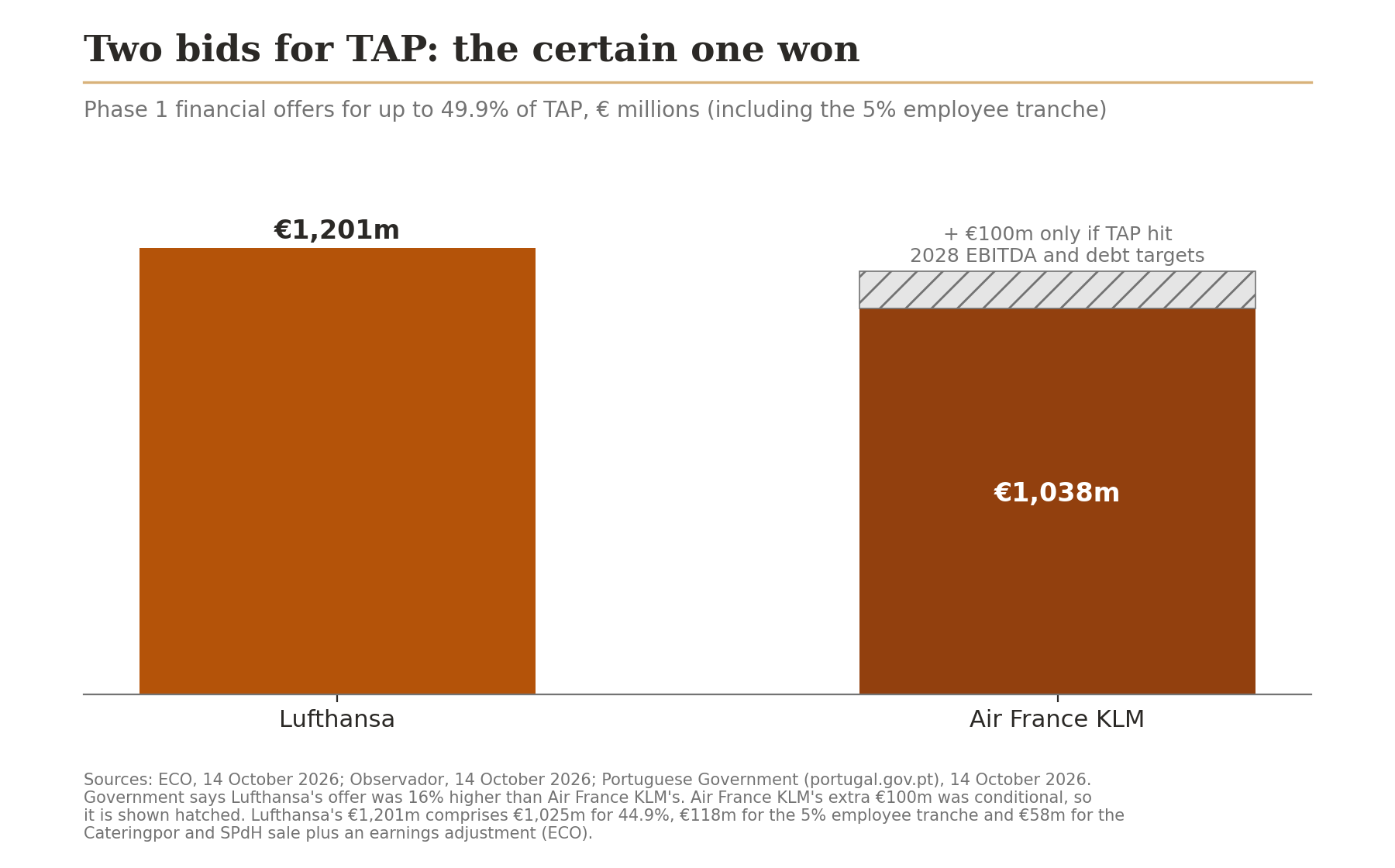
On 14 October 2026, Portugal's Council of Ministers chose Lufthansa to buy up to 49.9% of TAP Air Portugal, the national airline, for €1,201m. The Government says the offer was 16% higher than the rival bid from Air France KLM and "carries a lower degree of uncertainty". The state keeps 50.1%, so it remains the majority owner, but Lufthansa will run the airline day to day.
The headline number has three parts. According to ECO, Lufthansa will pay €1,025m for 44.9% of TAP, a further €118m for the 5% of shares reserved for TAP's employees (it buys whatever staff do not take up, at the same price), and €58m linked to the sale of two TAP businesses, the caterer Cateringpor and the ground handler SPdH, plus a mechanism that adjusts the price to TAP's results. That values the whole of TAP at about €2,407m (ECO). Lufthansa also put a second offer on the table: €863m in cash plus Lufthansa shares worth €488m for the state's remaining 50.1%. Adding both phases gives the Government's headline valuation of €2,552m (Observador, ECO).
The Parties
Lufthansa Group is Europe's largest airline group. In 2025 it carried 135 million passengers, made €39.6bn in revenue and flew 737 aircraft to about 330 destinations (ECO). Alongside Lufthansa itself it owns Swiss, Austrian Airlines and Brussels Airlines, holds 41% of Italy's ITA Airways (with an agreed move to 90%) and runs the low cost carrier Eurowings. TAP would become its sixth network carrier (a full service airline that feeds passengers through a central hub airport onto long haul flights).
TAP Air Portugal flies 101 aircraft to more than 90 destinations and carried 16.7 million passengers in 2025. It is the European leader on flights to Brazil (ECO). It has been under state control since a pandemic rescue, and the Government puts the public money invested at more than €3,200m. Euronews, citing Portuguese business press, reports that TAP lost €99.2m in the first half of 2026.
The Portuguese state is the seller, acting through Parpública (the state holding company that manages the Government's shareholdings). The losing bidder, Air France KLM, said it was "disappointed" but valued the "constructive dialogue" (Observador).
Structure & Process
This is a share purchase, not an asset purchase. Lufthansa buys shares in TAP from the state, so it takes on TAP as a whole, with its aircraft, debts, contracts and staff, rather than picking out particular assets. The legal basis is Decree Law 92/2025 published in August 2025. It allows the state to sell up to 44.9% directly to one "reference investor" and to offer up to 5% to TAP employees. If staff do not buy all of their 5%, the investor must buy the rest (Lusa).
The sale was run as a competitive tender. IAG reportedly dropped out, leaving Lufthansa and Air France KLM, who submitted improved final bids at the end of September. Price was only one criterion, as the decree also required an industrial plan, a commitment to keep TAP's head office and main base in Portugal, and protection of strategic routes.
Next, the Council of Ministers must approve the contracts Parpública has prepared. These include the share purchase agreement (the contract transferring the shares) and a shareholders' agreement (a contract between owners setting out who controls what). Lufthansa then has five days to object, and signing is expected by the end of the year (ECO). Under the agreed governance, Lufthansa appoints three executive directors including the CEO; the state appoints one executive director, the chairman and five of the nine board members. Changes to share capital, the articles, the hub and the head office are reserved to the general meeting, where the state has the majority (Observador).
The Financing Angle
Lufthansa's offer is reported to be all cash, whereas Air France KLM's mixed cash with shares in the Franco Dutch group (SIC, reported by Reuters). How Lufthansa will fund the payment has not been disclosed. ECO reports that the Government puts the price at 6.4 times TAP's EBITDA (earnings before interest, tax, depreciation and amortisation, a rough measure of operating cash profit) and claims this is 80% above the multiple Apollo paid for easyJet. That is the Government's comparison, not an independent one.
For the state, the money matters as much as the strategy. The Government's stated goal is to recover the more than €3,200m of public money put into TAP. The finance minister has said the proceeds will only reduce public debt in 2028, after Brussels approves (ECO). The proposed phase 2 would pay the state partly in Lufthansa shares (about 5% of the group), and the Government says this could make Portugal Lufthansa's second largest shareholder and earn it future dividends.
Why it Matters
European aviation is consolidating around a few big groups. Lufthansa has agreed to raise its stake in ITA Airways from 41% to 90% for €325m (Skift). Air France KLM is moving to a majority of SAS, which Observador reports still awaits European Commission approval. Each time, the buyer is taking over a former flag carrier that had been owned or rescued by the state. TAP shows a model where the state keeps the majority but gives up management, and the buyer pays extra for the chance of full control later.
For a student, the deal is a lesson in three things: how a privatisation is legally set up (a decree law, a reserved employee tranche, scoring criteria beyond price); how control can be split from ownership through a shareholders' agreement; and how EU merger control shapes the timetable and can even reopen the price. It also links to the easyJet/Apollo bid, where EU airline ownership rules are the main risk.
Real World Impact
If you fly from Lisbon, Porto or Faro, or to Brazil, this could change your trips over the next few years. TAP stays in the Star Alliance, and Lufthansa plans to ask for TAP to join its transatlantic partnership with United (ECO), which might mean more joined up connections to North America and smoother transfers through Frankfurt and Munich. The Government is promising a bigger fleet (from 101 to 117 aircraft by 2035) and around 5,500 direct and indirect jobs.
The other side is competition. TAP and Lufthansa together would carry about 56% of Lisbon's traffic (Observador). Less competition on some routes can mean higher fares, which is why Brussels may force the airlines to give up slots to rivals. Portuguese taxpayers also have a stake, as the Government hopes to recover the €3,200m spent rescuing TAP, but part of that depends on Lufthansa's share price and dividends years from now. Worth watching.
Why they did it this way
Why a government tender rather than a board recommended takeover. TAP is not listed, so there are no public shareholders and no takeover code to follow. The seller is the state, and when a state sells a strategic company it normally runs a formal tender with published criteria, so the result can be defended to taxpayers, Parliament and the EU. The Prime Minister describes the process as conducted "with strict respect for competition" and "complete transparency" (Euronews). Observador reports that the Government added an extra negotiation round with both bidders to push up the binding offers.
Why a minority stake, and why 44.9% plus 5%. The decree law only allows the Government to sell up to 49.9%; Observador reports that selling all of TAP would need support from at least one of the two largest opposition parties. The 5% for employees reflects the Law on Privatisations, which the Government cites. Keeping 50.1% lets the state say it still owns the national airline, while the shareholders' agreement hands Lufthansa the day to day control an industrial buyer normally insists on before it commits capital and integrates networks.
Why Lufthansa beat Air France KLM. The Government says Lufthansa's offer was 16% higher and carried less uncertainty. Observador reports that Air France KLM's extra €100m depended on TAP hitting 2028 profit targets, and that even with it the offer stayed slightly below Lufthansa's. A cash price that does not depend on future performance is generally worth more to a seller than a larger but conditional one, because the seller does not carry the risk of the targets being missed.
Why a separate phase 2 with shares. Lufthansa's chief executive Carsten Spohr says that "a majority stake allows additional benefits to be generated for all parties" (Observador). Paying partly in its own shares lets a buyer keep cash in reserve and gives the seller a continuing interest in the combined group, a common way to bridge the gap between price and politics when a seller does not want to cash out completely.
Why the regulatory conditions and the long timeline. Because both airlines operate in the EU, the deal needs merger control clearance (approval from competition authorities that a deal will not unfairly reduce competition), mainly from the European Commission, plus Portugal's aviation and competition authorities (ECO). The finance minister expects the Commission to take 18 to 24 months. Observador reports that the Commission may require remedies (conditions such as giving up take off and landing slots), that TAP's share of Lisbon traffic would rise from 50% to 56% with Lufthansa, and that the contract lets Lufthansa reopen the terms if the remedies are very significant. Until clearance, Lufthansa cannot join TAP's board. Taking control before approval would be gun jumping (implementing a deal before regulators have cleared it), which EU law prohibits.