Ithaca Holdings takes Bumble private for $1.3bn
Hussain Jeddy · 14 October 2026
Share on LinkedIn- Target
- Bumble Inc.
- Buyer
- Ithaca Holdco, Inc.
- Deal value
- $1.3bn
- Price/share
- $6.05 cash per Class A share, $0.000001 per Class B share
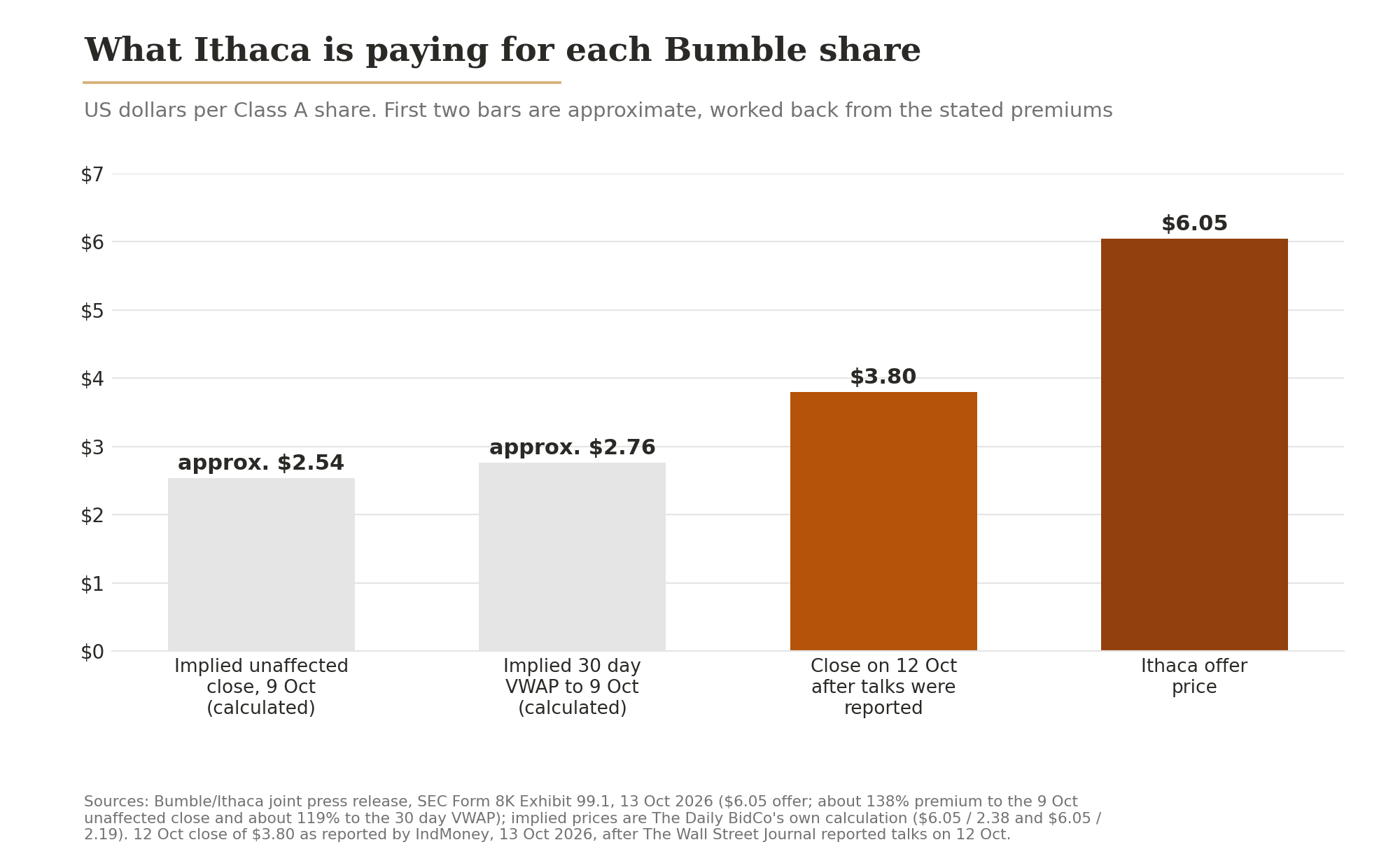
On 13 October 2026, Bumble, the dating app famous for letting women make the first move, announced that it had agreed to be taken private by Ithaca Holdings for $6.05 per share in cash, valuing the company at $1.3bn. That is about 138% above Bumble's closing price on Friday 9 October, the last trading day before news of talks broke. On Monday 12 October, The Wall Street Journal reported that the two sides were in advanced talks, and the shares jumped about 50% to $3.80. On announcement day they climbed again, trading at about $5.94 by mid morning, just under the offer price.
For context, Bumble floated in 2021 at a valuation of roughly $14bn, according to TechCrunch, so this deal values the business at less than a tenth of its debut. It is a good reminder that a huge premium can still mean a painful loss for anyone who bought near the top.
The deal is already approved. Straight after signing, Blackstone affiliates and founder Whitney Wolfe Herd, who together control the vote, approved it by written consent. Public shareholders will not be asked to vote. They will receive an information statement explaining the deal, and the merger cannot close until 20 days after it is mailed.
The Parties
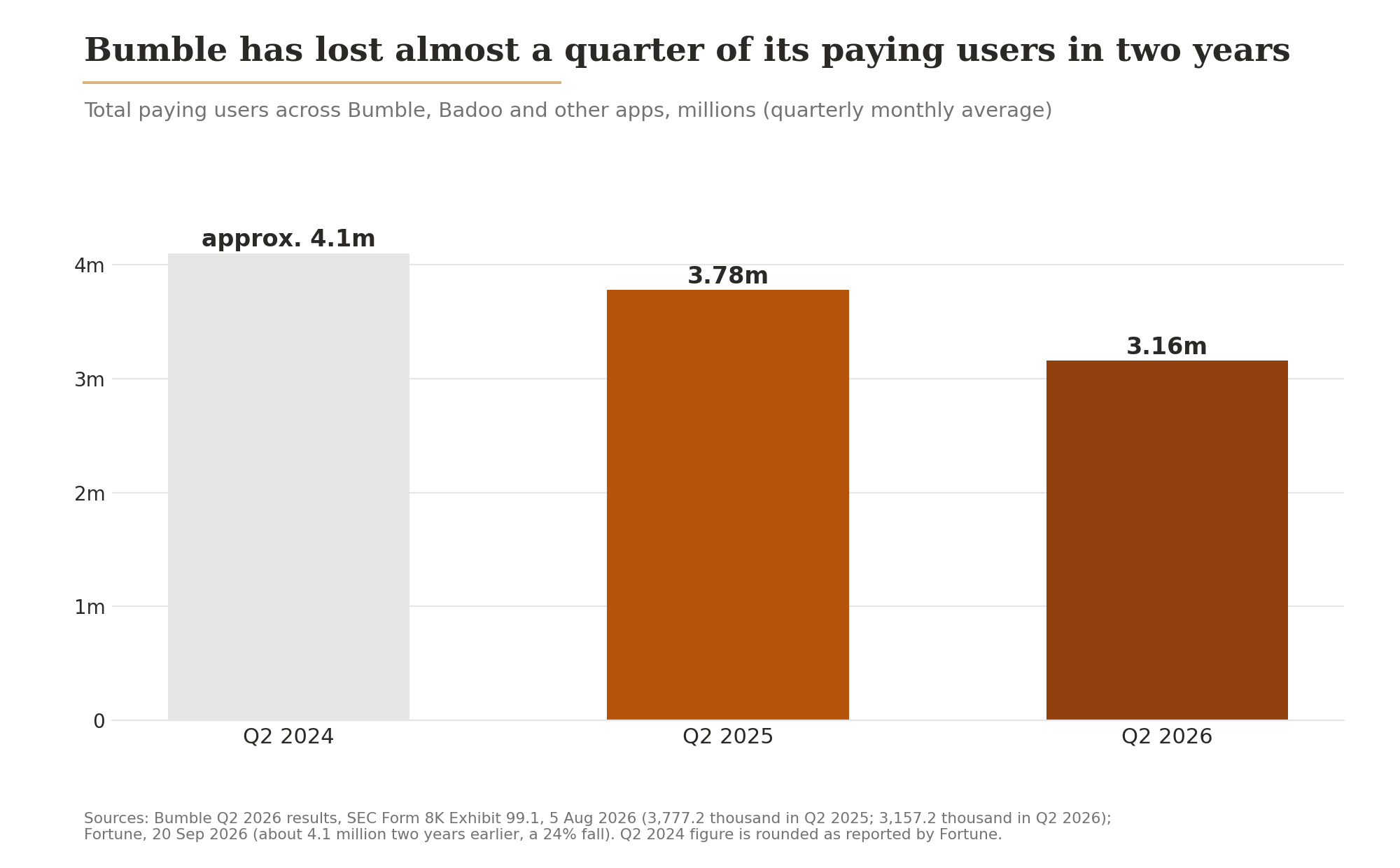
Bumble Inc. is based in Austin, Texas, and owns the Bumble and Badoo dating apps and the BFF friendship app. Wolfe Herd founded it in 2014. The business has been shrinking, as in the second quarter of 2026, revenue fell 15.2% to $210.5m and total paying users fell 16.4% to about 3.16 million. Fortune puts the two year fall in paying users about 24%. Bumble is still profitable on an adjusted EBITDA basis, reporting $72.9m for the quarter, but also booked a $169.3m impairment and had $451m of debt against $154m of cash at 30 June 2026.
Ithaca Holdings describes itself as "a holding company for enduring, market leading technology businesses", with a mission "to apply frontier technology to renew and accelerate businesses" in a world transformed by A.I. It is led by joint chief executives Ravi Gupta and John Hegeman, who will take the same roles at Bumble after closing.
Greenoaks Prime Radiant LP has signed an equity commitment letter (a promise by an investor to fund the buyer with a set amount of equity at closing). The amount has not been published.
Blackstone affiliates are Bumble's long standing controlling investor alongside the founder; Bumble's own filings list "the outsized voting rights of Blackstone and our Founder" as a risk factor. Whitney Wolfe Herd is the founder and chief executive. Through her vehicle Beehive Holdings III, LP she is rolling part of her stake into the buyer's new top company rather than taking cash. The Special Committee, chaired by Bumble's board chair Ann Mather and made up only of independent and disinterested directors, ran the sale process.
Structure & Process
Bumble uses an Up C structure. That means there are two things to buy, so the deal uses two mergers that happen at the same moment.
The Corporate Merger. Oak Merger Sub 1, Inc., an Ithaca subsidiary, merges into Bumble Inc., which survives as a wholly owned subsidiary of Ithaca. Each Class A share becomes the right to $6.05 in cash. Each Class B share, which carries votes but almost no economic value, receives $0.000001.
The Opco Merger. Oak Merger Sub 2, LLC merges into Buzz Holdings L.P., Bumble's operating partnership. Each unit not already owned by Bumble becomes cash equal to $6.05 less the tiny Class B price, so unitholders end up economically level with public shareholders.
Bumble is bound by a no shop clause. Before the written consent was delivered, Bumble could still talk to an unsolicited bidder with a potentially superior proposal. With the consent delivered, that window has effectively closed. Furthermore, closing conditions of the deal include expiry of the waiting period under the Hart Scott Rodino Act, other government clearances, mailing of the information statement plus 20 days, accuracy of warranties, and no material adverse effect on Bumble. Lastly, Because insiders sit on both sides, the parties will file a Schedule 13E3.
The Financing Angle
This is an all cash deal with no financing condition, which means Ithaca must close even if its funding falls through. The filings disclose three building blocks.
New equity. Greenoaks Prime Radiant has signed an equity commitment letter. The amount is set out in the letter but has not been made public.
Founder rollover. Wolfe Herd's vehicle contributes Class A shares to Oak Topco, Inc. in exchange for equity in the new owner, which reduces the cash Ithaca needs and keeps the founder invested.
Advisers. KKR Capital Markets is Ithaca's capital markets adviser, and Kirkland's team includes debt finance lawyers. No debt financing terms have been disclosed.
Law Firms. Kirkland & Ellis are listed as legal counsel for Ithaca Holdings, Davis Polk & Wardwell for the Special Committee, Wachtell, Lipton, Rosen & Katz for Whitney Wolfe Herd, and Simpson Thacher & Bartlett for Blackstone.
The main protection for Bumble is the reverse termination fee of $102m. That is about 7.8% of the $1.3bn headline value, against about 2.2% for Bumble's own $29m fee. Ithaca must also put the $102m into an escrow account by 19 October 2026. Bumble refinanced its term loan in April 2026, and how that debt is treated at closing should appear in the information statement.
Why it Matters
For students, this is a short case study in controlled company take privates, with the Up C double merger, written consent replacing a vote, a special committee building a fair process, a founder rollover and a buyer buying certainty with its own money on the line. Those moving parts recur throughout US public M&A, and UK readers will spot the parallel with irrevocable undertakings, which do a similar job here.
It also says something about the market. AI focused holding companies, here backed by Greenoaks, are now buying struggling consumer apps outright, betting that a well known brand and user base are worth more than public investors think if the product can be rebuilt away from quarterly pressure. Rival Match Group rose only about 2% on the news, suggesting investors read this as a Bumble specific rescue rather than a re rating of the whole sector.
Real World Impact
If you have ever swiped on Bumble, the people who own your matches are about to change. In the short term nothing should look different. The app, your profile and your subscription carry on, and Bumble says it will stay based in Austin with offices in London and New York.
Over time, the new owners say they want to put "frontier technology" at the heart of the app. That could mean AI that suggests better matches, helps you start conversations or spots fake profiles faster. Bumble was already moving away from endless swiping towards meeting in real life, through its Plans app and singles events, and private owners may push that further without worrying about the share price.
There are two ways to read it. Optimistically, fewer but better matches and safer, more in person dating. Less optimistically, more of your data feeding AI systems, and perhaps new paid tiers to earn back the purchase price. Bumble will also stop publishing quarterly results, so the public will see less of how the app is really doing.
Why they did it this way
Why recommended rather than hostile? With Blackstone and the founder controlling the vote, a hostile approach was never realistic, and a buyer needed the controllers on side. In a controlled company the standard route is to negotiate with a special committee of independent directors and then have the controllers sign up. Ann Mather says the committee "thoroughly evaluated all available paths" and concluded the deal "represents the best outcome for our shareholders".
Why a special committee at all? Wolfe Herd is rolling equity into the buyer, so her interests differ from ordinary shareholders', and Blackstone is a controller selling out. When insiders stand on both sides, Delaware courts look hard at whether the process was fair. Handing negotiations to an empowered committee of independent directors with its own bankers and lawyers is the standard way to show a fair process and reduce litigation risk. That explains the committee's separate advisers (Goldman Sachs, Morgan Stanley and Davis Polk) and Wolfe Herd stepping out of the board vote.
Why written consent instead of a meeting? Delaware allows shareholders to act by written consent where the charter permits, and the controllers had the votes. Delivering consent straight after signing removes vote risk immediately and also shuts the window for entertaining a rival offer. The trade off is less say for public holders, which federal securities law balances by requiring an information statement and a 20 day wait before closing.
Why two mergers? In an Up C, value sits partly in the listed company and partly in the operating partnership, so a buyer must acquire both to own the whole business. Merging a subsidiary into each at the same moment is the standard way to collapse an Up C. The token $0.000001 for Class B shares reflects that those shares were always designed to carry votes, not value.
Why a founder rollover? Wolfe Herd says she believes "deeply in Bumble's future" and will "remain actively involved", and Ithaca's leaders say they are grateful for her partnership. Rolling equity keeps a founder's incentives aligned with the new owner and lowers the cash bill; it is a common feature of take privates where the founder stays.
Why no financing condition and an escrowed reverse fee? For a new buyer without a long acquisition record, certainty is part of the price. A deal with no financing condition, backed by an equity commitment and a reverse fee sitting in escrow, gives a special committee the comfort it needs to recommend.
Regulatory conditions and timeline. HSR clearance plus other government approvals is the standard package for a US deal of this size, and the outside date of 12 July 2027 leaves plenty of room. Next come the escrow deposit (by 19 October), the Schedule 14C information statement and Schedule 13E3, the 20 day wait, and closing once regulators have cleared it.