Getty Images Goes Private Through A Prepackaged Chapter 11 Restructuring
Hussain Jeddy · 13 October 2026
Share on LinkedIn- Target
- Getty Images Holdings, Inc.
- Buyer
- Affiliates of both the Getty Family and KED
- Deal value
- Up to $533m of new equity for 100% of the reorganized company.
On 12 October 2026, Getty Images announced a restructuring support agreement with every major group of people it owes money to. The Getty family and Koch Equity Development (KED) will invest up to $533 million of new equity. Holders of 83.5% of Getty's unsecured bonds have agreed to retire $270 million of notes, in return for a fixed cash payment that the RSA sets at $170,212,922.50. Holders of about 89% of the secured bonds and term loans and all of the revolving credit lenders, have agreed to lower interest and longer repayment periods. The plan will be carried out through a prepackaged Chapter 11. The filing will cover only certain US entities. When it is finished, the Getty family and KED will own 100% of the business. Getty's own risk disclosures say that holders of its existing common stock are not expected to receive or keep any property.
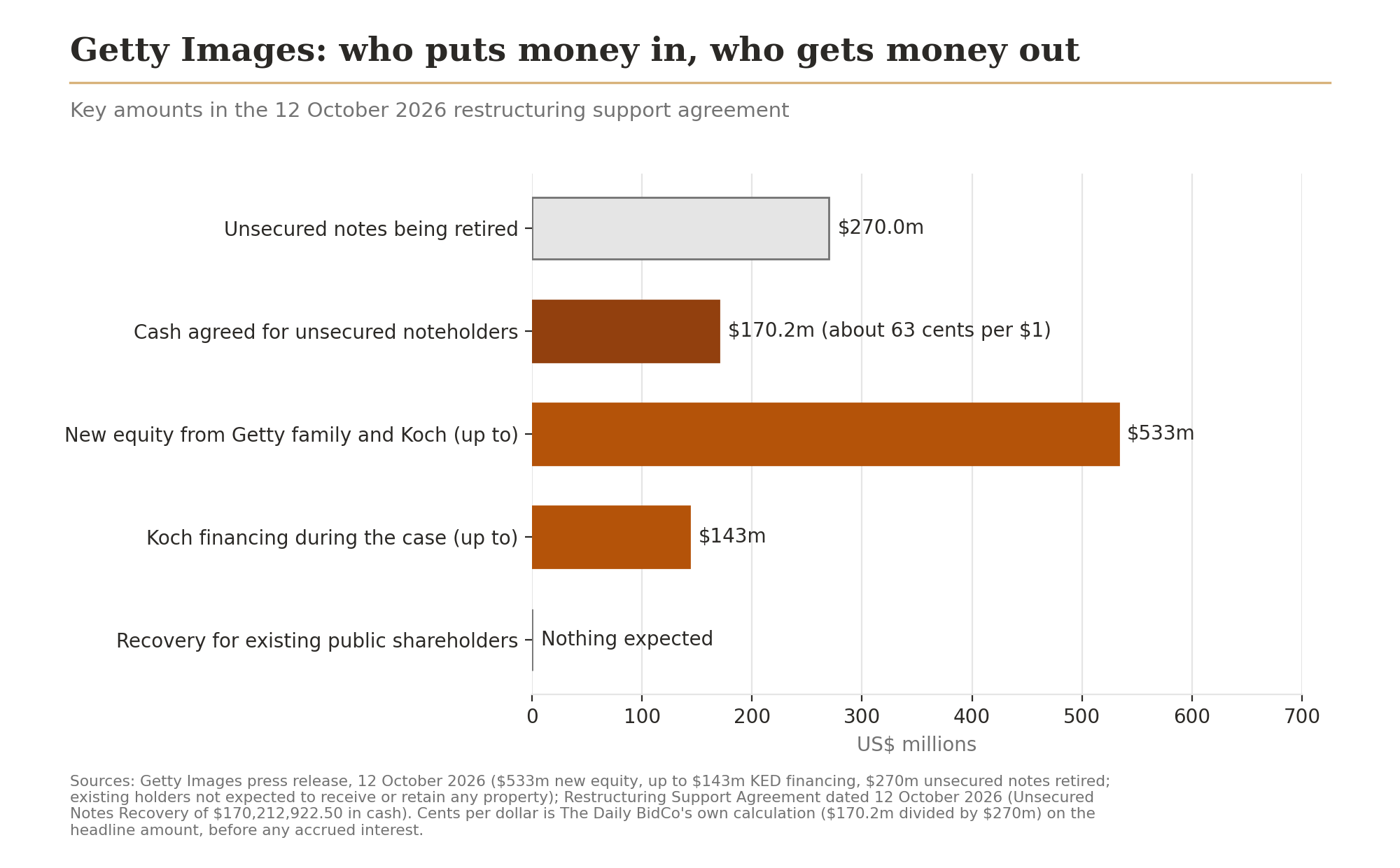
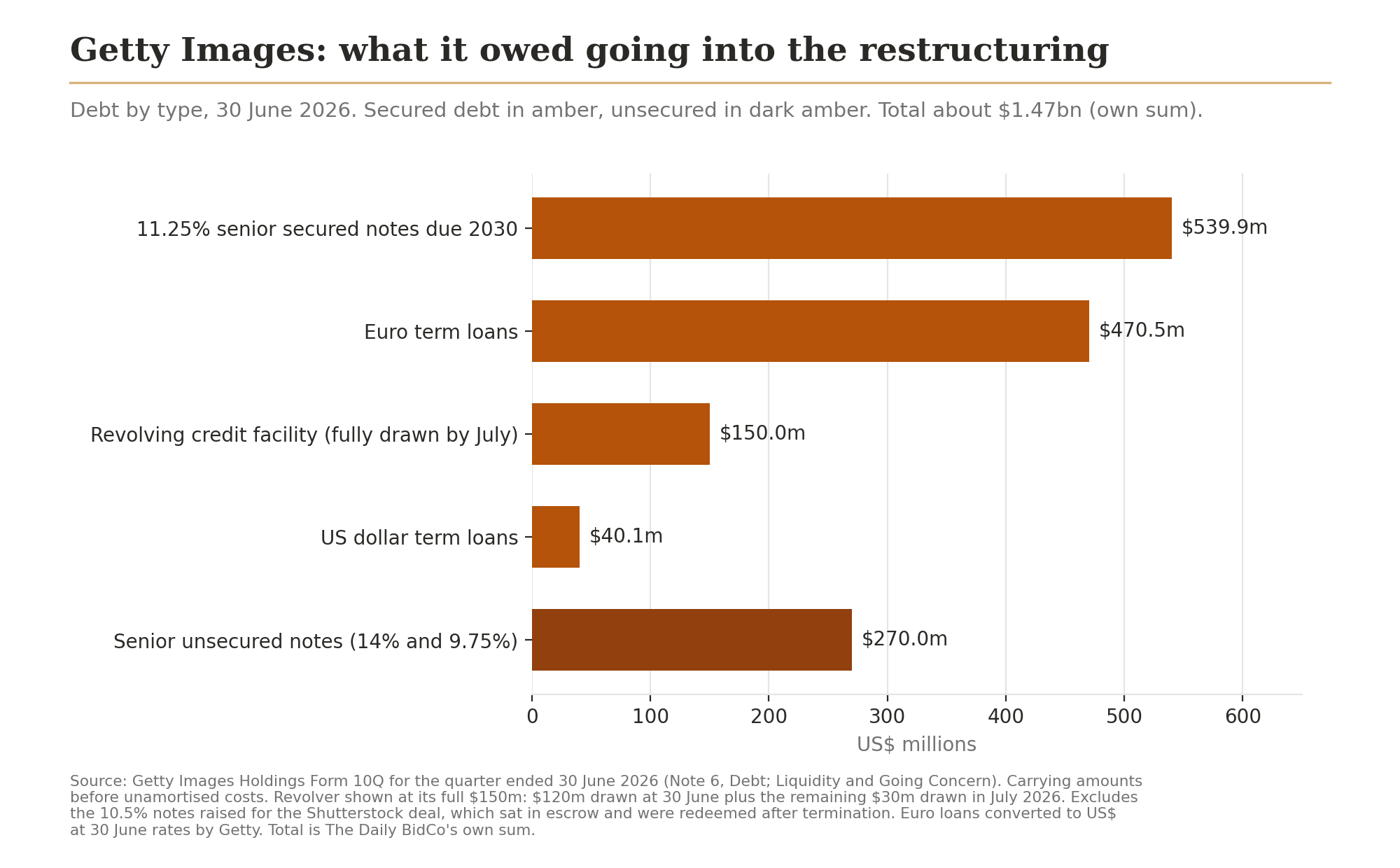
While the headline makes it sound like new money is arriving out of confidence, the documents tell a different story. This is how a company with roughly $1.47 billion of debt, about $51.6 million of cash at 30 June and a 'going concern' warning in its accounts avoids a disorderly collapse. Getty says operations will carry on as normal, with vendors to be paid in full, and it expects no impact on contributors, partners, customers or employees.
The Parties
Getty Images is one of the world's best known suppliers of photos and video, through the Getty Images, iStock, and Unsplash brands. It says it works with more than 600,000 content creators and covers more than 160,000 news, sport, and entertainment events a year. It returned to the stock market in July 2022 by merging with SPAC. Its revenue was $229.1 million in the second quarter of 2026, down from $234.9 million a year earlier.
The Getty family cofounded the business and has stayed involved with every change of owner. Koch Equity Development is the principal investment and acquisition arm of Koch, Inc., one of the largest privately held businesses in America. KED has invested in Getty since 2018. Photo Business News reports that, as of April 2026, the family held about 45.7% of the shares and Koch about 27.5%, according to Getty's SEC filings. So the "new" owners are, in practice, the two largest existing shareholders. The secured lenders (holders of the 11.25% secured notes due 2030, euro and US dollar term loans and the revolving credit facility) and the unsecured noteholders (holders of the 14.00% notes due 2028 and 9.75% notes due 2027) are the other main parties.
Structure & Process
Getty's problems built up over 2026. First came litigation over warrants left over from the SPAC deal. Former holders sued after Getty redeemed the warrants in 2022, and Getty paid $110.9 million in judgements and interest in April 2026. Its 30 June accounts still carried a $99.5 million reserve for the remaining cases. Second, Getty's planned $3.7 billion merger with Shutterstock collapsed. The UK Competition and Markets Authority cleared it on 15 May 2026 only on condition that Shutterstock's global editorial business was sold. Getty's board decided not to go ahead with that sale, and the merger agreement was terminated on 7 July 2026. Getty had already spent about $60.4 million on merger costs by 30 June. The NYSE suspended trading in Getty's shares on 29 September because the price was abnormally low, and they moved to the OTC Pink market the next day.
The restructuring has three steps:
Lock in support (done): The RSA binds the signing creditors and the Equity Investors to vote for and support the plan
Solicit votes before filing: Getty plans to ask for votes on the agreed plan of reorganisation "in the coming days".
File and confirm: Getty then files Chapter 11 for certain US entities "in the coming weeks", and asks the court to confirm the plan quickly. KED's up to $143 million of financing keeps the business running in the meantime.
Two technical points stand out in the RSA. First, all claims linked to the old warrants are treated under section 510(b) of the US Bankruptcy Code. Because shareholders get nothing in this plan, that moves the old warrant litigation, which Getty calls its "non operating legal liabilities", to the back of the queue. Second, on agreement giving Getty Images trademark will be kept "as is" under Section 365 of the Bankruptcy Code. Its rights are expressly reserved. Photo Business News reports that Getty's annual report describes this as a right to acquire trademarks for a nominal sum if an unaffiliated third party takes control of the company.
The Financing Angle
There are three layers of money:
At the top is up to $143 million of interim financing from KED. In US practice, this is called DIP financing. It funds the business during the case.
Next is the exit financing. New senior secured notes, new term loans, and an amended and restated $150 million revolving credit facility, which replace the old secured debt on easier terms.
At the bottom is up to $553 million of new equity from the Getty family and KED, which pays for the cash going to unsecured noteholders and leaves the company with a stronger balance sheet. The split of the $533 million between the family and KED, and the pricing if the KED financing, sit in term sheets attached to the RSA that have not yet been published.
The unsecured noteholders take the only real loss among the lenders. They give up to $270 million of notes for about $170.2 million in cash, roughly 63 cents per dollar. The secured lenders are not cutting what they are owed. Instead they accept a lower return and wait longer to be repaid. Existing public shareholders are wiped out.
Why it Matters
For students, the deal shows that a 'take private' does not always mean a buyer paying a premium. Here, ownership changes through a bankruptcy court. The brings the absolute priority idea to life, as secured lenders are protected, and unsecured lenders take a haircut, and public shareholders and the warrant claimants at the same level are wiped out. Its also shows how a failed merger can cascade. The CMA's condition on the Shutterstock deal led Getty to walk away, and the money already spent on the deal, together with the warrant judgments, helped push the company to this point.
It also fits a wider pattern. S&P Global Market Intelligence counted 372 larger US corporate bankruptcy filings in the first half of 2026, just above the 371 a year earlier and the highest first half total since 2010, according to the CFO Dive. Highly indebted companies with flat revenue are finding that high interest costs leave them little room for mistakes.
Real World Impact
You have almost certainly seen a Getty photo today, either in a news story, a sports report or an advert. Getty says nothing should change for the people who supply or use those pictures, and vendors are to be paid in full. That should mean the photos in your feed stay the same. Photographers and creators may still want to watch how their contracts are treated in the court papers. Getty's statement is a forecast, and the new private owners will decide on future terms.
The bigger picture, as usual, is AI. Getty has been trying to make money from AI on its own terms. It signed a display deal in June 2026 that puts its licensed photos inside ChatGPT, and it has permission to appeal a UK High Court ruling that largely went against it in its copyright case against Stability AI. As a private company, Getty will no longer have to publish detailed annual reports. That could mean less public information about how much creators are paid when their images are used by AI. The opposite could also happen, where a stronger balance sheet might let Getty invest more in licensed AI tools that pay creators.
If you own Getty shares, perhaps through an old trading app position, the company's own disclosures say they are expected to end up worth nothing.
Why they did it this way
Why a court process at all, rather than a private deal with lenders? Getty did not get 100% of any lender group: 83.5% of unsecured bondholders and about 89% of secured lenders signed. An out of court debt exchange only binds the people who agree, so holdouts could keep their original claims and demand full payment. In Chapter 11, a class of creditors accepts a plan if holders of at least two thirds of the amount, and more than half of the number, of the claims voting in that class vote yes. Once that happens, the plan binds the whole class, including the minority who said no. With support at these levels, Getty can use Chapter 11 to bind the remaining holdouts.
Why "prepackaged"? A normal Chapter 11 case can run for many months while the company negotiates in court. That damages customer confidence and runs up large fees. Collecting votes before the filing means the court mainly has to check that the process was fair and that the plan meets the legal tests. Getty says it expects to finish "by year end", and the RSA builds in an outside date 150 days after it took effect. For a brand that depends on media customers and hundreds of thousands of contributors, a short case is the standard way to limit disruption.
Why only certain US entities? Chapter 11 is needed only where the debt and the legal problems sit. Filing only the US entities keeps Getty's international operating companies out of court. That is the usual approach for a global business, because it avoids separate insolvency proceedings in other countries and keeps local contracts and staff unaffected. Getty says vendors will be paid in full in the ordinary course.
Why Delaware? The RSA names the US Bankruptcy Court for the District of Delaware (or another agreed venue). Getty Images Holdings is a Delaware corporation, and Delaware's bankruptcy judges have a long record with large prepackaged cases, so it is a common choice for this kind of filing.
Why does the plan deal with the warrant claims this way? Getty says the process will "address the Company's non operating legal liabilities". The RSA treats warrant related claims as section 510(b) claims, ranking with shareholders. Inside a plan where shareholders receive nothing, that is the mechanism that takes the remaining warrant judgments off the business going forward. The secured and unsecured lenders have also agreed not to object to any settlement with warrant holders that does not reduce their own recoveries.
Why are the family and Koch the buyers, not the lenders? In many restructurings, lenders swap their debt for ownership. Here, the existing major shareholders are putting in fresh equity instead. Mark Getty says the deal is "underpinned by the strength of the business and the significant growth potential we see ahead", and KED's Mike Harris says KED "remain[s] confident in the company's future". Owners who already know the business and are willing to provide new cash give lenders a quicker, more certain outcome than taking the keys themselves. The RSA also keeps the family's trademark option agreement in place unchanged. Photo Business News argues this made a lender takeover less attractive. The RSA itself does not say why the lenders agreed.
Why a management incentive plan? Reserving up to 10% of the new equity for management is standard in Chapter 11 reorganizations. It replaces share awards that are cancelled with the old equity, and it gives the team running the business a stake in the reorganized company. The terms are left to the new board after emergence.
Timeline. Signed RSA (12 October); vote solicitation (days); Chapter 11 filing (weeks); confirmation and emergence (target: year end 2026); outside date about 150 days after the RSA took effect.