Why Accel-KKR Is Taking a Growing Software Company Private: The £207.6m Eleco Deal
Karan Murthi · 11 October 2026
Share on LinkedIn- Target
- Eleco plc
- Buyer
- Avocet Bidco Limited, backed by Accel-KKR
- Deal value
- £207.6 million
- Price/share
- 235p
The Deal
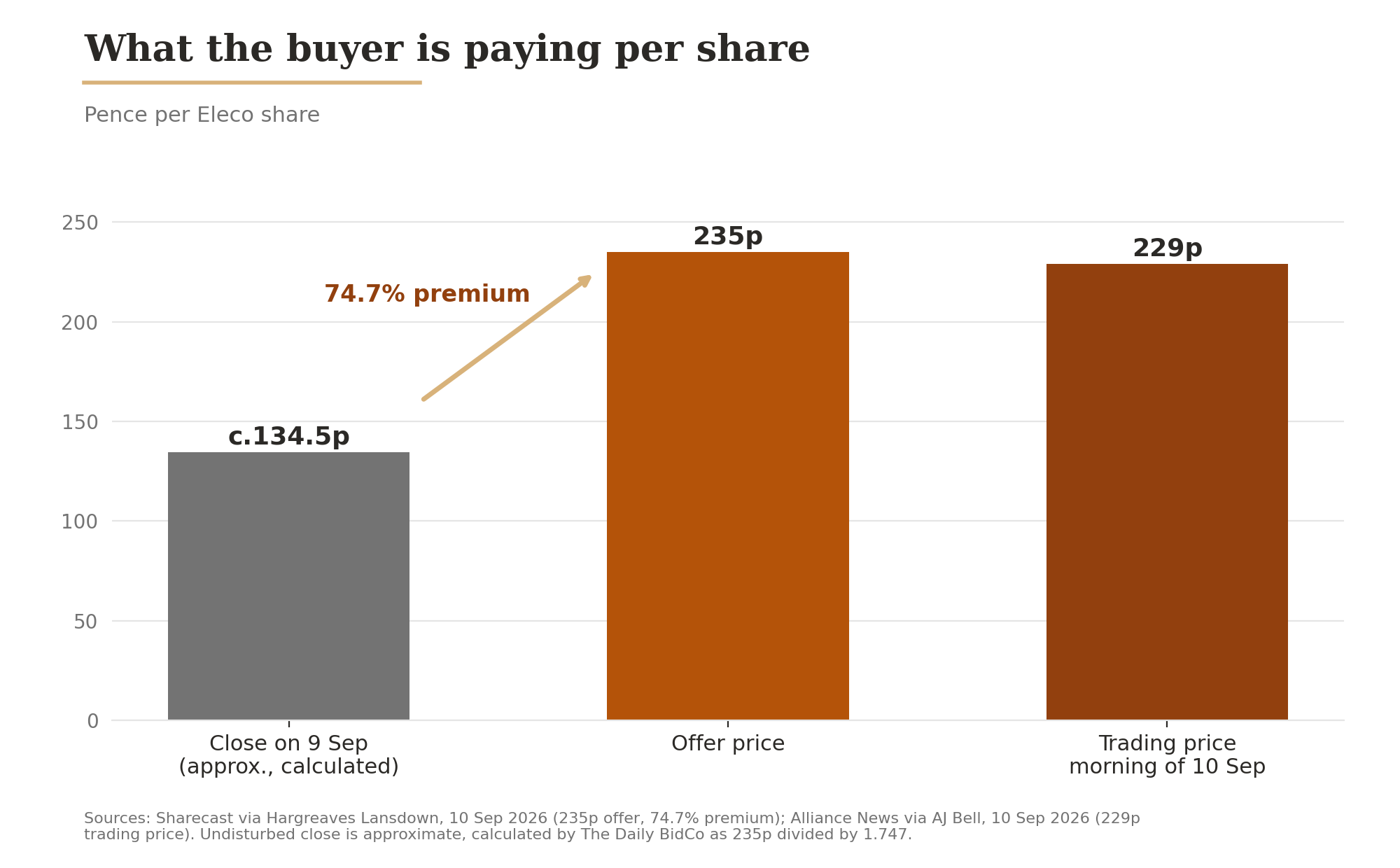
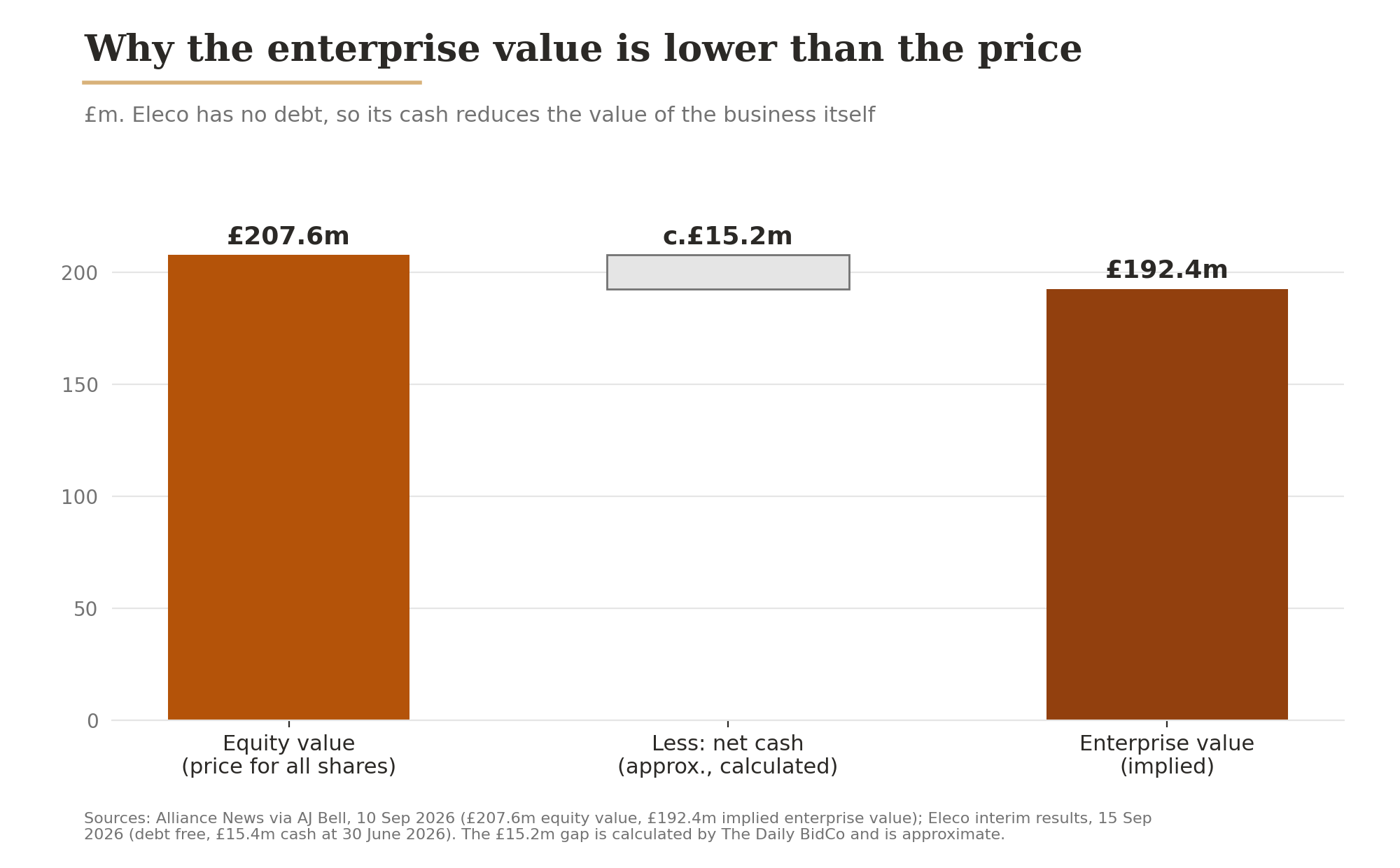
On 10 September 2026, technology-focused private equity investor Accel-KKR announced a recommended all-cash acquisition of UK-listed software company Eleco plc through Avocet Bidco Limited, valuing its fully diluted equity at approximately £207.6 million. Shareholders will receive 235p per share, representing a 74.7% premium to Eleco's closing share price on 9 September.
The interesting question is why a growing, profitable software company would choose private equity ownership rather than continue independently.
The Parties
The Buyer: Accel-KKR
Accel-KKR is a technology-focused private equity investor specialising in software and technology-enabled businesses. Its strategy involves supporting portfolio companies through operational improvements, product development and acquisitions.
The Target: Eleco
Eleco provides software used across the building lifecycle, including project management, design and asset management.
The business was performing strongly before the proposed acquisition. In the first half of 2026, annualised recurring revenue increased 16% to approximately £35.5 million, while recurring revenue represented 85% of total revenue. Eleco also remained debt-free.
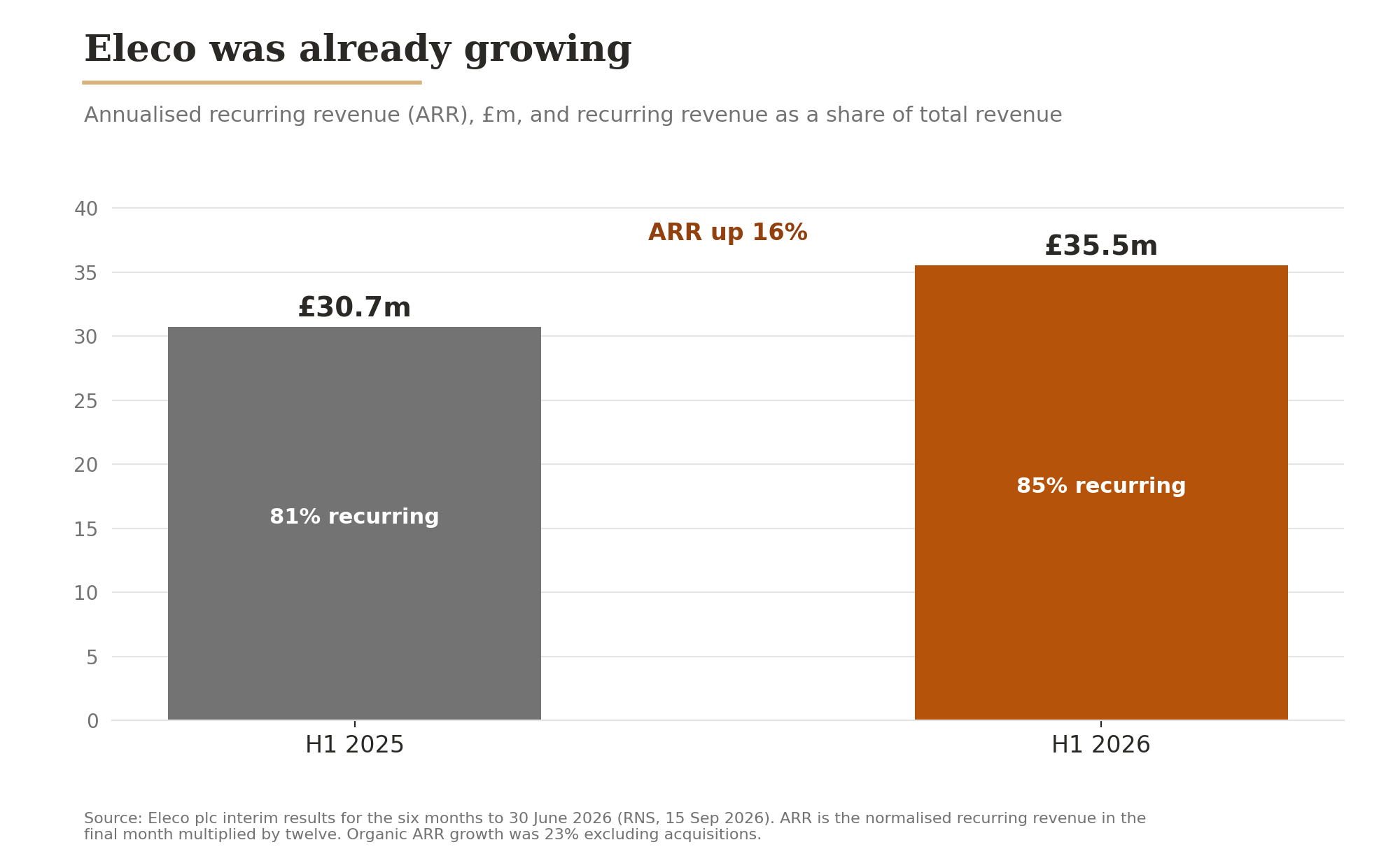
These figures matter because subscription-based revenue provides greater visibility over future income, potentially making the business attractive to a financial sponsor seeking predictable cash flows alongside opportunities for growth.
Structure & Process
The acquisition is a Public-to-private transaction implemented through a court-sanctioned Scheme of arrangement under Part 26 of the Companies Act 2006.
Unlike a conventional Takeover offer, where shareholders individually decide whether to accept the bidder's offer, a scheme requires approval at shareholder meetings and subsequent court sanction. Once effective, it binds the relevant shareholders and enables the buyer to acquire the entire share capital.
The transaction is governed by the UK Takeover Code, with the Takeover Panel overseeing compliance. The scheme also requires satisfaction of applicable conditions, including relevant regulatory approvals.
A key attraction of this structure is transaction certainty. Accel-KKR's investment strategy depends on obtaining full ownership rather than being left with a minority of shareholders outside its control.
Completion is anticipated by the first quarter of 2027, subject to the necessary approvals and conditions.
The Financing Angle
The acquisition announcement confirms that the cash consideration payable to Eleco shareholders will be financed through equity invested by Accel-KKR funds.
Rothschild & Co, acting as financial adviser to Accel-KKR and Bidco, confirmed that sufficient resources were available to satisfy the cash consideration in full.
This provides the seller and its shareholders with assurance that the buyer can fund the acquisition, an important requirement in a recommended cash takeover.
No acquisition lenders or debt-financing package were identified in the announcement. Accordingly, the transaction should not automatically be described as a debt-funded Leveraged buyout.
The announced financing arrangement is noteworthy because private equity acquisitions are often associated with substantial borrowing. Here, the disclosed funding commitment is equity-based, although the precise capital structure following completion remains a separate question.
Why It Matters
Private equity ownership does not necessarily signal underperformance.
The most interesting feature of this transaction is that Eleco was already growing. Accel-KKR's investment thesis therefore centres on accelerating an existing strategy rather than rescuing a struggling company.
Eleco's next phase requires increasingly intensive investment in artificial intelligence, cloud technology, product development and acquisitions. These initiatives offer opportunities for growth but involve substantial upfront expenditure, execution risks and potentially lengthy periods before returns materialise.
Accel-KKR believes its capital and specialist experience in scaling software businesses can support that transition.
This raises a wider commercial question: why might a successful public company benefit from becoming privately owned?
Private ownership may give management and investors greater flexibility to pursue a multi-year investment strategy without the same pressures associated with public-market valuations and shareholder expectations. However, those potential advantages must be weighed against the costs and risks of concentrated ownership.
Shareholders face a different calculation.
The 235p offer provides a substantial premium and allows shareholders to realise their investment immediately.
Rejecting the offer would preserve their exposure to Eleco's future growth, but they would also retain the risks associated with delivering its investment programme.
This is particularly significant because Eleco's shares traded on AIM, where limited liquidity can make it difficult for larger shareholders to sell substantial holdings without affecting the market price.
The transaction therefore presents a trade-off between certain value today and potentially greater but uncertain value tomorrow.
Wider industry significance
The acquisition also reflects growing investor interest in software serving traditional industries such as construction.
As construction businesses increasingly adopt digital project management and AI-enabled tools, software providers with established customer relationships and recurring revenues may become attractive acquisition targets.
For Eleco's customers, accelerated investment could ultimately produce better integrated software, improved project management and more efficient construction workflows. Those outcomes remain potential benefits rather than guaranteed consequences of the takeover.
Ultimately, the deal illustrates how private equity can create value through investment in technology and operational expansion, not merely through restructuring or cost reduction.
Legal and Commercial Considerations
Shareholder approval and deal certainty
Because the acquisition uses a scheme of arrangement, shareholder voting and court approval are central to completion. Lawyers must manage the statutory timetable, disclosure obligations and conditions while maintaining transaction certainty.
Due diligence
Accel-KKR must assess whether Eleco's recurring revenues are sustainable and whether its software, intellectual property, customer contracts and acquisition pipeline support the investment thesis.
Regulatory considerations
Kirkland's advisory team includes corporate and antitrust lawyers, reflecting the need to consider competition and regulatory issues alongside transaction execution. The presence of antitrust advisers does not itself establish that a particular merger clearance is required.
Real-World Impact
Eleco's software supports businesses involved in designing, constructing and managing buildings.
If Accel-KKR successfully accelerates investment in AI and cloud technology, customers could benefit from improved project management, better information sharing and more efficient construction workflows.
However, the benefits are not guaranteed. Faster expansion could also involve product changes, integration challenges and adjustments to pricing or services.
Ultimately, the transaction demonstrates how private equity investment can influence not only ownership and shareholder returns, but also the technology available to businesses and their customers.
The central lesson is that private equity ownership need not signal that a company has failed. Sometimes, the investment case is that an already successful business could grow faster under a different ownership structure.
Law Firm Contacts
Buyer: Accel-KKR / Avocet Bidco Limited
Legal adviser: Kirkland & Ellis
Corporate team: Carlos Gil Rivas, Chris Connolly, Sherlin Wong, Raphael Khoo and Lucy Parton
Antitrust team: Philipp Gnatzy and Aleksandra Katolik
Financial adviser: Rothschild & Co
Target: Eleco plc
Legal adviser: Dorsey & Whitney
Lead financial adviser and Rule 3 adviser: Stephens Europe
Nominated adviser, broker and financial adviser: Cavendish Capital Markets
The involvement of corporate and antitrust specialists on the buyer's side illustrates how even a relatively modest public-to-private acquisition can require coordination between transactional and regulatory expertise.
Why they did it this way
A take-private rather than a minority investment: Full ownership would give Accel-KKR greater control over Eleco's investment priorities and strategic direction. This may be particularly valuable where the investment thesis depends on accelerating product development and acquisitions.
A scheme rather than a conventional takeover offer: A court-sanctioned scheme offers a defined process for obtaining complete ownership once the requisite shareholder and court approvals are secured.
An all-cash offer: Cash gives existing shareholders certainty over the consideration they will receive, avoiding exposure to the future value of shares in the acquiring business.
A substantial takeover premium: The 74.7% premium helps compensate shareholders for surrendering potential future upside and provides a commercial incentive to support the transaction.
Specialist private equity ownership: Accel-KKR's experience in software investment may allow Eleco to pursue its existing strategy with additional capital and operational expertise.
The central lesson is that private equity ownership need not signal that a company has failed. Sometimes, the investment case is that an already successful business could grow faster under a different ownership structure.