Devon Energy to sell Eagle Ford business to Crescent Energy for $4.2bn cash
Hussain Jeddy · 10 October 2026
Share on LinkedIn- Target
- Devon Energy's Eagle Ford oil and gas assets
- Buyer
- Crescent Energy Company (NYSE: CRGY), backed by KKR
- Deal value
- $4.2bn total consideration in cash
- Price/share
- About $56,600 per barrel of oil equivalent per day on the net price
On 8 October 2026, Devon Energy agreed to sell its entire Eagle Ford business in South Texas to Crescent Energy for $4.2bn in cash. The package is about 90,000 net acres across Karnes, DeWitt and Gonzales Counties, producing roughly 68,000 barrels of oil equivalent per day (a standard measure that converts gas into its oil energy equivalent so different fuels can be added together). It also includes more than 600 Tier 1 drilling locations (the industry's term for the best remaining spots to drill new wells). Devon says the assets are about 4% of its total production. Bloomberg reports the output is roughly 60% oil.
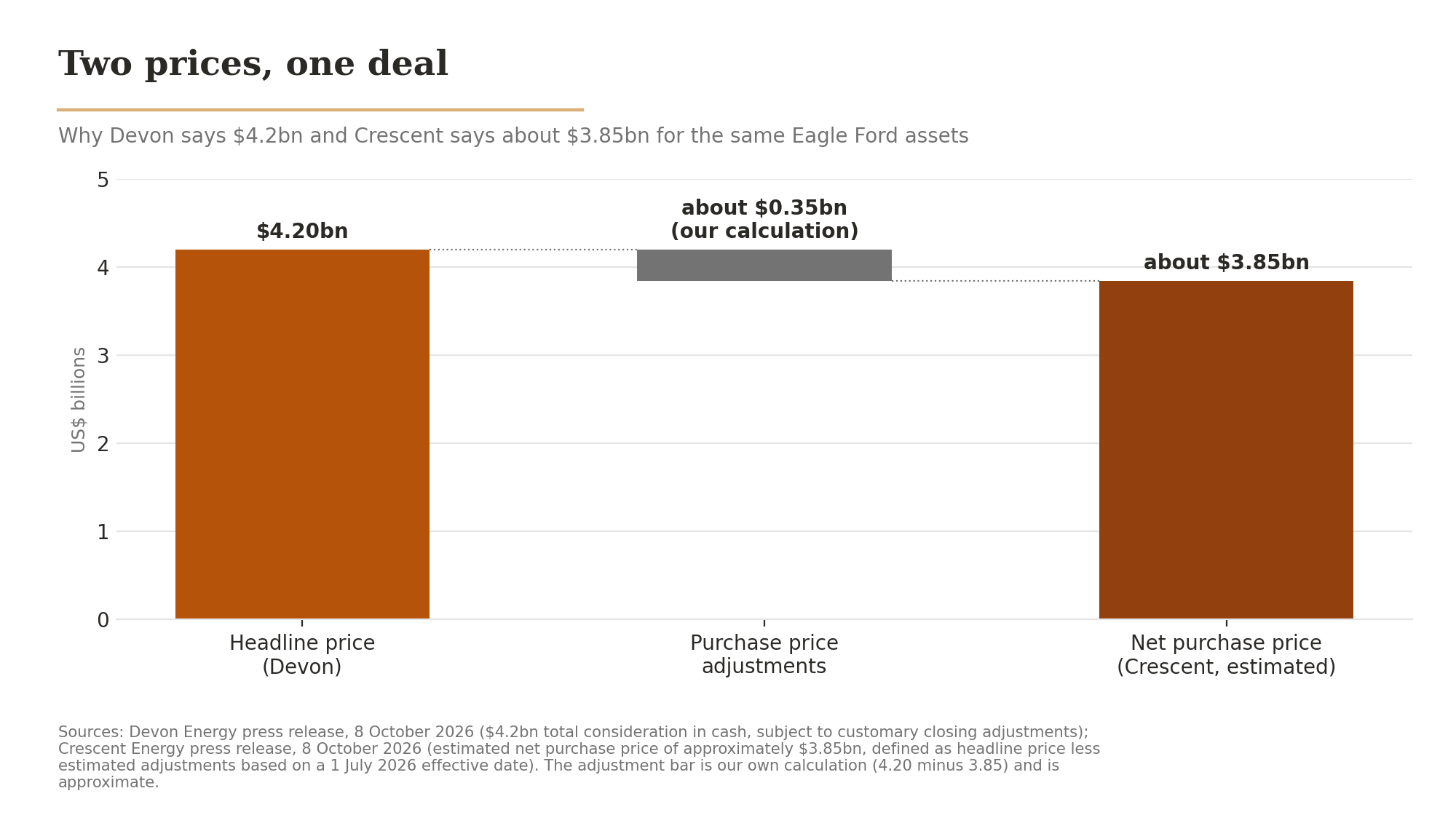
Devon calls the sale "a direct outcome of our ongoing portfolio review" and says the price was "above our internal hold case", meaning above what Devon thought the assets were worth if it simply kept them. Crescent's chief executive, David Rockecharlie, says the deal adds "high quality assets at an attractive valuation in the heart of one of our core operating areas". The two companies quote different prices for the same deal. Devon uses the $4.2bn headline figure, and Crescent uses an estimated net price of about $3.85bn. The gap is explained under Structure & Process below.
The Parties
Devon Energy is one of the largest US oil and gas producers, with a market value of about $53bn according to Bloomberg. Its core business is in the Permian Basin of West Texas and New Mexico. In May 2026 it completed a merger with Coterra Energy worth about $25bn (Bloomberg; Enverus values it at $25.4bn), and since then it has been reviewing every part of its portfolio. Bloomberg reports that activist investors, including Kimmeridge Energy Management, have been pushing Devon to sell assets outside the Permian faster, or to sell itself. Kimmeridge called the Crescent sale "a positive step".
Crescent Energy is a Houston based producer with a market value of about $4.5bn (Bloomberg), focused on the Eagle Ford, Permian and Uinta basins, with a separate minerals and royalties business. It describes its strategy as "growth through acquisition", which in practice means buying assets from larger companies and running them more cheaply. KKR is a long standing backer, with a KKR affiliate already holding about 7.9% of Crescent's Class A shares before this deal. Crescent already operates right next to the Devon acreage and owns mineral rights underneath some of it, which it says gives it "differentiated insight" into what it is buying.
Structure & Process
This is an asset purchase, as Crescent is buying specific property (oil and gas leases, wells and related equipment) from Devon Energy Production Company, L.P., a Devon subsidiary. It is not buying shares in a company. That is the main difference from most deals in The Daily BidCo. In a share purchase, the buyer acquires the company itself, along with all its history and liabilities. In an asset purchase, the buyer chooses which assets and liabilities it takes on, as set out in the contract.
The pricing mechanism follows from that. The deal has an effective date of 1 July 2026, the date from which the economic benefit of the assets is treated as passing to the buyer, even though legal ownership only transfers at closing. Between July and closing, Devon keeps running the wells and collecting the oil revenue. Purchase price adjustments then settle that gap: broadly, the seller credits the buyer with the net cash the assets earned after the effective date. Crescent defines its roughly $3.85bn net purchase price as the headline price "less estimated purchase price adjustments, including, among other things, allocations of certain revenues and expenses based on a July 1, 2026 effective date". By our own calculation, the expected adjustments come to roughly $0.35bn. The final number will only be known after closing.
No shareholder vote is needed on either side. The main legal condition is the Hart Scott Rodino waiting period: under US antitrust law, larger deals must be notified to the Federal Trade Commission and the Department of Justice, and cannot close until a waiting period expires or is ended early. Both companies expect closing in Q4 2026 or early 2027.
The Financing Angle
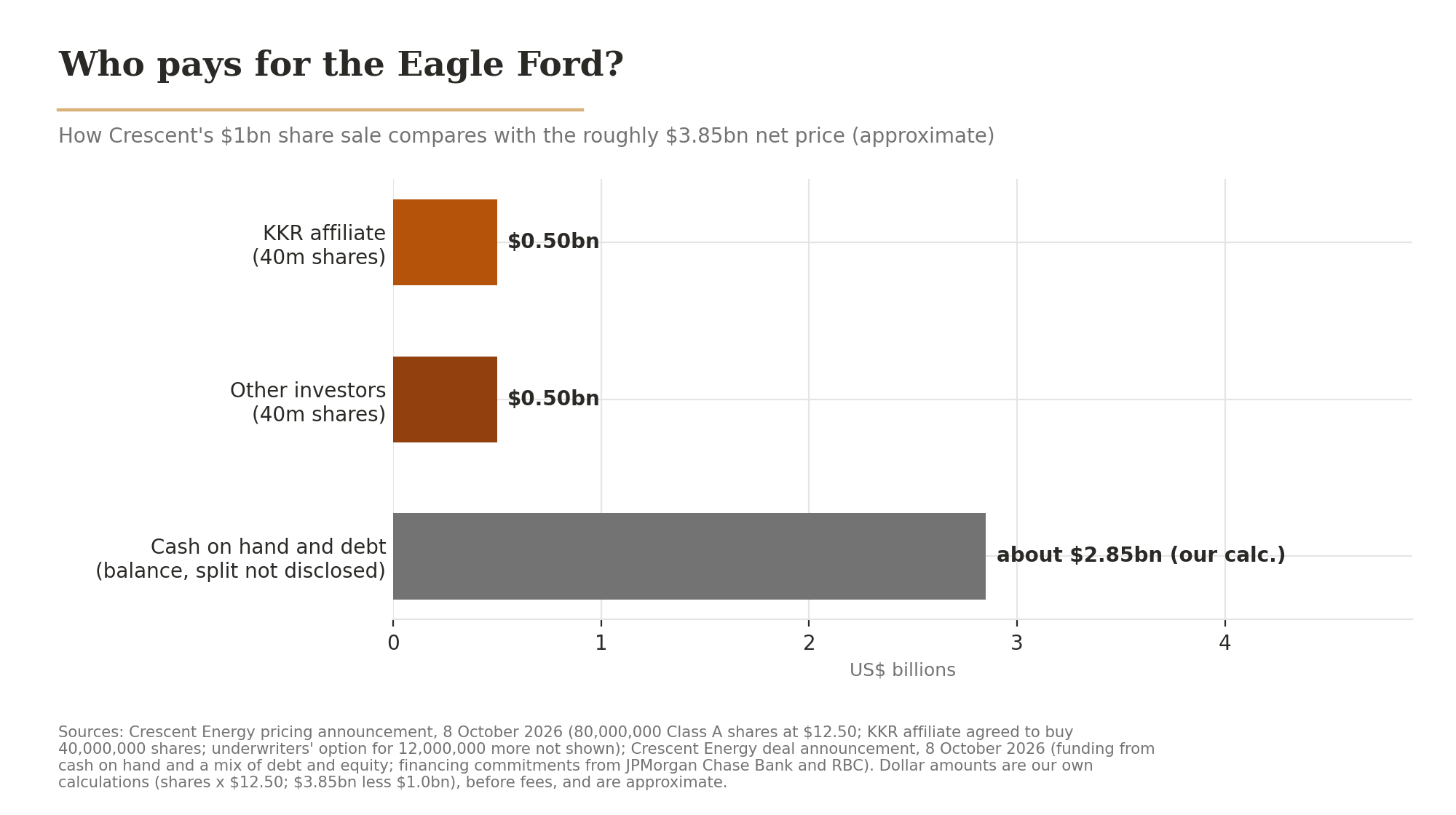
Crescent is paying cash, and it has assembled that cash from three sources. First, it obtained debt financing commitments from JPMorgan Chase Bank and RBC Capital Markets, with KKR Capital Markets advising on the financing. These are effectively a bank's promise to lend if needed, so the seller knows the buyer can pay. Second, it will use cash on hand. Third, on the same day as the announcement, it launched and priced a public share offering: 80 million new Class A shares at $12.50 each, which works out at $1.0bn before fees (our calculation). The underwriters also have a 30 day option to buy up to 12 million more shares.
Two details stand out. The KKR affiliate, Independence Energy Aggregator, agreed to buy 40 million of the 80 million shares, so the existing anchor investor is putting in about half the new equity ($0.5bn, our calculation). And the offering is not contingent on the acquisition: if the Devon deal fails, Crescent keeps the money and says it will use it for general purposes, including repaying subsidiary debt. The offering was made off a shelf registration, which Crescent filed on 8 October and which became effective on filing. The offering is expected to close on 13 October. Selling new shares dilutes existing holders (each existing share becomes a smaller slice of the company), and Bloomberg reports Crescent's shares fell as much as 7% before the market opened on the announcement day.
Why it Matters
For students, this is a good case study of an asset purchase, which most UK public M&A coverage never shows you. It has an effective date, purchase price adjustments, a deal that needs antitrust clearance but no shareholder vote, and a buyer that funds itself through a same day equity raise. The two headline prices are also a reminder to read the definitions in a press release before repeating a number.
For the market, the deal fits a clear pattern. Enverus reports that US upstream deal value hit $38bn in Q1 2026, two thirds of it from Devon's Coterra merger, then fell to $9.1bn in Q2 as oil price swings made deals harder to price. Enverus also flagged Eagle Ford inventory as "catching a bid" after Magnolia Oil & Gas paid just over $4bn for WildFire Energy, and it expected busier dealmaking in the second half of 2026. Bloomberg describes producers selling smaller, non core assets to cut debt after a consolidation wave worth hundreds of billions of dollars since 2023. Devon selling to a specialist buyer like Crescent follows this pattern, where big companies concentrate on their best basin, and focused buyers pick up the rest.
Real World Impact
If own a petrol or diesel powered car, the honest answer is that this deal is unlikely to move the price you pay. The same wells keep producing whoever owns them, and petrol prices are set by global crude markets. Those markets are high right now, with AAA reporting a US national average of $4.36 a gallon on 8 October, a record for the time of year, with crude back above $90 a barrel.
Where it could matter is closer to home for some people. Thousands of landowners in South Texas receive royalties from these wells. A new operator that drills more could mean bigger cheques; one that cuts costs aggressively could mean fewer local contracts and jobs. Both are possible, and it is worth seeing what Crescent does in 2027. If you have a pension or index fund, you may own a sliver of Devon, Crescent or KKR. Devon plans to use the proceeds for share buybacks and debt reduction, which some investors favour and others see as money that is not going into new production. The bigger picture is that when oil is expensive, there is political pressure for more supply. This deal is about who owns supply, not how much there is.
Why they did it this way
Agreed sale, not a contested bid: This was a negotiated sale between a willing seller and a willing buyer. Hostile tactics do not really exist for a sale like this as you cannot launch a takeover bid for a set of oil wells, because there are no shareholders of the assets to appeal to. The seller decides whether to sell. Devon says the sale came out of its portfolio review, and Bloomberg reports that activist investors had been pushing for exactly this kind of disposal. A bilateral sale of a defined asset package is the standard way a large producer trims its portfolio.
Asset purchase rather than buying a company: Devon's Eagle Ford business sat inside a larger Devon subsidiary alongside other operations. Selling the properties directly lets Devon hand over exactly what it wants to sell, and lets Crescent avoid inheriting unrelated liabilities. This is how most US onshore oil and gas divestitures are done. The asset form also explains why there is no shareholder vote. At about 4% of Devon's production, the sale is far below the "all or substantially all assets" threshold at which US corporate law, including Delaware law, normally requires shareholder approval. For Crescent, buying assets for cash does not trigger a vote either.
Effective date and price adjustments: Oil fields earn money every day, and asset deals in this sector can take months to close. Fixing the economics at an earlier effective date, then adjusting the cash at closing, means neither side gains or loses from timing. It also allows the price to be agreed on a clean, known production base (Crescent cites July 2026 production). That is why the two press releases quote different numbers, and why the final figure will only be known after closing.
Funding with cash, committed debt and new shares: Crescent's market value (about $4.5bn) is similar in size to the purchase price, so it needed outside money. Committed bank financing gives Devon certainty that the buyer can pay. Raising equity at the same time keeps Crescent's borrowing in check: Crescent says the "balanced financing structure" supports "continued progress toward an investment grade credit profile". Having the anchor shareholder, KKR, commit to half the offering signals support from an insider and reduces the risk of the raise. Making the raise not conditional on the deal is a common way to get the money in quickly while investor appetite is there.