Wittington Investments sign definitive agreement to acquire Boots from The Boots Group for $8.9bn
Hussain Jeddy · 8 October 2026
Share on LinkedIn- Target
- Boots
- Buyer
- Wittington Investments, Limited
- Deal value
- $8.9bn
On 7 October 2026, Wittington Investments, the private holding company of Canada's Weston family, signed a definitive agreement to buy Boots from The Boots Group. The total purchase consideration is US$8.9bn including assumed debt. What Wittinton is buying is precisely defined as Boots' retail operations in the UK and Ireland, Boots Opticians, the No7 Beauty Company, and Boots' Thailand and franchised businesses. The Boots Group's other two businesses, Farmacias Benavides in Mexico and the German pharmaceutical wholesaler Alliance Healthcare Deutschland, stay with Sycamore Partners and the Pessina family.
Wittington is not buying alone. Fairfax Financial, the Toronto holding company run by Prem Watsa, has signed an equity commitment letter for up to about $2.3bn, and expects to own 50% of Boots' equity after closing. Wittington keeps operational control, and Galen Weston, Wittington's chairman, will become chair of Boots. The deal needs certain regulatory approvals and is expected to close in the first quarter of 2027.
The Parties
The Buyer: Wittington Investments is the holding company of the Canadian Weston family. Through George Weston Limited it controls Loblaw, Canada's largest grocery retailer with more than 2,800 locations, which owns Shoppers Drug Mart, Canada's largest pharmacy, health and beauty business. It also controls Choice Properties, Canada's largest REIT. Wittington has history in Britain. It owned Selfridges from 2003 to 2021. The British branch of the Weston family is separate and controls Associated British Foods, the owner of Primark.
The Partner: Fairfax Financial is a Toronto based holding company whose subsidiaries are mainly property and casualty insurers and reinsurers, together with their investment management. Its retail investments include Sleep Country, which owns Simba Sleep in the UK. Insurers hold large pools of long term capital built up from premiums, which is one reason they can act as patient equity partners.
The Target: Boots traces its history back more than 177 years and, according to the Wittington release, employs more than 50,000 colleagues, with around 1,800 shops. Private Equity Wire, summarising an FT report, says Boots' revenue rose 3.2% to £7.5bn in the year to August 2025, with pre tax profit up about 25% to £337m, partly reflecting the reversal of impairment charges. Alex Baldock remains CEO.
The Sellers: Sycamore Partners is a New York PE firm founded in 2011, with about $14bn of assets under management, specialising in consumer and retail. It took Walgreens Boots Alliance private in 2025 and then made Boots a standalone company. Stefano Pessina, who bought the chain in 2007 according to the Canadian Press and later led Walgreens Boots Alliance, kept a stake with his family.
Structure & Process
This is a private M&A deal. Because neither Boots nor The Boots Group is listed in the UK, the Takeover Code does not apply. There is no scheme of arrangement, no shareholder vote, and no court hearing. Instead, the terms sit in a privately negotiated sale agreement, and the deal completes once its conditions precedent are satisfied.
It is also a carve out. The Boots Group is splitting itself in two: the UK, Irish, opticians, beauty brand, Thai and franchise business go to Wittington, while the Mexican and German businesses stay behind. The parties have not said whether Wittington is buying shares in the companies that run these business or the underlying assets. In large carve outs of this kind, buyers usually acquire the shares of the holding companies that sit above the relevant businesses, because that moves contracts, employees, and licences across in one step instead of transferring each one individually.
The timeline runs from signing on 7 October 2026 to expected completion in Q1 2027. The hap exists to obtain "certain regulatory approvals", which the releases do not list. For a UK target of this size, the usual candidates are UK merger control by the Competition and Markets Authority, equivalent review in Ireland, and possibly a check under the National Security and Investment Act 2021. Which, if any, apply here is not yet public.
The Financing Angle
Three sources of money sit behind the $8.9bn price:
Fairfax equity. Fairfax has committed up to about $2.3bn under its equity commitment letter, for an expected 50% of Boots' equity.
Wittington equity. Wittington's own cheque is not disclosed.
Debt. The price includes assumed debt, and CIBC and Morgan Stanley Senior Funding are lead arrangers providing new acquisition financing. The amount and terms are not disclosed.
A rough calculation suggests that if Wittington put in roughly the same as Fairfax for an equal equity stake total equity would be up to about $4.6bn, leaving about $4.3bn of the $8.9bn to come from assumed and new debt. Keep in mind, however, Fairfax's figure is a cap, and equity stakes do not always mirror the cash each partner contributes.
The equity letter is also worth noticing. Sellers want certainty that a buyer can actually pay at completion. A binding commitment from a large and established balance sheet like Fairfax's, combined with committed bank financing, gives that comfort and certainty of funds is part of what a seller weight when choosing between bidders.
Why it Matters
The deal is a good example of three things that come up repeatedly in private M&A:
A carve out from a larger group
A two investor consortium where control and economics are split differently
And a private equity exit sale to a long term strategic owner
It also shows a full deal life cycle in motion: Boots' parent was taken private in 2025, Boots was separated into a standalone company, and it is now being sold on.
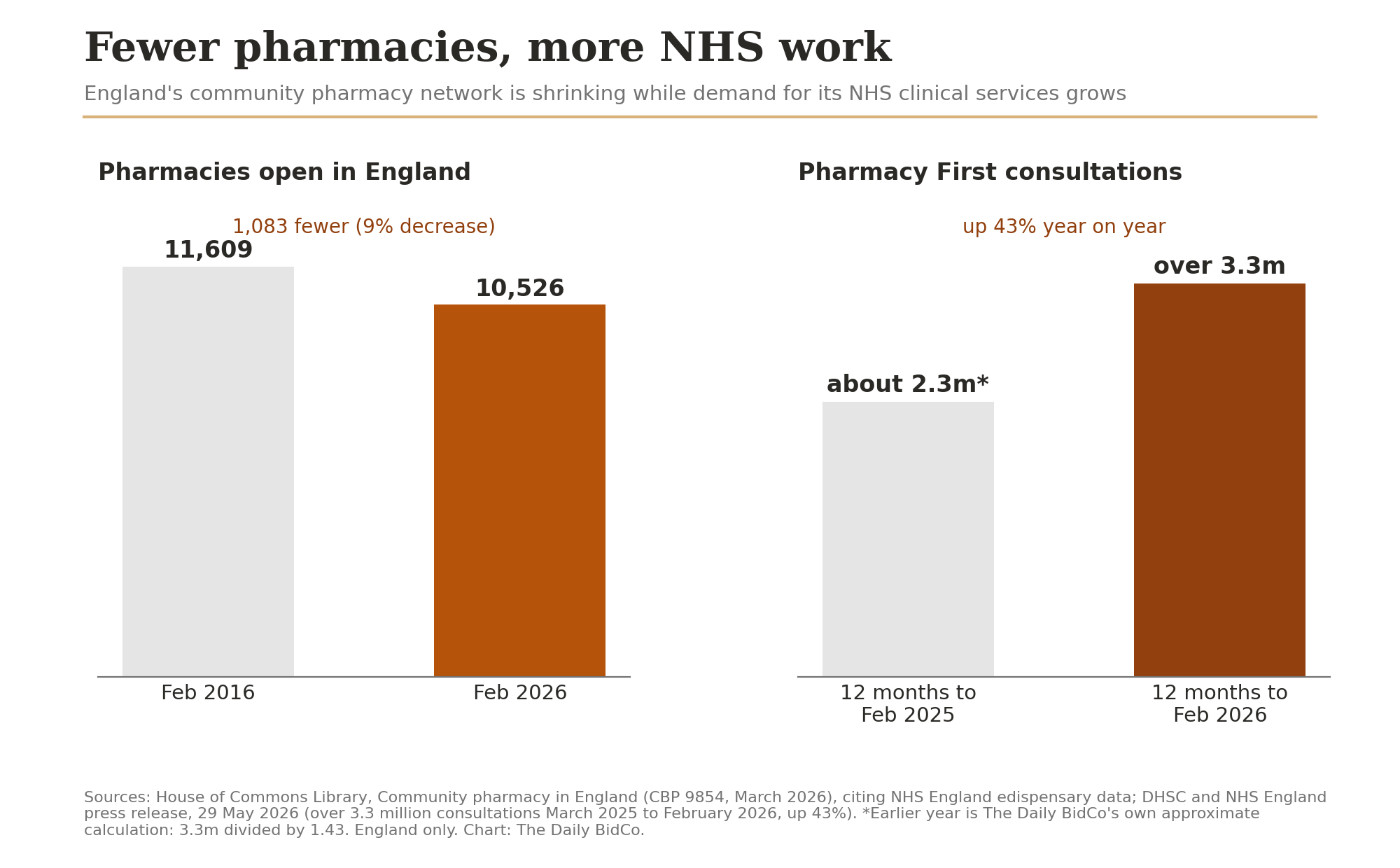
For the market, it tests the broader idea that family holding companies and long term investors are competing with private equity for large consumer assets. And it lands in a sector under pressure. The House of Commons Library reports that England had 10,526 pharmacies in February 2026, 1,083 fewer than in February 2016, while DHSC says more than 3.3 million Pharmacy First consultations were delivered in the year to February 2026, up 43%.
Real World Impact
If you have ever picked up a prescription, a meal deal or a No7 serum, this deal could reach you. Boots is the pharmacy many people turn to when the GP is booked up, and the government is pushing more NHS care into pharmacies, and from autumn 2026, pharmacists with an independent prescribing qualification can assess patients and prescribe medicines directly, on top of the Pharmacy First service for common conditions like sore throats and urinary tract infections.
New owners promising further capital investment could mean nicer stores, better online ordering and more consultation rooms. That is the hopeful reading. The cautious one is that the deal is partly funded with debt, and debt has to be repaid, so cost cutting and store reviews remain possible. National Pharmacy Association analysis finds that pharmacy closures have already hit deprived areas hardest. Nothing has been announced about stores or prices, so whether your local Boots changes is something to watch, not something to assume.
Why they did it this way
A negotiated private sale rather than a public bid: Boots has been privately owned since Sycamore's take private of its former parent, so the only route to buying it was a deal with Sycamore and the Pessina family. Private Equity Wire reports that Boots had been on and off the market since 2022 and that earlier private capital bids failed to meet the seller's expectations. A private sale lets the seller negotiate price, warranties and risk allocation directly with one preferred buyer, without the disclosure and timetable rules that apply to public bids.
Selling Boots but keeping Mexico and Germany: Sycamore's Stefan Kaluzny says that making Boots a standalone company a year ago let its management team "focus solely on their business and customers". Private equity owners often sell a group in pieces when separate buyers value each piece more highly than anyone values the whole. Here the UK and Irish pharmacy and beauty business suits a buyer whose core expertise, according to the Wittington release, is pharmacy led retail, while a Mexican pharmacy chain and a German wholesaler are very different businesses.
Why the Westons: The Wittington release says the Weston group brings deep expertise in pharmacy led retail through Shoppers Drug Mart, and that it plans to upgrade stores, improve the online experience and expand healthcare services. Galen Weston speaks of stable long term ownership, further capital investment and renewed operating focus. Retail analyst Neil Saunders of GlobalData, quoted by The Canadian Press, contrasts that ownership style with "the private equity approach".
A 50/50 equity split with control left to Wittington: Fairfax says it is "very confident that Wittington will be an excellent steward of the Boots business", and Galen Weston says Fairfax shares "our conviction in Boots' future". Splitting equity this way is a common consortium structure: it halves the capital each partner must commit, while a shareholders' agreement (the contract between co owners that sets out who controls what) gives one party day to day control. Those governance terms have not been published.
Committed bank debt plus equity: Large private acquisitions are normally funded with a mix of equity and debt, because debt is cheaper capital and lets the owners commit less of their own money. Having banks act as lead arrangers from signing gives the seller certainty that the funds will be there at completion.
A Q1 2027 completion date: A gap of several months between signing and closing is standard in deals that need regulatory clearance, because completion cannot happen until each required approval is in hand.