CD&R and McKesson take Option Care Health private for about $5.8bn
Hussain Jeddy · 7 October 2026
Share on LinkedIn- Target
- Option Care Health, Inc. (Nasdaq: OPCH)
- Buyer
- Onyx Bidco LLC
- Deal value
- About $5.8bn EV
- Price/share
- $32.05 per share in cash
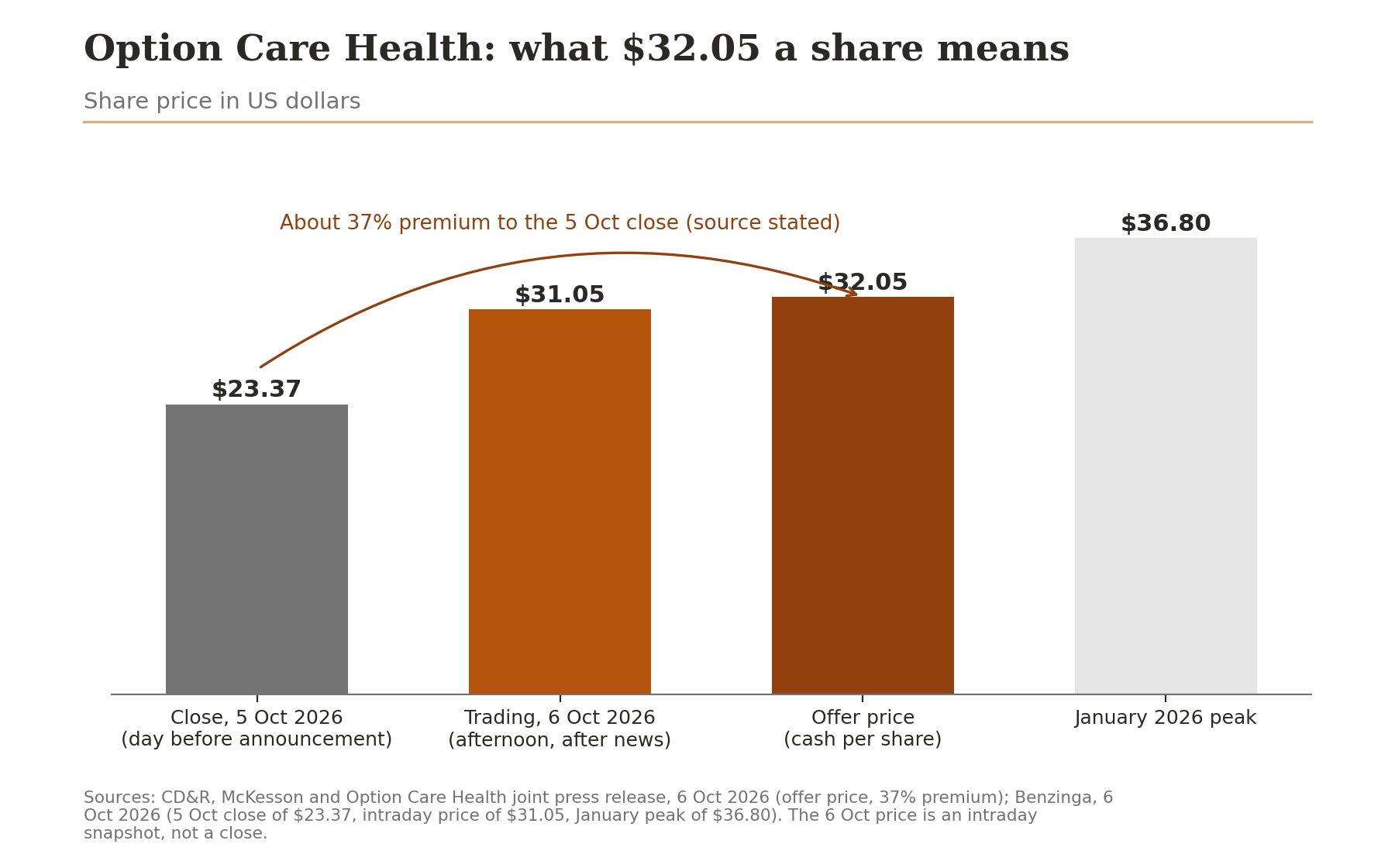
On 6 October 2026, Option Care Health announced that it had agreed to be bought by an investor group made up of the private equity firm Clayton, Dubilier & Rice (CD&R) and McKesson, one of the largest healthcare distributors in the United States. Shareholders will receive $32.05 in cash for every share they own. That values the business at about $5.8 billion including debt, and represents a premium of roughly 37% to the closing share price on 5 October, which Benzinga reports as $23.37.
The market reaction has been significant. By the afternoon of 6 October the shares were trading at about $31.05, roughly $1 below the offer price, on volume that Benzinga put at about 22 times the normal daily average. That small gap is the merger arbitrage spread. A thin spread signals that the market thinks the deal is likely to close, just not quickly. There is a sting in the tail for some long term holder. Benzinga notes the offer is still about 13% below the stock's January 2026 peak of $36.80, after the shares fell 29% in a single week in late April.
The Parties
Option Care Health describes itself as the largest independent provider of home and alternate site infusion services (giving medicines through a drip or injection at a patient's home or in a local infusion suite rather than in a hospital). It operates in all 50 states, employs more than 8,000 people including over 5,000 clinicians, and, according to Fierce Healthcare, cares for more than 308,000 patients a year. Fierce reports 2025 net revenue of more than $5.6 billion and net income of $207.6 million. It is headquartered in Bannockburn, Illinois, and led by chief executive John Rademacher.
Clayton, Dubilier & Rice is a private investment firm founded in 1978, with offices in New York and London. It invests across industrials, healthcare, consumer, technology and financial services, and describes its approach as combining investment experience with "deep operating capabilities". The equity cheque here comes from Clayton, Dubilier & Rice Fund XII, L.P., according to the 8 K.
McKesson Corporation (NYSE: MCK) is a diversified healthcare services company, best known as one of America's largest drug distributors. Fierce Healthcare reports that its oncology and multispecialty unit generated $48.4 billion of revenue in 2025. In this deal McKesson acts as a strategic investor (a trading company buying into a business in its own sector, as opposed to a financial investor like a private equity fund).
Structure & Process
Legally, this is a reverse triangular merger under Delaware law (the buyer creates a shell subsidiary, here Onyx Merger Sub, Inc., which merges into the target; the target survives and becomes a wholly owned subsidiary of the buyer's holding company, here Onyx Bidco LLC). At the effective time (the moment the merger legally takes effect), every Option Care share is cancelled and converted into the right to receive $32.05 in cash. Options, restricted stock units, performance units and some 2017 warrants are cashed out on set formulas described in the 8 K.
Option Care's board approved the deal unanimously and will recommend that shareholders vote for it. Under the Delaware General Corporation Law (DGCL), the merger needs the approval of holders of a majority of all outstanding shares, not just a majority of those who turn up to vote. Shareholders who vote against can instead seek appraisal rights under section 262 of the DGCL (a right to ask the Delaware Court of Chancery to set the "fair value" of their shares and pay that instead of the deal price).
Closing also needs the expiry of the waiting period under the Hart Scott Rodino Act (the US pre merger notification regime that gives the antitrust agencies time to review deals before they close), plus certain state healthcare regulatory approvals. The parties must use "reasonable best efforts" on antitrust and the buyer must use "best efforts" on the healthcare filings. If the deal has not closed by 11:59pm New York time on 5 October 2027 (the outside date, the deadline after which either side can walk away), either party can terminate.
The agreement contains a no shop clause (a promise by the target not to solicit or encourage rival bids). As is standard in Delaware, it has a fiduciary out (an exception allowing the board to engage with an unsolicited superior proposal, or change its recommendation, where failing to do so would breach its legal duties to shareholders), subject to matching rights (the buyer's right to be told about a rival offer and to improve its own terms first).
The Financing Angle
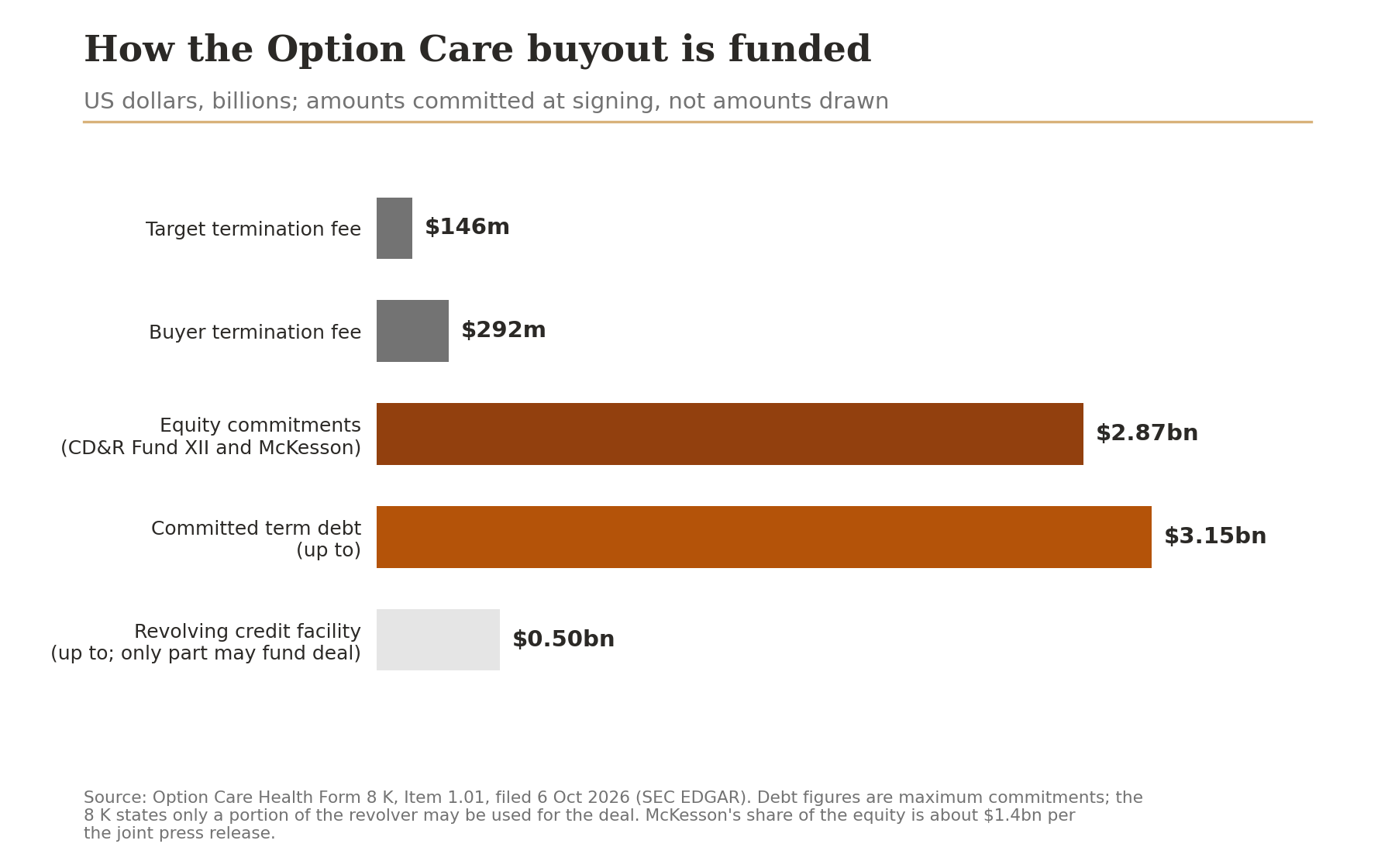
This is a classic leveraged buyout (an acquisition funded partly with borrowed money that is ultimately secured on the target's own business) with a twist: one of the equity investors is a strategic buyer. According to the 8 K, CD&R Fund XII and McKesson have signed equity commitment letters (binding promises to put a set amount of equity into the buyer) totalling $2,873,295,853. The joint press release says McKesson's share is about $1.4 billion. On the debt side, lenders have committed up to $3.15 billion of loans, which will also refinance Option Care's existing debt, plus up to $500 million of revolving credit (a flexible borrowing line that can be drawn, repaid and drawn again), part of which may be used for the deal. The five banks advising the consortium are also the lenders.
Crucially, the deal has no financing condition (the buyer cannot refuse to complete just because the loans fall through). Instead, the target is protected in two ways. First, CD&R Fund XII and McKesson have each given a guarantee, "severally and not jointly" (each liable only for its own share, not for the other's), covering certain buyer obligations. Second, if the buyer breaches or fails to close when it should, it owes a reverse termination fee (a break fee paid by the buyer rather than the target) of $291,927,951. That is exactly twice the $145,963,976 target termination fee Option Care would pay if it walked away for a better offer or its board changed its recommendation. The target termination fee works out at about 2.5% of the $5.8 billion enterprise value, which sits within the range Delaware courts have generally accepted.
Why it Matters
For a student, this is a strong case study in the anatomy of a US take private. A Delaware reverse triangular merger, a majority of outstanding shares vote, appraisal rights, a no shop with a fiduciary out, and a two tier termination fee structure where the buyer's fee is double the target's. It also shows a less common hybrid, a private equity firm and a corporate buyer co investing, with a built in route for the corporate to take over later. That combination blurs the usual line between "strategic" and "financial" buyers.
For the market, it is another sign that investors are betting on care moving out of hospitals and into homes and local clinics. McKesson explicitly links the deal to "specialty, rare and orphan therapies" whose delivery is "increasingly complex". It is also a reminder that public markets do not always reward these businesses: the board accepted a price below the share price earlier in the year, and some shareholders who bought at the top may feel short changed even with a 37% premium.
Real World Impact
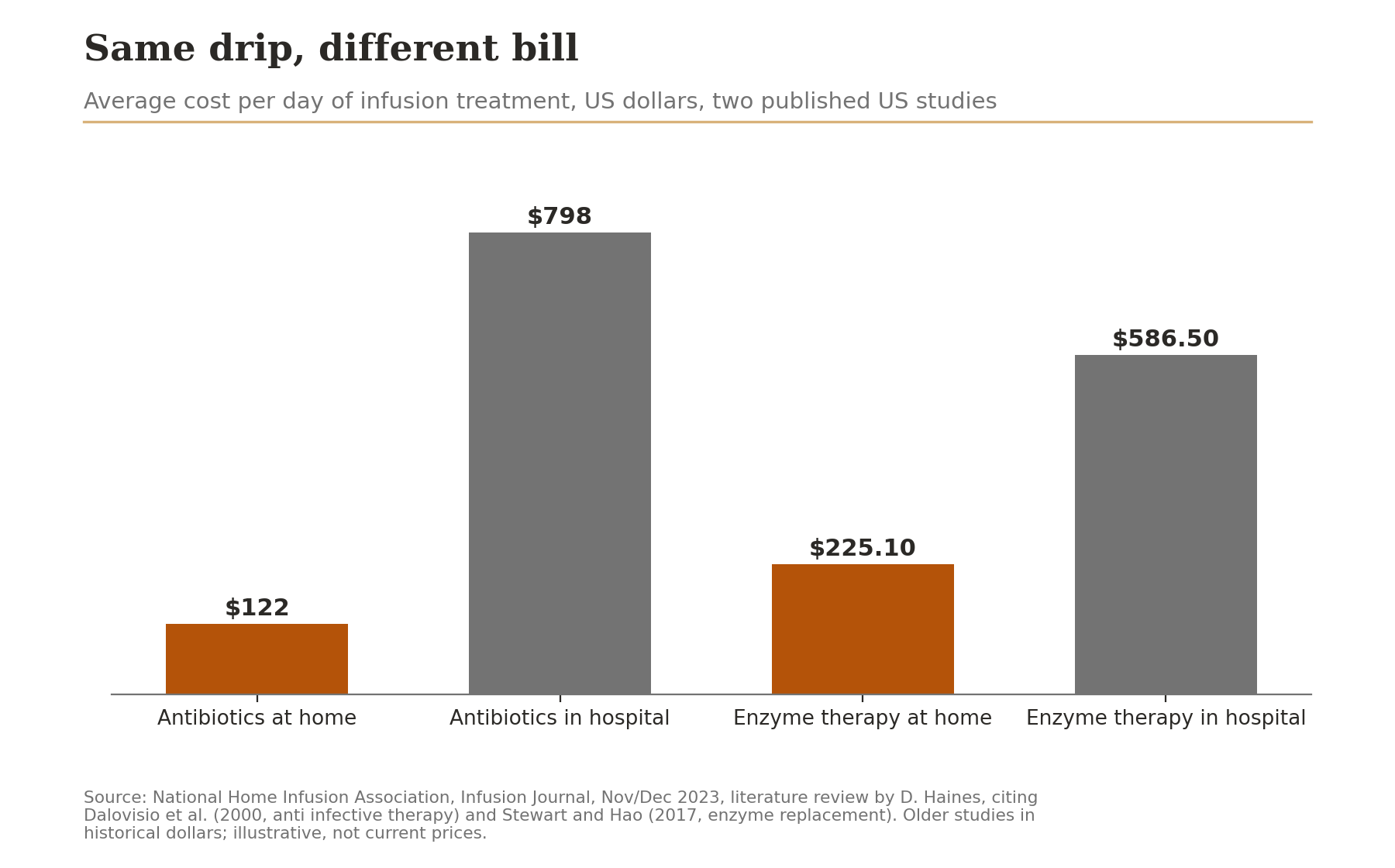
If you or someone in your family has ever needed a long course of IV antibiotics, or regular infusions for a condition like Crohn's disease or multiple sclerosis, the question of whether that happens on a hospital ward or on your own sofa matters a lot, both for comfort and for cost. A 2023 review published by the National Home Infusion Association found studies where home infusion of antibiotics cost about $122 a day against $798 a day in hospital. Those are older studies in historical dollars, but the direction is clear.
What could change for patients? On the upside, more capital and McKesson's drug supply expertise might mean more patients being offered home treatment, faster rollout of new specialty drugs, and more local infusion suites. On the downside, it is worth watching whether a drug distributor having a stake in the company that delivers the drugs creates pressure on pricing, or on which drugs patients are steered towards, and whether a business carrying more debt cuts costs in ways patients notice. None of this is certain; regulators reviewing the deal will be asking similar questions.
Why they did it this way
Why recommended, not hostile? The board says it "completed an extensive assessment, involving thorough discussions with our advisors, and unanimously concluded this transaction maximises value for our stockholders" (Chairman Harry Kraemer). For a US listed company, a negotiated deal with board support is the normal route for a private equity buyer, as it gives access to due diligence, a merger agreement with tailored protections, and a single shareholder vote rather than a costly tender fight.
Why a one step merger with a vote? For a Delaware target, a cash merger approved by a majority of the outstanding shares is the standard way to acquire 100% in a single stroke. Once the vote passes, every share converts into cash, including those held by shareholders who voted against, so there is no rump of minority holders to deal with afterwards. Where a deal needs antitrust and state healthcare clearances that will take months anyway, there is little to gain from the faster tender offer route, so the long form merger is the natural choice.
Why the 51/49 split and the path to full ownership? McKesson's chief executive Brian Tyler says the investment "aligns with McKesson's long term strategy to expand access and affordability to innovative therapies across the care continuum", and that McKesson wants to support care "in lower cost community settings, at or closer to home". CD&R partner Sarah Kim points to CD&R's "deep experience in healthcare services". In structures like this, a financial sponsor holding the majority while a strategic partner takes a large minority with an option to buy the rest lets the strategic buyer share the upfront cost and risk, and learn the business, before committing to full ownership. McKesson says it will account for its stake using the equity method (recording its share of the investee's profit or loss as one line, rather than consolidating the investee's full revenues and debts onto its own balance sheet), which keeps the new acquisition debt off McKesson's own accounts for now. Any future buyout of CD&R's stake is expressly subject to "specified conditions and regulatory approvals".
Why leverage plus committed equity? Funding roughly half the price with debt (about 52% debt to 48% equity on the committed figures, my calculation, ignoring the revolver) is typical of a private equity buyout of a cash generative business. The certainty package of equity commitment letters, guarantees, a reverse termination fee and no financing condition is what a target board will usually insist on before it recommends a leveraged bid, because it shifts the risk of the debt markets onto the buyers.
Why regulatory conditions and the timeline? A healthcare distributor taking an indirect stake in a large infusion provider is exactly the kind of vertical relationship antitrust agencies look at, and healthcare businesses also hold state licences that require consent to a change of control. That explains both the HSR condition and the separate state healthcare approvals, and why the parties have given themselves a full year, to 5 October 2027, as the outside date, with completion expected in the first half of 2027.