C.H. Robinson to acquire RXO for $5.8bn
Hussain Jeddy · 6 October 2026
Share on LinkedIn- Target
- RXO, Inc. (NYSE: RXO)
- Buyer
- C.H. Robinson Worldwide, Inc. (Nasdaq: CHRW)
- Deal value
- Combined EV $25bn
- Price/share
- $17.25 cash plus 0.0856 C.H. Robinson shares per RXO share
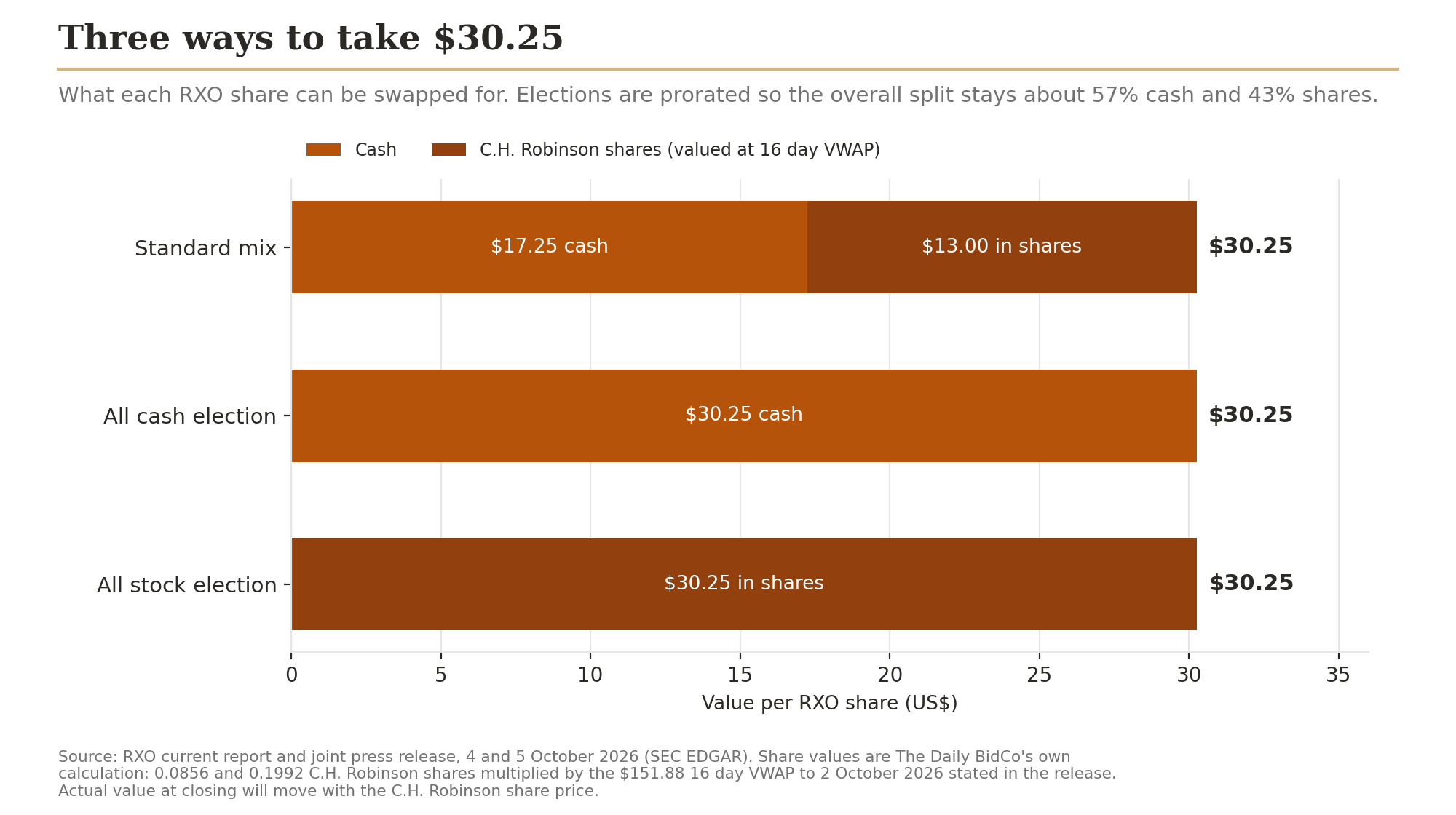
On 4 October 2026, C.H Robinson signed an agreement to buy RXO, and the two companies announced it the next morning. For every RXO share, investors will by default receive $17.25 in cash plus 0.0856 of a C.H Robinson share. Using C.H. Robinson's average share price over the 16 trading days to 2 October ($151.88), that bundle is worth $30.25, which the companies say is a 29% premium to RXO's closing price on Friday 2 October and 27% above its average over the last 90 days.
Shareholders who would rather have all cash ($30.25) or all shares (0.1992 C.H Robinson shares) can say so, but their wishes are subject to proration (a rationing formula that scales back popular choices so the buyer pays out exactly the same total cash and issues exactly the same number of shares as if everyone has taken the standard mix). Across the whole deal, roughly 57% will be paid in cash and 43% in stock, and RXO investors will end up owning about 11% of the enlarged C.H Robinson. Because part of the price is paid in shares, the real value on completion day will move up or down with C.H. Robinson's share price. Markets reacted quickly, and a Bloomberg report said RXO shares rose 23% in early trading on 5 October, while C.H. Robinson fell 10%.
The Parties
C.H. Robinson is one of the biggest names in third party logistics (companies that organise the movement of other businesses' goods without just owning the trucks, ships or planes). It says it serves 75,000 customers and 450,000 contract carriers and manages 37 million shipments a year, representing $23 billion in freight. Under chief executive Dave Bozeman it has been rebuilding itself around what it calls a 'Lean AI' operating model, using automation and AI to handle quotes, booking and carrier matching with fewer people per load.
RXO is a freight broker that was spun out of XPO in November 2022 through a tac free distribution of RXO shares to XPO's own shareholders, at which point Paul, Weiss (then acting for XPO) described it as the fourth largest US truckload broker. In 2024 it agreed to buy Coyote Logistics from UPS for $1.025 billion, which Paul, Weiss said would make RXO the third largest provider of brokered transportation in North America. RXO describes itself as 'asset light'. It arranges trucking, managed transportation, and last mile delivery, but relies mainly on independent carriers to do the driving.
Structure & Process
The deal is a negotiated merger (an agreed deal signed by both boards, as opposed to an offer made directly to shareholders over the board's head). It is carried out as a two step merger.
First, a newly created C.H. Robinson subsidiary, Rover Merger Sub Inc., merges into RXO, so RXO survives as a wholly owned subsidiary. Immediately afterwards, RXO merges into a second subsidiary, Viking Logistics LLC. The filing states that the two steps together are intended to qualify as a reorganisation under Section 368(a) (a category in the US tax code that lets target shareholders receive buyer shares without being taxed on that part straight away).
RXO's board has unanimously recommended the deal, and adoption needs the votes of a majority of all RXO shares in issue (not just those voting). MFN Partners, holding about 17.04%, has signed a voting and support agreement (a contract to vote its shares in favour and not sell them), though it falls away if RXO's board changes its recommendation. Before the vote can happen, C.H. Robinson must file and have declared effective a Form S4 (the SEC registration document needed when a buyer issues new shares to the target's investors), which doubles as RXO's proxy statement.
Between signing and closing, RXO is bound by a no shop clause (a promise not to seek out rival bidders or share confidential information with them). There is a fiduciary out (an exception allowing RXO's board to consider an unsolicited better offer, to honour its legal duties to shareholders), but C.H. Robinson gets matching rights (the chance to improve its own terms before RXO can walk away). If RXO leaves for a superior proposal, or its board withdraws support, it must pay a termination fee of $175 million, which is about 3% of the $5.8 billion headline value.
Completion also needs antitrust clearance: the waiting period under the US Hart Scott Rodino Act (the law that requires large deals to be notified to the Federal Trade Commission and the Department of Justice, who can investigate before closing) must expire, along with clearances in certain other countries listed in the agreement. Either side can walk away if the deal has not closed by 4 July 2027, with two automatic three month extensions available if only regulatory approvals are outstanding.
The Financing Angle
The cash part of the price (about 57% of the total) will be paid with new borrowing. To guarantee the money is there, C.H. Robinson signed a commitment letter with Morgan Stanley Senior Funding for a bridge facility (a short term loan agreed in advance, used only if longer term funding is not raised in time) of up to $4.5 billion, lasting 364 days and senior unsecured (ranking ahead of junior debt but not backed by specific assets). The bridge would also refinance RXO's existing credit facility and pay fees. C.H. Robinson says it expects to fund the deal mainly through bond issues, new term loans and cash on hand, drawing on the bridge only if necessary.
Crucially, there is no financing condition. C.H. Robinson cannot refuse to close just because it fails to raise the money. It has also said it will pause share buybacks until its leverage falls back to its target range of 1.75 to 2.25 times net debt to EBITDA (a common measure of how many years of operating profit it would take to repay borrowings), which it aims to reach by the end of 2028, while keeping its investment grade credit rating. One detail worth stating is that Morgan Stanley is both C.H. Robinson's financial adviser and one of its lenders, a dual role that has to be disclosed so shareholders can weigh any potential conflict.
Why it Matters
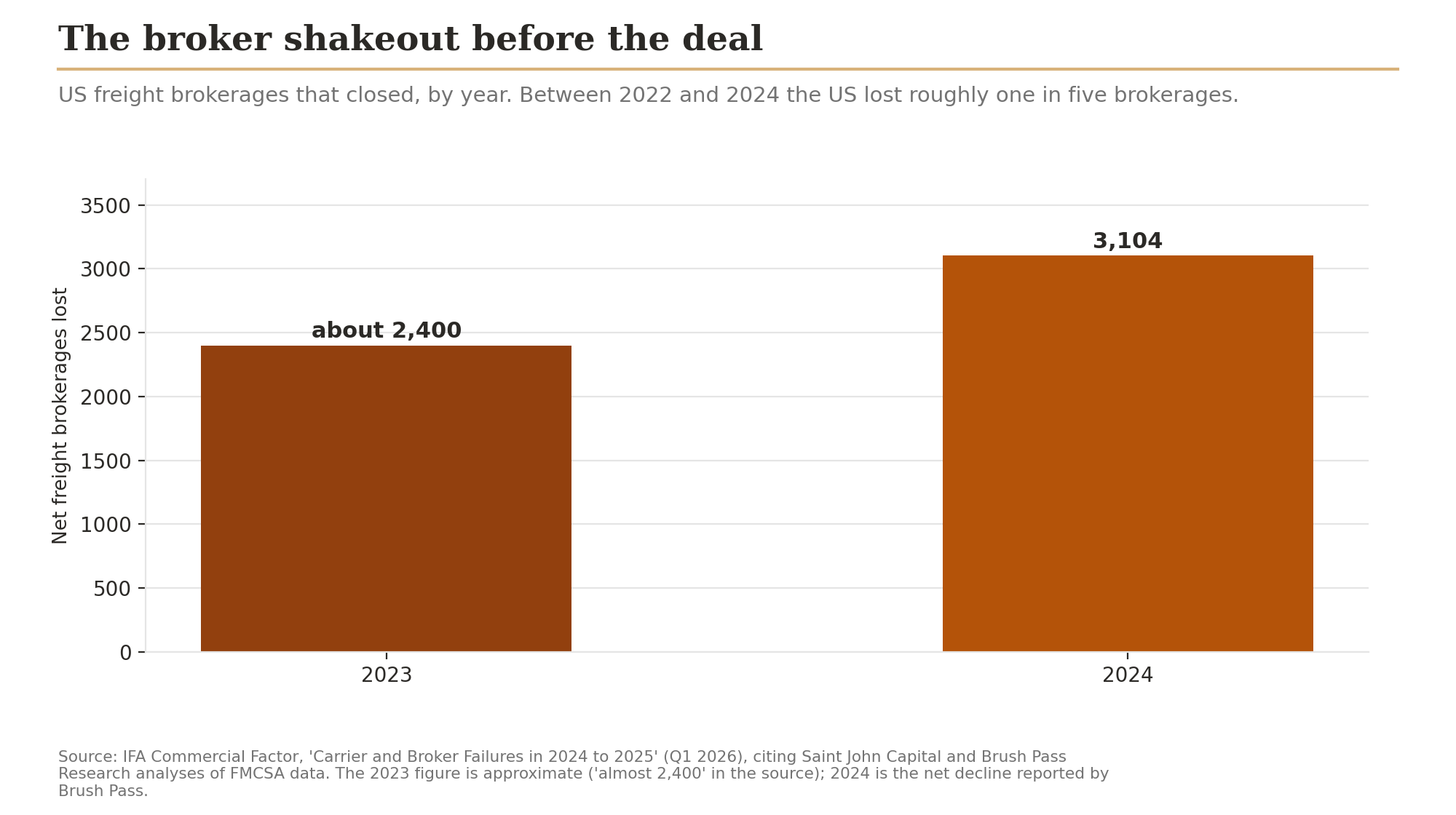
This is a consolidation story in an industry that has been shrinking. Industry analyses of FMCSA data, summarised by IFA Commercial Factor, show about 2,400 US freight brokerages closing in 2023 and 3,104 more in 2024, with roughly one in five brokerages lost between 2022 and 2024. The survivors tend to be larger and better funded, and this deal joins two of the biggest.
It also lands just months after a major legal shift. On 14 May 2026, in Montgomery v. Caribe Transport II, the US Supreme Court unanimously held that the federal law which usually shields brokers from state rules (the FAAAA) does not block state negligent hiring claims (lawsuits alleging a broker carelessly chose an unsafe trucking company). C.H. Robinson was itself the broker in that case. Transport Topics reports that a Dallas County jury later returned a $604 million advisory award in a separate case involving a carrier C.H. Robinson had engaged, which the company has said it will appeal. Bozeman has predicted the ruling will speed up consolidation as shippers look for brokers able to vet carriers properly, telling Transport Topics there is "a call for quality right now." The deal is therefore an example of how a court decision on preemption (when federal law overrides state law) can reshape the commercial logic of an entire sector.
Real World Impact
Almost everything you buy spent some time on a truck, and a broker like C.H. Robinson or RXO is often the business that found that truck. If the combined company really does strip out $300 million of costs, some of that could, in theory, show up as cheaper or more reliable shipping for retailers. That is not guaranteed as fewer big brokers could also mean less competition on price over time, which is one of the things the competition authorities will look at.
The savings are meant to come largely from AI driven productivity, which could mean fewer back office and sales roles at the combined business. Small trucking firms that rely on brokers for work might find themselves dealing with one larger counterparty instead of two. And after the Supreme Court ruling, brokers are under pressure to vet carriers more carefully, which could make roads safer but might also add costs that, as Justice Kavanaugh's concurrence warned, can be "paid in part by American consumers in the form of higher prices."
Why they did it this way
Recommended rather than hostile. Both boards approved the deal unanimously. For a US listed target, an agreed deal is the normal route. Delaware law gives a target board significant tools to resist an unwanted approach, so a buyer that wants certainty and access to due diligence typically negotiates with the board first. C.H. Robinson's own explanation of the "why" is commercial as it says combining the two networks will give it more density across North American trucking, add RXO's expedited and last mile capabilities, and let it apply its Lean AI model to unlock about $300 million of annual savings within two years.
A two step merger aimed at tax free treatment. The filing says the double merger is designed to qualify as a Section 368(a) reorganisation, and RXO will only close if it receives a tax opinion confirming that. In US practice, a stock and cash deal is often routed through a second merger into an LLC precisely because that is how the tax rules recognise the combination as a reorganisation, so the share element can be received without immediate tax.
Mixed consideration with elections. Paying part in cash and part in shares lets C.H. Robinson keep its borrowing manageable while giving RXO holders a stake in the upside. Orbis, RXO's largest shareholder, says the mix "gives RXO shareholders substantial cash today and continued ownership in a combined platform with significant upside." The election and proration mechanism is the standard way to let different investors tilt towards what they prefer without changing the buyer's total cash bill.
Locking in support early. Signing a voting agreement with MFN Partners (about 17%) on the same day as the merger agreement is a common way for buyers to reduce the risk that the shareholder vote fails. Because it lapses if the RXO board changes its recommendation, it sits comfortably alongside the board's fiduciary out rather than making the deal impossible to stop.