Schneider Electric to buy PTC for $22.6bn in cash
Hussain Jeddy · 5 October 2026
Share on LinkedIn- Target
- PTC Inc. (Nasdaq: PTC, Boston)
- Buyer
- Schneider Electric (France)
- Deal value
- $23.7bn (€21.1bn) EV
- Price/share
- $205 per share in cash
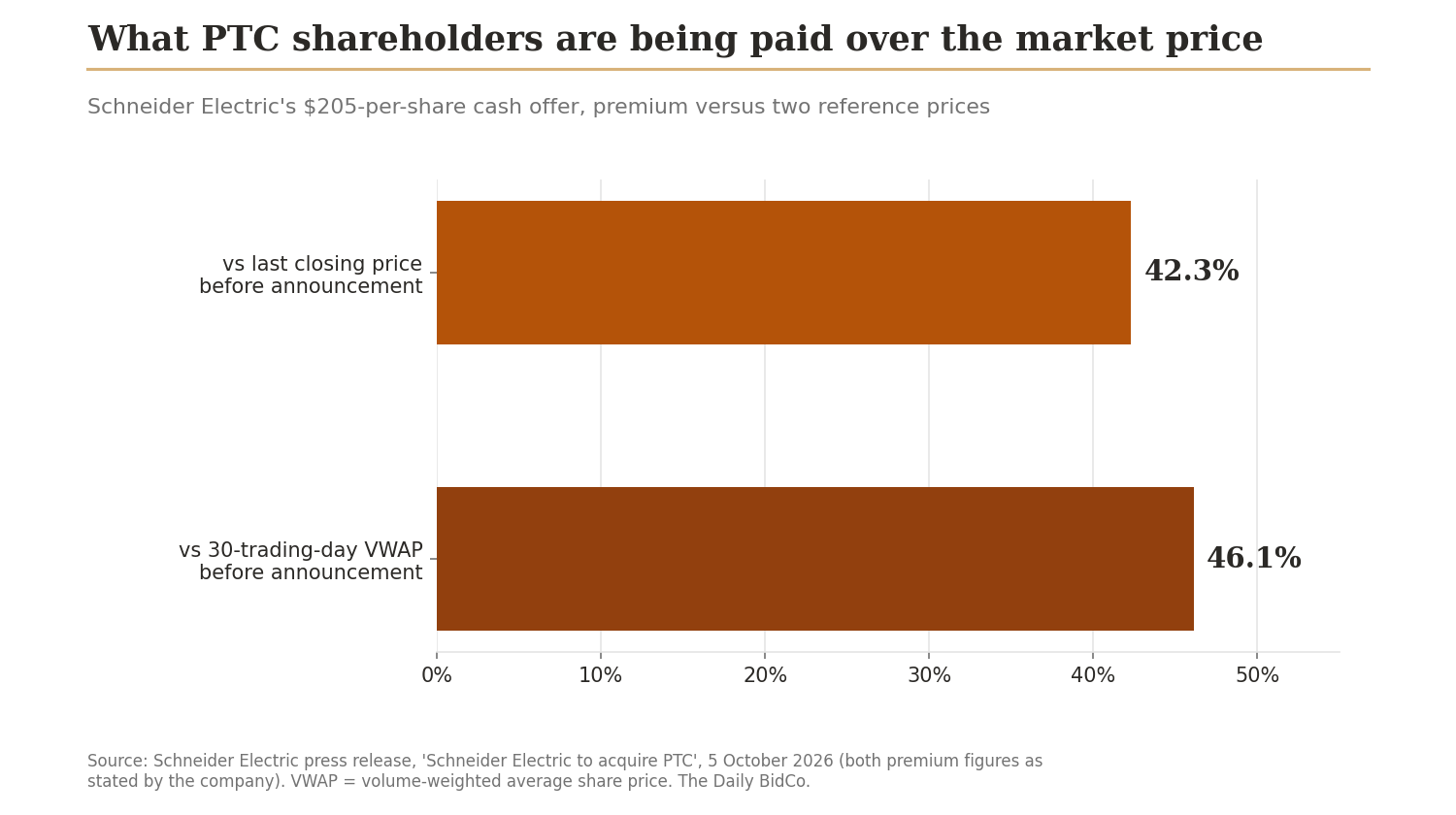
On 5 October 2026, Schneider Electric and PTC announced a definitive agreement for Schneider to buy all of PTC for $205 per share in cash. That values PTC's equity at about $22.6 billion and the whole business, including debt, at $23.7 billion.
The Parties
Schneider Electric is a French energy-technology group with about 160,000 employees. It makes electrical equipment, automation systems and software for buildings, data centres, factories and power grids. It already owns industrial software house AVEVA and has a pending $3.1bn deal to buy Cognite, an industrial data and AI company.
PTC is a Boston software company with more than 7,000 staff and over 30,000 customers. It makes CAD (computer-aided design: the software engineers use to design physical products) and PLM (product lifecycle management: software that tracks a product's data from design through manufacture to servicing). Its products include Creo, Windchill and Onshape. Schneider says PTC made €2.4bn of revenue in 2025 at an adjusted EBITA margin of about 40%.
Structure & Process
This is a US public-company merger agreement (a contract under which the target merges into a subsidiary of the buyer, and target shareholders' shares turn into cash). Both boards approved it unanimously. It needs a "yes" vote from holders of a majority of PTC's outstanding shares at a special meeting, so PTC will file a proxy statement on Schedule 14A (the SEC disclosure document sent to shareholders before a vote). It also needs regulatory approvals, which the release does not list.
The Financing Angle
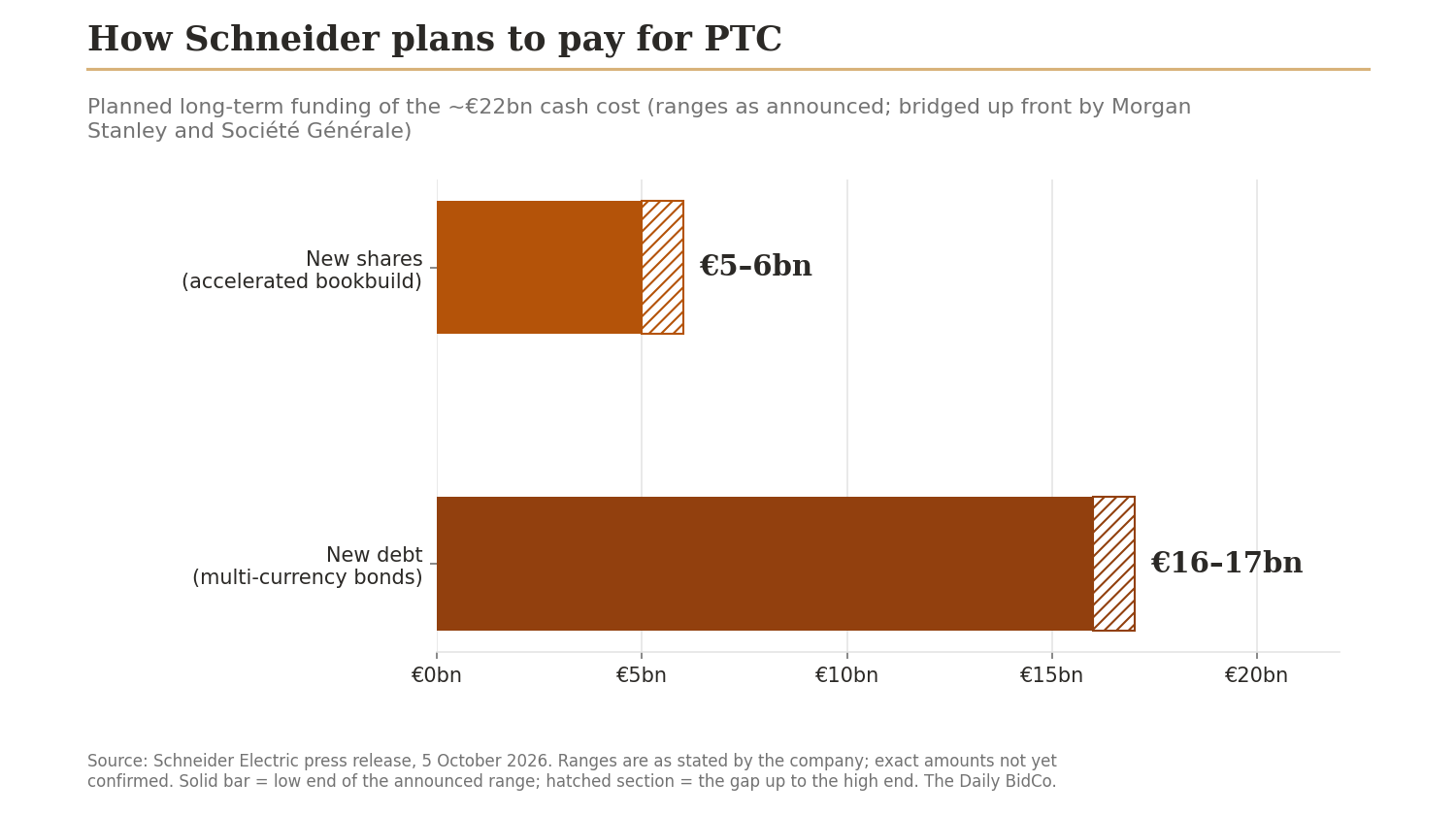
The total cash cost is about €22bn. It is guaranteed by a fully committed bridge facility (a short-term loan that guarantees the money is there on day one, to be repaid from longer-term funding later) from Morgan Stanley and Société Générale. Schneider plans to replace the bridge with about €5–6bn of new shares, sold through an accelerated bookbuild (a fast placing of new shares with institutional investors, usually overnight), plus €16–17bn of new bonds in several currencies. Schneider says it expects to keep "Category A" credit ratings, keep its progressive dividend, and pause share buybacks in 2027 and 2028. No law firm advising on the financing has been named.
Why it Matters
Schneider is building what it calls "the industry's most complete Software & AI powerhouse". PTC (designing products), AVEVA (running plants) and Cognite (industrial data and AI) together cover a product's whole life, from drawing board to factory floor to maintenance. Schneider says software and services would make up about 24% of group revenue, and that the deal triples its addressable market in industrial software. It is also Schneider's second big deal in under two weeks, after the €1.2bn Shelly Group offer. The pricing is significant too: 21x 2027 EBITA, or 13x including synergies, plus €250m of targeted annual cost savings by year three.
Real-World Impact
Most people have never heard of PTC, but they've almost certainly used something designed with it. This includes cars, medical devices, washing machines, aircraft parts. The question for ordinary people is whether one giant controlling more of the "design-to-factory" software stack makes things cheaper and better, or just makes manufacturers more dependent on one supplier.
Schneider says the platform will stay "open and interoperable", and that's a promise to keep an eye on. The €250m cost-savings target could mean overlapping roles are cut across PTC's 7,000+ staff, though no job cuts have been announced. Schneider shareholders also lose share buybacks for two years. That's a small knock-on for pension funds that hold the stock. And with US–EU tech and investment tensions running high, a French group buying a major US software firm is a deal that could draw political attention in Washington, though none has been reported yet.
Why they did it this way
Why all cash? PTC's CEO Neil Barua said the all-cash deal "delivers certain and compelling value to our shareholders". Cash removes the risk that a fall in the buyer's share price erodes the offer. This is the opposite of the onsemi/Synaptics switch (issue 64), where the deal also moved to cash, but at a lower headline price.
Why a merger agreement rather than a scheme or tender offer? PTC is a US-listed, Delaware-style company, and a one-step merger with a shareholder vote is the standard route for US public targets when the buyer needs long regulatory timelines anyway.
Why fund partly with new equity? Schneider ties this to "retaining Category A credit ratings" and its 2025 Capital Markets Day framework. Paying €22bn entirely with debt would likely put pressure on those ratings. The buyback pause is part of the same balancing act.
Why such a long timetable (to Q3 2027)? The release cites "required regulatory approvals" without naming them. A cross-border software deal this size will likely need several merger-control and foreign-investment filings.