onsemi cuts its Synaptics price to $5.7bn and switches to all cash after a rival bidder appears
Hussain Jeddy · 2 October 2026
Share on LinkedIn- Target
- Synaptics Incorporated, Nasdaq: SYNA
- Buyer
- ON Semiconductor Corporation ("onsemi"), Nasdaq: ON
- Deal value
- ~$5.7bn aggregate
- Price/share
- $123.00 per share in cash
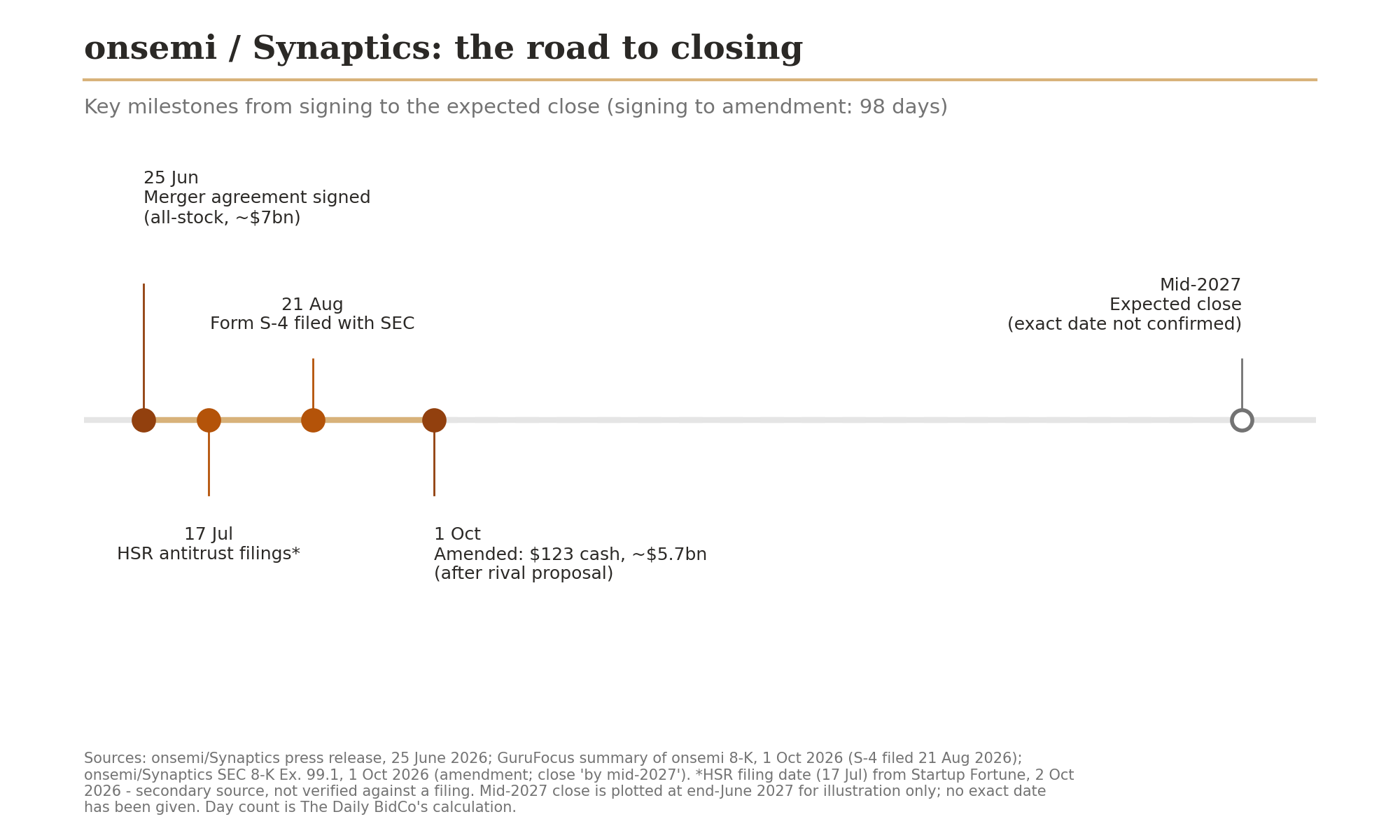
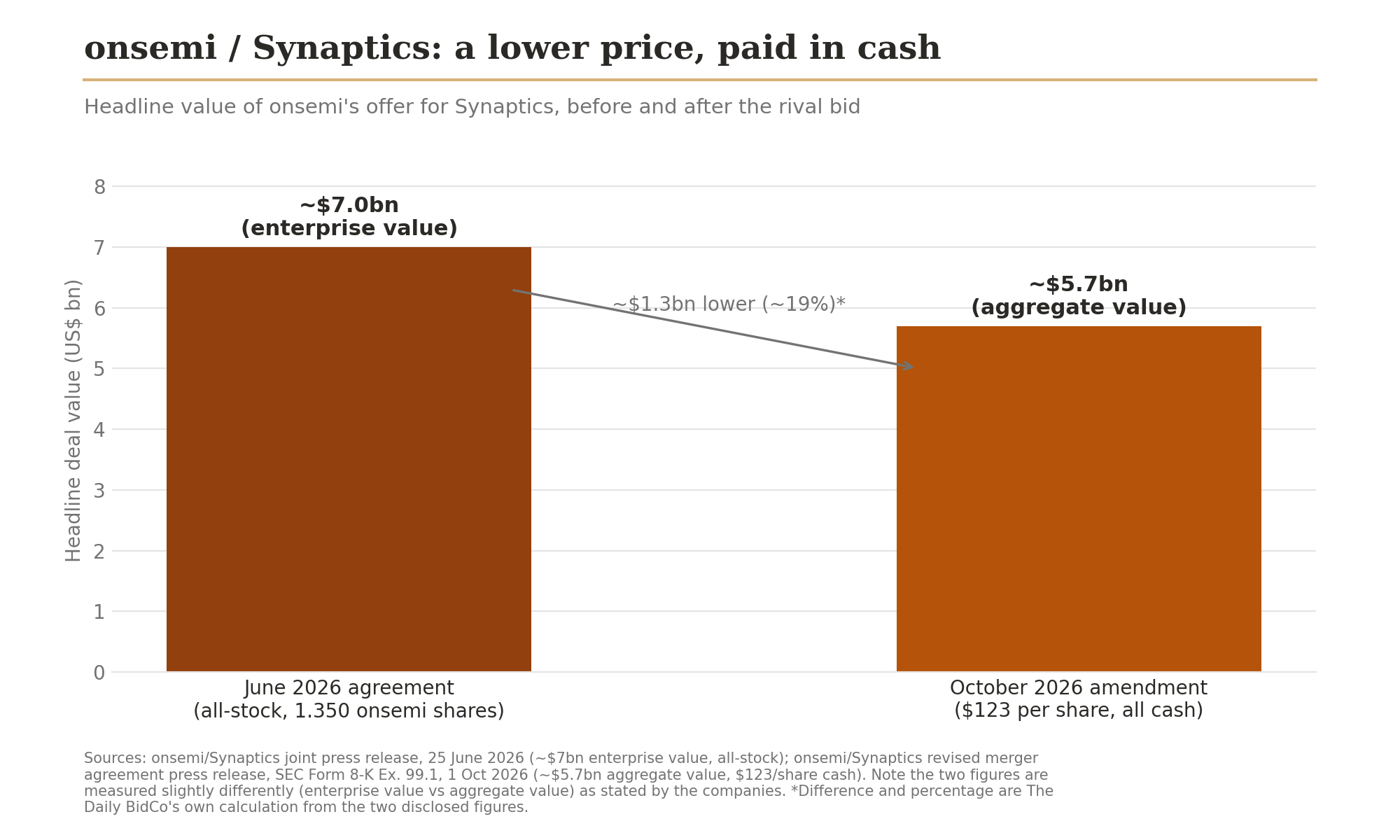
On 1 October 2026, onsemi and Synaptics announced that they had rewritten their June 2026 merger agreement. The new terms pay Synaptics shareholders $123 per share in cash, about $5.7 billion in total, instead of the all-stock offer of 1.350 onsemi shares per Synaptics share, which valued the deal at about $7 billion when it was signed. The change came after Synaptics received an unsolicited competing proposal (an approach from a rival bidder that the target had not invited) from a third party that neither company has named.
The Parties
onsemi is a US chipmaker based in Scottsdale, Arizona, and a member of the S&P 500. It makes power and sensing chips used in electric-vehicle drivetrains, industrial automation and AI data centres. Its silicon carbide power chips, for example, help EVs and server racks handle electricity efficiently. Synaptics, based in San Jose, makes the chips behind how people physically use devices: laptop touchpads and touchscreen controllers, fingerprint sensors, display drivers, Wi-Fi and Bluetooth chips, and its "Astra" processors for running AI directly on a device. In plain terms, onsemi supplies the power and the senses, and Synaptics supplies the touch, the connectivity and some of the on-device technology software.
Structure & Process
The deal is a US reverse triangular merger (a structure where the buyer creates a shell subsidiary that merges into the target, leaving the target alive as a wholly owned subsidiary of the buyer). Here, onsemi's subsidiary Sonic Acquisition Corp. merges into Synaptics. The June agreement was an "Agreement and Plan of Reorganization", designed to qualify as a tax-free reorganization under Section 368 of the US Internal Revenue Code (a regime that lets target shareholders swap shares without immediately paying tax on the gain). The amended version is an all-cash merger. It is therefore no longer structured as a Section 368 reorganization, and onsemi plans to withdraw the Form S-4 (the SEC registration statement needed when a buyer issues new shares as payment), which it filed on 21 August 2026.
Because no onsemi shares are being issued any more, several closing conditions have been removed. This includes the S-4 becoming effective, Nasdaq listing approval for the new onsemi shares, the condition that no material adverse effect had hit onsemi itself, and the closing tax opinions. What remains is a vote of Synaptics shareholders on a proxy statement (the document sent to shareholders before they vote), which Synaptics must file in preliminary form within 10 days, plus the outstanding regulatory approvals. The companies say the US Federal Trade Commission has already approved the deal. Shareholders who vote against it keep appraisal rights under Delaware law (the right to ask a court to set a "fair value" for their shares instead of taking the deal price).
The Financing Angle
The original deal needed no external financing because it was paid in shares. The amended deal is funded with cash on hand plus committed debt. On 1 October 2026, onsemi signed a commitment letter with Morgan Stanley Senior Funding, Inc. for up to $2.45 billion of senior secured term loan financing (a loan backed by security over the borrower's assets and repaid over a fixed term). The amended merger agreement contains no financing condition (onsemi cannot walk away because the loan falls through), which gives Synaptics shareholders certainty. No source names onsemi's financing counsel or the lenders' counsel.
Why it Matters
For a student, this is a strong example of what happens between signing and closing. A signed public-company merger is not the end of the story. A rival can appear, the target board has to take that seriously, and the original buyer may have to restructure its offer to keep the deal. It is also unusual, as a contested situation that ended with a lower headline price that both sets of shareholders apparently welcomed, because the form of payment (cash or stock) can matter as much as the number.
Strategically, onsemi is betting on what both sides call "Physical AI", meaning AI that moves out of data centres into cars, robots and factory equipment. The pitch is that onsemi brings power and sensing chips and Synaptics brings on-device compute and connectivity. onsemi says the deal expands its addressable market by $30bn, to $243bn by 2030 (June press release figures).
Real-World Impact
Every time you tap a laptop touchpad, unlock something with your fingerprint or connect earbuds over Bluetooth, a Synaptics chip may be involved. This deal is about who owns that chip and what they plan to do with it.
For ordinary people, the clearest near-term angle is jobs. onsemi has promised $200 million a year in cost savings, and a June-era filing summary says 85–90% of that is expected to come from SG&A (sales, general and administrative costs: office, sales and back-office functions rather than factory work). That points to possible overlap cuts in corporate roles once the companies combine. Synaptics has told staff there are "no immediate changes" to its organisation, and no layoffs have been announced. Separately, onsemi now says it plans to "insource" part of Synaptics' production, meaning it would make in its own factories some chips that Synaptics currently outsources. That could shift manufacturing work between suppliers and plants, though no specifics have been given.
For consumers, the honest answer is "probably not much, soon". Synaptics chips are components inside devices made by other companies, so any price effect would be indirect and is not something any source has predicted. The longer-term pitch is that combining power, sensing and on-device AI could speed up smarter cars, robots and home devices.
A rival was willing to fight for Synaptics, which says something about how hotly contested "edge AI" chip assets have become. And a buyer taking on a $2.45bn loan to win the deal is a reminder that the AI chip race is increasingly paid for with debt.
Why they did it this way
Why the deal was reopened at all.
The parties say directly that the amendment "follows an unsolicited competing proposal received from a third party". Synaptics' board reviewed that proposal with its financial and legal advisers and "in accordance with... the previously announced agreement with onsemi". The CEO's all-employee email filed with the SEC says so. Under a US merger agreement, a target board can usually engage with a superior unsolicited offer but must give the existing buyer a chance to match it. That right is commonly called a match right.
Why switch from stock to cash, even at a lower headline number?
onsemi: CEO Hassane El-Khoury said the all-cash deal "delivers higher value to our shareholders through lower total cost consideration" and should make the deal "immediately accretive to non-GAAP EPS" (meaning it is expected to raise onsemi's adjusted earnings per share from day one). In June, accretion was only expected within 18 months. Paying cash also avoids issuing new shares, which would have handed Synaptics holders about 12% of the combined company (the June figure).
Synaptics: CEO Rahul Patel said the switch provides "value certainty at a meaningful premium as compared to current value". In a stock deal, the seller's payout rises and falls with the buyer's share price until closing. A fixed cash price removes that risk, which matters when closing is about nine months away. Press reports say shares in both companies rose after the announcement (onsemi up more than 5% and Synaptics up more than 12% after hours, per Investing.com as cited by Startup Fortune)
Why did Synaptics' board accept a lower headline number rather than run an auction?
The rival bid was non-binding (an expression of interest, not a signed offer), and Synaptics' board concluded that the amended onsemi deal "continues to be in the best interests of Synaptics and its shareholders". A certain cash price from a buyer with an approved FTC review and committed financing may have looked better than an uncertain, non-binding rival proposal. That would be especially true if the ~$7bn June value had fallen since signing as onsemi's share price moved.
Why the long timeline (mid-2027)?
It is unchanged from June. The parties cite "required regulatory approvals" in "other jurisdictions". No source lists which jurisdictions. Chip deals frequently need clearance from several national competition authorities, sometimes including China's SAMR.