Brixmor and Everview's US$2.3bn take-private of Slate Grocery REIT
Hussain Jeddy · 1 October 2026
Share on LinkedIn- Target
- Slate Grocery REIT (TSX: SGR.U / SGR.UN)
- Buyer
- Brixmor Property Group (NYSE: BRX) and affiliates of Everview Partners
- Deal value
- ~US$2.3bn EV
- Price/share
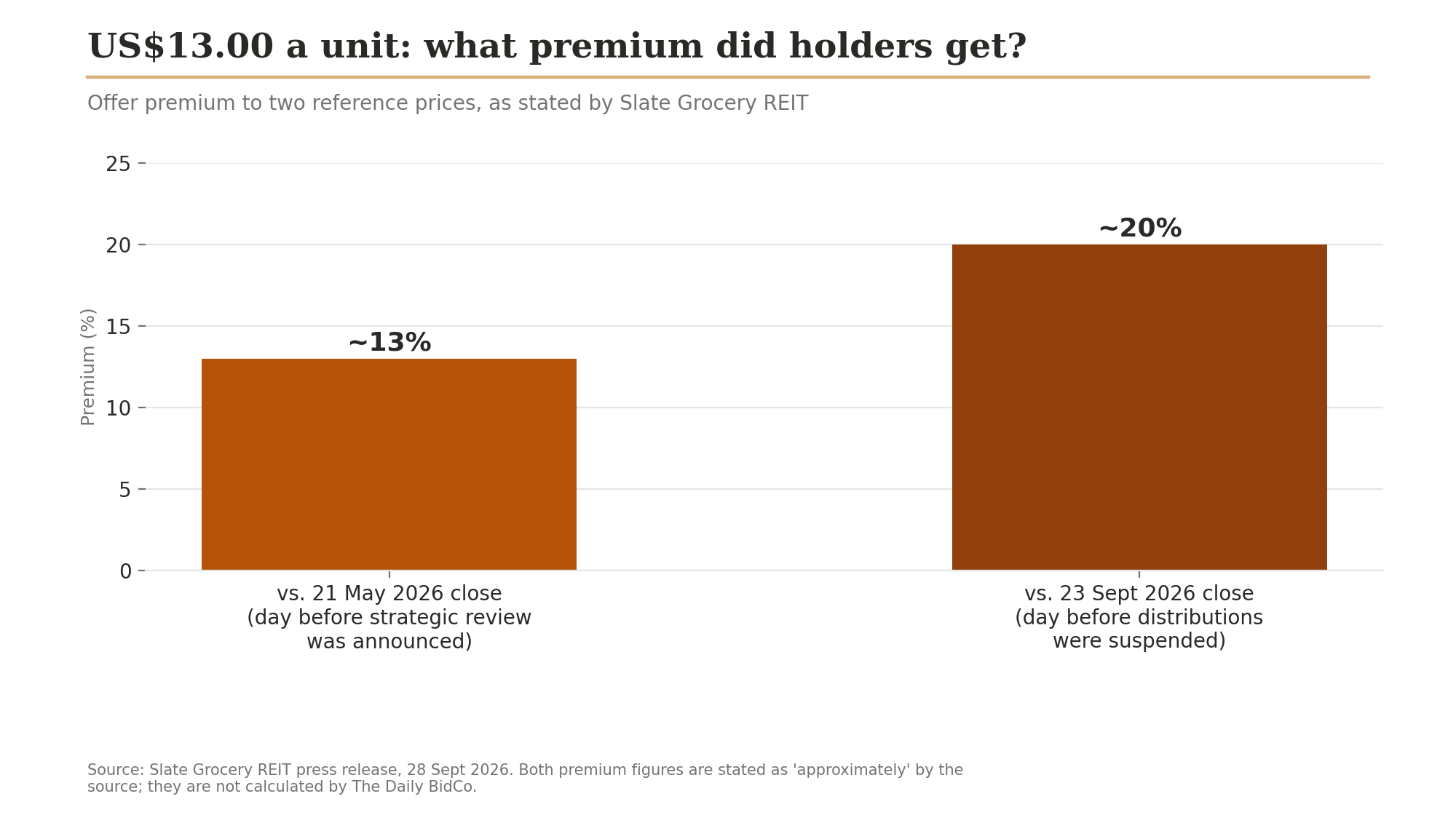
- US$13.00 cash per unit
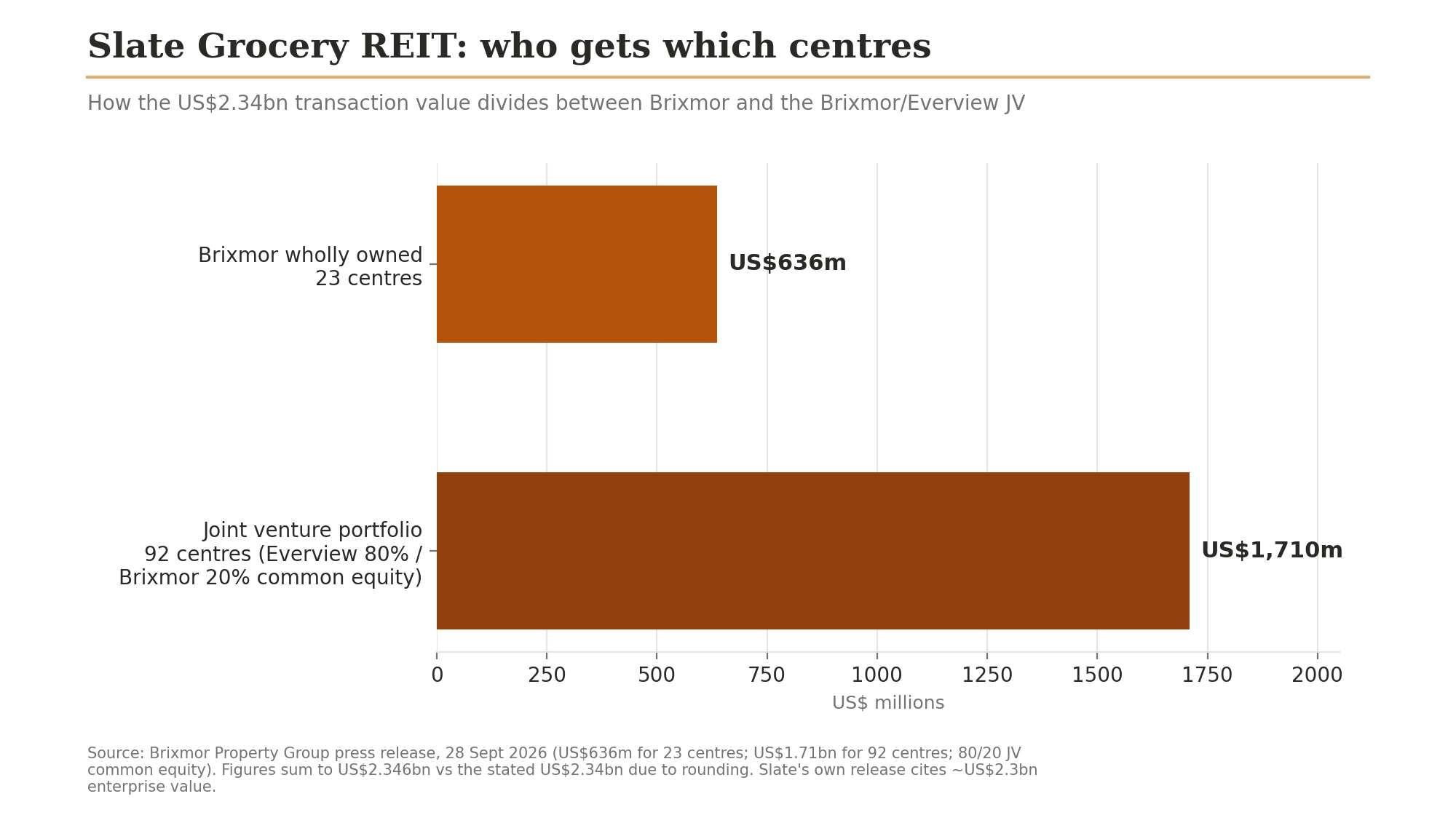
On 28 September 2026, Slate Grocery REIT agreed to be bought by a joint venture between Brixmor Property Group and affiliates of Everview Partners for US$13.00 per unit in cash. That gives an enterprise value of about US$2.3 billion and ends the REIT's 12-year listing on the Toronto Stock Exchange. Under the arrangement, Brixmor effectively takes 23 shopping centres outright for US$636 million. A new institutional joint venture, 80% Everview and 20% Brixmor, takes the remaining 92 centres for US$1.71 billion.
The Parties
Slate Grocery REIT is a Toronto-listed real estate investment trust (a listed vehicle that owns income-producing property and passes most of its rental income to investors). It owns and runs grocery-anchored shopping centres across major US cities. That means the strip of shops built around a supermarket: for example, the dry cleaner, pharmacy and coffee shop sharing a car park with the grocer. The REIT is externally managed (run under contract by a separate firm, Slate Asset Management, instead of by its own employees), and Slate Asset Management is also its largest investor.
Brixmor is a New York Stock Exchange-listed REIT that owns 346 open-air shopping centres covering about 63 million square feet. Its tenants include TJX, Kroger, Publix and Ross Stores.
Everview Partners is a private investment firm founded in 2024 that invests in real assets using both private equity and credit. The Abu Dhabi Investment Authority (ADIA), the sovereign wealth fund that invests on behalf of the Government of Abu Dhabi, is coming in alongside Everview as a strategic investor through a wholly owned subsidiary.
Structure & Process
The deal will be implemented by a plan of arrangement (a court-supervised procedure, broadly Canada's equivalent of a UK scheme of arrangement, in which a target's securityholders vote on a deal and a court then approves it as fair) under Ontario's Business Corporations Act and Trustee Act. Unitholders face a two-limbed vote. First, at least 66⅔% of votes cast must be in favour. Second, a simple majority of votes cast must be in favour once the Manager and its affiliates are excluded. The second limb comes from Multilateral Instrument 61-101 (the Canadian securities rule that protects minority holders when insiders stand on both sides of a deal). The Ontario Superior Court of Justice (Commercial List) must then approve the arrangement.
The deal came out of a strategic review that started on 22 May 2026 after an unsolicited proposal from the REIT's own external manager, Slate Asset Management. The board set up a special committee (a committee of independent trustees only, used when insiders have a conflict) to run the process. That committee ran a competitive auction, which Brixmor and Everview won. Apart from any approval needed under the Investment Canada Act, no regulatory approvals are required. The deal is also not conditional on financing. Other protections:
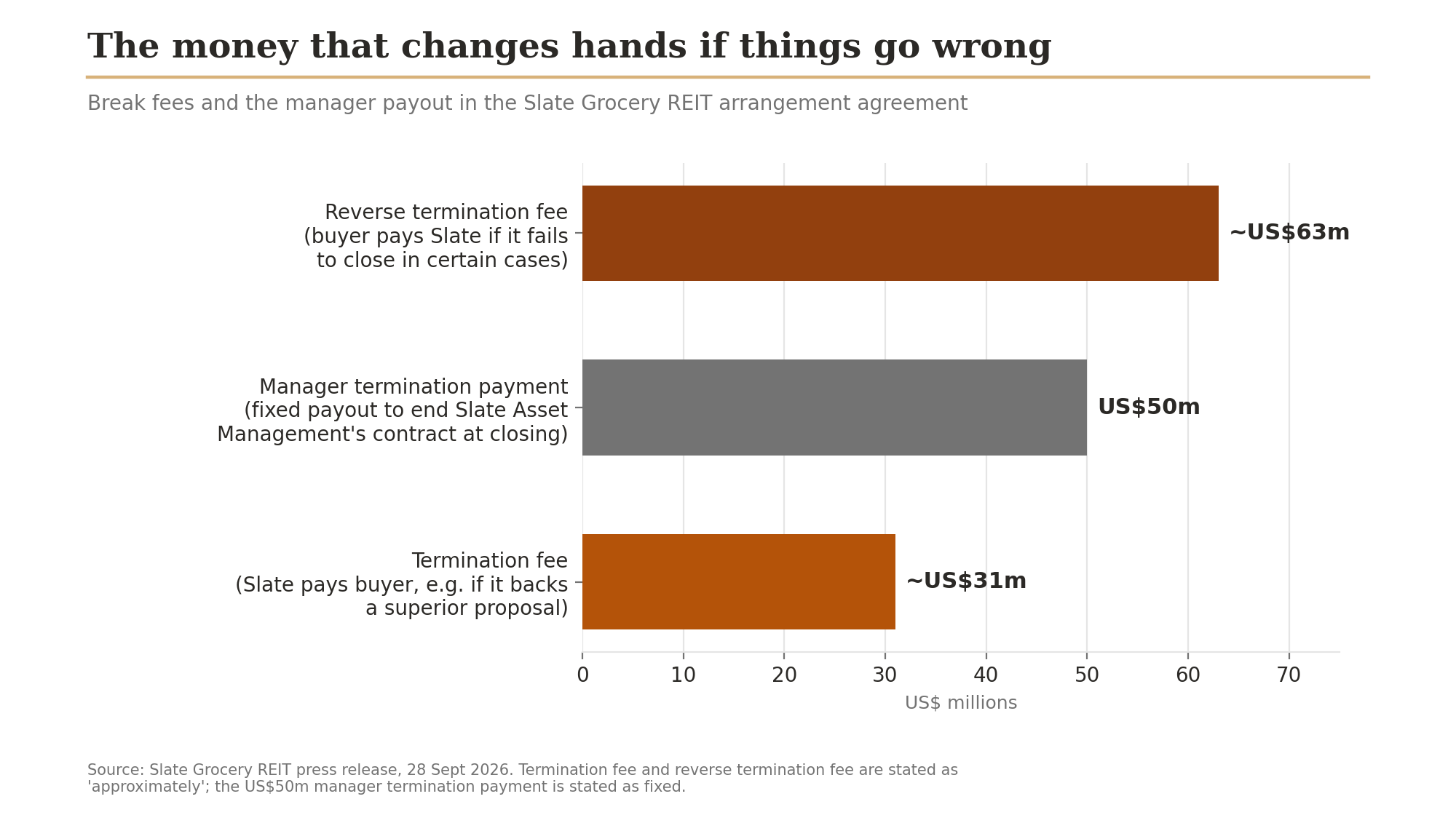
A termination fee (a break fee the target pays if it walks away for a better offer) of about US$31m
A reverse termination fee (paid by the buyer if it fails to close in certain circumstances) of about US$63m
A ticking fee (extra consideration that builds up daily if closing slips) of US$0.002482
Voting support agreements covering about 5.9% of units
The Financing Angle
Slate states that the buyer "has provided evidence of fully committed financing, including debt commitments letter and equity commitment letters." Brixmor's release also states:
Royal Bank of Canada gave Brixmor a bridge commitment (short term loan facility, normally financed later) covering all of the capital Brixmor needs, for both its wholly owned portfolio and its JV stake
Wells Fargo Bank, N.A. (as administrative agent) and Royal Bank of Canada gave a debt commitment to the joint venture. Wells Fargo Securities and RBC will be joint bookrunners on the JV financing.
Brixmor will also put about US$174m of preferred equity into the JV, earning a 9% dividend. Preferred equity sits between debt and ordinary equity and is paid a fixed return before ordinary equity holders
Why it Matters
This is an example of public-to-private real estate consolidation, and of an increasingly common structure. A listed REIT pairs with private capital (here Everview, backed by a sovereign wealth fund) so it can buy a whole listed portfolio while keeping only the assets it wants. It also shows the governance problem with externally managed vehicles. The process started because the manager itself wanted to buy, which is why the special committee, the minority vote and the fixed manager payout all matter. It brings together several takeover concepts in one deal, namely, special committees, majority-of-the-minority votes, break fees in both directions and ticking fees.
Real-World Impact
If you buy groceries in Florida, Georgia or the Carolinas, your local Publix, Kroger or Harris Teeter probably sits in one of these centres, and this deal changes your landlord. The day-to-day effect could go either way. Brixmor openly says rents at these centres are about 32% below the rents in its existing portfolio, and that it sees "meaningful… mark-to-market opportunities." Put simply, it expects to charge more when leases come up. That could squeeze the small independent tenants (the nail salon, the local pharmacy) and might eventually show up in their prices.
On the other hand, Brixmor has identified about US$100m of redevelopment and outparcel opportunities, including possible Publix redevelopments. That could mean refurbished centres, new shop units and construction work locally.
On the policy end, a Gulf sovereign wealth fund (ADIA) is putting money into US neighbourhood shopping centres, at a time when foreign state investment in US assets is drawing attention.
Why they did it this way
Why a special committee and auction instead of a sale to the manager?
Slate's release says the committee was formed "in response to an unsolicited proposal from affiliates of Slate Asset Management… the external manager of the REIT" and given "a broad mandate to consider and evaluate strategic alternatives, including a potential sale." The manager was effectively a would-be bidder with inside knowledge, so the independent trustees tested the market. The committee's chair says the deal was "the culmination of a competitive process focused on maximizing value for all Unitholders."
Why a plan of arrangement instead of a takeover bid?
The likely reason is that arrangements are the standard Canadian route for agreed take-privates of trusts and companies. One court-approved vote binds everyone at once, and the process can also deal with side steps such as ending the management agreement and buying out joint-venture interests.
Why the minority vote excluding the Manager?
This is a legal requirement. Slate states the separate majority-of-the-minority vote is required by MI 61-101, because the Manager is a related party receiving a benefit, namely a fixed US$50m termination payment to end its management contract.
Why split the portfolio between Brixmor (23 assets) and a JV (92 assets)?
Brixmor describes the JV as "capital efficient." It wants the 23 centres in its existing Southeast footprint (Florida, Georgia, the Carolinas) on its own balance sheet. For the other 92 it puts in only 20% of the common equity but still earns fees as asset manager, property manager and leasing agent, which supports its "strong investment-grade balance sheet."
Why a ticking fee?
Ticking fees compensate holders for delay and push the buyer to close quickly. Slate also paused distributions from October 2026 until closing, so the ticking fee may partly compensate for that lost income.