AAR Corp. to buy 65% of MRO Holdings at a $4.0bn enterprise value
Hussain Jeddy · 30 September 2026
Share on LinkedIn- Target
- MRO Holdings (private; aircraft heavy maintenance)
- Buyer
- AAR CORP. (NYSE: AIR)
- Deal value
- $4.0bn (EV)
- Price/share
- 65% for ~$1.8bn equity value
On 28 September 2026, AAR agreed to buy a 65% controlling interest in MRO Holdings, one of the largest independent aircraft heavy-maintenance providers in the Americas. The deal implies a $4.0bn enterprise value, and AAR has options to buy the remaining 35% over the next six years.
The Parties
AAR is a Chicago-area aviation aftermarket company. It supplies aircraft parts, repairs components and airframes, sells aviation software, and supports government and defence customers. Q1 FY2027 sales were $918m.
MRO Holdings does heavy maintenance (the deep, scheduled overhauls where an airliner is taken out of service and partly stripped down in a hangar). It has about 10,000 staff and 115 "lines" of hangar capacity at five facilities in El Salvador, Mexico, Colombia and the US. About 90% of its revenue comes from US customers. It expects ~$1.0bn of sales and ~$285m of adjusted EBITDA in 2026.
Structure & Process
This is a private share purchase. AAR signs a share purchase agreement (SPA) with MRO Holdings' owners, so there's no public offer or shareholder vote at the target. AAR's board has approved it unanimously.
Closing needs regulatory approvals. AAR's release mentions "regulatory approvals" without listing them, and Kirkland's antitrust team is on the deal.
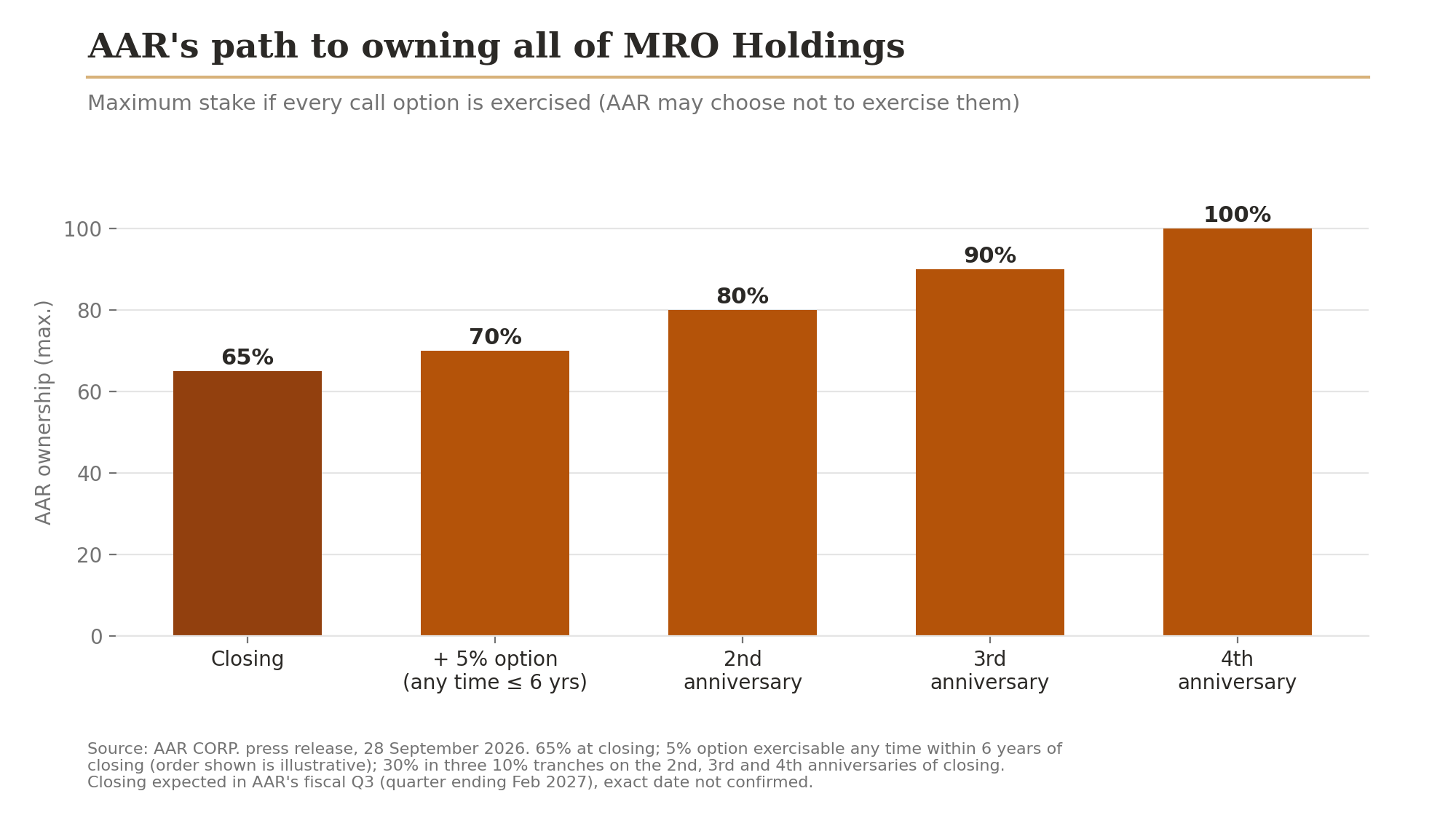
The unusual feature is that AAR only buys 65% up front. The other 35% is covered by call options (rights, but not obligations, for AAR to buy more later):
5% can be exercised any time within six years
30% can be exercised in three 10% tranches, on t he second, third, and fourth anniversaries of closing
AAR gets board control, and the sellers are subject to lock-ups and voting-support commitments on the AAR shares they receive.
The Financing Angle
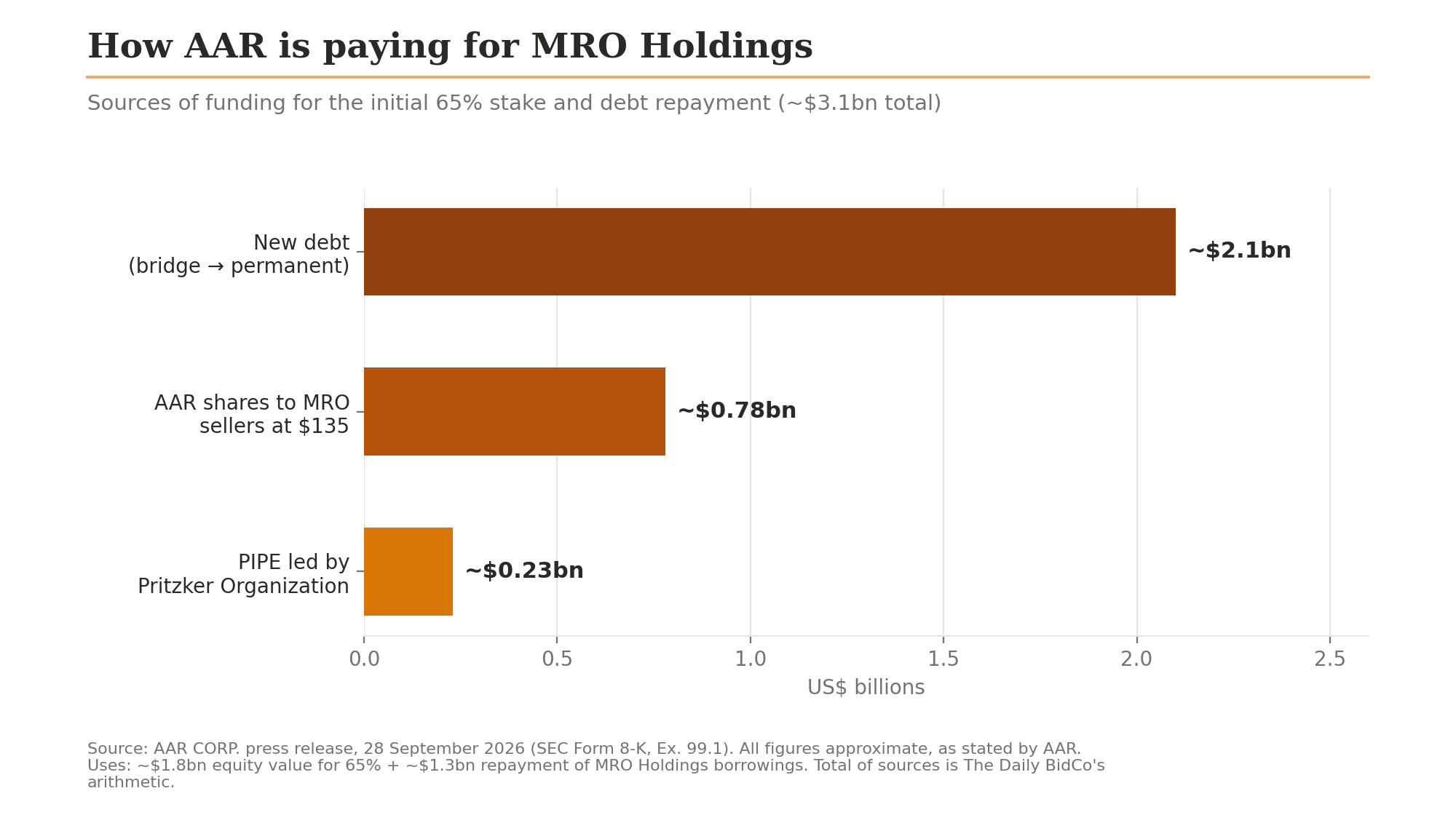
AAR's sources of cash add up to roughly the ~$3.1bn it needs for the equity plus debt repayment:
New debt, backed by a fully committed bridge facility from Goldman Bank USA and Wells Fargo, to be replaced by permanent debt before closing: ~$2.1bn
New AAR shares issued to MRO Holdings' existing owners at $135/share: ~$780m
PIPE (private investment in public equity, where new shares sold privately to investors), led by the Pritzker Organisation. Goldman is the placement agent: ~$230m
AAR expects net leverage (net debt divided by EBITDA) of about 3.6x at closing falling to ~3.0x within two years, and says it expects to keep its BB-category ratings. It will also receive 100% of MRO Holdings' excess cash flow for the first two years, which helps it pay down debt quickly. Kirkland's debt finance team advised AAR on the financing.
Why it Matters
AAR says the deal creates "the largest heavy maintenance MRO in the world", servicing almost 3,000 aircraft a year. It also lifts AAR's adjusted EBITDA margin from about 12% to 16% before synergies.
It's a good example of consolidation in the aviation aftermarket. That market has been in demand as airlines keep older aircraft flying longer. The staged-ownership structure is a halfway house between a joint venture and a full acquisition.
Real-World Impact
Every plane you board has to go in for a deep 'MOT' every few years. A big share of US airline jets get that overhaul in hangars in El Salvador, Mexico, and Columbia, and that's what MRO Holdings goes.
If one company now runs the world's biggest set of these hangars, airlines could get more reliable scheduling and capacity. They could also end up with fewer places to shop around, which over time could feed into maintenance costs and eventually fares.
The 10,000 workers are another story. Most are in Central and South America, and the $75m a year of "synergies" is partly about "SG&A optimisation" (overheads). No job cuts have been announced.
There may be a policy catch too. A US company taking control of maintenance work largely done outside the US. Whether this becomes part of any US labour or safety debate is not clear.
Why they did it this way
Why 65% now rather than 100%?
AAR's CEO says the structure "allows us to partner with a proven team that brings decades of experience in a strategically important region" and "provides the financial flexibility to continue to pursue AAR's broader strategy" (AAR release). Buying in stages also spreads the cash cost over several years, which is consistent with the leverage figures.
Why would sellers stay in?
MRO Holdings' chairman says the owners are "staying on as shareholders… because we share AAR's ambition". Bain Capital's partner says it looks forward to "participating in continued value creation". Sourced. Being paid partly in AAR shares at $135 also lines their interests up with AAR's.
Why give AAR 100% of excess cash flow for two years?
It's most plausibly a way to speed up deleveraging (reducing debt) while AAR's leverage is at its highest, which is consistent with the 3.6x → 3.0x path AAR gives.
Why a bridge facility?
It guarantees the money is available at signing, and AAR "intends to replace [it] with permanent debt financing prior to closing".