AMD's $8.2bn all-stock acquisition of World Labs
Hussain Jeddy · 29 September 2026
Share on LinkedIn- Target
- World Labs (private; San Francisco)
- Buyer
- Advanced Micro Devices, Inc. (Nasdaq: AMD)
- Deal value
- ~$8.2bn
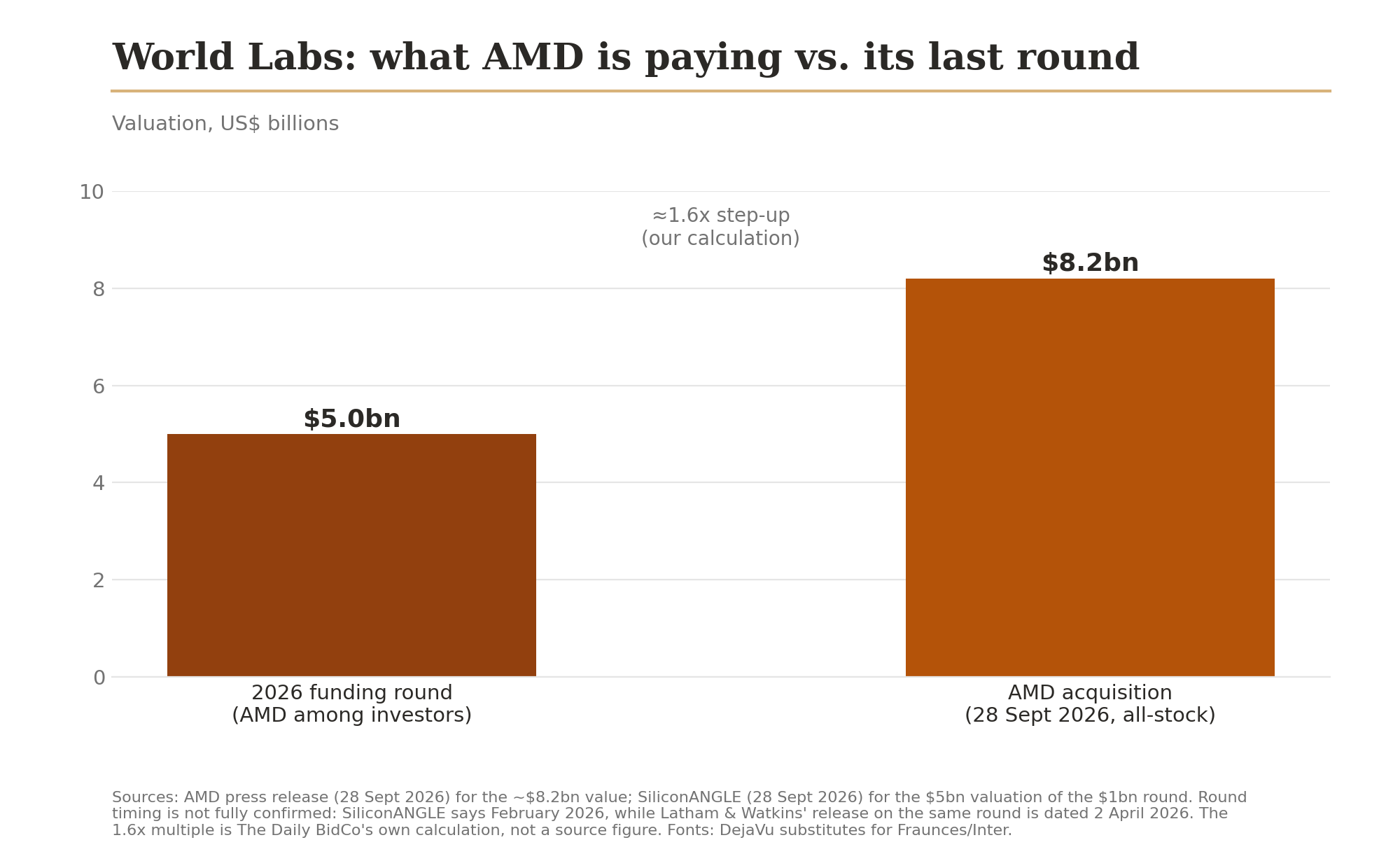
On 28 September 2026, AMD signed a definitive agreement to buy World Labs, the AI research lab founded by Stanford professor Fei-Fei Li. AMD will pay entirely in its own shares, in a deal valued at about $8.2 billion. It expects the deal to close by the end of 2026.
The Parties
AMD designs processors. It makes the CPUs in laptops and servers, the GPUs used for gaming and AI, and a growing line of AI accelerators for data centres. In AI chips it is Nvidia's main rival.
World Labs was founded in 2024. It builds "world models" (AI systems that generate and simulate interactive 3D environments, rather than just text or images). You give one a few photos, a video or a text prompt, and it builds a 3D space you can move around in. Its first product, Marble, is aimed at entertainment. SiliconANGLE reports that its newer model, Atlas, can rebuild a virtual copy of a factory or warehouse from a handful of photos. That makes it useful for training robots in simulation before they work in the real world.
Li is best known for creating ImageNet, the image dataset behind the early deep-learning boom. After the deal she will join AMD as executive vice president and chief scientist, reporting to CEO Lisa Su.
Structure & Process
This is the purchase of a private company under a definitive agreement (the final, binding contract that sets the price and conditions). World Labs isn't listed on a stock exchange. So there is no tender offer, no scheme of arrangement and no public shareholder vote. The buyer simply agrees terms with the company and its investors.
Closing depends on "regulatory approvals and other customary closing conditions." AMD didn't say which approvals. For a deal this size you would normally expect a US Hart-Scott-Rodino filing (the pre-merger notice that lets the FTC or DOJ review a deal before it closes).
The Financing Angle
No cash and no debt are involved. AMD pays World Labs' shareholders in newly issued AMD shares, so there are no lenders or financing lawyers. No source discloses the exchange ratio, how many shares AMD will issue, or how the payment is split among World Labs' investors.
Why it Matters
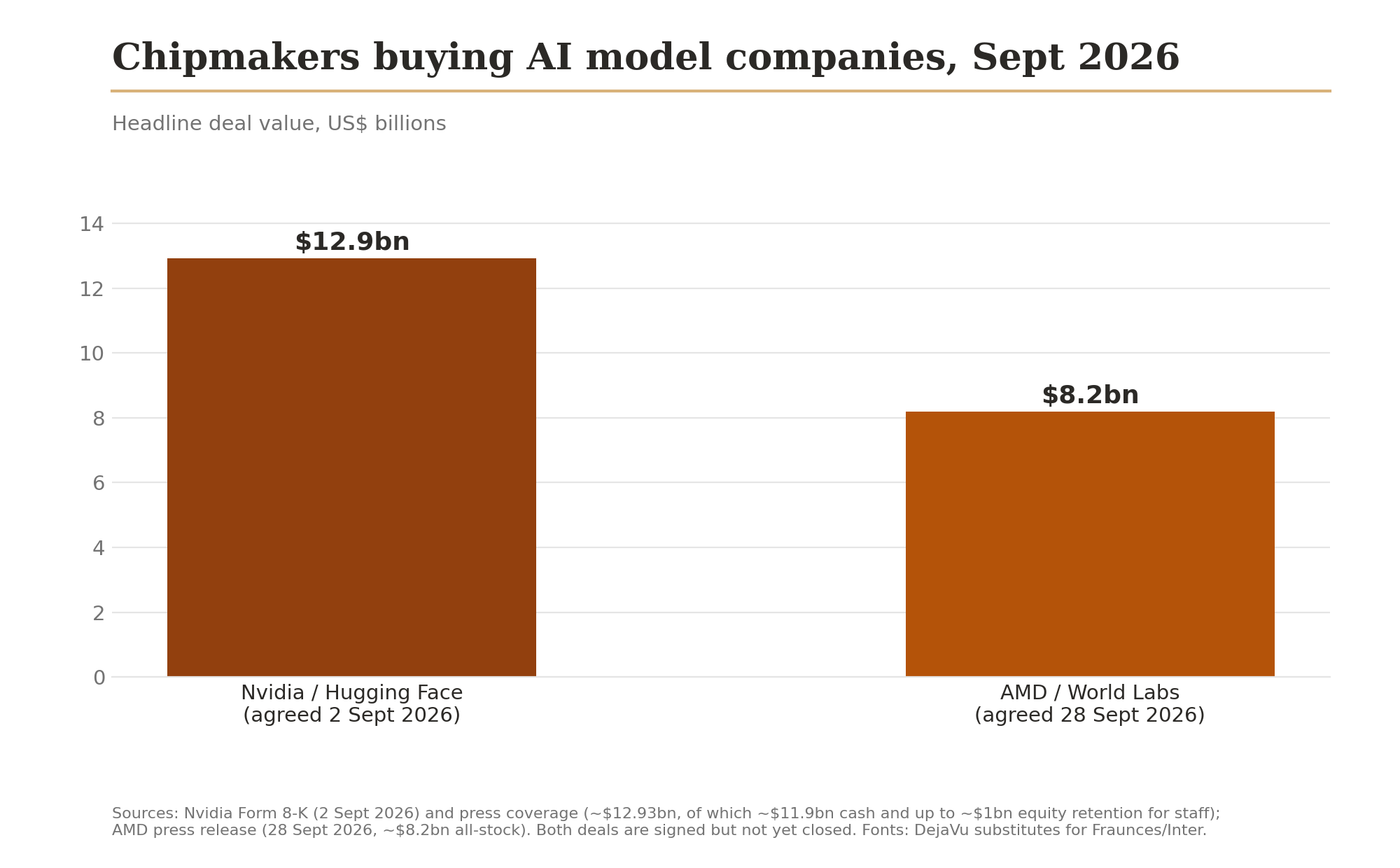
This is a chipmaker buying a leading AI model lab. It fits a pattern of hardware companies moving into models and software. It comes weeks after Nvidia's $12.9bn Hugging Face deal, covered in Issue 40.
It's also a clear example of an acqui-hire at scale (a deal where the main asset is the team rather than revenue). The price is roughly 1.6x the valuation World Labs raised money at only months earlier.
Real-World Impact
Think about the robot vacuum in living rooms, the self-checkout at the supermarket, or the warehouse robots packing your online order. Before a robot can work safely in the real world, it has to practise. Practising in a simulation is far cheaper than crashing real machines, and World Labs makes the software that builds those practice worlds.
AMD buying it could, over time, make that training cheaper and available on chips other than Nvidia's. If more competition in AI chips pushes costs down, that could eventually show up in the price of AI products. .
There's also a political angle. Big tech companies buying up AI startups (Nvidia/Hugging Face, now AMD/World Labs) is what competition regulators in the US and Europe have been watching. Whether this deal draws scrutiny is worth watching, but no regulator has commented yet. No layoffs have been announced, and AMD says the World Labs team will keep doing research.
Why they did it this way
Why buy the lab at all?
AMD states this directly. Lisa Su said building "the compute platforms for the next generation of AI requires a deep understanding of how models are evolving" (AMD release). The logic is that owning a frontier model team shows AMD what future chips need to handle. TechCrunch adds that Nvidia already offers its own open world models (Cosmos), while AMD had only released text and video models. The deal closes that gap.
Why all-stock?
Neither side explained this, but paying in shares keeps AMD's cash free for chip R&D and manufacturing commitments, and it gives Li and her researchers a continuing stake in AMD's success. That is a typical way to keep key talent in a deal that is mainly about people.
Why an acquisition rather than the existing partnership?
Li's own post (quoted by TechCrunch) says the team needs "scaling our efforts, widening our reach, and getting closer to the hardware." The two companies already had an inference and training partnership, and AMD had invested in World Labs' earlier round. The acquisition turns an investor-partner relationship into full ownership.