Schneider Electric's €1.2bn takeover offer for Shelly Group
Hussain Jeddy · 26 September 2026
Share on LinkedIn- Target
- Shelly Group SE (Sofia Stock Exchange; Frankfurt Prime Standard, SDAX)
- Buyer
- Schneider Electric SE, via bid vehicle SE 2026 A SAS
- Deal value
- ~€1.2bn (~$1.4bn per Reuters)
- Price/share
- €70.00 per share, all cash
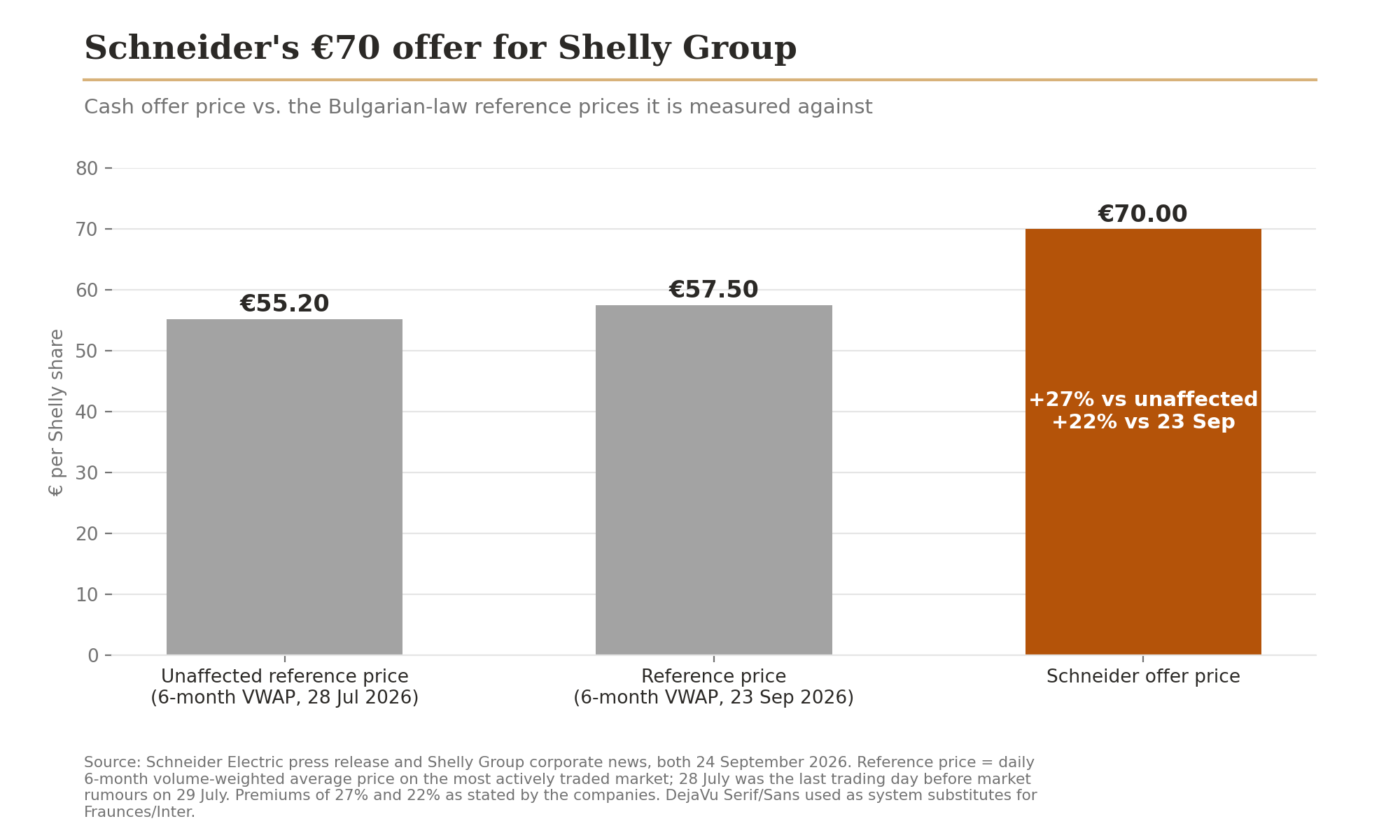
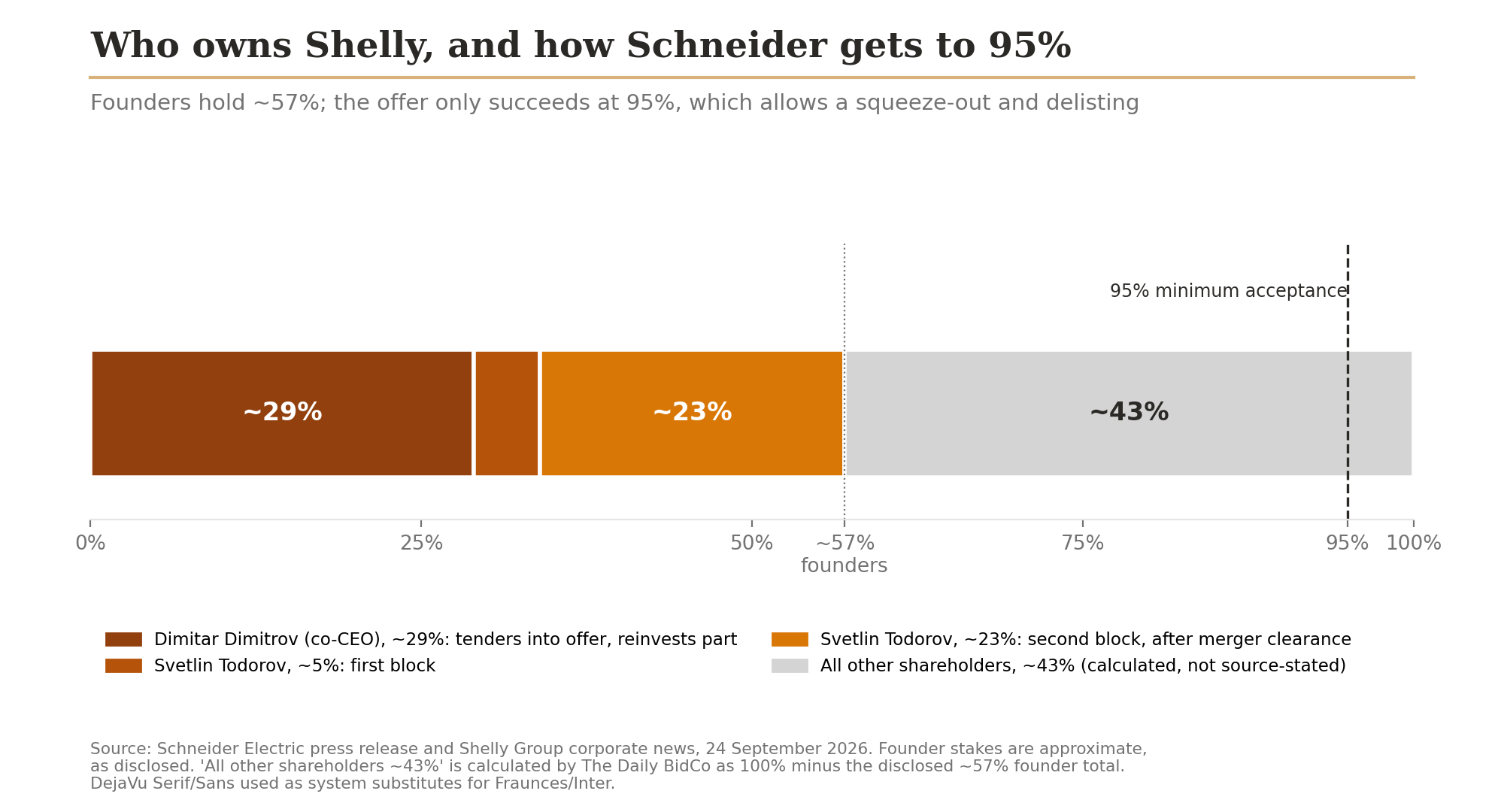
On 24 September 2026, French energy-technology group Schneider Electric announced that it intends to launch a cash takeover offer of €70 per share for Shelly Group, the Bulgarian maker of smart-home devices. The offer values Shelly at about €1.2 billion. Shelly's board has taken a preliminary view in favour, and both founders, who hold about 57% between them, have agreed to sell.
The Parties
Schneider Electric is a Paris-listed maker of electrical and energy-management equipment for buildings, data centres, factories and grids, including switches, circuit breakers, automation and software. It has about 160,000 employees, and Reuters puts its market value at around €165 billion.
Shelly Group designs smart plugs, relays, meters, locks and cameras that let people control and monitor home appliances and energy use from a phone. It sells to DIY users and professional installers in more than 100 countries, with its strongest position in German-speaking markets. Manufacturing is contracted out (an "asset-light" model). Shelly listed in Sofia in 2016, added a Frankfurt listing in 2021, and this year became the first Bulgarian company in Germany's SDAX index. Reuters reports its revenue has grown by more than 40% a year since 2022.
Structure & Process
The acquisition will be made through a voluntary public tender offer (an offer made directly to all shareholders to buy their shares, rather than a deal voted through at a shareholder meeting). It is run under Bulgarian securities law because Shelly is a Bulgarian-incorporated SE. The bidder must register the offer with Bulgaria's Financial Supervision Commission (FSC) (the national securities regulator). Only after the FSC clears it is the offer document published and the acceptance period opened. The Shelly board will then publish a reasoned opinion (the target board's formal view on the offer, required by Bulgarian law).
For now the parties have signed an Investment Agreement (a contract setting out the terms on which Shelly will support and facilitate the offer). It is not yet an offer. The offer carries a 95% minimum acceptance threshold, which means it only succeeds if Schneider ends up with at least 95% of the shares. That level lets it run a squeeze-out (a legal procedure forcing the last minority holders to sell) and then delist.
The two founders are handled differently:
Dimitar Dimitrov (co-CEO, ~29%) will tender his shares into the offer. He will reinvest part of the proceeds alongside Schneider for at least three years and stay on as co-CEO with Wolfgang Kirsch.
Svetlin Todorov (~28%) will sell directly to Schneider in two tranches. The first is a 5% block. The second, about 23%, only moves after merger-control clearance. Both purchases are cancelled if the offer fails.
The Financing Angle
This is an all-cash offer. Neither party's release discloses how Schneider is funding it, and no financing banks or financing counsel are named. RBC's Mark Fielding, quoted by Reuters, notes the price is under 1% of Schneider's market value. That makes it likely, though unconfirmed, that the deal is funded from existing cash and facilities rather than dedicated acquisition debt. UniCredit Bulbank is acting as the Bulgarian authorised investment intermediary (the licensed local firm Bulgarian law requires to handle a tender offer). That is a procedural role, not a financing one.
Why it Matters
Reuters reports that the deal pushes Schneider deeper into the connected-home market against Legrand, ABB and Plejd. Jefferies sees "strong rationale and high potential for synergies" with Schneider's residential business, which makes up about a third of its buildings exposure. It is a classic bolt-on (a small acquisition added to an existing business line). It also fits a theme across this autumn's deals, with big industrial groups paying up for the hardware and software that manage electricity at the edge of the grid. Eaton's €810m agreement for COL Group on 25 September is a second example from the same week. For law students, it is also a rare example of a Bulgarian-law takeover of a company whose shares mostly trade in Frankfurt, with two founders exiting in two different ways.
Real-World Impact
If you own a smart plug that tells you how much electricity your washing machine uses, a company like Shelly probably made it. Now one of the world's biggest electrical equipment groups is buying it. The upside is that Shelly devices could start appearing bundled with Schneider's fuse boxes, heat pumps and home-battery systems, making "smart" energy control easier to fit when you renovate. The worry for enthusiasts is that Shelly is popular because it is open and works with lots of third-party systems. Big-company ownership sometimes means walled gardens. Shelly insists it will stay open, but that is worth watching.
On jobs, the news is reassuring in the short term. Schneider has committed to keep Shelly's headquarters, engineering teams and workforce in Bulgaria for at least three years. For Bulgaria's tech scene, the sale of its best-known listed tech company to a French giant is both a win (a big exit) and a loss (a flagship leaving the local market). It also comes as European households are being pushed to manage their energy use more actively. The deal is plausibly connected to that policy backdrop, though no source ties the two directly.
Why they did it this way