Caesars shareholders approve Fertitta's $17.6bn take-private
Hussain Jeddy · 25 September 2026
Share on LinkedIn- Target
- Caesars Entertainment, Inc. (NASDAQ: CZR)
- Buyer
- Fertitta Entertainment, Inc.
- Deal value
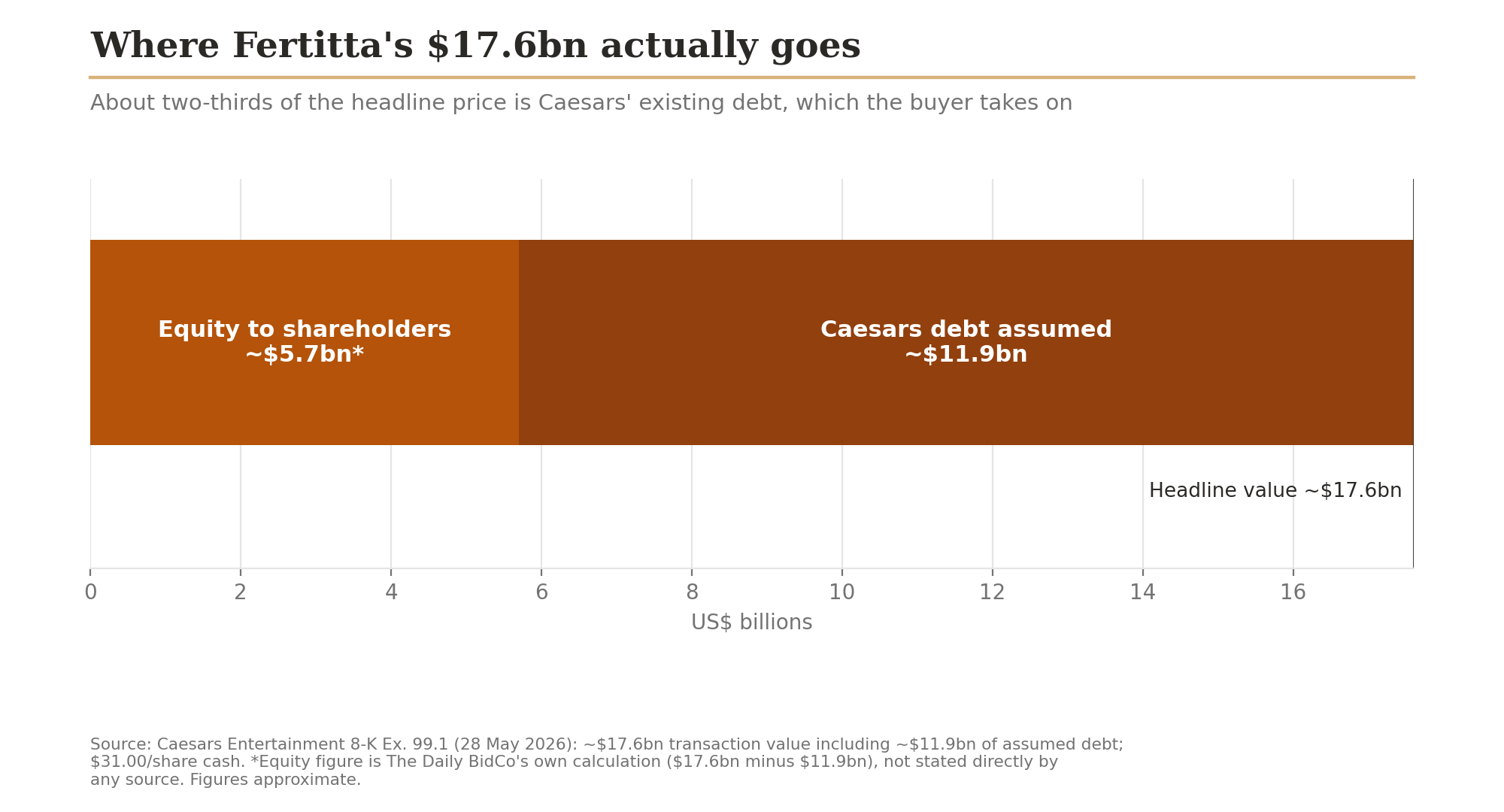
- ~$17.6bn including ~$11.9bn of assumed Caesars debt
- Price/share
- $31.00 per share in cash
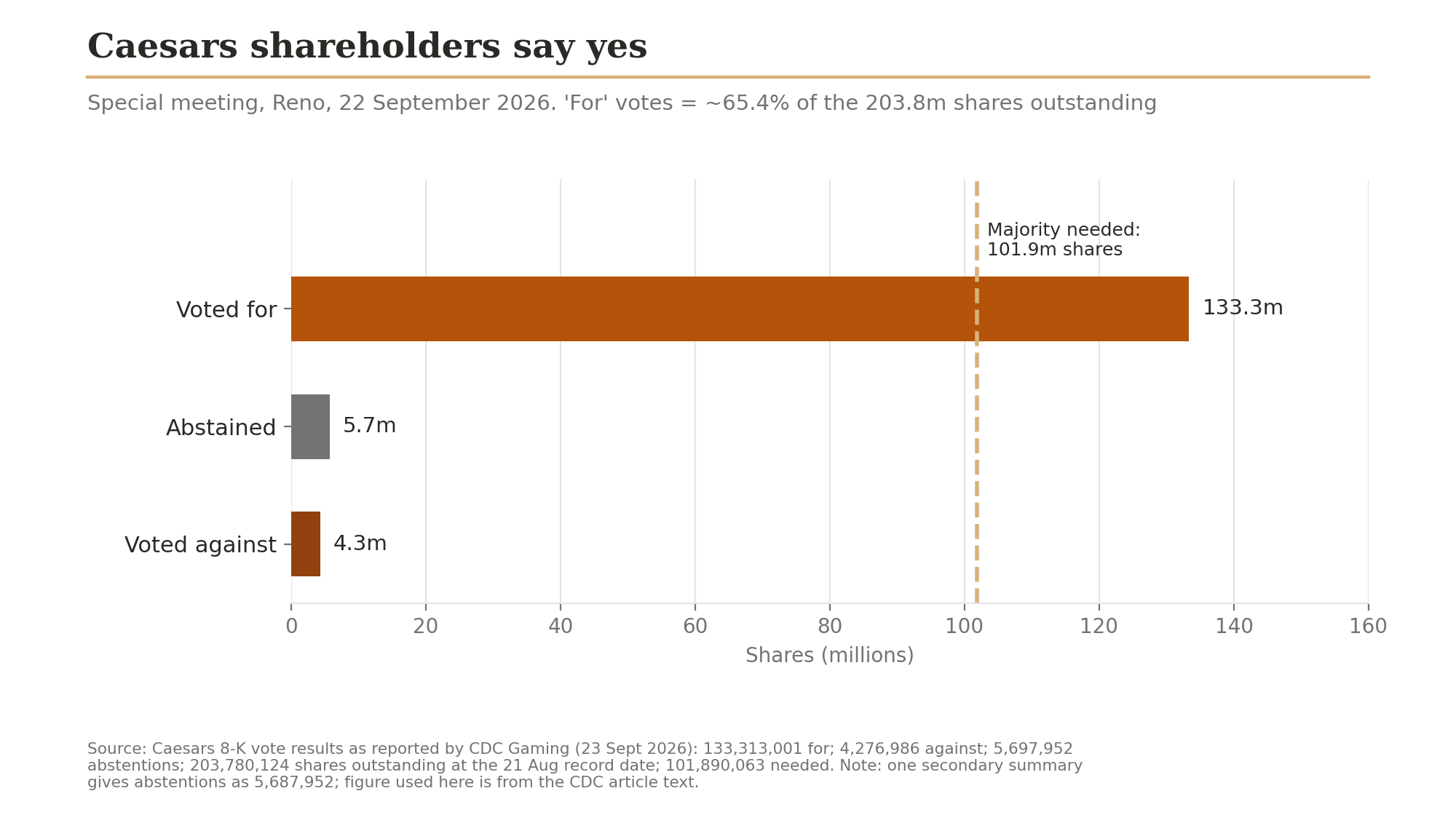
On 22 September 2026, Caesars Entertainment shareholders voted to approve the company's sale to Fertitta Entertainment, the holding company of Houston Rockets owner Tilman Fertitta. Fertitta is paying $31 cash per share in a deal worth about $17.6 billion including roughly $11.9 billion of Caesars debt it takes on. About 133.3 million shares voted in favour, around 65.4% of shares outstanding, against roughly 4.3 million voting no.
The Parties
Caesars Entertainment is the largest casino-entertainment operator in the US. It runs more than 50 casinos in 19 states, including eight on the Las Vegas Strip, under brands like Caesars, Harrah's, Horseshoe and Eldorado. It also owns the Caesars Rewards loyalty programme, an online sportsbook and iCasino business, and William Hill retail betting. It became this big through the 2020 merger with Eldorado Resorts, the business founded by the Carano family.
Fertitta Entertainment holds substantially all of Tilman and Paige Fertitta's assets. Those include Golden Nugget casinos (Las Vegas, Atlantic City, Biloxi, Lake Charles and others), Landry's and more than 450 full-service restaurants (Morton's, Mastro's, Bubba Gump, Rainforest Cafe, The Palm), luxury hotels, aquariums and the NBA's Houston Rockets. CDC Gaming reports that Fertitta also holds a 12.3% stake in Wynn Resorts.
Structure & Process
This is a US public-company merger (a statutory process where the target combines into a buyer subsidiary and its shares are cancelled for cash). Two features stand out.
The first is a "go-shop" (a window after signing when the target may actively seek better offers). It ran until 11 July 2026. No superior bid was ever announced.
The second is a rollover (an existing shareholder swapping part of its stake for equity in the buyer rather than cashing out). The Carano family, which owns about 5% of Caesars, agreed to roll part of its stake into Fertitta Entertainment.
The deal needed a simple majority of outstanding shares to pass. It cleared that comfortably, so the adjournment proposal was never needed.
What remains is regulatory. On 14 September Caesars disclosed that the FTC had issued a second request (a demand for much more information that extends the US antitrust waiting period until 30 days after the parties substantially comply). Casino deals also need approval from each state's gaming regulator.
The Financing Angle
Per the press release, the deal has no financing condition. It is funded by a mix of Fertitta equity, Caesars' existing debt (which carries over), and new committed debt arranged by a group of 10 banks. Morgan Stanley and Goldman Sachs are Fertitta's financial advisers. White & Case's finance team advised Fertitta on the financing. CDC Gaming also reports a ticking fee (a daily per-share amount paid to target shareholders if closing slips past a set date) of $0.007150 per share per day if the deal hasn't closed by 26 June. Latham & Watkins are legal counsel to Caesars, Skadden are the antitrust counsel to Caesars, and Freshfields are legal counsel to the Carano family.
Why it Matters
This is one of the largest take-privates of the year. It puts the biggest US casino operator under the control of a single billionaire family. It's also a case of standard a US public-to-private, following the standard procedure of go-shop, rollover, shareholder vote, then an FTC second request. CDC Gaming notes it's "unclear" whether the FTC will require asset sales in markets where Golden Nugget and Caesars overlap.
Real-World Impact
If you're a chronic gambler, or you've ever stayed at Caesars Palace, earned points on a Caesars Rewards card, placed a bet on the Caesars Sportsbook app, or eaten at a Bubba Gump or Morton's, this deal pulls all of those under one owner. Management has pitched the upside. Your Caesars Rewards status could eventually work across more than 600 Fertitta restaurants, aquariums and venues as well as 60 casino resorts.
The flip side is debt. The deal loads about $11.9 billion of existing debt plus new bank borrowing onto a privately owned company. Heavily indebted owners can look for savings through staffing, pricing or reinvestment, though no job cuts have been announced and management is staying put.
The FTC's closer look also matters for gamblers in towns where Caesars and Golden Nugget are both present. Fewer competing casinos could mean fewer promotions or worse odds. That's speculative, and it's what the regulator is now examining. One Wall Street analyst quoted by CDC Gaming even argues rivals MGM and Boyd could benefit, a sign that some think competitors may come out ahead.
Why they did it this way