Royal Caribbean Group buys 50% of Sandals & Beaches Resorts for ~$3bn
Hussain Jeddy · 23 September 2026
Share on LinkedIn- Target
- Sandals Resorts and Beaches Resorts
- Buyer
- Royal Caribbean Group
- Deal value
- ~$3bn for a 50% equity interest
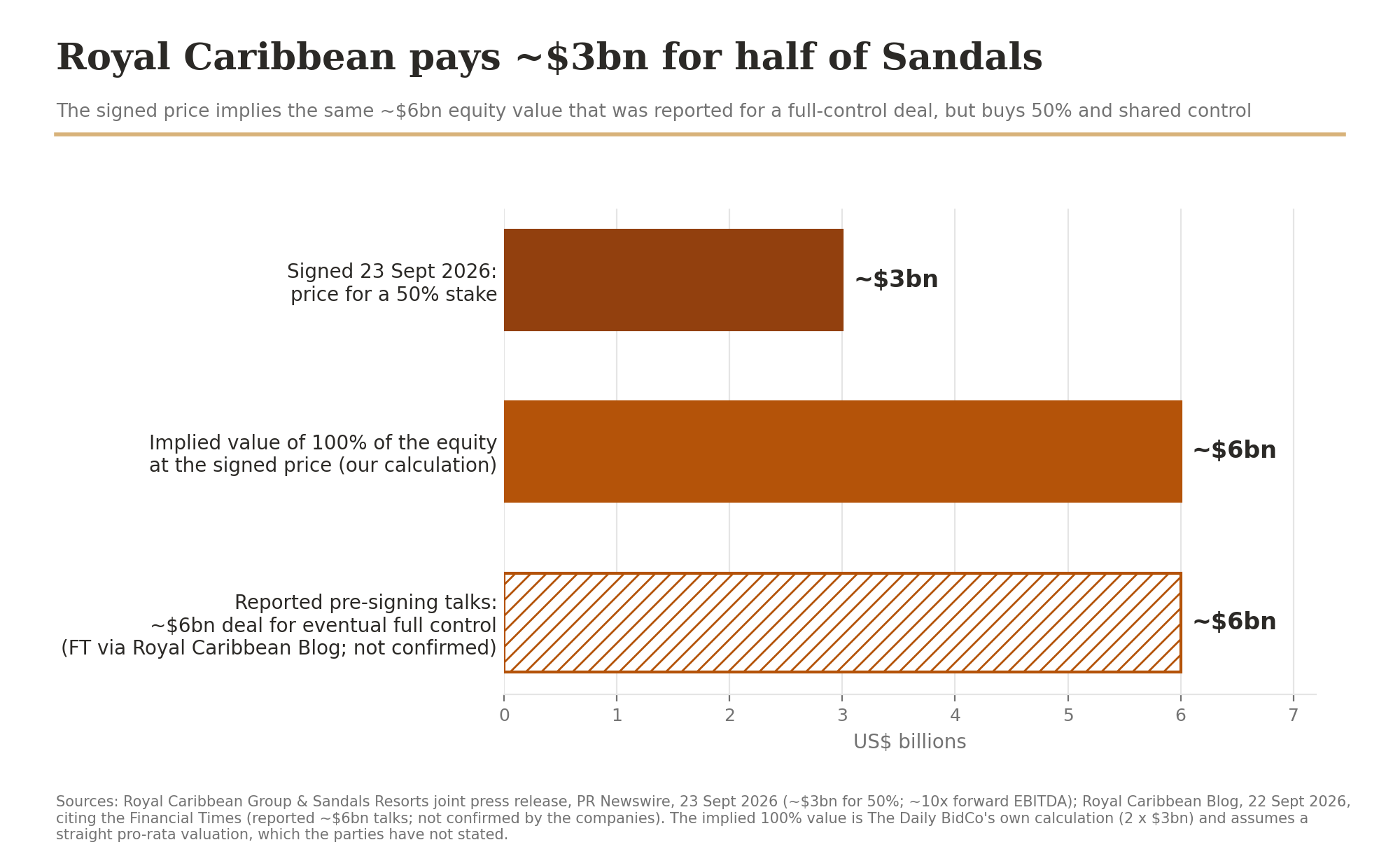
On 23 September 2026, Royal Caribbean Group and Sandals Resorts announced they had signed an agreement for Royal Caribbean to acquire a 50% equity interest in Sandals and Beaches Resorts for about $3bn. That price works out at roughly 10 times Sandals' forward EBITDA (expected earnings before interest, tax, depreciation and amortisation over the coming year, a common shorthand for a business's operating profit). The two companies will run the business as a joint venture, and completion is expected in early 2027.
The Parties
Royal Caribbean Group is a global cruise company. It operates 71 ships through three wholly owned brands (Royal Caribbean, Celebrity Cruises and Silversea) and owns 50% of TUI Cruises. It also runs private destinations such as its "Perfect Day" islands and "Royal Beach Club" venues, and it plans to enter river cruising in 2027.
Sandals Resorts operates adults-only all-inclusive beachfront resorts across Jamaica, Antigua, Saint Lucia, The Bahamas, Barbados, Grenada, Curaçao, and Saint Vincent and the Grenadines. Its sister brand, Beaches Resorts, is the family version, with resorts in Negril (Jamaica) and Turks and Caicos and more planned.
The business was founded by Gordon "Butch" Stewart more than four decades ago. His son Adam Stewart is Executive Chairman, and the family still owns it. Before this deal it was entirely private, so there was no public share price for Royal Caribbean to pay a premium over.
Structure & Process
This is a private minority-to-parity stake purchase and not a takeover. Because Sandals isn't listed, there was no public offer, tender offer or scheme of arrangement. Royal Caribbean negotiated directly with the owners and signed a purchase agreement for half the equity.
The result is a joint venture (a business owned and controlled jointly by two parties) governed by a board under the "shared leadership" of Adam Stewart and Royal Caribbean CEO Jason Liberty. Stewart stays on as Executive Chairman of Sandals and Beaches.
Closing is subject to "customary approvals and closing conditions". The parties haven't said which regulators are involved. Given Royal Caribbean's size and the number of Caribbean jurisdictions Sandals operates in, merger-control filings are likely.
The Financing Angle
Royal Caribbean says it has committed debt financing from Morgan Stanley to fund the investment. That means a bank has contractually agreed to lend the money, as opposed to a "highly confident" letter that falls short of a binding promise. Morgan Stanley is also one of Royal Caribbean's financial advisers.
Kirkland & Ellis are listed legal advisers to Royal Caribbean Group, and Jones Day and Latham & Watkins are legal advisers to Sandals Group,
Why it Matters
This is a significant cruise company buying into significant land-based holidays. Royal Caribbean's framing is that it wants a larger share of what it calls the "approximately $2 trillion global vacation market".
The strategic logic has been stated for a while. As quoted by Royal Caribbean Blog, CEO Jason Liberty said in a 2024 interview that his company competes directly with "places like Orlando and Las Vegas". The Sandals deal puts that into practice. Royal Caribbean can now sell a cruise, a private island day and an all-inclusive resort stay to the same customer. From a business point of view, the deal shows that a large strategic acquisition doesn't have to be a takeover. Buying 50% of a private, founder-owned business needs very different documents and protections, such as shareholder agreements, board composition rules, deadlock mechanisms and any exit rights.
Real-World Impact
Nothing changes for those who have a Sandals or Beaches holiday booked. Reservations, loyalty programmes and resort operations "will continue as usual". The bigger question is what happens over the next few years. With both brands under one roof, you could start seeing cruise-plus-resort bundles, shared loyalty perks, or Sandals stays promoted to Royal Caribbean's cruise customers. The companies say they will "explore opportunities to broaden distribution" and "make it easier for travelers to discover vacation experiences offered across both portfolios".
That could mean more convenient package deals. It might also mean that, over time, fewer big independent players control more of how Caribbean holidays are sold. No price changes have been announced, and any effect on prices is speculative.
For the Caribbean itself, Sandals is a home-grown Jamaican company that grew into a regional brand. Its chairman says the deal lets it "grow faster", which could mean more resorts and hiring across the islands. It could also raise questions about local ownership once a US-listed company holds half. Royal Caribbean's own filing flags "growing anti-tourism sentiments and environmental concerns" as a business risk, so debate about how much tourism the islands can handle is worth watching. Neither company has linked that debate to this deal.
Why they did it this way