Paramount Skydance clears the last major hurdle to its $111bn acquisition of Warner Bros. Discovery
Hussain Jeddy · 22 September 2026
Share on LinkedIn- Target
- Warner Bros. Discovery, Inc.
- Buyer
- Paramount Skydance Corporation
- Deal value
- $110bn enterprise value
- Price/share
- $31.00 per WBD share
On 21 September 2026, Paramount Skydance reached a settlement with a coalition of 12 Democratic state attorneys general, led by California's Rob Bonta, resolving the antitrust lawsuit that had threatened to derail its $111 billion takeover bid for Warner Bros. Discovery. The underlying deal, a definitive, board-approved, all-cash merger agreement at $31.00 per WBD share, was originally signed on 27 February 2026, after Paramount out-bid a rival agreement WBD had struck with Netflix in December 2025. Monday's settlement clears what both sides describe as the last major legal obstacle to closing, though it still requires a judge's sign-off.
The Parties
Paramount Skydance is the US media and entertainment company formed in August 2025 when David Ellison's Skydance Media merged with the former Paramount Global, bringing together CBS, the Paramount film studio, Paramount+, and various cable networks. Warner Bros. Discovery is its larger rival: it owns Warner Bros. Studios, HBO and the HBO Max streaming service, CNN, and a broad slate of cable networks including Discovery, TNT and TBS, along with franchises such as DC Comics and Harry Potter. Together, the combined company would bring under one roof two film studios, two streaming platforms (Paramount+ and HBO Max), and two news organisations (CBS News and CNN).
Structure & Process
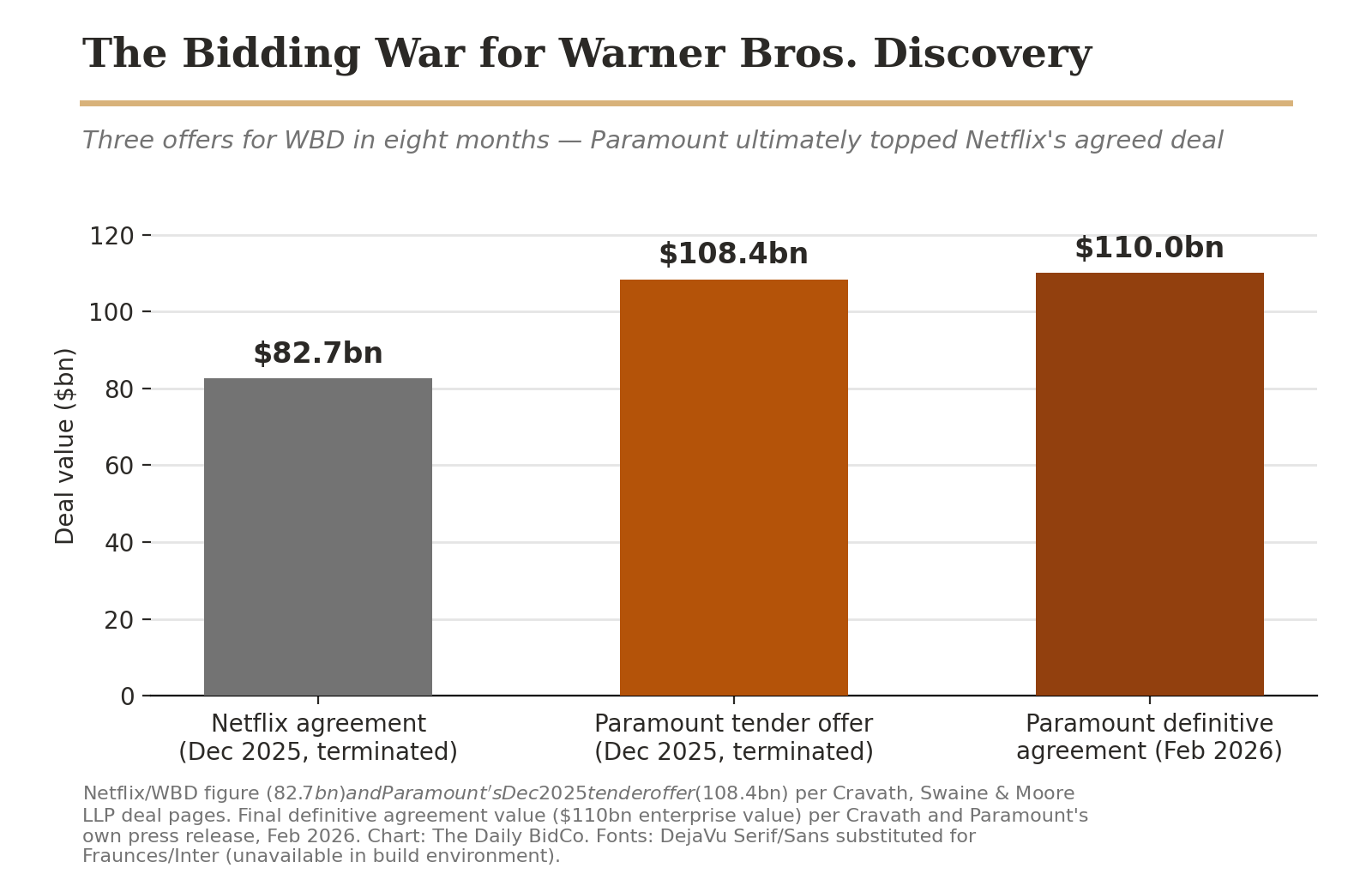
This is a US definitive merger agreement a negotiated, board-recommended, all-cash acquisition, not a hostile tender offer, though it didn't start that way. Paramount initially launched an unsolicited all-cash tender offer a direct offer to the target's shareholders, bypassing the target's board, worth $108.4bn in December 2025, after WBD's board had already agreed to sell to Netflix for $82.7bn. Following a competitive bidding process between Netflix and Paramount, WBD's board concluded Paramount's offer was superior, pulled out of the Netflix agreement, and signed a definitive merger agreement with Paramount in February 2026, at which point Paramount terminated its tender offer in favour of the negotiated deal. The transaction cleared US Department of Justice antitrust review in June 2026 (the DOJ found the deal was "not likely to result in harm to competition," and in fact concluded it was likely to increase competition against larger streamers) and won approval "from competition authorities in nearly 70 jurisdictions worldwide," according to Paramount CEO David Ellison. The remaining obstacle was a separate lawsuit brought by 12 state attorneys general (plus a related challenge from the Writers Guild of America), now resolved via settlement, though the settlement still requires approval from the presiding federal judge before it's final.
The Financing Angle
The purchase is financed by roughly $47 billion in cash equity, fully backed by the Ellison family and RedBird Capital Partners (with the possibility of additional strategic or financial partners joining before completion), plus debt commitments of around $54 billion from Bank of America, Citigroup and Apollo, comprising $15bn to backstop WBD's existing bridge facility and $39bn of incremental new debt (source figures for the debt components: $15bn + $39bn = $54bn).
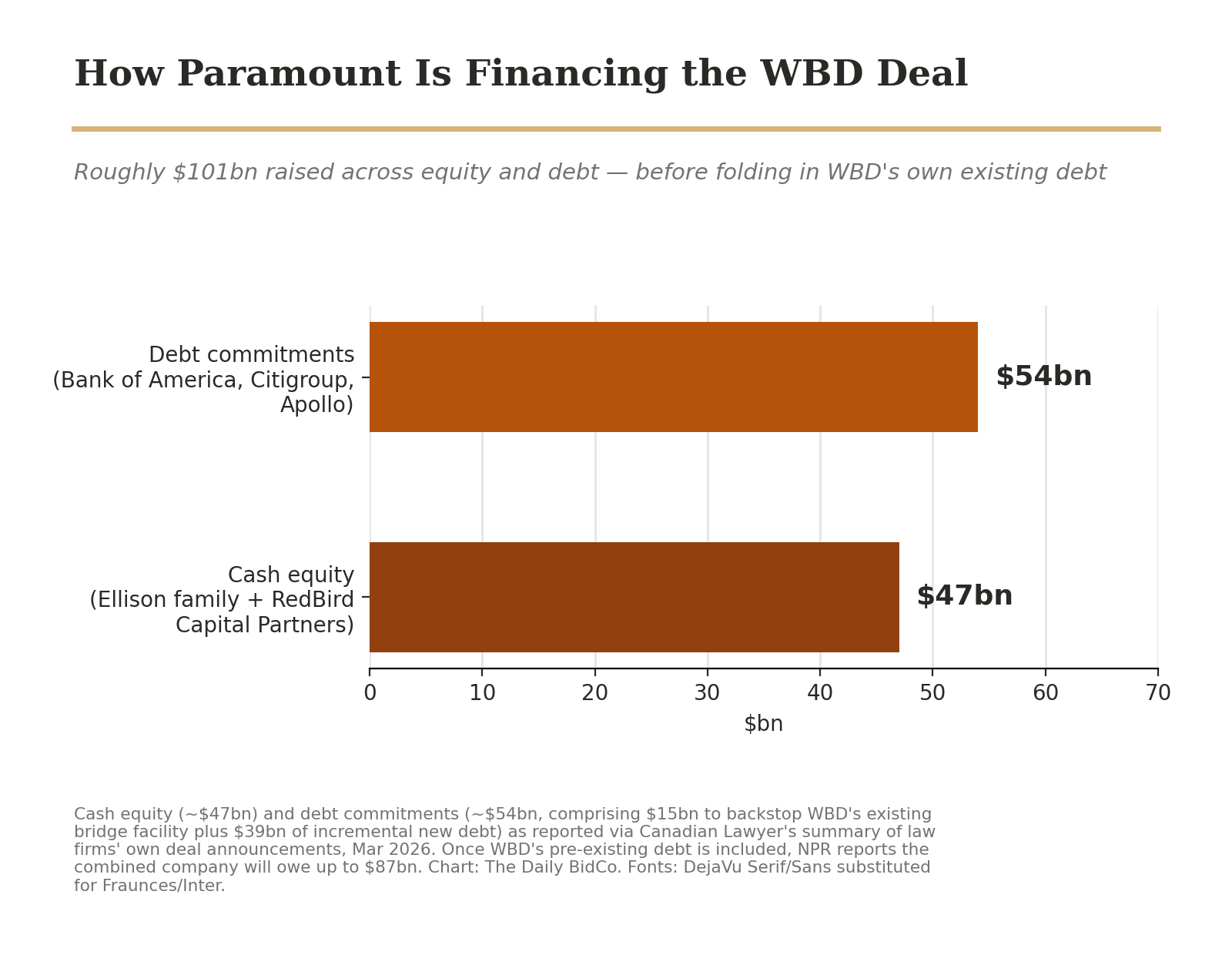
Separately, on 18 September 2026 the FCC approved financing arrangements that will leave the combined company up to 49.5% owned by foreign interests — including sovereign wealth funds from Saudi Arabia, Qatar and Abu Dhabi, structured as silent, non-voting shares, with the regulator ruling that stake could rise as high as 100% on the same non-voting basis. Warner Bros.' own existing debt adds to the pile. NPR reports the combined company will owe up to $87 billion once the deal closes. Latham & Watkins advised Paramount separately on the debt financing, and separately again on financing for what's been described as the largest leveraged buyout in history, and Cahill Gordon acted for the lead arrangers and debt financing banks.
Why it Matters
If it closes, this would be the largest all-cash deal in corporate history and would fundamentally reshape the US media landscape, combining two of the "big" legacy Hollywood studios, two major streaming platforms, and two national news organisations under one owner for the first time. It's also a case for how far a heavily leveraged buyer can go in taking on debt (up to $87bn combined) to win a contested media asset against a well-capitalised rival (Netflix), and for how state antitrust enforcers can extract structural and behavioural concessions (output commitments, editorial firewalls) as the price of allowing a deal to proceed rather than blocking it outright.
Real World Impact
If you've ever complained about your streaming bill, or wondered why your local cable package keeps creeping up in price, this is a deal worth watching. Two of the biggest names in Hollywood, the studio behind Mission: Impossible and the one behind Harry Potter, are about to become one company, and it's happening on a mountain of borrowed money. Up to $87 billion once WBD's existing debt is folded in.
Unions representing entertainment workers are already predicting significant layoffs as the combined company looks for ways to service that debt, though California's attorney general has publicly pushed back on that prediction and the settlement includes a $47.5 million fund specifically for workers affected by the merger.
There's a bet on where movies get made, too. As part of the settlement, the company has committed to release at least 30 (rising to 32) films a year and spend an extra $300 million annually making movies in the US, explicitly aimed at protecting production jobs, after Paramount had reportedly floated moving its headquarters out of Hollywood to Tennessee or Texas if the deal collapsed. And there's a political dimension as nearly half the combined company (up to 49.5%, potentially more) could end up owned by foreign sovereign wealth funds from Saudi Arabia, Qatar and Abu Dhabi, and the settlement had to build in a specific editorial-independence board for CNN and CBS News amid public concern about the Ellison family's ties to the Trump White House, concerns serious enough that Connecticut's attorney general said he wanted full divestiture of CNN and CBS News and was "deeply disappointed" the states couldn't secure it. Whichever way you look at it, your monthly bill, a friend's job in the industry, or who owns the news you watch, this deal touches more people than most.
Why they did it this way