THE DEAL BENCH
Who advised, and who did what
Tap a team to see what it does in a deal like this.
BUYER SIDE
Herbert Smith Freehills Kramer
Legal adviser to Coca Cola HBC
BUYER SIDE
Latham & Watkins
Antitrust counsel to Coca Cola HBC
BUYER SIDE
ENS
Antitrust counsel to Coca Cola HBC
BUYER SIDE
Pestalozzi
Swiss law adviser to Coca Cola HBC
TARGET SIDE
McDermott Will & Schulte
Lead counsel to The Coca Cola Company
TARGET SIDE
Webber Wentzel
Lead counsel to Gutsche Family Investments
TARGET SIDE
Schellenberg Wittmer
Swiss counsel to The Coca Cola Company and Gutsche Family Investments
OTHER SIDE
Skadden, Arps, Slate, Meagher & Flom
Reported adviser to Coca Cola Holdings Africa and Gutsche Family Investments (unconfirmed)
OTHER SIDE
Bowmans
Local adviser on the deal, client not stated
OTHER SIDE
Cliffe Dekker Hofmeyr
Local adviser on the deal, client not stated
Select a team above.
On Friday 27 November 2026 Coca Cola HBC announced that it had completed its purchase of 75% of Coca Cola Beverages Africa, a deal first signed on 21 October 2025. The last piece of the puzzle was a merger control approval from the Fair Competition Commission of Tanzania, the sixth and final authority on the list.
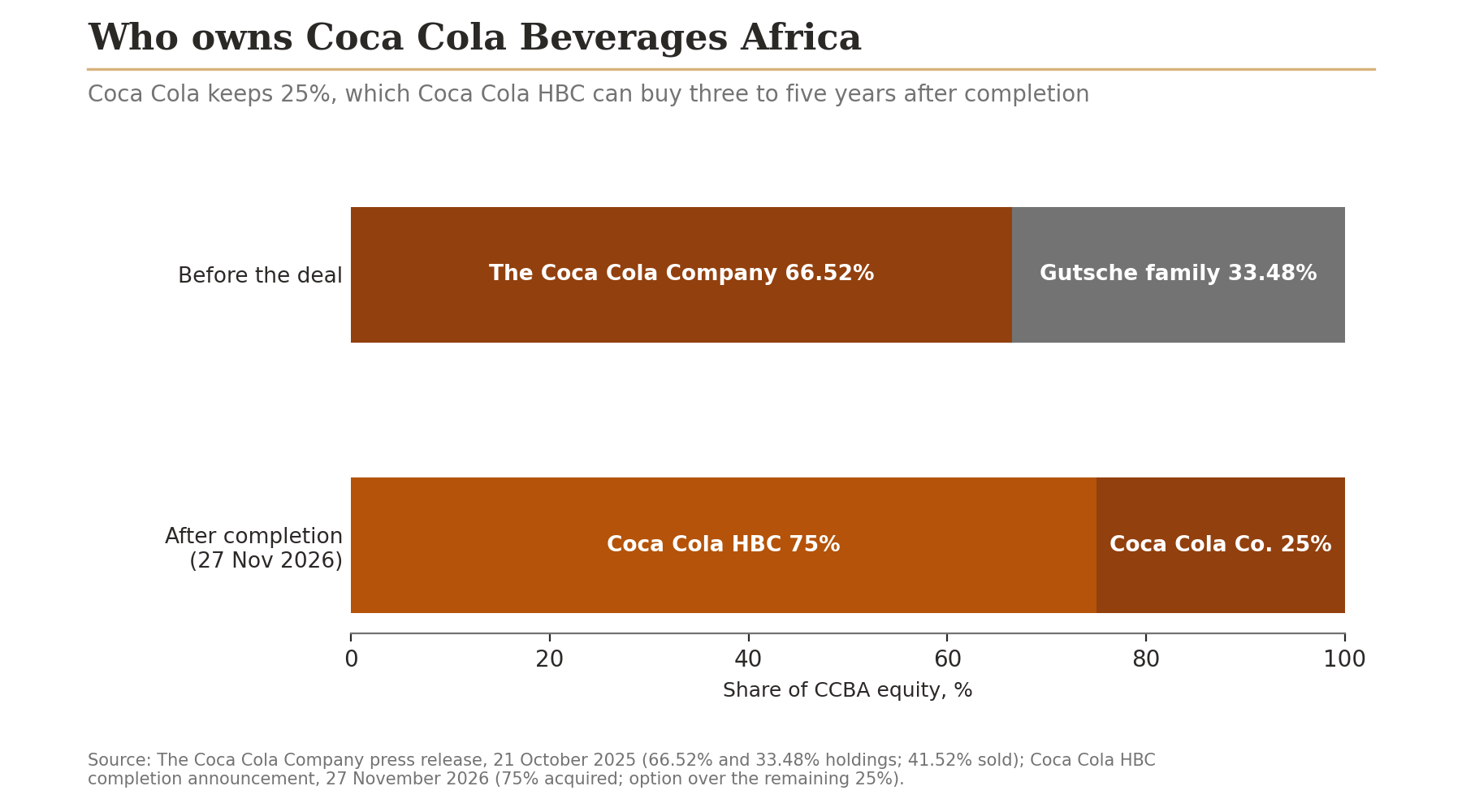
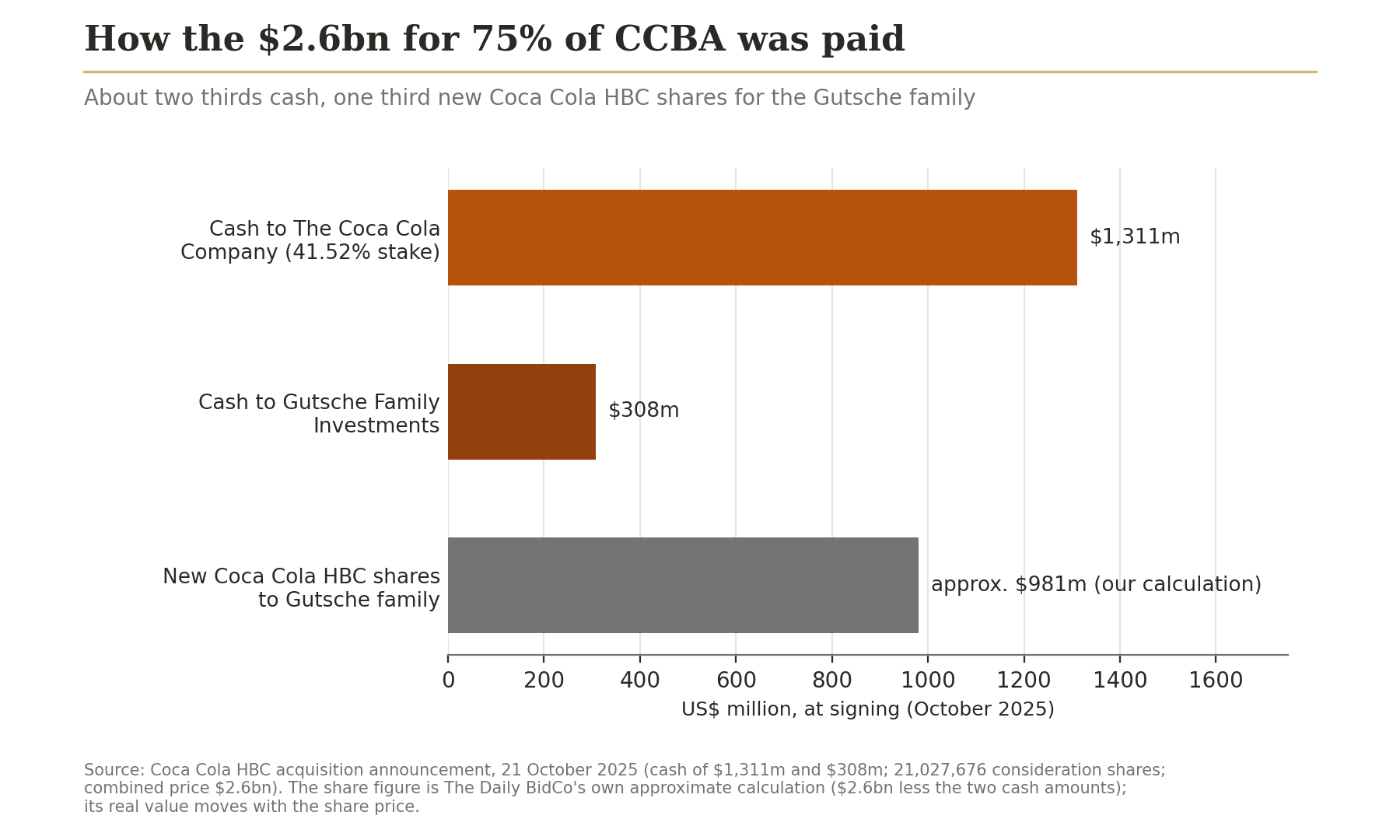
The price was $2.6bn at signing, which the company says values the whole of CCBA at $3.4bn. It was paid in two very different ways. The Coca Cola Company sold 41.52% of CCBA for about $1.3bn in cash. The Gutsche family, through Gutsche Family Investments, sold its entire 33.48% for $308m in cash plus 21,027,676 brand new Coca Cola HBC shares. That makes the family a 5.45% shareholder in the buyer. Coca Cola keeps the last 25% of CCBA for now, but the two sides signed an option agreement under which Coca Cola HBC can buy it, or Coca Cola can make it buy, within six years.
Coca Cola HBC says the deal makes it the world's second largest Coca Cola bottler by volume, adds 14 African markets and gives it about two thirds of Coca Cola's entire bottling volume in Africa.
The Parties
Coca Cola HBC is one of Coca Cola's biggest bottlers (independent companies that make, package and distribute Coca Cola drinks under licence in a set territory). It began in Nigeria in 1951, is headquartered in Zug, Switzerland, and before this deal served 29 countries across Europe and Africa, including Nigeria and Egypt. Its two biggest shareholders, Kar Tess Holding and The Coca Cola Company itself, together held about 45% of the voting rights when the deal was signed.
Coca Cola Beverages Africa was formed in 2016 when Coca Cola, SABMiller and the Gutsche family pooled their African bottling businesses. It is headquartered in Johannesburg, operates in 14 countries from South Africa and Kenya to Ethiopia and Mayotte, employs over 14,000 people and accounts for about 40% of all Coca Cola volume sold in Africa. South Africa alone is about 60% of its volume. In 2025 it made net sales of $3,691m and EBIT of $259m.
The sellers are The Coca Cola Company, which owned 66.52% of CCBA, and Gutsche Family Investments, a South African private company whose family has been bottling Coca Cola in Southern and Eastern Africa since 1940.
Structure & Process
Because CCBA is a private company, this was not a takeover of a listed target. It was a share purchase under a single sale and purchase agreement, or SPA. The SPA is governed by English law, with disputes going to arbitration in London under the rules of the London Court of International Arbitration.
The SPA contained conditions precedent. There were four groups:
Merger control approvals in South Africa, Botswana, COMESA (the regional competition authority for the Common Market for Eastern and Southern Africa), Mozambique, Namibia and Tanzania.
Approval by Coca Cola HBC's own shareholders to change its Swiss articles of association, so it could create the new shares for the Gutsche family without first offering them to existing shareholders.
Admission of the new shares to trading in London and Athens, and approval of a secondary listing on the Johannesburg Stock Exchange (JSE).
Exchange control approval from the South African Reserve Bank, needed because South African sellers were receiving shares in a foreign company.
The price was also protected by a leakage adjustment, and the sellers agreed conduct of business covenants. The SPA had a longstop date of 31 October 2026, which extended automatically by six months because the conditions were still outstanding on that date. Coca Cola HBC's shareholders approved the resolutions in January 2026, South Africa's Competition Tribunal approved the deal in September 2026, and Tanzania's approval arrived just before completion.
The option over the final 25% has two sides. A call option lets Coca Cola HBC buy the stake between three and five years after completion. A put option lets Coca Cola sell it to Coca Cola HBC between three and a half and six years after completion. Either way the price is the same per share price Coca Cola received in this deal plus a coupon, payable in cash or, at Coca Cola HBC's choice, in its own shares.
The Financing Angle
When it signed, Coca Cola HBC put in place €2.5bn of committed bridge facilities. Of that, €1.4bn covered the cash price and €1.1bn was available, if needed, to refinance some of CCBA's existing debt. In March 2026 it issued bonds to replace the bridge, and the cash paid at completion came from those bonds and cash already on hand.
The other third of the price was paid in consideration shares. The number, 21,027,676, was fixed by reference to Coca Cola HBC's 30 trading day volume weighted average price up to 17 October 2025. On our own rough calculation, those shares were worth about $981m at signing ($2.6bn less the two cash payments). Using shares for part of the price meant less borrowing. Coca Cola HBC says its leverage should stay within its target range of 1.5 to 2.0 times, and that the deal should be low single digit EPS accretive from the first full financial year. It also cancelled its share buyback programme when it signed.
Why it Matters
This is a textbook example of how a brand owner reshapes its supply chain. The Coca Cola Company says bottling businesses it controls made up 52% of its net revenue in 2015 and 13% in 2024, and expects that to fall to about 5% after this sale. CCBA is one of the largest pieces of that refranchising strategy, following the sale of a 40% stake in its Indian bottler in July 2025.
For Coca Cola HBC, the deal shifts its centre of gravity. S&P (via Business Day) estimates South Africa will overtake Russia as its largest market, at about 15% of revenue, with Russia and Nigeria at about 10% each. For students, it shows how a single private deal can involve English contract law, Swiss company law, UK listing rules, South African exchange controls and six competition regimes at the same time.
Real World Impact
If you buy a Coke, Fanta or Sprite almost anywhere in East or Southern Africa, the company behind the bottle has just changed hands. For most shoppers nothing will look different tomorrow: the drinks, brands and shops stay the same.
The changes worth watching are about jobs and investment. In South Africa, the deal was approved on the condition that there are no merger related job cuts and that the business keeps its headquarters in the country. Coca Cola HBC says it plans to "invest in our leading 24/7 portfolio", so new products or new factories could follow. On the other hand, a bigger bottler with a stronger hand in negotiations with shops could push harder on prices. Whether that leads to cheaper drinks through efficiency or higher prices through less competition is something to keep an eye on.
Why they did it this way
- 1Buying 75% now and 25% later spreads the cost and keeps Coca Cola invested during the handover.Could have: Buy 100% at once
- 2Paying the Gutsche family partly in shares kept them invested in the buyer and cut the amount borrowed.Could have: An all cash price
- 3A vote was needed only to change Swiss rules so new shares could be issued, and big holders had already promised support.
- 4Six African competition regimes had to clear the deal, and South Africa added job and headquarters conditions.