On Wednesday 25 November 2026 a group of investors led by Eldridge, the holding company run by US billionaire Todd Boehly, announced that it had entered a definitive agreement to buy Lukoil International GmbH. LIG is the Austrian company through which Lukoil, Russia's second largest oil producer, owns almost everything it has outside Russia. The consortium's own press release describes the deal as bringing "critical global energy assets under American and allied ownership".
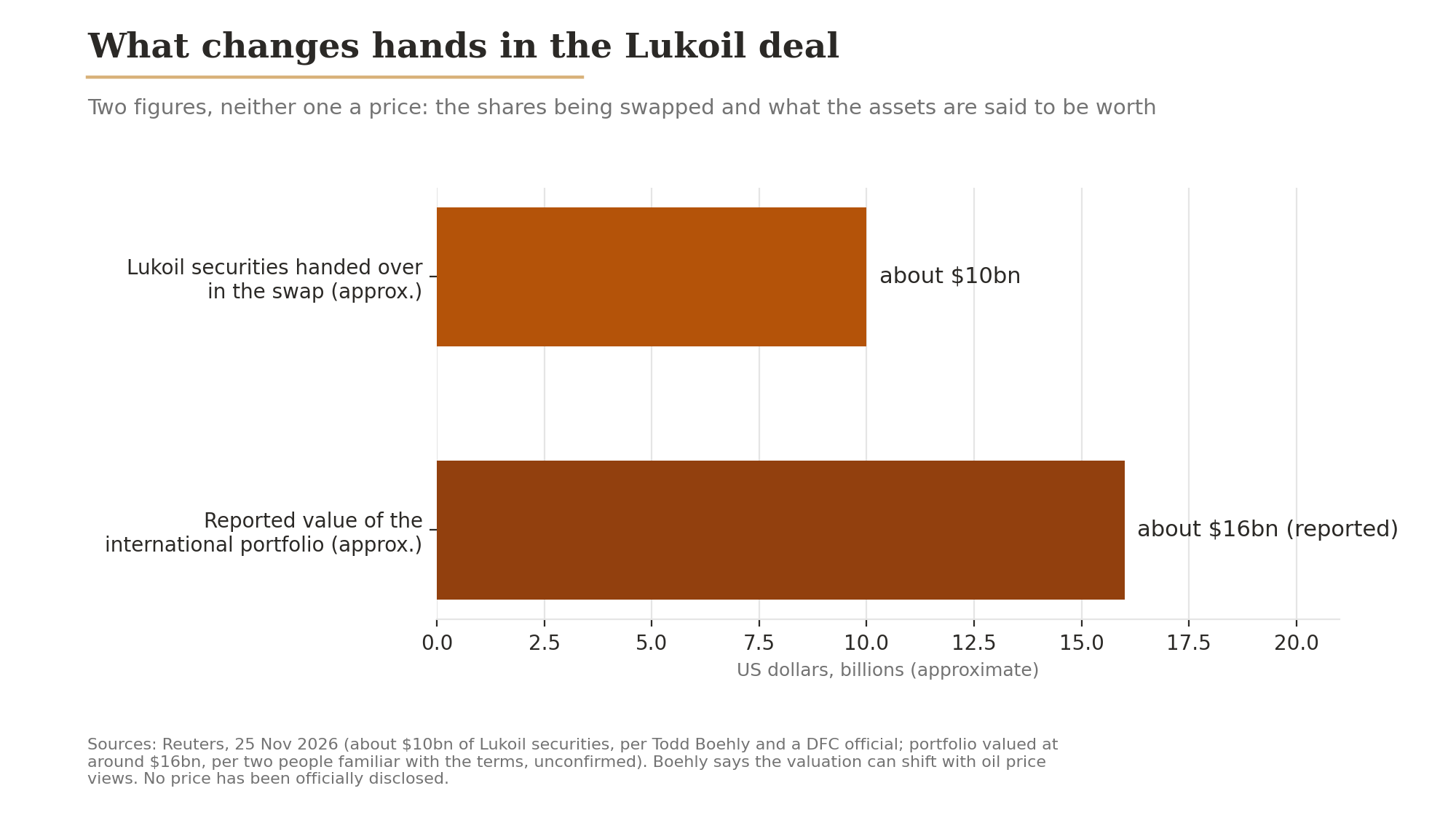
The unusual feature is the price. Nobody is paying cash. The consortium says it will hand over restricted Russian shares (shares that cannot be freely traded or moved because of sanctions) in PJSC Lukoil and other Russian companies, and take 100% of LIG in return. In the release's words, using these shares "avoids any direct cash payment to Russia1 under the transaction". Boehly and a DFC official told Reuters the securities are worth about $10bn. Two people familiar with the terms told Reuters the international portfolio itself is valued at around $16bn, although Boehly said that number "can shift depending on views on oil prices". Neither figure has been confirmed in an official document, and no formal price has been published.
The deal is signed but it cannot close yet. It needs conditional approval from OFAC, plus due diligence, other regulatory approvals and normal closing conditions. Boehly told Reuters that closing could take up to a year, and that the business will be renamed afterwards.
The Parties
The buyers. The consortium has four members. Eldridge leads it. According to the press release, it is a diversified holding company employing more than 15,000 people, owning the insurer Security Benefit and an alternative asset manager; Reuters describes it as having $75bn under management. Boehly, its chairman and chief executive, previously ran Guggenheim Partners' credit business, co owns the Los Angeles Dodgers and Lakers, and until recently held a stake in Chelsea FC. The DFC is the US government's international investment arm, set up in 2019. Xtellus Partners is a financial advisory and investment group, and Catena Investment Holding is a UAE based energy investor. The line up has changed: Reuters reports that two earlier partners, the Al Khayyat brothers and Abu Dhabi's International Holding Company, left the consortium last week. Boehly declined to say how the equity is split. Earlier reporting by the New York Times, summarised by the US sanctions firm Fesenko Law in October, put the DFC's intended stake at about 15%; the current figure is undisclosed.
The seller. PJSC Lukoil is Russia's largest private oil company. The US Treasury placed it, together with Rosneft, under blocking sanctions in October 2025. That forced Lukoil to look for a buyer for its foreign arm. Lukoil co founder Vagit Alekperov said on 26 November that the shrinking of Lukoil's international presence was caused by political circumstances rather than a voluntary business decision (as reported by UNN).
The target. LIG's portfolio, as described by the consortium, runs from oil and gas fields in 11 countries to three refineries: Burgas in Bulgaria (the largest in the Balkans), Zeeland in the Netherlands and Petrotel in Romania. It also owns LITASCO, an international oil trading business, and more than 2,000 petrol stations across 16 countries in Europe, North America and Central Asia. One point is contested. Reuters' report lists oilfields in Kazakhstan among the assets, but Lukoil has said the agreement does not include its Kazakhstan assets (as reported by UPI), consistent with the earlier Carlyle deal, which also excluded Kazakhstan.
Structure & Process
Legally this is a share purchase rather than an asset by asset sale. The consideration is unusual: instead of money, the buyers deliver securities. Reuters, in a 3 November report summarised by Fesenko Law, said a bank acting for the consortium bought frozen Lukoil securities from about ten Western funds and US depositary banks at roughly 30 cents on the dollar. Those were shares that index funds had owned because Lukoil sat in major emerging market indices, and that were frozen and written down after 2022. As Boehly put it to Reuters: "We're basically exchanging shares that are worthless to Americans ... for cash that is going back to them."
The swapped shares will not go straight to Lukoil. The consortium says the sale consideration will be held in a "restricted custodial account for five years2 or until sanctions are lifted", and Reuters reports that this escrow will be in the UAE. The release also says that on closing LIG will be "completely severed" from PJSC Lukoil.
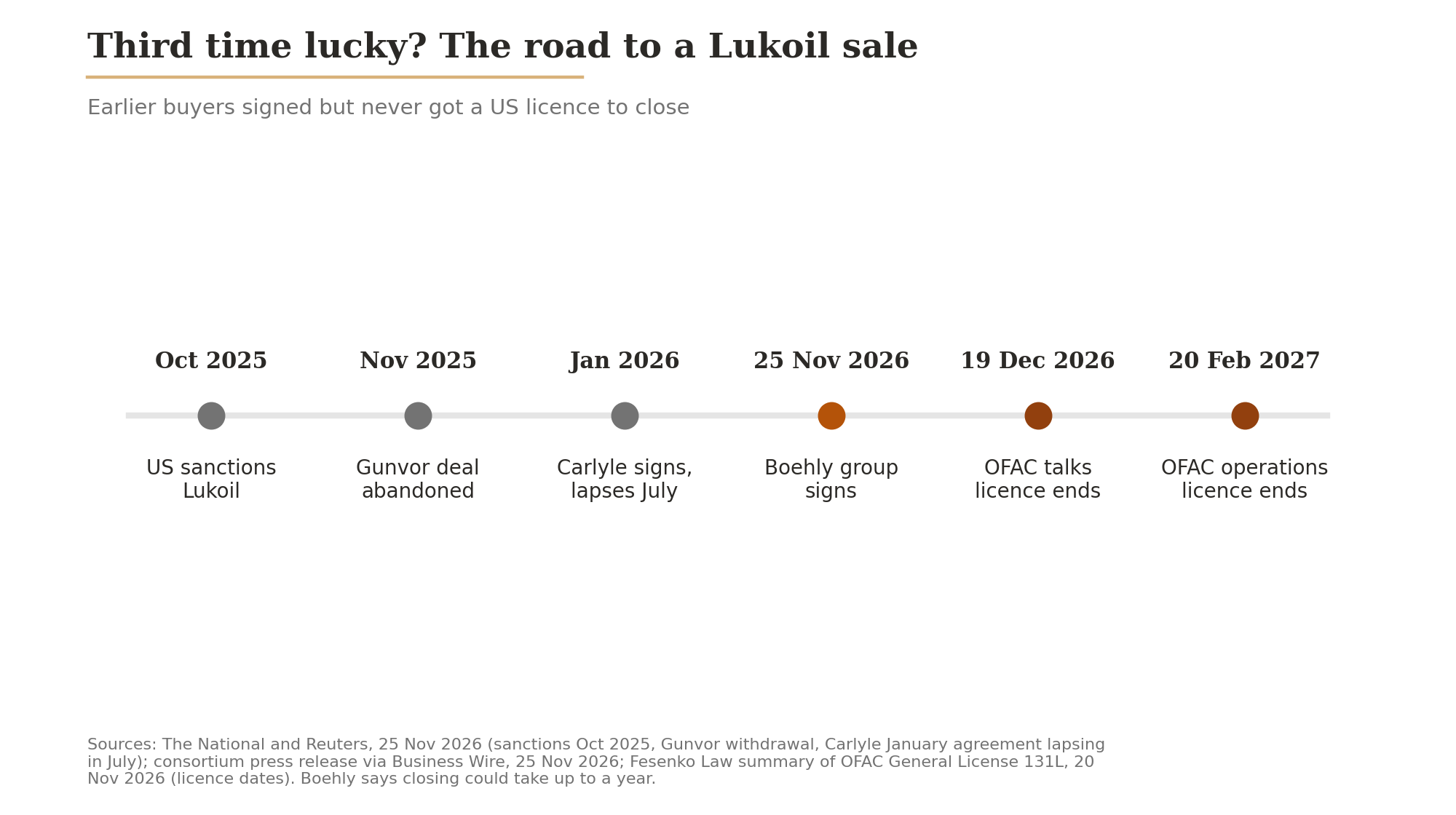
The process runs through OFAC at every stage. Since late 2025 OFAC has issued a rolling series of general licences, numbered GL 131. The current version, GL 131L, issued on 19 November, allows the parties to negotiate and sign contingent contracts until 19 December 2026, and lets LIG keep operating until 20 February 2027 (Fesenko Law). It does not authorise the sale itself. That is why the deal is signed but cannot close. The consortium now needs a specific OFAC authorisation for the transfer. OFAC's published guidance (FAQ 1224, as summarised by Fesenko Law) says any sale must sever LIG from Lukoil, keep anything owed to Lukoil blocked in an account subject to US jurisdiction until sanctions end, and give Lukoil no windfall, naming share swaps as an example. Fesenko Law notes the tension between that guidance and this structure, and Reuters reports that the share swap idea was initially rejected by the Treasury but later won support from the State Department.
Two earlier buyers fell at the same hurdle. Gunvor's offer was accepted by Lukoil in 2025 but abandoned after the Treasury objected, and Carlyle's January 2026 agreement lapsed in July without an OFAC licence (The National; OGJ).
The Financing Angle
There is no acquisition debt or cash price disclosed, because the consideration is securities rather than money. The financing question is really how the consortium paid for those securities. Reuters reports that they were bought from US and British funds and depositary banks, and the 3 November report put the purchase price at around 30 cents on the dollar; the total amount spent has not been disclosed, and Fesenko Law points out that it is not public what OFAC authorisation covered those purchases.
The DFC's role is distinctive. The release says it will receive "an ownership interest with no upfront cost3 to the American taxpayer". The DFC official told Reuters the government will share in future profits only after the private investors have recovered their capital and an agreed rate of return, and will have a role on the company's board. In finance terms that is a back ended equity interest. The DFC says the arrangement is "expected to return billions to American taxpayers" (The National); that is the DFC's own projection.
What the consortium will spend after closing is not disclosed. The release says it will prioritise "bringing full refining capacity back online", which suggests investment will be needed, and Reuters' sources say the portfolio has lost value because some assets have stopped operating (as summarised by Fesenko Law). Citi is the consortium's lead financial adviser.
Why It Matters
UNN describes it as potentially one of the largest cases of a Russian business losing control of its foreign assets because of Western sanctions. It also puts a US government agency directly into the shareholder register of a former Russian business. Reuters notes it fits the Trump administration's "hands on style of state capitalism", with the US taking stakes in key companies, and that the DFC has focused increasingly on energy, critical minerals and telecoms. The politics are live: Gregory Meeks, the senior Democrat on the House Foreign Affairs Committee, said the American people deserve to know "why a U.S. government agency is taking an ownership stake in a Russian oil company's portfolio while Russia continues its war", and called for the DFC's role to be halted (Kyiv Independent).
For a law student, the deal is an example of how sanctions law shapes M&A from start to finish. It shows the difference between a licence to negotiate and a licence to close, how consideration can be engineered to satisfy a regulator, how escrow and custodial arrangements are used to keep value away from a blocked party, and how a share purchase of a single holding company can move refineries and petrol stations in a dozen countries at once. It also shows the limits of signing: two previous buyers signed and never closed.
Real World Impact
If you have filled up at a Lukoil station in Europe or the US, this deal is about who owns that forecourt. More than 2,000 stations in 16 countries, and three refineries supplying diesel and other fuels around the Black Sea, the Balkans and North West Europe, would move from Russian to American and Gulf ownership. The consortium says it will keep operations stable and bring full refining capacity back online. If that happens, it could support steadier fuel supply in places like Bulgaria, where the Burgas refinery is the country's largest and has been run by a state appointed special administrator who reported a €200m shortfall for 2025 (Radio Bulgaria). If OFAC rejects the deal, as it effectively did with two earlier buyers, that uncertainty continues.
Pump prices are a different matter. They depend mainly on global crude prices, taxes and local competition, not on who owns a refinery, so any effect from this deal alone is likely to be small and slow. Station names could change: Boehly says the business will be renamed after closing. American taxpayers are promised a share of future profits, but only after private investors are paid back with a return, so how much reaches the public, and when, is worth watching.
Why they did it this way
- 1Paying in frozen Russian shares means no cash goes to Russia, the first thing a sanctions regulator checks.Could have: A cash price paid into a blocked account
- 2Locking the shares away for five years shows the regulator that Lukoil cannot use the value while sanctions last.
- 3A free stake for a US government agency puts the regulator's own side inside the buyer group after two buyers failed.Could have: A purely private buyer group
- 4The OFAC licence only lets the parties sign a conditional deal now, so signing is the step before asking to close.