THE DEAL BENCH
Who advised, and who did what
Tap a team to see what it does in a deal like this.
BUYER SIDE
Cravath, Swaine & Moore
Legal adviser to Sanofi
TARGET SIDE
Freshfields
Lead legal adviser to Insmed
TARGET SIDE
Cooley
Legal adviser to Insmed
TARGET SIDE
Hunton Andrews Kurth
Legal adviser to Insmed
Select a team above.
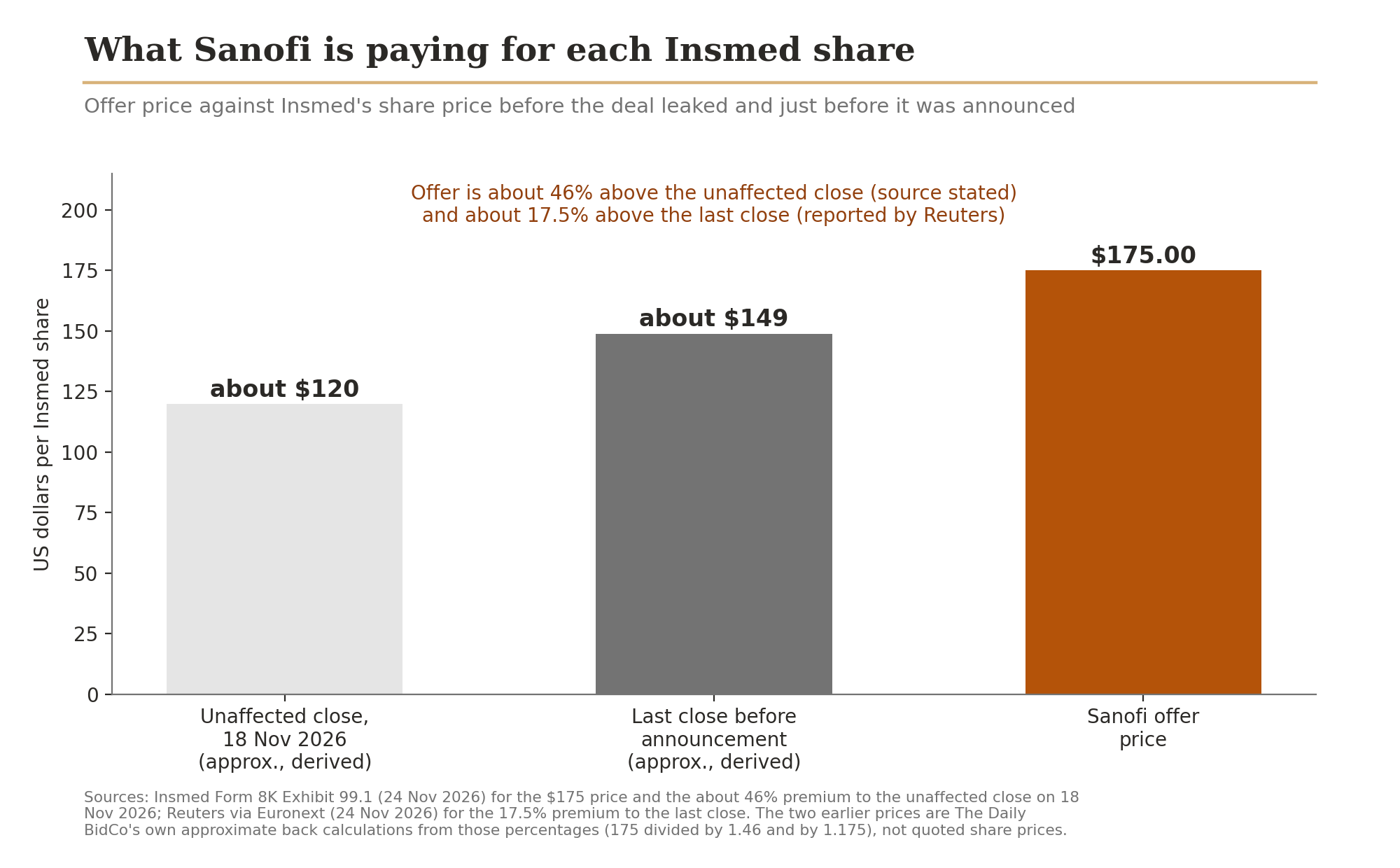
On 24 November 2026, Sanofi announced that it had agreed to buy Insmed Incorporated, a US biotech with two approved lung medicines, for $175 per share in cash. That values Insmed's shares at about $41.0bn, or €37.6bn. The merger agreement was signed the day before, on 23 November. Insmed says the price is a premium of about 46% to its unaffected share price, taken as its close on 18 November, the day before media first reported possible talks. Reuters puts the premium at 17.5% to Insmed's last close before the announcement. The gap between the two figures shows how much of the takeover value the market had already priced in once the rumours appeared.
Both boards have approved the deal, and Insmed's board has recommended that its shareholders vote in favour. Closing still depends on that vote and on competition and foreign investment clearances. Sanofi expects to complete in the first half of 2027. Reuters reports that this is Sanofi's biggest deal in two decades, and that Sanofi's finance chief described it to journalists as the fourth largest cash deal ever in Europe and the largest ever in France.
The Parties
Sanofi is a Paris based pharmaceutical group listed in Paris and on Nasdaq. Its best known product is Dupixent, an eczema and asthma drug that, according to Reuters, made over €15bn of sales last year and accounts for almost 40% of Sanofi's revenue. Reuters reports that Dupixent faces patent expiries (the point at which rivals can legally sell cheaper copies) in the early 2030s, and that chief executive Belen Garijo, who took over in May, has a mandate to rebuild the drug pipeline.
Insmed is based in Bridgewater, New Jersey, but is incorporated in Virginia, a detail that matters for the legal mechanics below. It has two approved medicines. Brinsupri is the first and only approved treatment for non cystic fibrosis bronchiectasis (NCFB, a chronic disease in which the airways are permanently widened, causing a persistent cough and repeated flare ups). The companies say it brought in $1.09bn of revenue between its US launch in August 2025 and 30 September 2026. Arikayce is an inhaled antibiotic for a hard to treat lung infection called MAC lung disease, with $433.8m of revenue in 2025. Insmed also has TPIP, an inhaled drug in phase 3 trials (the final, large scale stage of testing before a company asks regulators for approval). Reuters notes that Sanofi's former chief executive, Paul Hudson, joined Insmed's board in October.
Structure & Process
This is a reverse triangular merger. Here the subsidiary is Polaris Merger Sub, a Delaware company owned by Sanofi. At completion, each Insmed share is cancelled and turned into the right to receive $175 in cash. The deal is a one step merger with a shareholder vote1, not a tender offer.
Because Insmed is a Virginia company, the vote needed is set by Virginia law and the merger agreement. Approval by more than two thirds of all the votes2 entitled to be cast. That is a higher bar than the simple majority used for many US mergers, and it counts every outstanding share, not just those that turn up to vote. Insmed will now prepare a proxy statement and file it with the Securities and Exchange Commission (SEC).
The agreement contains the usual deal protections. Insmed may not shop itself to other bidders, but it can still respond to an unsolicited Superior Proposal. If Insmed's board changes its recommendation, or Insmed ends the deal to accept a better offer, it must pay Sanofi a termination fee of $1.125bn, about 2.7% of the equity value (my calculation). The 8K summary does not describe any fee payable by Sanofi if regulators block the deal.
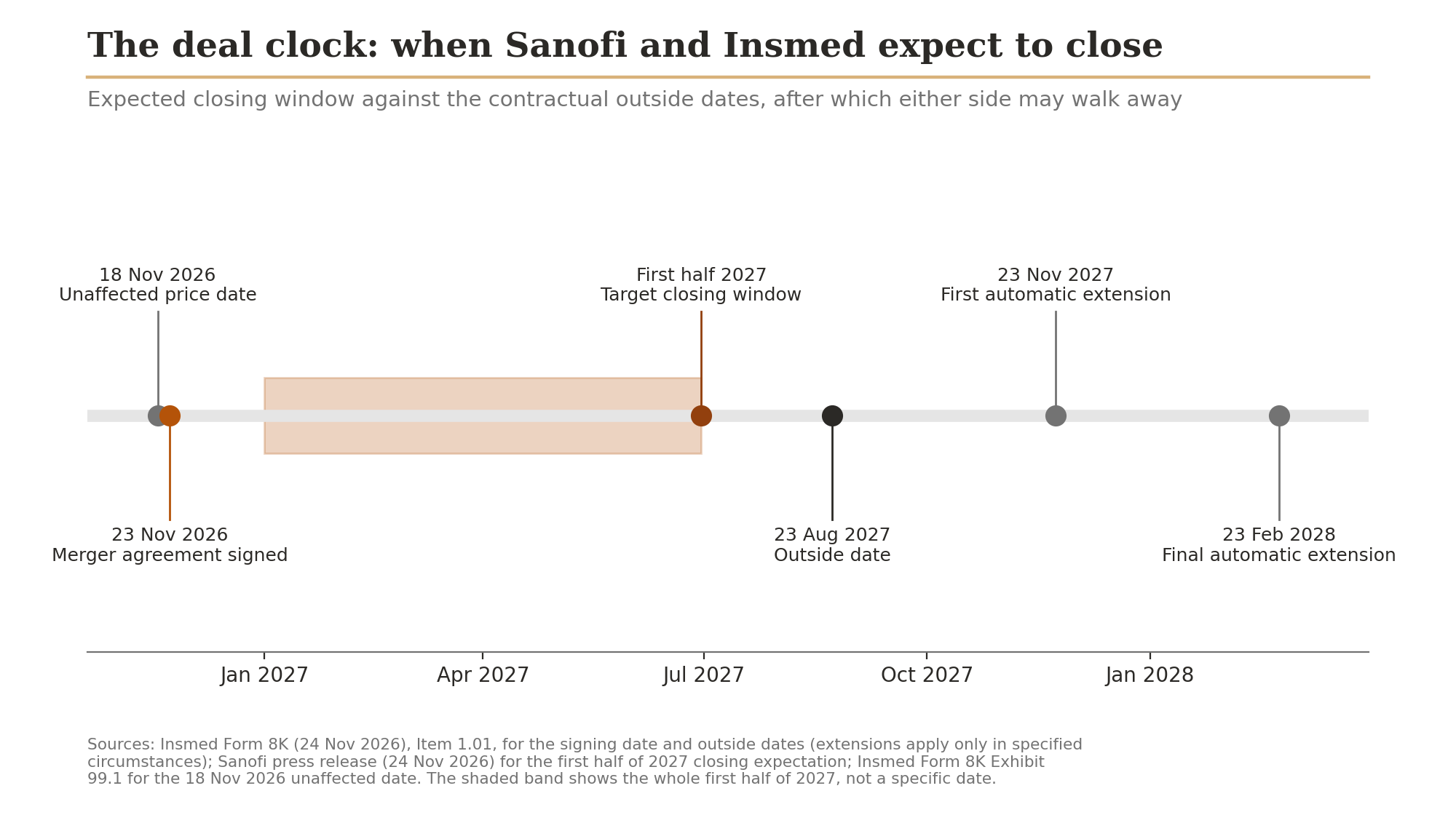
On regulation, the deal needs the HSR waiting period to expire, plus certain foreign antitrust and foreign direct investment clearances. If the deal has not closed by the outside date of 23 August 20273, either side may end it. That date extends automatically to 23 November 2027 and then to 23 February 2028 in specified circumstances.
The Financing Angle
This is an all cash deal, and Sanofi is paying for it with a mix of new borrowing and money it already has. The 8K says Sanofi has obtained debt financing commitments that include bridge facilities under a bridge facilities mandate letter. Reuters reports that J.P. Morgan, as well as advising Sanofi, co underwrote a $35bn bridge financing package. Crucially for Insmed's shareholders, the deal has no financing condition, so the risk of the loans falling through sits with Sanofi, not with them.
Sanofi says it will keep a conservative financial policy, expects to "maintain a strong credit rating", confirms its progressive dividend and expects strong cash generation to support "rapid deleveraging" (paying the new debt down quickly). Reuters reports that analysts agreed Sanofi could fund the deal without putting its dividend or rating at risk. Insmed itself has existing borrowings, including a senior secured loan from funds managed by Pharmakon Advisors and a royalty financing with OrbiMed, according to its 8K. What happens to them at closing is not disclosed.
Why It Matters
This is one of the largest pharmaceutical takeovers of 2026 and Sanofi's biggest in twenty years, according to Reuters. It fits a pattern seen across recent issues: large drugmakers paying big premiums for biotechs with proven products, to replace revenue that will disappear when their own patents expire. Reuters quotes the broker Jefferies as saying the deal "does not fix Sanofi's R&D/pipeline questions, but it buys time".
For a law student, the deal is a good example of a US public company sale. This includes a reverse triangular merger, a higher than usual shareholder vote because of the target's state of incorporation, a no shop clause with a fiduciary exception, a termination fee, a multi stage outside date and a bridge financed cash price with no financing condition4. It also shows how the legal teams are put together. The buyer's firm lists tax, intellectual property, employee benefits, real estate and environmental specialists. The target's lead firm adds antitrust, foreign investment, healthcare regulatory and finance teams, and two further firms advise Insmed alongside it.
Real World Impact
If you or someone you know lives with a chronic lung condition, this deal could matter more than the headline number suggests. Insmed estimates that about 500,000 people in the US, 600,000 across France, Germany, Italy, Spain and the UK combined, and 150,000 in Japan are diagnosed with NCFB, and Brinsupri is the first approved treatment for it. Both companies say joining Sanofi's global sales network should get Insmed's drugs to more patients in more countries, faster. That is their prediction, not a guarantee.
Price is the open question. Sanofi has just paid $41bn and has to earn that money back. On the other side, its own risk warnings mention US political pressure for lower drug prices, including "most favored nation" pricing. Whether patients pay more, less or the same for these medicines is worth watching. For Insmed's staff, a takeover usually brings some job changes once the two companies are combined. Reuters reports that Sanofi expects more than $500m a year of cost savings, and savings on that scale often include fewer roles.
Why they did it this way
- 1A one step merger with a vote suits a deal that needs months of regulatory review anyway, so speed from a tender offer adds little.Could have: A cash tender offer
- 2Insmed is a Virginia company, so approval needs more than two thirds of all votes, making turnout as important as support.
- 3A long outside date with automatic extensions gives regulators time without letting either side walk away early.Could have: A shorter deadline with a reverse break fee
- 4Committed bridge loans mean the deal has no financing condition, so Insmed holders do not carry the risk of the money falling through.Could have: Paying partly in Sanofi shares