THE DEAL BENCH
Who advised, and who did what
Tap a team to see what it does in a deal like this.
BUYER SIDE
Davis Polk & Wardwell
Legal counsel to CrowdStrike
TARGET SIDE
Wilson Sonsini Goodrich & Rosati
Legal counsel to Zscaler
Select a team above.
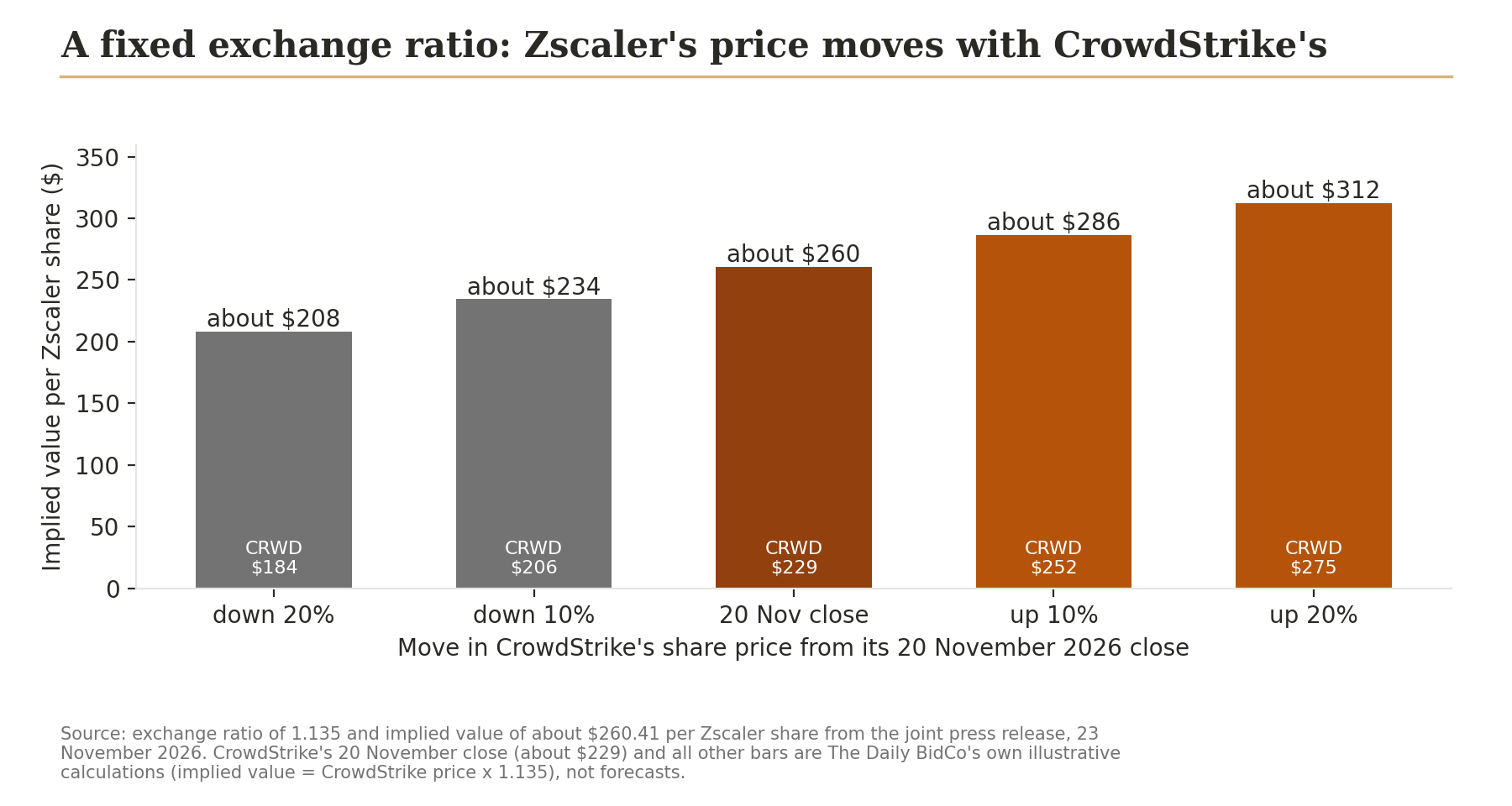
On 22 November 2026 CrowdStrike, the cybersecurity company best known for its Falcon platform, signed an Agreement and Plan of Merger to buy Zscaler. The two companies announced it the next morning. Zscaler shareholders will receive 1.135 CrowdStrike shares for every Zscaler share they own. On CrowdStrike's closing price on Friday 20 November, that works out at about $260.41 per Zscaler share, a premium of about 34%, and values Zscaler at an enterprise value of about $43.9bn.
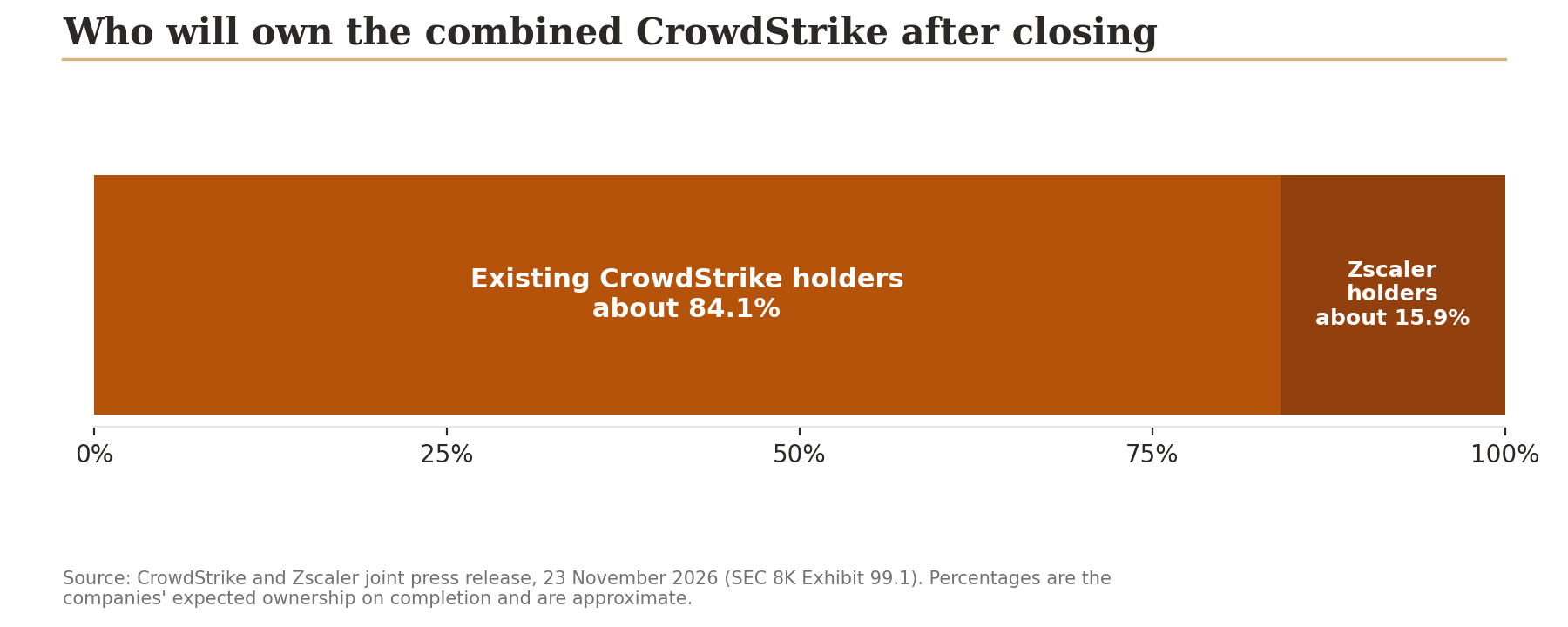
Because CrowdStrike is paying in its own shares rather than cash, nobody is being bought out in the usual sense. Zscaler shareholders become CrowdStrike shareholders, and the companies expect them to own about 15.9% of the enlarged group, with existing CrowdStrike holders keeping about 84.1%. Both boards approved the deal unanimously. Zscaler's founder and CEO Jay Chaudhry, together with related trusts and other holders, has signed voting and support agreements covering about 34% of Zscaler's shares. After closing, Chaudhry will keep running the Zscaler business and join CrowdStrike's board.
The Parties
CrowdStrike is headquartered in Austin, Texas. Its Falcon platform protects endpoints (laptops, phones and servers), cloud workloads, identities and data, using one lightweight piece of software installed on each device. It is growing quickly: on the same day as the deal, CrowdStrike reported third quarter revenue of $1.58bn, up 28% on a year earlier, and record free cash flow of $474.4m (as reported by TheStreet). Ordinary readers may remember the name from July 2024, when a faulty CrowdStrike software update crashed about 8.5 million Windows computers, which Microsoft said was less than 1% of Windows machines worldwide but which grounded flights and disrupted banks and retailers.
Zscaler is based in Santa Clara, California. Where CrowdStrike guards the device, Zscaler guards the connection. Its Zero Trust Exchange sits between users, AI agents and the apps they reach, checking every connection rather than trusting anything simply because it is "inside" the company network. The companies say Zscaler protects 50% of the Fortune 500, runs more than 200 service locations and processes more than 750 billion transactions a day. It reported $3.9bn of annual recurring revenue at its latest quarter end.
The two have been partners since 2019, with about 2,000 shared customers and 16 product integrations, according to the companies and Cybersecurity Dive. That history matters. This is a partner being absorbed, and not a stranger.
Structure & Process
The legal mechanism is a reverse triangular merger. CrowdStrike created a new subsidiary, Neon Speedway, Inc., which will merge into Zscaler. Neon Speedway disappears, Zscaler survives, and Zscaler becomes a wholly owned subsidiary of CrowdStrike. At that moment every Zscaler share converts automatically into the right to receive 1.135 CrowdStrike shares.
Because both companies are Delaware corporations, the merger needs the approval of holders of a majority of Zscaler's outstanding shares at a special meeting. With about 34% already locked in through the support agreements, the vote starts a third of the way there. Before the meeting, CrowdStrike must file a registration statement with the SEC (Form S4) registering the new shares, which will also contain Zscaler's proxy statement. The new shares must also be approved for listing on Nasdaq.
The other key conditions are regulatory. This includes the expiry of the Hart Scott Rodino waiting period, clearance under any other applicable antitrust or foreign direct investment (FDI) laws, and certain other regulatory approvals. Importantly, CrowdStrike does not have to close if a regulator imposes a Burdensome Condition unless CrowdStrike chooses to accept it.
Zscaler has agreed to a no shop, subject to the usual exceptions allowing its board to respond to an unsolicited superior proposal. If Zscaler's board changes its recommendation, or Zscaler walks away to sign a better offer, Zscaler must pay CrowdStrike a termination fee of $1.4bn. That is about 3.2% of the $43.9bn headline value. Either side may terminate if the deal has not closed by 23 November 2027, extended automatically to 23 February 2028 if only antitrust or foreign investment approvals are outstanding, and further (up to 60 days) for any US government shutdown that delays the HSR review.
Zscaler's employee equity is rolled over rather than cashed out in most cases: vested awards convert into the merger consideration, while unvested restricted stock units, performance units and options convert into equivalent CrowdStrike awards using the same 1.135 ratio.
The Financing Angle
This deal needs no acquisition loans or bond issue to pay the price. CrowdStrike pays with newly issued shares, so the financing is, in effect, its own stock. Cash is only needed for fractional shares and in one specific scenario described below.
That scenario is a built in cap. If issuing 1.135 shares for every Zscaler share would ever push the new shares above one share less than 20% of CrowdStrike's shares outstanding (measured under Nasdaq rules), the exchange ratio automatically drops by the smallest amount needed, and CrowdStrike pays the difference in cash instead. From the expected ownership split, the new shares come to about 18.9% of CrowdStrike's current share count (15.9 divided by 84.1), so the cap sits close above the expected issuance.
Zscaler also has existing debt to deal with: its 0.00% convertible senior notes due 2028. On closing, the notes will become convertible into CrowdStrike shares instead, with CrowdStrike able to settle conversions in cash, shares or a mix. Zscaler bought capped calls alongside those notes; CrowdStrike can ask Zscaler to unwind them at closing, at CrowdStrike's expense.
The trade off for investors is the one TheStreet highlights. Because the ratio is fixed, the dollar value Zscaler holders receive rises and falls with CrowdStrike's share price. For every $10 CrowdStrike's shares fall, the implied value per Zscaler share falls by $11.35. CrowdStrike's shares fell on the news, while Zscaler's jumped.
Why it Matters
First, scale. Bloomberg Law calls it one of the largest cybersecurity transactions, and CrowdStrike says the combined group will start with more than $10bn of ARR. It joins endpoint security (the device) with network security (the connection), which CrowdStrike calls "cybersecurity's largest single addressable market segment".
Second, it is part of a clear industry trend: platformization (big customers buying most of their security from one vendor instead of dozens of point products). Cybersecurity Dive notes that Palo Alto Networks pushed this strategy hard, offering steep incentives to win customers and setting off something of a pricing war. TD Cowen's Shaul Eyal told Cybersecurity Dive the combined company will be better placed to compete with Palo Alto. CrowdStrike targets about $1bn of annual revenue synergies within 30 months and $500m of annual cost synergies within 18 to 24 months of closing.
Third, AI. Both CEOs frame the deal around AI agents (software that acts on its own to complete tasks) and the new security risks they create. Kurtz says CrowdStrike wants "a single control plane to deploy AI, control AI, and enable any agentic application to run safely".
For law students, it is a clean example of a modern US stock for stock merger: a reverse triangular structure, a Nasdaq 20% cap to avoid a buyer vote, a founder support agreement, a one way break fee, and a timeline built around antitrust review.
Real World Impact
Most people will never buy a CrowdStrike or Zscaler product. But the hospital that holds your records, the bank that holds your savings and the airline that holds your booking very likely rely on one or both. That makes this deal more personal than it looks.
The upside case: one company seeing both what happens on a device and where its traffic goes could, in principle, spot and stop attacks faster, including the AI driven attacks that Cybersecurity Dive says are now exploiting software flaws "at unprecedented speed". If that works, the result is fewer data breaches and fewer letters telling you your details have been stolen.
The downside case is concentration. July 2024 showed how one faulty CrowdStrike update could ground flights and disrupt banks worldwide. A bigger CrowdStrike that also routes company internet traffic could mean that a single mistake reaches even further. And fewer big vendors could, over time, give large customers less bargaining power on price, which could eventually show up in the cost of the services we all use. Neither outcome is certain: it depends on how well the integration goes and how regulators respond. It is worth watching.
On jobs, CrowdStrike says its $500m of cost savings will come mainly from data centre infrastructure, vendors and wider operations. It has not announced job cuts, but savings of that scale after a merger often involve some overlap being removed.
Why they did it this way
- 1Agreeing terms with the board and locking in the founder's 34% stake made the Zscaler vote far more certain.Could have: A hostile approach to shareholders
- 2Paying in shares avoids tens of billions of new debt and lets Zscaler holders share in the upside.Could have: An all cash offer funded by new borrowing
- 3Keeping new shares just under 20% of CrowdStrike's stock means CrowdStrike's own shareholders do not need to vote.Could have: A second vote by CrowdStrike shareholders
- 4A long outside date and a burdensome condition carve out give room for a lengthy antitrust review.