THE DEAL BENCH
Who advised, and who did what
Tap a team to see what it does in a deal like this.
BUYER SIDE
Davis Polk & Wardwell
Legal counsel to TPG
BUYER SIDE
Sullivan & Cromwell
Legal counsel to Corpay
TARGET SIDE
Fenwick & West
Legal adviser to BILL
Select a team above.
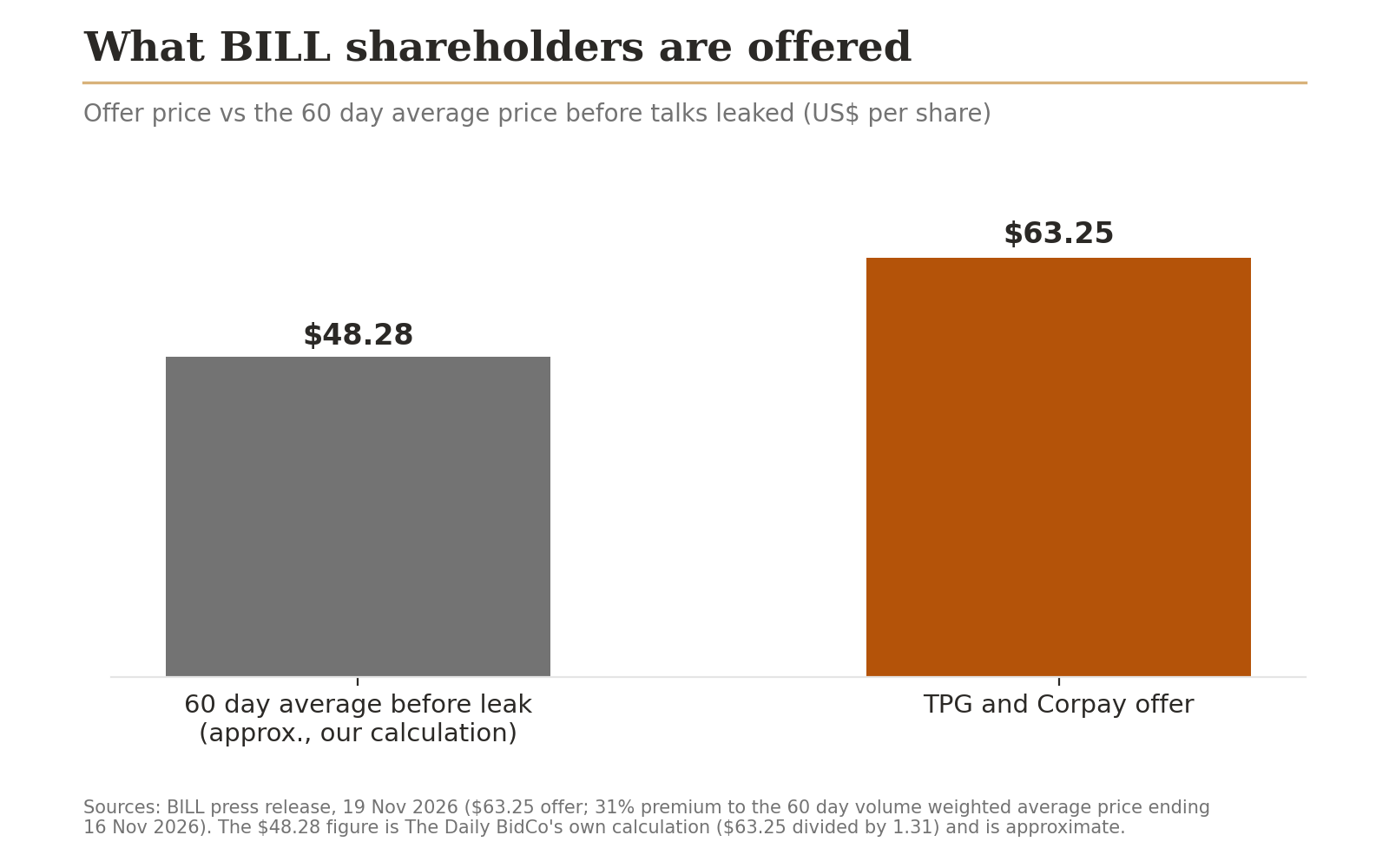
On 19 November 2026 BILL, the software company that nearly half a million small and midsize businesses use to pay their bills and get paid, agreed to be bought by the private equity firm TPG in partnership with Corpay, a listed payments company. Shareholders will receive $63.25 in cash for every BILL share, which values the company at about $6.0bn on a fully diluted basis. BILL says the price is a 31% premium to its volume weighted average price over the 60 trading days up to 16 November, the last full trading day before the press reported the talks.
TPG will own the majority of BILL through TPG Capital, its US and European buyout platform. Corpay will invest $1.1bn for what it calls "an approximately one third equity stake", and it gets an option to buy the whole company later. Corpay's finance chief, Peter Walker, said on the day: "We have the option to buy the rest of the company in 2030." BILL's board approved the deal unanimously1. Starboard Value, BILL's largest stockholder, and founder and CEO René Lacerte have both agreed to vote their shares in favour. When the deal closes, BILL's shares will stop trading and Lacerte will stay on as chief executive.
The news did not come out of nowhere. On 17 November Reuters and the Financial Times reported that TPG was close to a deal, and BILL's shares jumped nearly 13% that day, according to Finimize's summary of the Reuters report. Reuters put BILL's market value at "a little under $5 billion" before that jump.
The Parties
BILL is based in San Jose, California. Its software automates the back office jobs that small firms hate. That includes approving and paying supplier invoices, sending invoices to customers, managing expenses and company cards. BILL says it has a member network of more than 9 million and that its platform processes over 1% of US GDP each year. A big part of its reach comes through accountants, who use BILL to run the books for many small clients at once. BILL has been a Fenwick client since 2006, and Fenwick also acted for it on its $2.5bn purchase of the expense management company Divvy.
BILL has also been under pressure from activist investors. Reuters reported in September 2025 that Starboard Value had built an 8.5% stake and planned to nominate directors. Reuters also reported that Elliott Investment Management had built a stake and pushed BILL to explore a sale.
TPG is a global alternative asset manager founded in San Francisco in 1992, with $346bn of assets under management according to the press release. It is buying through TPG Capital, its flagship buyout platform. The two TPG partners quoted on the deal are John Flynn and Tim Millikin.
Corpay (formerly FLEETCOR) is an S&P 500 company headquartered in Atlanta. It sells corporate cards, accounts payable automation, cross border payment services and fuel and vehicle payment tools to businesses. Chairman and CEO Ron Clarke said Corpay was "excited to participate in this transaction and invest in another large, complementary corporate payments business".
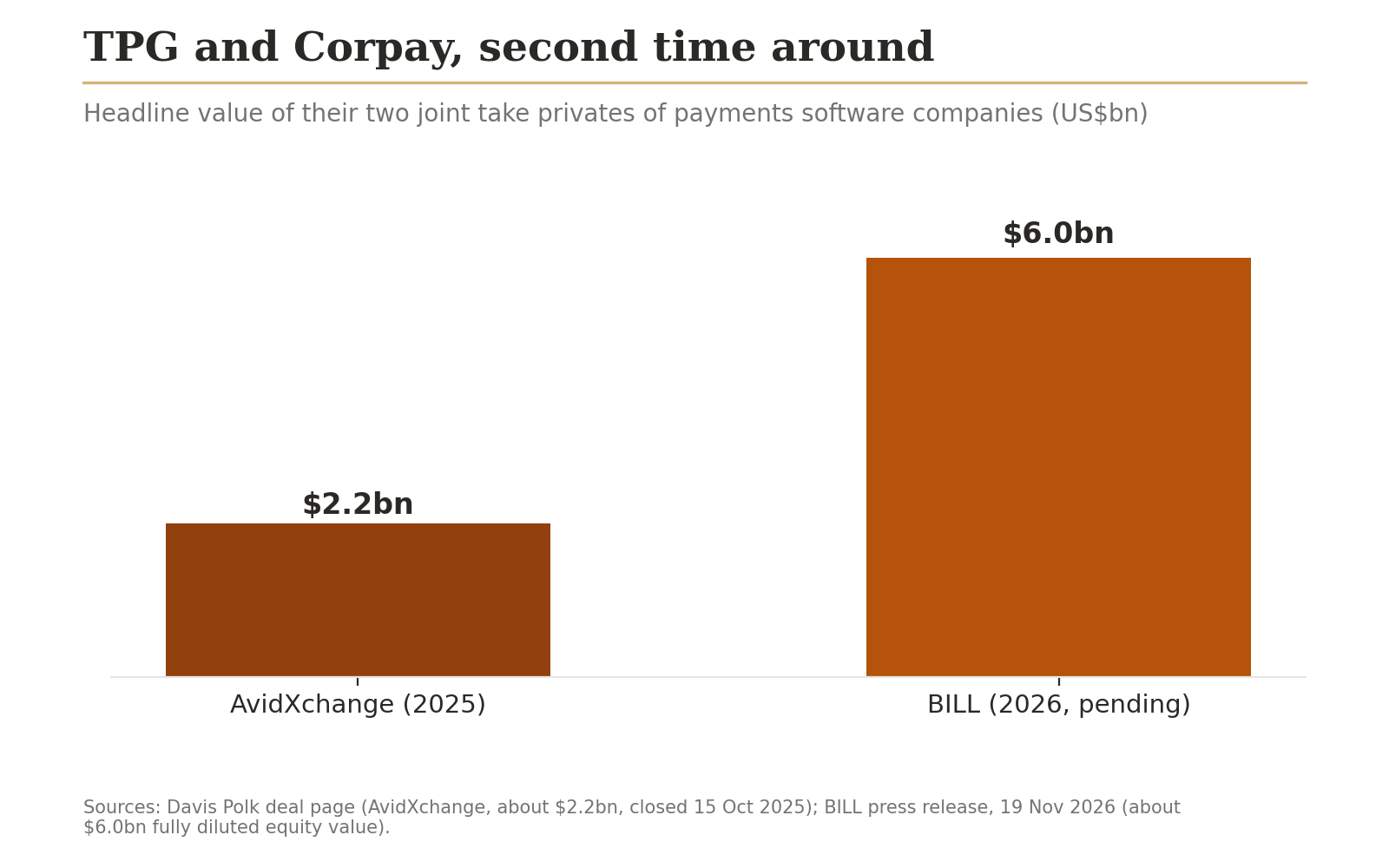
The "another" is significant here. In 2025 TPG and Corpay bought AvidXchange, another accounts payable software company, for about $2.2bn using exactly the same model. TPG took the majority through TPG Capital, and Corpay invested about $500m for a 33% stake with an option to buy the rest in 2028, according to Corpay's May 2025 release. AvidXchange left the stock market in October 2025. The BILL deal is close to a carbon copy, only bigger.
Structure & Process
This is a take private carried out as a one step cash merger. A company owned by the buyers merges with BILL. At the moment the merger takes effect, every BILL share that is still outstanding is automatically turned into the right to receive $63.25 in cash, whether or not its holder voted for the deal.
Because the buyers are taking every share through a merger, BILL's stockholders must approve it. BILL says it will file a proxy statement with the US Securities and Exchange Commission and then hold a special meeting of stockholders. The signed voting agreements from Starboard and Lacerte give the deal a head start at that meeting.
The other conditions are the "required regulatory approvals" and "customary closing conditions". The press releases do not list the regulators. The BILL release says there are "no financing conditions", so the buyers cannot walk away simply because their funding falls through2. BILL's release also warns that the merger agreement contains a termination fee that BILL may have to pay in some circumstances. The amount was not in the press releases, and I could not retrieve the merger agreement from SEC EDGAR during this run, so I have not stated a figure.
The Financing Angle
The press releases give one firm number on how the deal is paid for. Corpay's $1.1bn. Corpay calls this a minority investment for about one third of the equity. If $1.1bn buys about a third of the equity, the total equity cheque would be roughly $3.3bn (our own calculation). That would leave something in the region of $2.7bn of the $6.0bn price to come from other sources, such as TPG's further contribution, borrowing, or BILL's own cash (also our calculation). None of the parties has published that split, the size of any loans or the names of any lenders, so treat these numbers as a rough guide only. If debt is used, this would be a leveraged buyout.
Two financing features are confirmed. First, there is no financing condition, so TPG and Corpay bear the risk of raising the money. Second, Corpay holds an option to buy the rest of BILL. Corpay's CFO tied that option to 2030. Corpay also says the deal will add to its 2027 cash earnings per share, which is how a listed buyer usually reassures its own shareholders about a big investment.
TPG's three financial advisers are BofA Securities, Deutsche Bank Securities and RBC Capital Markets. In buyouts it is common for banks advising the sponsor to also provide acquisition loans, but none of the sources says whether these banks are lending here.
Why it Matters
This deal shows how public markets are struggling to value mid sized software companies. Reuters put BILL's value at a little under $5bn before the leak, and activists had been pushing for change. Private equity can offer a premium now and take on a longer turnaround away from quarterly results. BILL's CEO talks about using the "resources, expertise, and strategic support" of the new owners to "accelerate innovation, advance our AI transformation".
It is also a sign of consolidation in business payments. TPG and Corpay have now bought two accounts payable software companies together in about eighteen months. If Corpay later exercises its option, it would own BILL outright and become a bigger force in small business payments. For students, the deal is a clean example of a US take private: a signed merger agreement, a board recommendation, voting agreements, no financing condition and a club of buyers with different roles.
Real World Impact
If you run a café, a small building firm or a local charity in the US, there is a decent chance your bookkeeper uses BILL to pay your suppliers. For you, a change of owner is usually invisible at first. Over the next few years it might show up in two ways. On the upside, new money could mean better tools, including the AI features BILL's CEO talks about, which could cut the hours small firms spend chasing invoices. On the downside, owners focused on "profit growth" sometimes raise subscription prices or payment fees. Once Corpay sits in the ownership group, BILL might also start pushing Corpay products, such as cards and cross border payments. It is worth watching whether pricing changes after the deal closes.
For BILL's investors, the deal turns a share price that had been drifting into a fixed cash payout. For workers at BILL, private equity ownership can bring restructuring, though nothing about job cuts has been announced.
Why they did it this way
- 1The board backed a negotiated sale, and the largest shareholder and the founder have already agreed to vote for it.Could have: A hostile approach direct to shareholders
- 2With no financing condition, the buyers carry the funding risk instead of BILL's shareholders.
- 3A merger with a shareholder vote suits a deal that must wait months for regulatory approvals anyway.Could have: A tender offer made directly to shareholders
- 4TPG keeps control while Corpay brings payments know how, takes about a third and can buy the rest later.Could have: TPG buying 100% on its own