THE DEAL BENCH
Who advised, and who did what
Tap a team to see what it does in a deal like this.
BUYER SIDE
White & Case
Legal adviser to Iceye
BUYER SIDE
Avance Attorneys
Legal adviser to Iceye
BUYER SIDE
Studio del Prof. Avv. Andrea Zoppini e degli Avvocati associati
Legal adviser to Iceye
TARGET SIDE
Chiomenti
Legal adviser to the Avio board
Select a team above.
On 17 November 2026 Iceye, the Finnish company that runs the world's largest constellation of radar satellites, announced that it wants to buy every share in Avio, the Italian group that builds Europe's Vega rockets. The offer is €41.00 per share in cash. If every share is tendered, Iceye will pay up to about €2.05bn. The announcement was made in a formal Article 102 Notice.
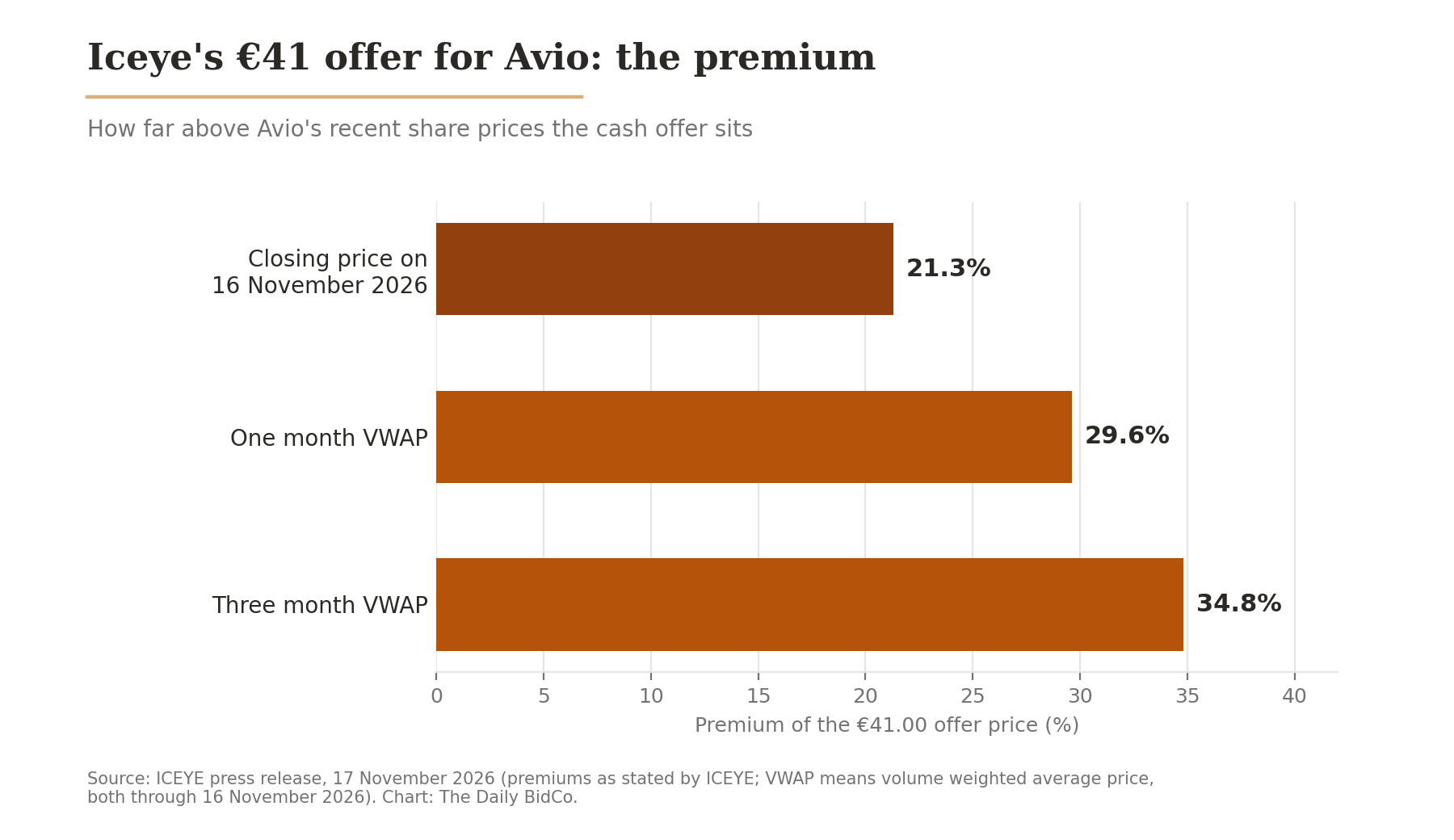
The price is 21.3% above Avio's closing share price on the day before the announcement. It is 29.6% above the average price over the previous month and 34.8% above the average over three months, measured as a volume weighted average price. The market's first reaction was positive but cautious. Avio shares rose 14.9% to €39.18 on 17 November, according to Il Fatto Quotidiano. That is still about 4.6% below the offer price (our own calculation), a gap that usually reflects doubts over whether, and how soon, a deal will complete.
This is not an agreed deal. Avio's board has "taken note" of the offer and begun assessing it, and Iceye owns no Avio shares and has no agreements with any of its shareholders, according to Websim. In return for the government's blessing, Iceye has made a long list of promises. It says it will invest an extra €1bn in Italy over five years, create up to 400 skilled jobs, and keep Avio's brand, Italian identity, management and workforce.
The Parties
Iceye was founded in Finland and, by its own account, launched the world's first synthetic aperture radar (SAR) satellite under 100kg in 2018 (a satellite that maps the ground using radar pulses, so it can see at night and through cloud). It says it has since launched 84 satellites, works with more than 25 governments and employs over 1,500 people. In June 2026 it raised money at a valuation above €10bn. It is privately owned, which matters for how it can pay (see section 4). Its CEO and one of its founders, Rafal Modrzewski, frames the deal around sovereignty: "Governments need control of their critical space infrastructure, and Europe needs it most."
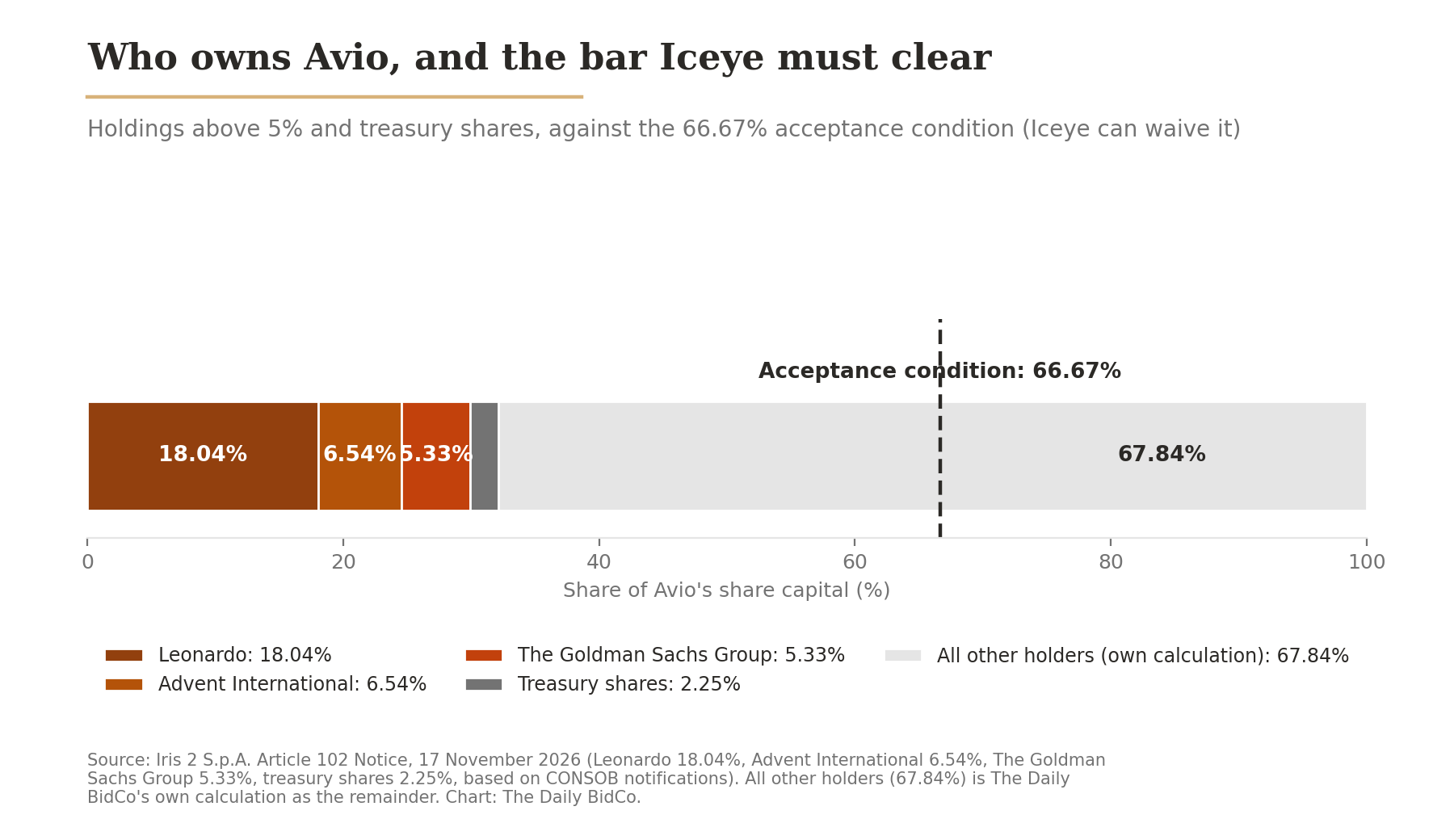
Avio is the prime contractor for Europe's Vega C rocket. Through joint ventures it also makes solid rocket boosters for Ariane 6, and it has a missile propulsion business that SatNews says now makes up 33% of its order backlog. Its largest shareholder is Leonardo, Italy's state backed defence group, with 18.04%. Advent International holds 6.54% and The Goldman Sachs Group 5.33%, according to the Article 102 Notice. No one controls Avio.
The bidder is Iris 2 S.p.A., a Milan company set up on 19 October 2026 and converted into a joint stock company on 11 November 2026 for the purpose of the offer. It is wholly owned by Iris 1 S.p.A., which is wholly owned by Iceye. This is a bid vehicle.
Structure & Process
The deal is a voluntary public tender offer, under Articles 102 and 106(4) of Italy's Consolidated Financial Act. The process now runs in steps. First, Iceye must file a full offer document with CONSOB for approval. Next, Avio's board will publish its own view of the offer, known as the issuer's statement. Then the acceptance period opens, which the notice says will last between 15 and 40 trading days. Shareholders are paid on a settlement date once every condition has been met or waived.
The offer has twelve conditions, according to Il Sole 24 Ore Radiocor. The headline one is the threshold condition. Iceye must end up with at least 66.67% of Avio's share capital, though it can waive this. The rest are mostly regulatory:
Italian golden power approval. This must also cover the security package for the acquisition loans. Iceye will accept conditions here as long as they do not have a materially adverse effect on the deal.
Foreign direct investment clearance in France and the UK, with no conditions.
Clearance from the European Commission under the Foreign Subsidies Regulation, with no conditions.
CFIUS approval, with no conditions.
A notification to the US Defense Counterintelligence and Security Agency (DCSA), and the end of a 60 day notice period under the US ITAR arms export rules.
Waivers from Avio's contract counterparties who could otherwise end contracts on a change of control.
A MAC condition. Iceye expressly names the war in Ukraine, the Middle East and Red Sea crisis, and US tariffs as known risks.
After the offer closes, there are two routes to delisting. If Iceye reaches 90% or more, it will use its squeeze out right under Article 111 and will not restore the free float. If it ends up below 90%, it can merge Avio into the unlisted Iris 2. Shareholders who do not vote for that delisting merger would get a withdrawal right, with their shares valued at the average closing price over the previous six months. Because Iris 2 would by then be a related party of Avio, the merger would also have to follow Avio's related party procedures.
The Financing Angle
Iceye is paying entirely in cash, and the money comes from two places. The Article 102 Notice says Iceye has signed equity commitment letters with Iris 2. Iceye will fund them from its own cash and from acquisition debt under commitment papers signed with "certain financing banks". The banks are not named. White & Case says it advised on "the launch and financing" of the offer, with a Milan finance team led by partner Stefano Bellani. According to Websim, Iceye's CEO said the company has already raised the debt and cash it needs.
Italian takeover rules require certain funds. Iris 2 has declared under Article 37 bis of CONSOB's Issuers' Regulation that it can meet the full payment. Before the offer document is published, it must also give CONSOB a guarantee of exact fulfilment for the maximum amount of €2,052,657,251. One detail is easy to miss: the golden power condition covers not only the acquisition but also the "customary security package supporting the financing". The lenders are likely to want security over the Avio shares, and in a strategic company that security itself needs government sign off.
The notice also says Iceye intends to let some of Avio's key managers and key shareholders reinvest part of their sale proceeds in Iceye shares. This kind of rollover keeps important people invested in the combined group.
Why It Matters
This is a test of whether Europe can build its own vertically integrated space champion through the stock market. Iceye wants to put satellite manufacturing, launch and data services in one group, which it says would give governments "greater certainty over deployment and continuity of supply". Italy's Defence Minister Guido Crosetto made a similar point days before the bid, writing that "owning satellites is not enough if you do not have adequate launch capacity", as quoted by Il Fatto Quotidiano.
It also cuts across Italy's existing industrial plans. Leonardo, the largest shareholder, is part of the planned Bromo joint venture with Airbus and Thales to combine their satellite businesses. Avio also supplies motors to MBDA, the European missile group in which Leonardo is a shareholder, according to Il Fatto Quotidiano. Leonardo's CEO Lorenzo Mariani called the bid "a good signal" and said he was "pleasantly surprised", but he also said Leonardo would study it carefully and coordinate with the government on golden power. For law students, the deal is a live example of how foreign investment screening now shapes European M&A as much as price does. A bidder from another EU member state still faces the same Italian golden power review as any outsider, plus reviews in France, the UK, Brussels and Washington.
Real World Impact
Most people never think about rockets, but they use what rockets carry every day. That includes weather forecasts, satellite navigation in phones and cars, and the images used to track floods, wildfires and crop failures. If Iceye's plan works, it could mean more frequent European launches and less dependence on American launchers such as SpaceX. That might make satellite services more reliable for European governments and, eventually, for the people who rely on them.
There are two sides to it. Iceye promises up to 400 new skilled jobs and €1bn of investment in Italy, and the aerospace and shipbuilding chains already matter to the Italian economy. A national report presented in Rome on 18 November put their combined value added at €46.3bn, or 2.4% of GDP, with 168,000 direct jobs (Adnkronos). The worry is control. Avio makes propulsion for missiles as well as rockets, so governments will want to know who ultimately decides where that capability goes. The outcome to watch is whether Rome approves the deal, and on what conditions.
Why they did it this way
- 1Iceye had no deal with Avio's board or main investors, so it put its price straight to shareholders.Could have: An agreed deal negotiated with the board first
- 2Iceye is private with no listed shares to offer, so cash is the natural way to pay.Could have: Paying in Iceye shares
- 3Owning two thirds would let Iceye pass the merger needed to delist Avio on its own.Could have: A simple majority threshold
- 4Accepting conditions from Rome lowers the risk of the Italian government blocking the deal outright.