THE DEAL BENCH
Who advised, and who did what
Tap a team to see what it does in a deal like this.
TARGET SIDE
Paul, Weiss
Legal adviser to Ollin Biosciences
TARGET SIDE
Goodwin Procter
Adviser to Ollin Biosciences on corporate matters
TARGET SIDE
Morrison & Foerster
Adviser to Ollin Biosciences on IP matters
TARGET SIDE
Cooley
Adviser to Ollin Biosciences on IP matters
Select a team above.
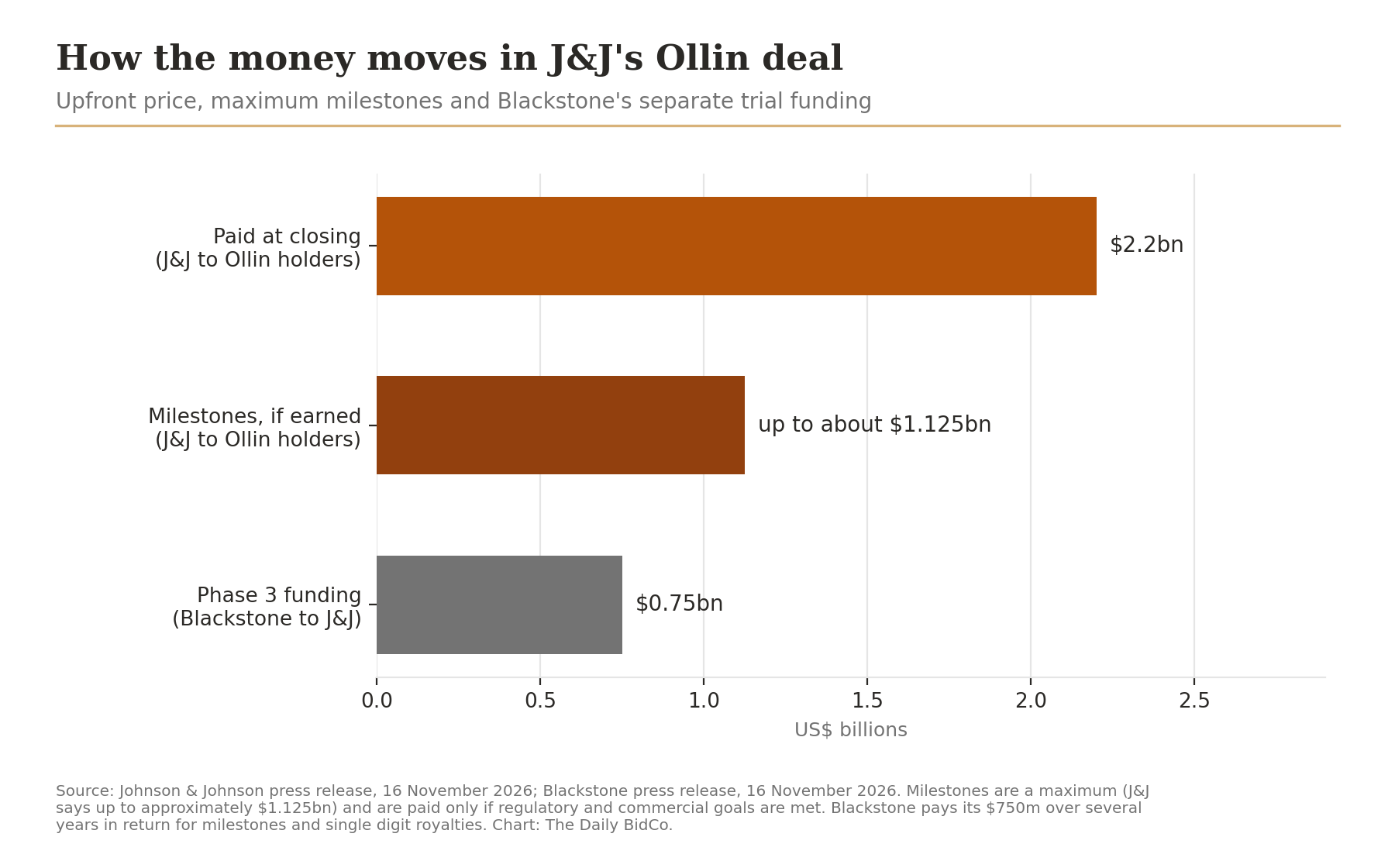
On 16 November 2026 Johnson & Johnson announced a definitive agreement to buy Ollin Biosciences, a privately held biotech developing treatments for serious eye diseases. J&J will pay $2.2bn upfront. On top of that, Ollin's former owners can receive up to approximately $1.125bn more if Ollin's lead drug reaches agreed regulatory and sales goals. These later sums are milestone payments, so the total could reach about $3.3bn but is only guaranteed at $2.2bn.
The drug at the centre of the deal is OLN324. It is a bispecific antibody (a single engineered protein that grabs two different disease targets at once), designed to block two signals, VEGF and Ang2, that drive leaky, abnormal blood vessels at the back of the eye. It is being developed for wet age related macular degeneration and diabetic macular oedema, which J&J says together affect more than 40 million people worldwide and are leading causes of vision loss.
Alongside the purchase, J&J signed a separate agreement with Blackstone Life Sciences. Once the acquisition closes, Blackstone will pay J&J $750m over several years to fully fund OLN324's Phase 3 trials. In return Blackstone can receive regulatory and sales milestones and single digit royalties. J&J expects the acquisition to close before the end of 2026.
The Parties
Johnson & Johnson is one of the world's largest healthcare groups, split into Innovative Medicine and MedTech. In eye care it is best known for Acuvue contact lenses and Tecnis lens implants used in cataract surgery, but BioSpace reports that it does not currently sell any drugs for retinal disease. Its recent retina bets have struggled: in 2026 it handed a gene therapy for an inherited eye disease back to MeiraGTx after a failed Phase 3 trial, and Fierce Biotech reports it dropped a separate gene therapy for geographic atrophy after a data review.
Ollin Biosciences was founded in 2023, incubated by ARCH Venture Partners and launched publicly in September 2025 with $100m of funding led by ARCH, Mubadala Capital and Monograph Capital. It licensed OLN324 from China's Innovent Biologics, which discovered the molecule. In a small head to head study called JADE, Ollin reported that OLN324 produced faster and larger improvements in retinal anatomy than Roche's Vabysmo, the current market leader in this drug class. On the back of that data Ollin raised a $330m Series B in June 2026, and Fierce Biotech reports it has filed to run four Phase 3 trials, all with primary completion dates in December 2028. MarketScreener's deal record lists the sellers as ARCH Venture Partners, Monograph Capital, Mubadala, TCGX and others.
Blackstone Life Sciences is the healthcare investing arm of Blackstone, with $18bn of assets under management. It specialises in providing large sums to drug companies for specific programmes. This is not its first deal with J&J: in February 2026 it agreed to co fund trials of J&J's leukaemia drug bleximenib, and only days before this deal BioSpace reports it agreed to provide Pfizer with up to $1.5bn for an obesity drug Pfizer gained through its Metsera acquisition.
Structure & Process
This is a private acquisition rather than a public takeover. Ollin has no listed shares, so there is no tender offer, no public shareholder vote and no scheme of arrangement. Instead J&J signed a definitive agreement to acquire the entire company. J&J's release does not say whether the deal is technically a share purchase or a merger, and no filing has been published that confirms the mechanism, so this issue does not assume one.
The consideration has two layers. The $2.2bn upfront is paid at closing. The up to $1.125bn of milestones is a form of contingent consideration, which means Ollin's investors share in the drug's success but also carry part of the risk that it fails in Phase 3 or never wins approval.
The Blackstone agreement sits beside the acquisition rather than inside it. It is between Blackstone and J&J, not Ollin's sellers, and it only takes effect if J&J completes the purchase. Blackstone's money flows to J&J over time to pay for trials, and Blackstone is paid back only if the drug succeeds.
Before closing, the deal needs regulatory approval. Neither party names the agencies, but J&J's release refers to "applicable regulatory approvals", and at $2.2bn upfront the deal is well above the size at which a US merger filing under the Hart Scott Rodino Act is normally required. A closing target of just six weeks after signing suggests the parties do not expect a lengthy competition review, which fits the fact that J&J does not currently sell a competing retinal drug.
The Financing Angle
J&J has not said how it will fund the $2.2bn, and with no financing condition or bond issue announced, there is no sign of acquisition debt. The interesting financing is on the development side. Running four large Phase 3 eye trials is expensive, and the Blackstone deal is a form of R&D funding. Fierce Biotech notes the arrangement lets J&J move OLN324 through late stage development without adding to its own R&D budget.
The trade off is that if OLN324 succeeds, part of its sales will go to Blackstone through milestones and royalties rather than to J&J. If the trials fail, Blackstone has spent $750m and J&J's loss is limited to the acquisition price. It is effectively a way of renting someone else's balance sheet for the riskiest stage of drug development.
Why it Matters
For law students, this deal is a good example of how drug acquisitions price risk. The headline "up to $3.3bn" hides the fact that only $2.2bn is certain, and the rest depends on clinical trials that will not finish until late 2028. Reading a deal like this means separating guaranteed consideration from contingent consideration, and understanding who carries which risk.
It also shows private equity moving into a new corner of pharma. Blackstone is not buying a company or lending against assets here; it is paying for a single drug's trials in return for a share of its revenue. With Blackstone signing similar agreements with Pfizer days earlier and with J&J itself in February, synthetic royalty style funding (paying for a drug's development in return for royalty like payments on future sales) looks like a growing alternative to drugmakers simply borrowing or cutting other projects.
Finally, it is a big bet on a crowded market. Roche reported Vabysmo sales of 3.2bn Swiss francs (about $3.8bn) in the first nine months of 2026, according to Fierce Biotech, and the drug competes with Regeneron's Eylea and Roche's own Lucentis. J&J is buying its way into that market rather than building from scratch.
Real World Impact
Most people with wet age related macular degeneration, which mainly affects older adults, today get regular injections into the eye to stop their vision getting worse. Ollin's pitch is a drug that might control the disease better and let patients go longer between treatments. If the Phase 3 trials confirm the early results, that could mean fewer hospital visits and fewer injections for millions of patients, though that will not be known until around 2028.
There is also a cost angle. These eye injections are among the most expensive drugs that US Medicare pays for in clinics: one study found Medicare's spending on this class of injections rose from $2.51bn in 2014 to $4.02bn in 2019. Another strong competitor could, in theory, push prices down. Or a new premium drug could simply add to the bill. Which way it goes will depend on pricing decisions years from now, so it is worth watching rather than predicting.
Why they did it this way
- 1Milestones mean Ollin's sellers only get the extra $1.125bn if the drug clears its trials and reaches sales goals.Could have: Pay a single fixed price upfront
- 2Blackstone pays $750m for the costly Phase 3 trials, so J&J keeps its own R&D budget free for other projects.Could have: Fund the trials from J&J's own R&D budget
- 3Blackstone's money only flows once J&J owns the drug, so it never funds a programme someone else ends up owning.
- 4With no shareholder vote needed for a private target, the US merger filing is the main step before a quick close.