FedEx/Advent-led consortium completes €7.8bn buyout of InPost
Hussain Jeddy · 21 September 2026
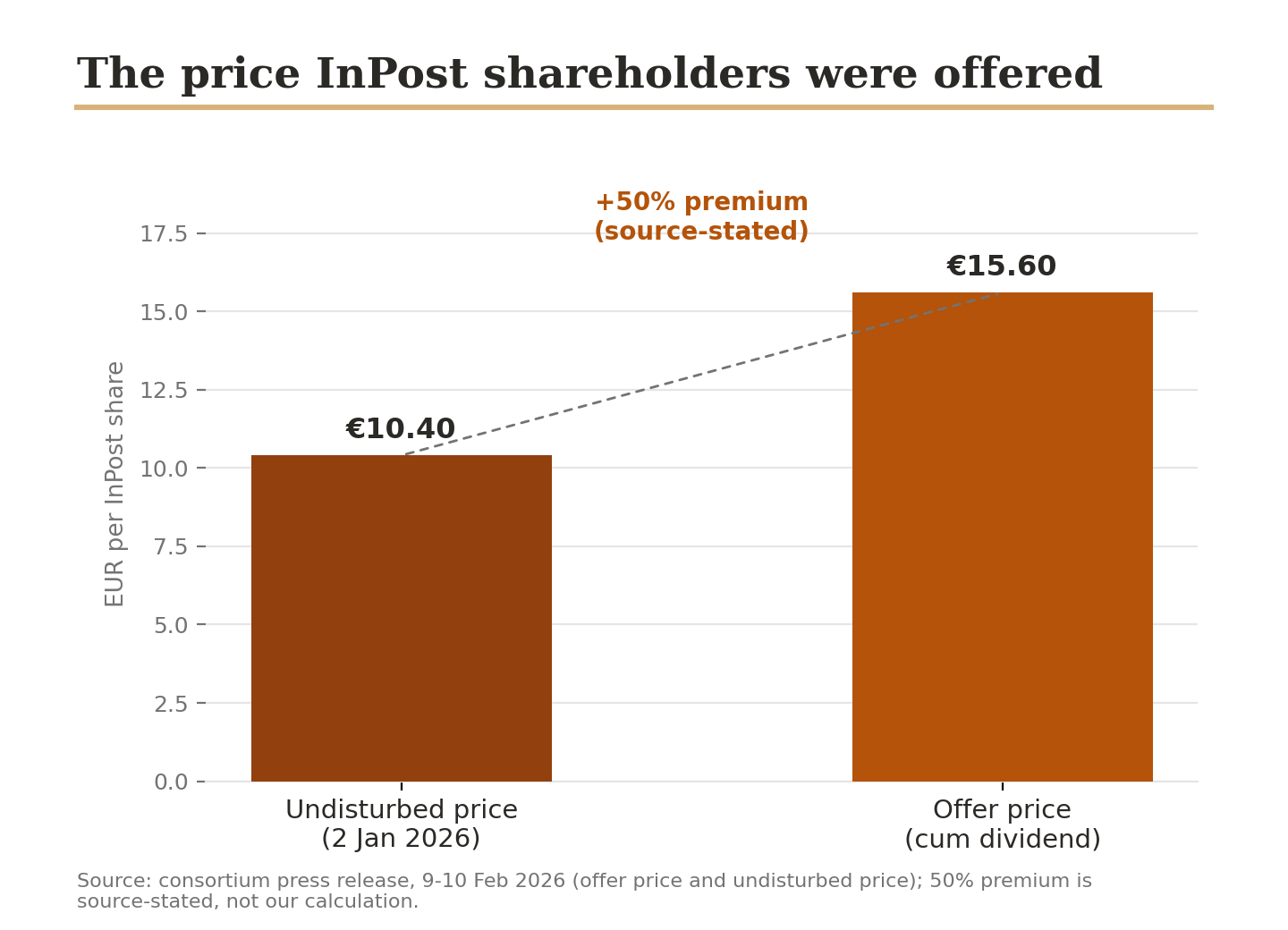
Share on LinkedInOn 18 September 2026, a consortium led by FedEx Corporation and private equity firm Advent International completed its takeover of InPost S.A., Europe's largest out-of-home parcel delivery network, after 89.8% of InPost's shares were tendered into the group's all-cash offer of €15.60 per share, clearing the 80% minimum acceptance threshold. The deal, first agreed in February 2026, values InPost's equity at approximately €7.8 billion ($8.9 billion).
The Parties
InPost is a Polish company that operates Europe's leading out-of-home delivery network. It has more than 40,000 automated parcel lockers and roughly 33,000 staffed pick-up and drop-off points across nine European countries, including Poland, the UK, Italy, France and Spain, used by more than 100,000 e-commerce sellers. FedEx is the US logistics and courier giant best known for express parcel and freight delivery, which has been looking to expand its European "last-mile" footprint. Advent International is a US-headquartered private equity firm. A&R Investments is the personal investment vehicle of InPost's founder and CEO, Rafał Brzoska, and PPF Group is a Czech investment group founded by the late billionaire Petr Kellner, which already held a stake in InPost going into the deal.
Structure & Process
This was a recommended all-cash tender offer (a public bid in which the target company's own board urges shareholders to accept, as opposed to a hostile bid the board opposes) for all of InPost's shares, launched under Dutch takeover rules because InPost trades on Euronext Amsterdam. The offer needed to clear an 80% minimum acceptance threshold, which it did comfortably at 89.8%. It also needed merger-control clearance in multiple jurisdictions. The European Commission cleared the deal unconditionally in mid-August 2026, but the offer period was then extended to 18 September 2026 specifically to allow time for a competition review in Vietnam, notable because InPost has no operations there, illustrating how even a purely European delivery deal can get caught up in merger-filing thresholds in unrelated jurisdictions. As a condition of EU clearance, FedEx and InPost will not integrate their operations after completion and will remain arm's length, independent competitors in their respective markets.
The Financing Angle
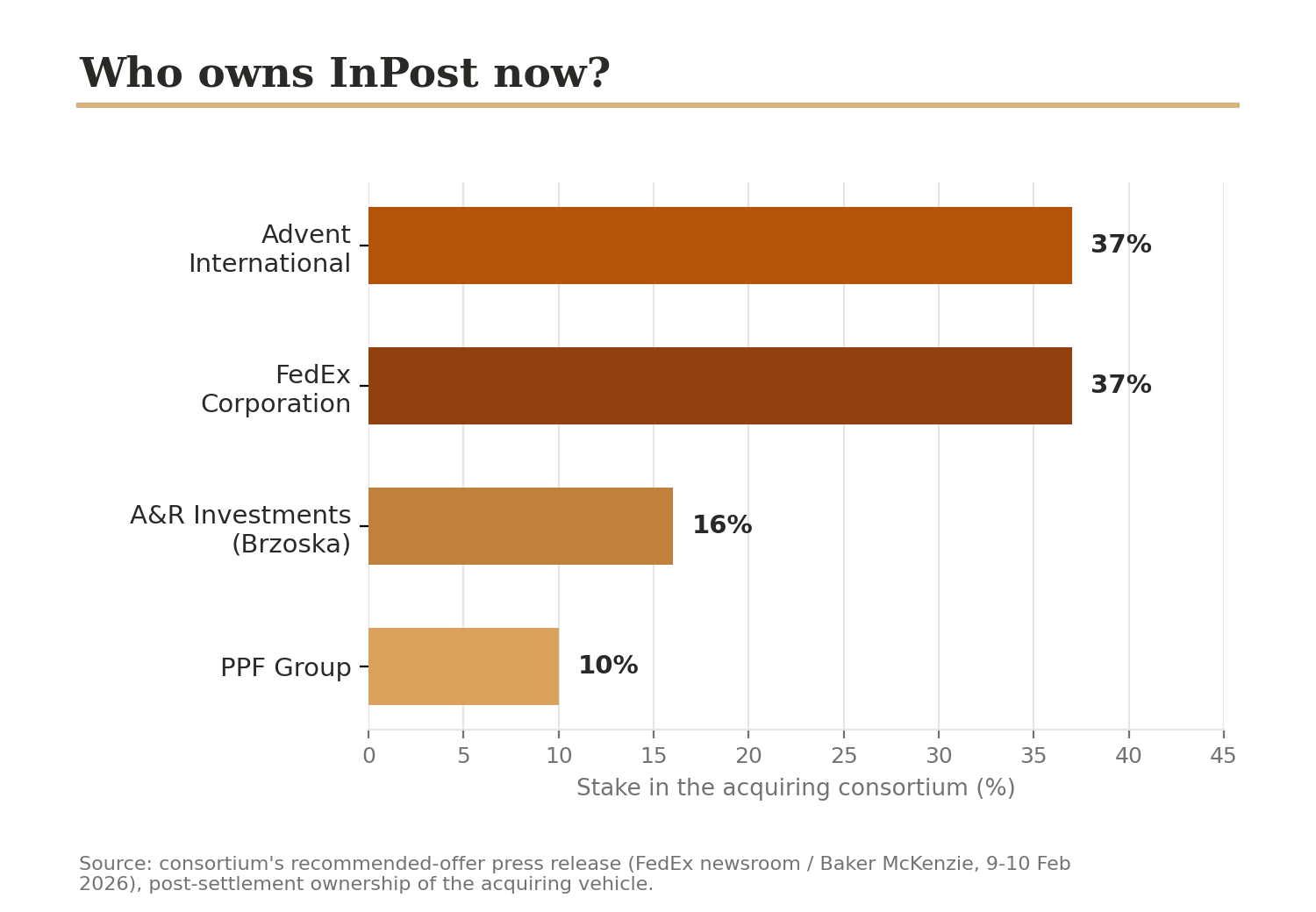
The consortium structured the deal with Advent and FedEx each taking a 37% stake in the acquiring vehicle, A&R Investments (Brzoska's vehicle) taking 16%, and PPF taking 10% by reinvesting part of the proceeds from selling its existing InPost stake. The purchase was funded through a mix of roughly €5.9 billion in equity commitments from the four consortium members and up to €4.95 billion of committed debt financing (reduced by any of InPost's existing debt left in place) from a syndicate of banks, structured as senior term facilities, a senior secured bridge facility and a revolving credit facility. Baker McKenzie advised FedEx, including on its internal arrangements with the other consortium members, and White & Case advised PPF Group specifically.
Why it Matters
This is one of the largest take-private deals of a European logistics company this year, and it hands FedEx a substantial, ready-made foothold in Europe's out-of-home delivery market at a time when lockers and pick-up points are increasingly replacing traditional home delivery for e-commerce parcels. It's also a case study in "de-equitisation", a fast-growing European tech-adjacent company leaving public markets entirely (InPost listed on Euronext Amsterdam back in January 2021) instead of raising capital there, a pattern several commentators have flagged as a concern for the depth of European stock markets more broadly.
Real-World Impact
If you've ever picked up an online order from an orange locker at a supermarket or petrol station in Poland, the UK or elsewhere in Europe, you've used InPost's network, and it just changed hands. For now, day-to-day service shouldn't change much. As part of getting EU approval, FedEx and InPost have to stay operationally separate and keep competing with each other rather than merging their networks, and InPost's founder Rafał Brzoska is staying on as CEO.
The bigger, slower-burn question is what a private-equity-and-debt-backed ownership structure means over time. The deal is partly funded with nearly €5 billion of new debt, and highly leveraged owners sometimes look to cut costs or raise fees to service that debt (this is a general pattern in PE-backed buyouts, not something InPost's new owners have said they'll do, so treat it as something worth watching rather than a prediction).
On the jobs side, no redundancies have been announced, and delisting a company from public markets doesn't by itself change staffing, though ownership changes of this size are always worth watching for later restructuring. There's also a milder political angle. European policymakers have been increasingly vocal about wanting to keep strategically important digital and logistics infrastructure in European hands, and this deal, a Polish "national champion" of sorts, in a sector Brussels cares about, being taken over by a US-led consortium sits right in the middle of that debate, even though no one has raised a formal objection on those grounds so far. What do you think? Comment down below!