H.I.G. Capital to acquire MISTRAS Group for ~$866 million
Hussain Jeddy · 19 September 2026
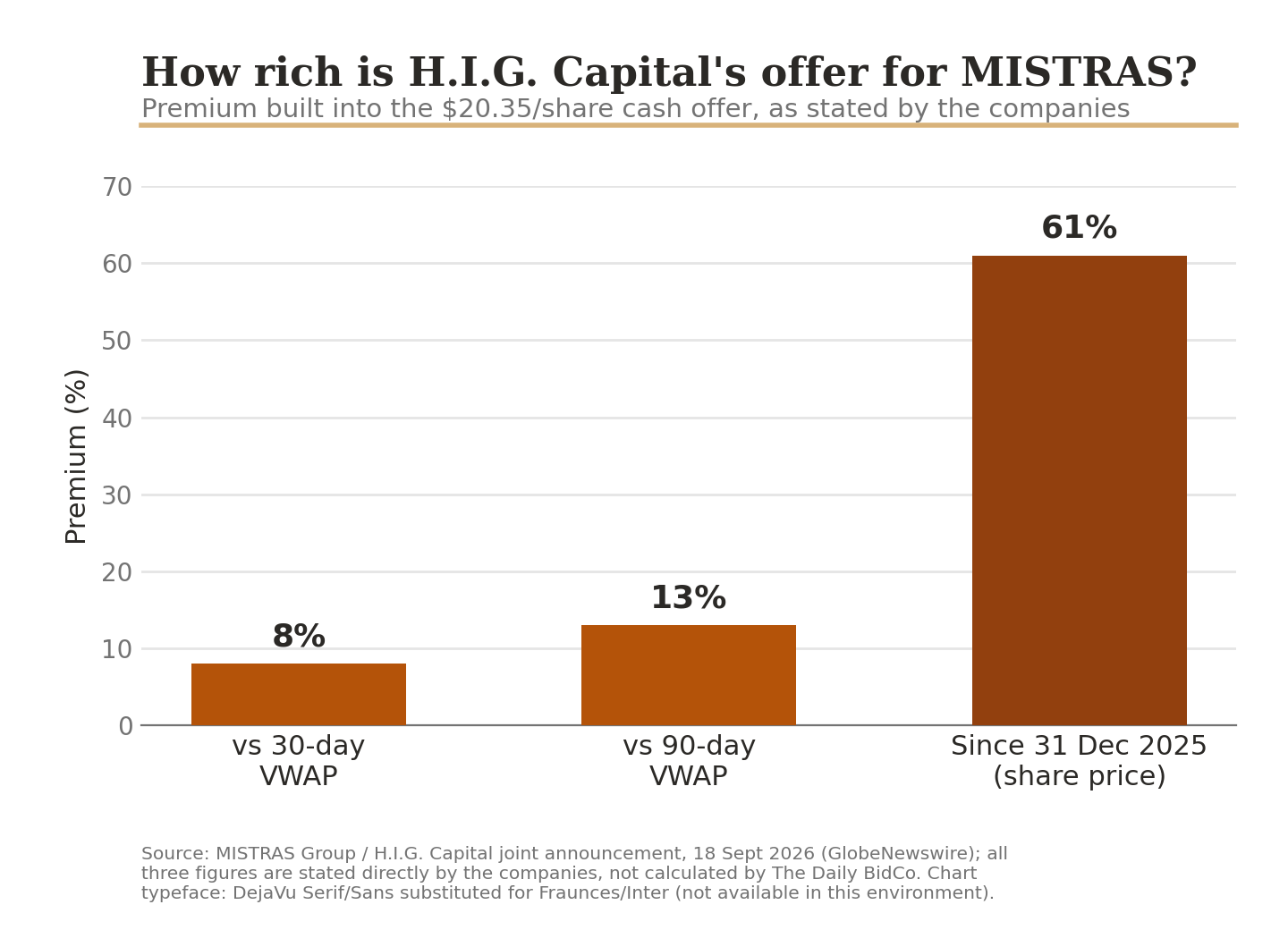
Share on LinkedInOn 18 September 2026, MISTRAS Group, Inc., a NYSE-listed industrial testing and inspection company, announced a definitive agreement to be acquired by affiliates of H.I.G. Capital for $20.35 per share in cash, valuing the business at approximately $866 million on an enterprise basis, including the debt it currently carries.
The Parties
MISTRAS (headquartered in Princeton Junction, New Jersey) describes itself as a global provider of "technology-enabled industrial asset integrity and laboratory testing solutions". In plain terms, it inspects pipelines, pressure vessels and other industrial infrastructure for oil & gas, aerospace, power and industrial clients, using both physical inspection and its own condition-monitoring software, to catch faults before they become safety failures. H.I.G. Capital is a Miami-based private equity firm that says it has raised $75 billion of capital since 1993 and currently holds over 100 portfolio companies with combined sales above $53 billion, with offices spanning the US, London, Hamburg, Madrid, Milan, Paris, Dubai and Hong Kong, among others.
Structure & Process
This is a US public-company merger (a deal in which a subsidiary of the buyer legally merges into the target, with the target's shareholders cashed out for shares) rather than a UK-style scheme of arrangement or tender offer. MISTRAS's board approved the deal unanimously, and H.I.G. affiliates already hold voting and support agreements covering roughly 31% of MISTRAS's outstanding shares. Unusually, the agreement includes a go-shop period (a window, here 40 days, running to 27 October 2026, during which the target's board can actively solicit rival bids even after signing, rather than simply waiting to see if one turns up). This is a mechanism MISTRAS's board, advised by Baird, is using to test whether a better price exists before the deal is locked in. Beyond MISTRAS stockholder approval, the deal needs "customary regulatory approvals."
The Financing Angle
The companies' joint release describes the transaction as all-cash with no financing contingency, but does not disclose the lenders, facility size or terms. Kirkland & Ellis's press release confirms it staffed a dedicated debt finance team for H.I.G., which is a reasonably strong signal that acquisition debt is part of the funding package, but the identity of the lenders and the size of that debt are unconfirmed. Baird acted as financial advisor to MISTRAS, and Texas Capital Securities advised H.I.G.
Why it Matters
This is another data point in 2026's run of US small/mid-cap public companies being taken private by PE sponsors, in a sector, industrial non-destructive testing and asset-integrity inspection, that rarely makes headlines but underpins safety compliance across oil & gas, aerospace and power infrastructure. The go-shop structure is a fairly standard "check-the-box" process for public deals like this one, aimed at showing MISTRAS's board did its job in testing the market.
Real-World Impact
MISTRAS's inspectors are the people who check that the pipelines carrying your gas, the pressure vessels in power stations and the parts on the aircraft you fly in haven't developed cracks or corrosion nobody's caught yet. It is not a business most people think about, but one that affects how safe a lot of everyday infrastructure actually is. Nothing suggests job cuts or service changes at MISTRAS, the deal is being sold on growth and hasn't been paired with any restructuring plan, but that's typical of a fresh announcement, and PE ownership does sometimes bring cost discipline down the line. There's no antitrust or political angle so far. The more interesting real-world thread is what this deal says about the broader US take-private wave. A wave of mid-cap industrial and infrastructure-adjacent companies quietly leaving public markets for private equity ownership, which matters because it shifts scrutiny of how these companies are run away from public shareholders and disclosure rules and into the more opaque world of private ownership.