Partior and LSEG DiSH Team Up to Rewire Cross-Border Payments
Dylan Brennan · 17 September 2026
Share on LinkedInImagine trying to send money to a friend in another country, but every bank involved in the chain closes at 5pm, needs advance notice, and charges you for the privilege of waiting. Now scale that frustration up to the level of multinational corporations and global banks moving billions of dollars, and you start to understand the problem that today's partnership is trying to solve.
On September 17, 2026, blockchain-based payments network Partior and LSEG's Digital Settlement House (DiSH) announced a partnership to build what they're calling a Multi-Settlement Bank (MSB) solution. No purchase price has been disclosed because no company is being bought; instead, the two firms (alongside a number of participating banks including J.P. Morgan's Kinexys division, Deutsche Bank, and Standard Chartered) are combining their existing infrastructure to create something neither could build alone. Industry testing is already underway, with a commercial launch targeted for Q1 2027.
The Parties
Partior is a blockchain-based network built and backed by some of the world's biggest financial institutions: DBS Bank, J.P. Morgan, Standard Chartered, Temasek, Deutsche Bank, and Emirates NBD, among others. In essence, it acts as a shared motorway that any participating bank can plug into to move money between countries quickly and cheaply. LSEG DiSH (the London Stock Exchange Group's Digital Settlement House), meanwhile, is a newer platform that acts as a referee sitting between different payment networks. Its key product here is called an omnibus trust account: a large holding tank of cash, managed by a neutral third party, that multiple banks can dip in and out of without needing to open individual accounts with each other. LSEG, the parent company, is one of the world's most significant financial market infrastructure groups, best known for running the London Stock Exchange.
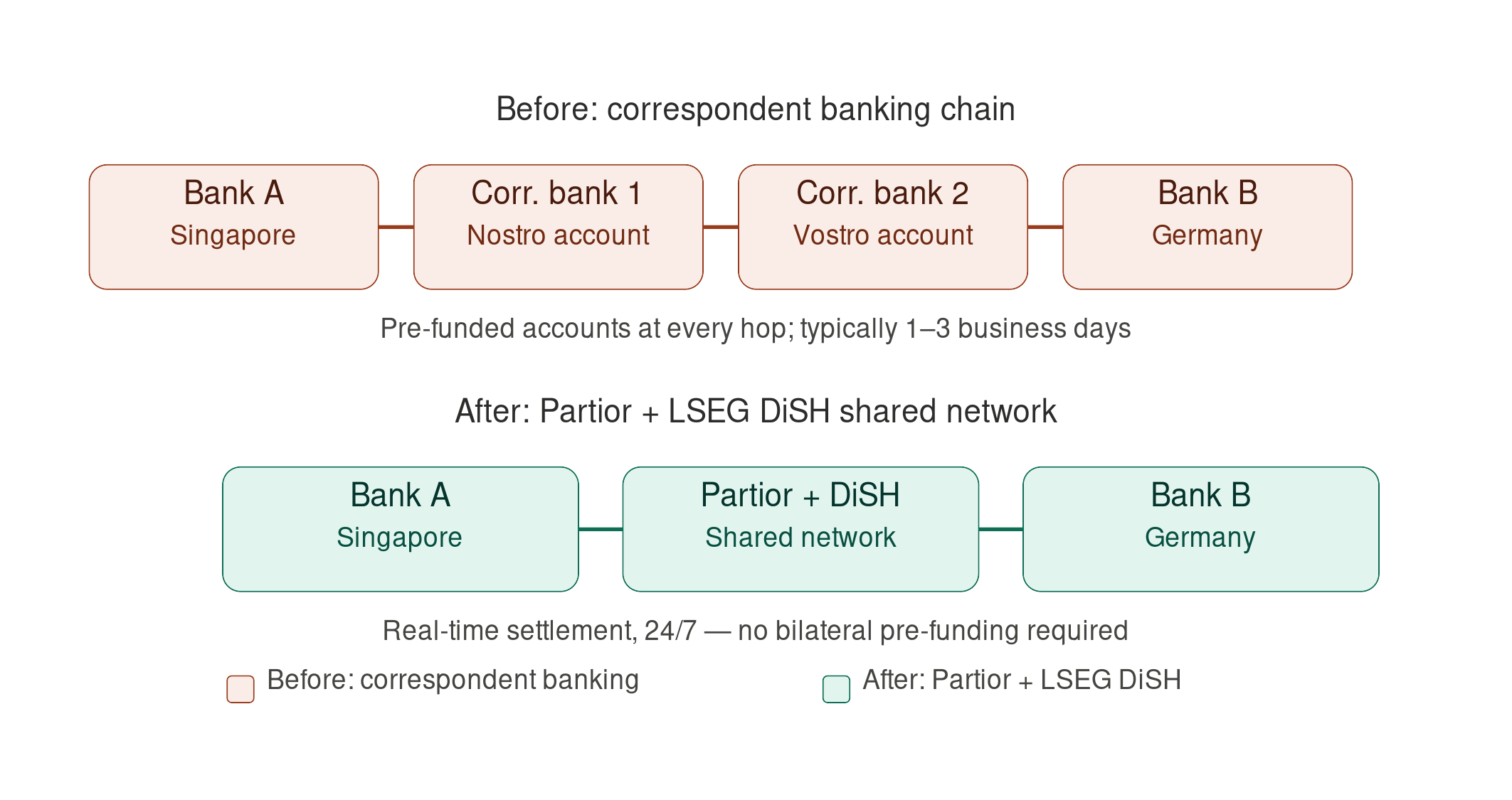
When a company in Singapore wants to pay a supplier in Germany at 11pm on a Sunday, the money typically has to hop through a chain of intermediate banks, each with their own cut-off times, each requiring the next one to have cash pre-deposited in an account just sitting there, waiting. These pre-deposited accounts are called nostro/vostro accounts (Italian for "ours/yours") and they're expensive. Banks have to lock up capital in dozens of these accounts around the world, just to keep the system operational. The current system is inefficient, and no single player has ever had the power or incentive to replace it wholesale.
The Financing Angle
This is a commercial collaboration agreement, meaning both companies keep their independence but agree to interoperate. The practical design works like this: Partior provides the blockchain network through which participating banks can clear and settle payments in multiple currencies, then LSEG DiSH's omnibus trust accounts let banks draw on settlement funds around the clock, without needing pre-funded bilateral accounts with every counterpart. Together, they let a bank send money internationally at 2am on a Saturday in real time, without having pre-positioned cash in a dozen different places.
Because this is a collaboration rather than a regulated transaction, there is no formal regulatory approval process disclosed. The go-live process involves phased industry testing before commercial onboarding begins.
No external financing has been disclosed, as this is being built on the existing infrastructure and capital of both companies. Partior is already well-funded, having raised backing from its founding shareholders and some later investors. No law firm advisers have been publicly announced in connection with this deal.
Why it Matters
This deal is significant for many reasons. First, banks are fierce competitors, so getting Deutsche Bank, Standard Chartered, and J.P. Morgan to agree to share the same plumbing is highly unusual, and likely means that competing on top of the solution is more profitable than owning it exclusively. Second, the capital locked up in nostro accounts globally runs into the trillions, and even marginal improvements in how efficiently that capital is deployed represent enormous savings for the banking system that can, in theory, be passed on to corporate clients through lower fees and faster payment times. Third, it signals that blockchain in banking is maturing: while early blockchain experiments in finance were often speculative or proof-of-concept, this deal is explicitly production-ready and backed by some of the most important financial institutions in the world. Fourth, it significantly benefits Asian markets, whose inability to settle payments outside Western business hours was a major economic constraint. Fifth, it lays the groundwork for more complex products, as PVP (Payment versus Payment, used in FX transactions) and DVP (Delivery versus Payment, used in securities settlement) have both been mentioned as future additions. If those are eventually bolted on, this may become the foundation for a whole new layer of global financial market infrastructure.