Baldwin Group to be acquired by Sequence Holdings in $7.7bn take-private
Hussain Jeddy · 15 September 2026
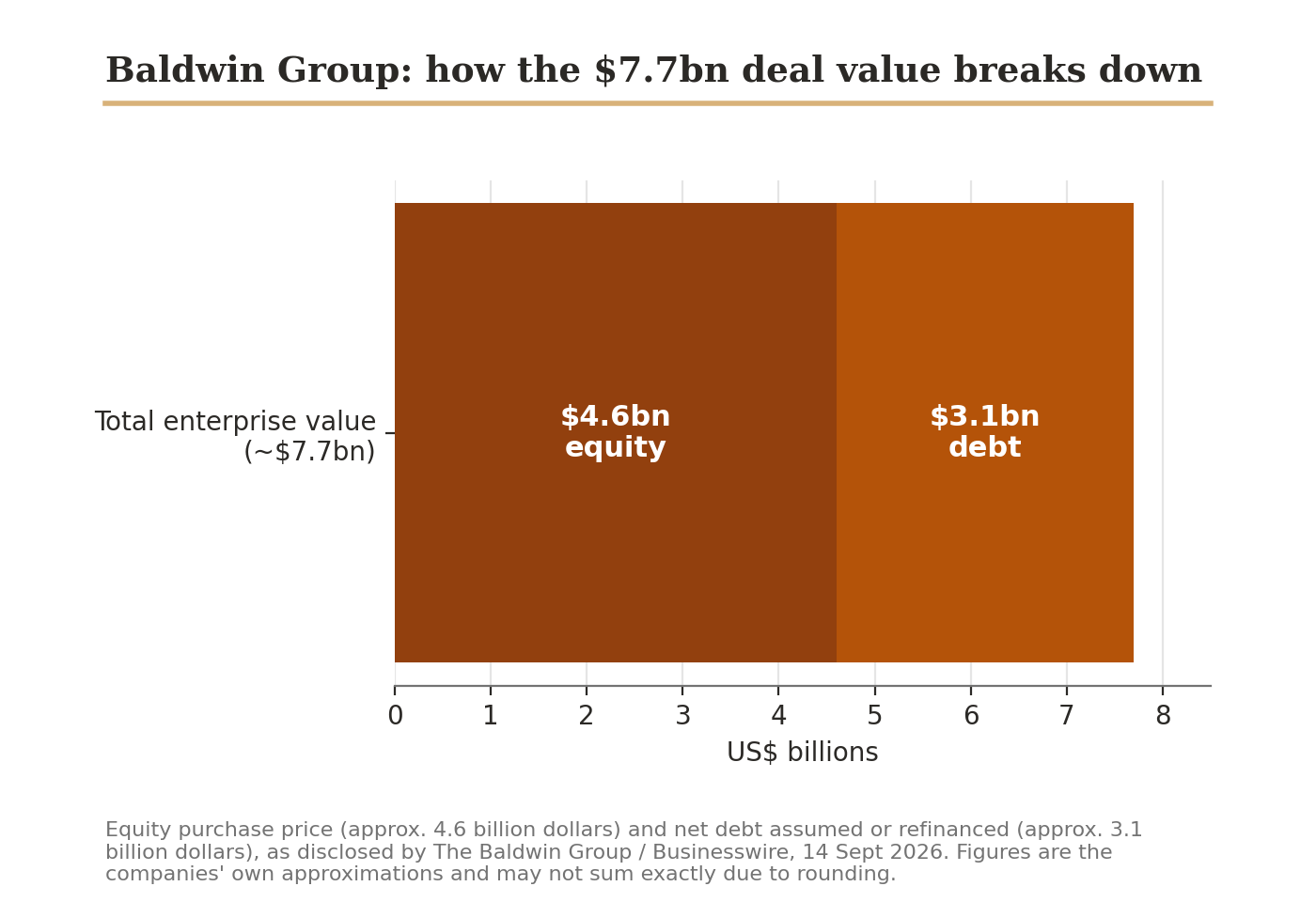
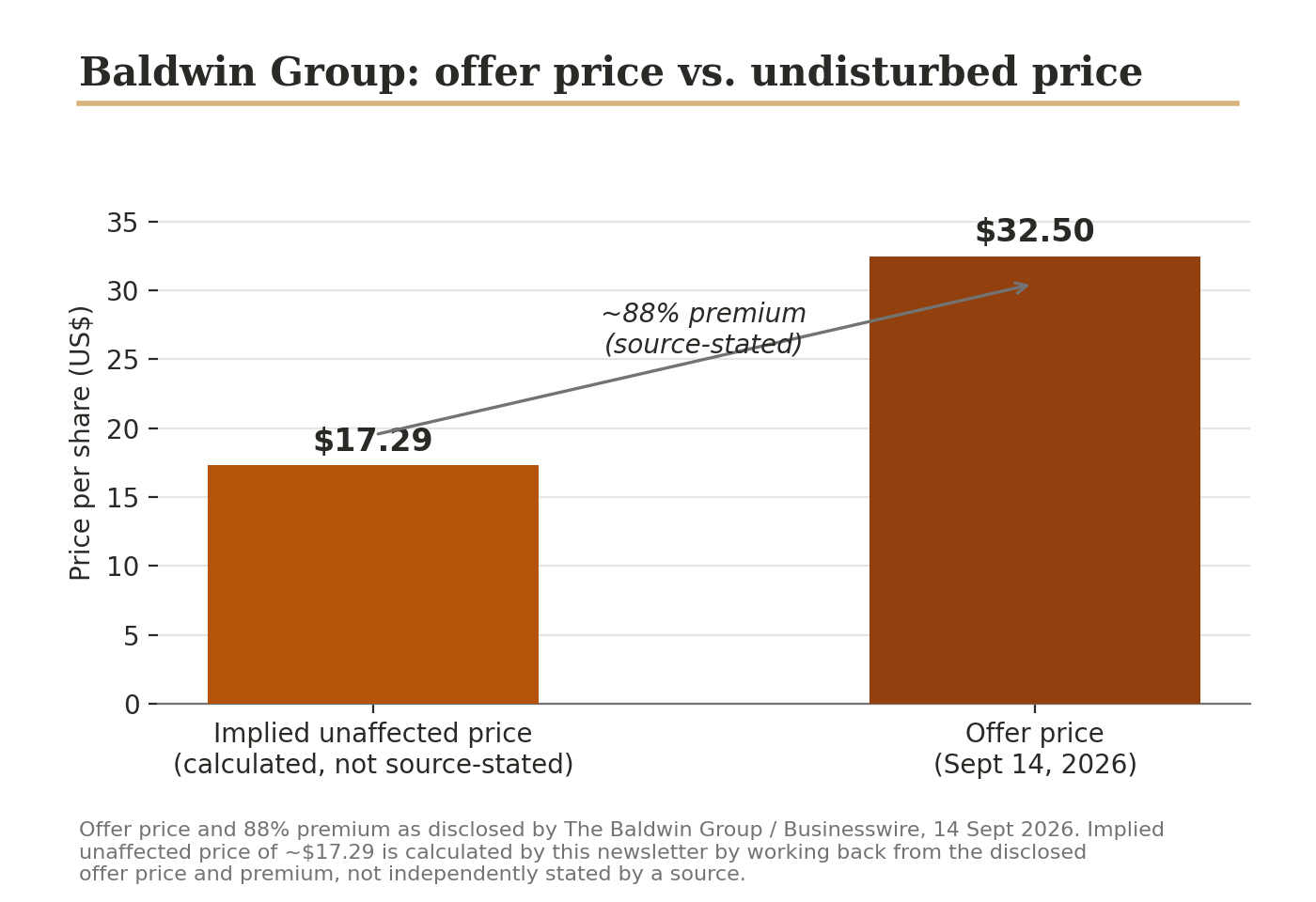
Share on LinkedInOn 14 September 2026, The Baldwin Group, Inc., a NASDAQ-listed insurance distribution firm, announced a definitive agreement to be taken private by a newly formed entity backed by Sequence Holdings and DFO Management, the family investment office of Dell Technologies founder Michael Dell. Shareholders will receive $32.50 in cash per share, valuing the deal at roughly $7.7 billion in terms of enterprise value.
The Parties
Baldwin is an independent insurance distribution firm headquartered in Tampa, Florida, representing more than three million clients across personal, commercial, and employee-benefits insurance lines in the US and internationally. Sequence Holdings is a New York-based 'permanent holding company' (meaning it buys established businesses to hold indefinitely rather than exit on a fund's typical multi-year clock), that pairs the companies it acquires with its own technology platform to rebuild their operations. DFO Management is Michael Dell's family office, which has managed his personal investment assets since 1998, originally as MSD Capital.
Structure & Process
The transaction is structured as a straightforward all-cash merger. A newly formed merger subsidiary will merge into Baldwin, leaving Baldwin as a wholly owned subsidiary of the acquiring entity. Because this takes US-listed public company private, it triggers the SEC's Schedule 13E-3 regime (the disclosure rules that apply specifically to 'going private' transactions, designed to give minority shareholders extra protection since insiders (here, existing management retaining equity) are effectively on both sides of the deal. Baldwin will also file a proxy statement seeking shareholder approval. The deal was unanimously approved by Baldwin's board following the recommendation of a Special Committee of independent directors, and it carries no financing condition, meaning the buyers aren't relying on securing a loan before they can complete, as the cash is already committed.
The Financing Angle
The transaction is entirely cash-funded by Sequence and DFO's own capital rather than through a leveraged buyout structure with new bank debt, since DFO describes itself as investing with "the flexibility and patience of permanent capital, not as a fund working against a fixed exit clock." Piper Sandler is lead financial adviser and Moelis sole capital markets adviser to Sequence and DFO, with Morgan Stanley, Barclays and Wells Fargo also advising the buyer side. Ardea Partners LP is lead financial adviser to Baldwin, with MarshBerry also advising.
Davis Polk & Wardwell LLP are the legal adviser to Baldwin, Troutman Pepper Locke LLP are the insurance regulatory counsel to Baldwin, Potter Anderson & Corroon LLP are the independent legal adviser to the Special Committee, Latham & Watkins LLP are the legal counsel to Sequence, and Sullivan & Cromwell LLP legal counsel to DFO. Lots of lawyers.
Why it Matters
This is another sign that traditional private equity isn't the only capital chasing specialty insurance distribution. Family offices and "permanent capital" vehicles are increasingly bidding directly against PE funds for these businesses, drawn by the recurring, fee-like revenue insurance brokerages generate. It's also notable that eligible Baldwin employees are being given the option to roll over equity into the private company, a retention mechanic increasingly common in take-privates that want to keep founder-era talent in place through the transition.
Real-World Impact
If you've bought home, auto or business insurance through an independent broker in the US, firms like Baldwin are often the invisible middle layer between you and the insurer, and Baldwin says the whole point of this deal is to move faster on AI integration into how it sources and prices risk for clients. That could plausibly mean faster, cheaper service for customers over time; it could also put pressure on back-office and administrative roles if AI tools start doing work junior staff currently do, though no job cuts have been announced and Baldwin has explicitly pledged to preserve broad-based employee ownership through the transition. Once the deal closes, Baldwin's shares disappear from the Nasdaq which is a reminder of the broader trend of public companies (especially mid-cap ones) going private, which means everyday investors lose the ability to own a piece of the business directly and it becomes accessible only to those wealthy enough to invest alongside firms like DFO.