Copart's $1.9bn acquisition of ADV Auctions
Hussain Jeddy · 12 September 2026
Share on LinkedInOn 10 September 2026, Copart, Inc., the Dallas-headquartered online vehicle auction group, agreed to acquire ACV Auctions Inc., a Buffalo-based digital wholesale vehicle marketplace, for $10.50 per share in cash, in an all-cash deal valuing ACV's equity at approximately $1.9 billion.
The Parties
Copart runs one of the world's largest online marketplaces for salvage and total-loss vehicles, connecting insurance companies, dealers, and other sellers of damaged or written-off cars with buyers (often dismantlers, rebuilders and exporters) through its online bidding platform. ACV Auctions, by contrast, focuses on dealer-to-dealer wholesale trade. It moved the traditional physical car-auction "lane," where dealers trade in used vehicles and off-lease cars amongst themselves, onto a mobile-first digital format. Its ACV MAX platform (a suite of AI-powered tools that help dealers value, appraise and manage vehicle inventory) has become a growing part of its business beyond the core auction marketplace. ACV reported first-quarter 2026 revenue of $204.2 million, up 11.8% year-on-year, and guided to roughly $850 million in full-year 2026 revenue.
Structure & Process
This is a US public-company acquisition structured as a cash tender offer. Copart, through a wholly owned subsidiary (Apple Merger Sub, Inc.), will offer to buy all of ACV's outstanding shares directly from shareholders at $10.50 each. A tender offer requires only that a majority of shares be tendered, rather than the longer route of convening a shareholder vote first. Any shares not tendered are then swept up in a follow-on "short-form" merger under Section 251(h) of the Delaware General Corporation Law, so that Copart ends up owning 100% of ACV without needing a separate shareholder vote for that final step. The deal is conditional on customary antitrust clearance under the Hart-Scott-Rodino Act (the US regime requiring competition-authority sign-off on larger mergers) and the absence of any court injunction blocking it, but is not subject to a financing condition. Certain ACV shareholders holding around 4.1% of its stock have signed support agreements committing to tender their shares.
The Financing Angle
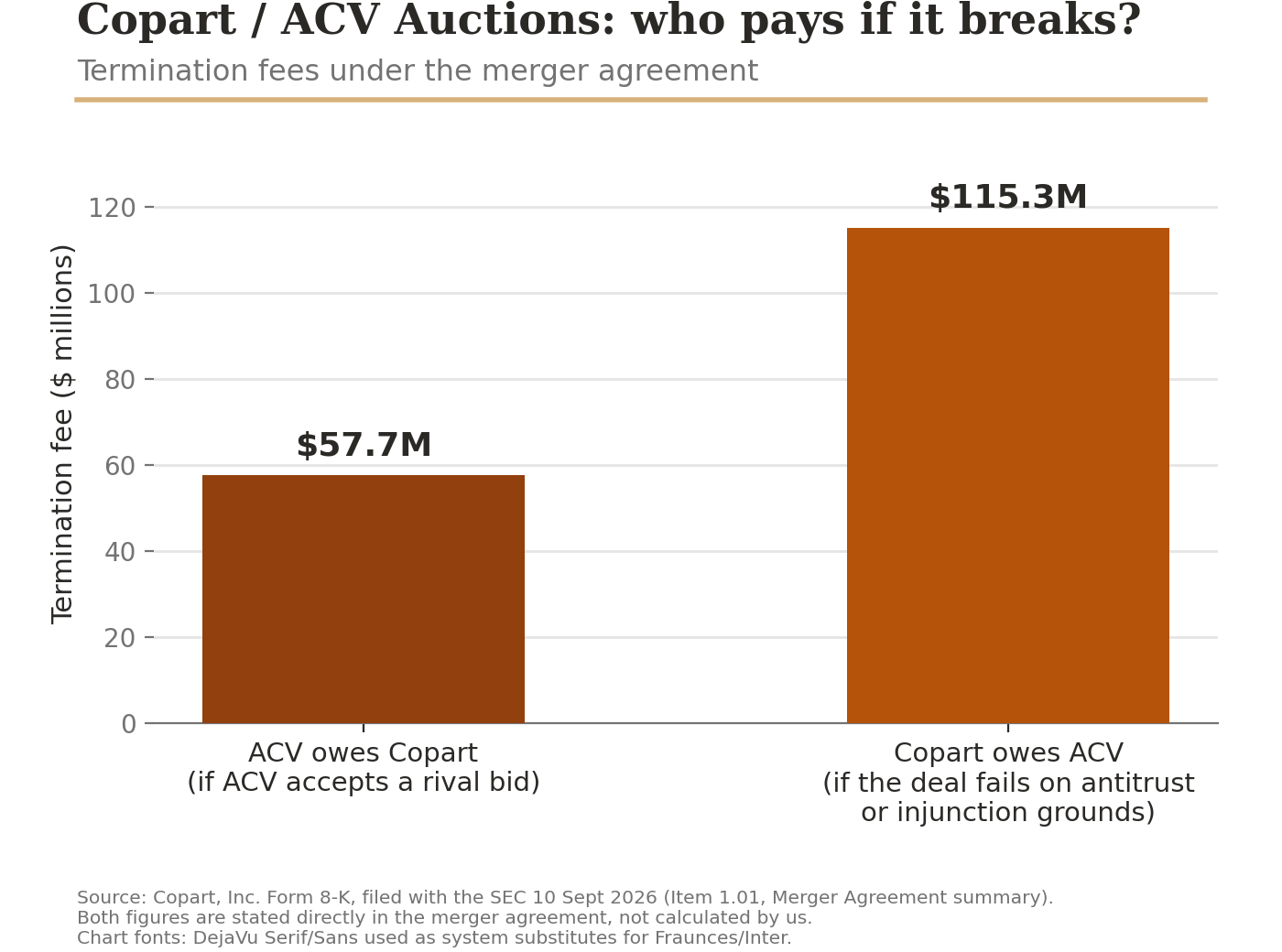
Copart is funding the acquisition from its own cash on hand. The transaction carries no financing contingency, which is a signal of balance-sheet confidence given Copart's scale. If the deal is terminated in specified circumstances (for example, ACV accepting a superior proposal), ACV would owe Copart a $57.7 million termination fee, while Copart would owe ACV $115.3 million under other specified circumstances (such as failing to clear antitrust review). This is an unusually large "reverse" termination fee that suggests Copart is confident enough in closing that it was willing to put a meaningful sum behind that confidence, while also compensating ACV for the risk of a long regulatory process.
Why it Matters
This deal is a good example of a company buying its way into an adjacent market rather than trying to build the capability itself. Copart's core business depends on the volume of salvage and total-loss vehicles, which is capped by how many cars are written off each year. ACV's dealer-to-dealer wholesale market is much larger and structurally different, giving Copart a second growth lane not tied to crash rates. It is also a useful example of the tender-offer route to a US public-company takeover, which is faster than a proxy-vote merger and worth contrasting with the UK's scheme-of-arrangement mechanism used in several deals covered on this site.
Real-World Impact
If you've ever traded in a car at a dealership, there's a good chance that vehicle later passed through a wholesale auction platform like ACV's before turning up on another dealer's forecourt, even though you, as the original owner, never saw any of it. This deal is about who controls that behind-the-scenes plumbing of the used-car market.
For car buyers, a bigger combined player controlling more of the wholesale-to-retail supply chain could, over time, affect how quickly and cheaply dealers can restock inventory, which can feed through into used-car prices and availability, though nothing about pricing has been announced and this is speculative. For ACV's roughly 2,000+ employees, this kind of platform acquisition can go either way: sometimes the acquired company keeps operating largely independently (which Copart has said is the plan here, at least initially), and sometimes back-office functions get consolidated over time, affecting jobs in areas like finance, HR or corporate support. No layoffs have been announced. The deal is also a live case study in a persistent competition-policy question in the US, whether increasing consolidation in specialist online marketplaces, even ones consumers rarely interact with directly, deserves more antitrust scrutiny. This transaction will need Hart-Scott-Rodino clearance, so it is a real (if modest, given the two companies serve different niches) test of how regulators are currently treating vertical-ish consolidation in auto marketplaces.