Analog Device's $1.35bn (up to $1.55bn) acquisition of Alif Semiconductor
Hussain Jeddy · 10 September 2026
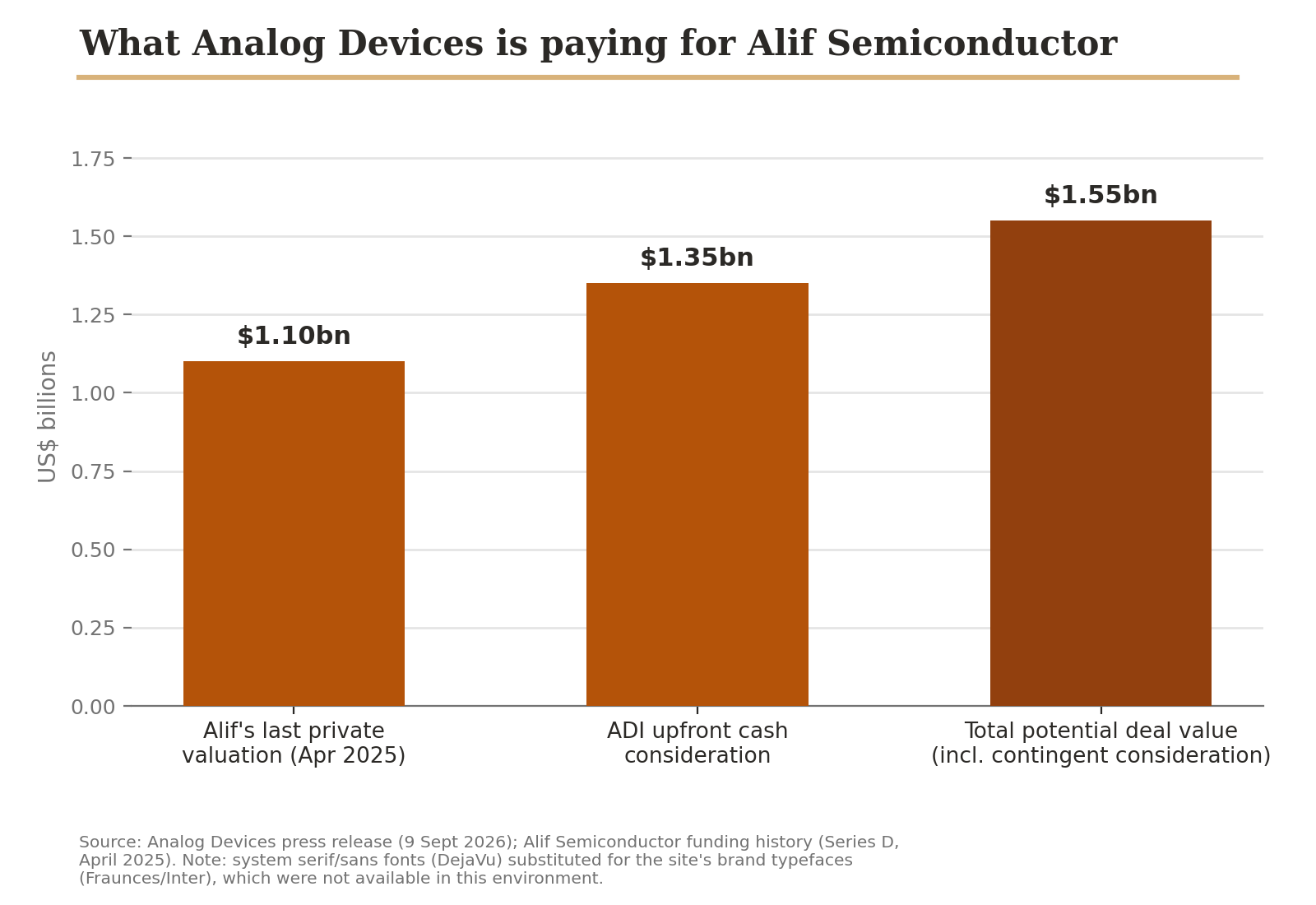
Share on LinkedInOn 9 September 2026, Analog Devices, Inc. announced a definitive agreement to acquire Alif Semiconductor, Inc., a privately held maker of AI-focused microcontrollers, in an all-cash trasaction. ADI will pay $1.35 billion upfront, with up to a further $200 million in contingent consideration tied to future milestones, taking the potential value to $1.55 billion. The deal is expected to close before the end of 2026, subject to Hart-Scott-Rodino (the US antitrust pre-merger notification regime requiring the parties to notify federal regulators and clear a waiting period before closing) review.
The Parties
Analog Devices is a US-listed semiconductor company with more than $11 billion in annual revenue, known for analog, mixed-signal and digital signal processing chips used across industrial, automotive, communications and consumer electronics. Alif Semiconductor, headquartered in Pleasanton, California, was founded in 2019 by Syed Ali and Reza Kazerounian and makes what it calls "AI-native" microcontrollers and fusion processors. These are chips designed to run machine-learning inference directly on small, low-power "edge" devices (sensors, wearables, industrial equipment) rather than sending data to the cloud for processing. Alif had raised roughly $342 million from investors including Kleiner Perkins, Mayfield, ICONIQ Growth, Fidelity/FMR and Celesta Capital, and was valued at $1.1 billion in an April 2025 funding round, meaning this deal prices the company at a premium to its last private valuation.
Structure & Process
This is a straightforward private US company acquisition. There is no scheme of arrangement or public takeover code, since Alif is privately held. The transaction is structured as a merger under Delaware corporate law (a statutory merger, where Alif's corporate existence is absorbed in) instead of an asset purchase, meaning ADI acquires the whole corporate entity, including its contracts, IP and liabilities. The main regulatory hurdle is US antitrust clearance under HSR. ADI expects this to complete by year-end 2026.
The Financing Angle
ADI is funding the acquisition as an all-cash deal, and given the company's scale (more than $$11 billion in annual revenue), commentary around the deal characterises it as funded from cash on hand rather than new acquisition debt, though ADI's own press release does not spell out the funding source in detail. PJT Partners acted as financial adviser to ADI, with Wachtell, Lipton, Rosen & Katz as ADI's legal counsel. Qatalyst Partners advised Alif as financial adviser, with DLA Piper as Alif's legal counsel.
Why it Matters
This is ADI's second major AI-related acquisition in 2026 (following its earlier deal for Empower Semiconductor), and it is a good example of a large, established semiconductor company buying its way into a fast-moving product category, those being 'edge AI' chips that run machine-learning models locally on small devices, instead of building the technology in-house from scratch. For those interested in the mechanics of the deal, it is a clean illustration of a straightforward private-company, all-cash acquisition structure, in contrast to the public-company schemes and tender offers that dominate much of this newsletter's UK coverage, and of contingent/earn-out consideration ($200m of the total is not paid upfront) being used to bridge a valuation gap or align incentives post-acquisition.
Real-World Impact
Alif's chips aren't something most people buy directly. They end up inside other companies' products, in things like wearables, smart sensors, and industrial equipment that need to think for themselves without a permanent internet connection (think: a security camera that recognises a person without sending video to the cloud, or a factory sensor that flags a fault on the spot). If this acquisition succeeds, it's a signal that "AI on the edge", or AI running on the device in your hand or your factory floor, rather than in a data centre, is becoming a mainstream enough market that a major, established chipmaker is willing to pay a premium over Alif's last private valuation to own it outright. That's a preview of the kind of low-power, always-on AI features that could show up in future gadgets, though which specific products change (and when) is not yet confirmed by either company.