Tata Motor's €3.8bn tender offer for Iveco Group
Hussain Jeddy · 9 September 2026
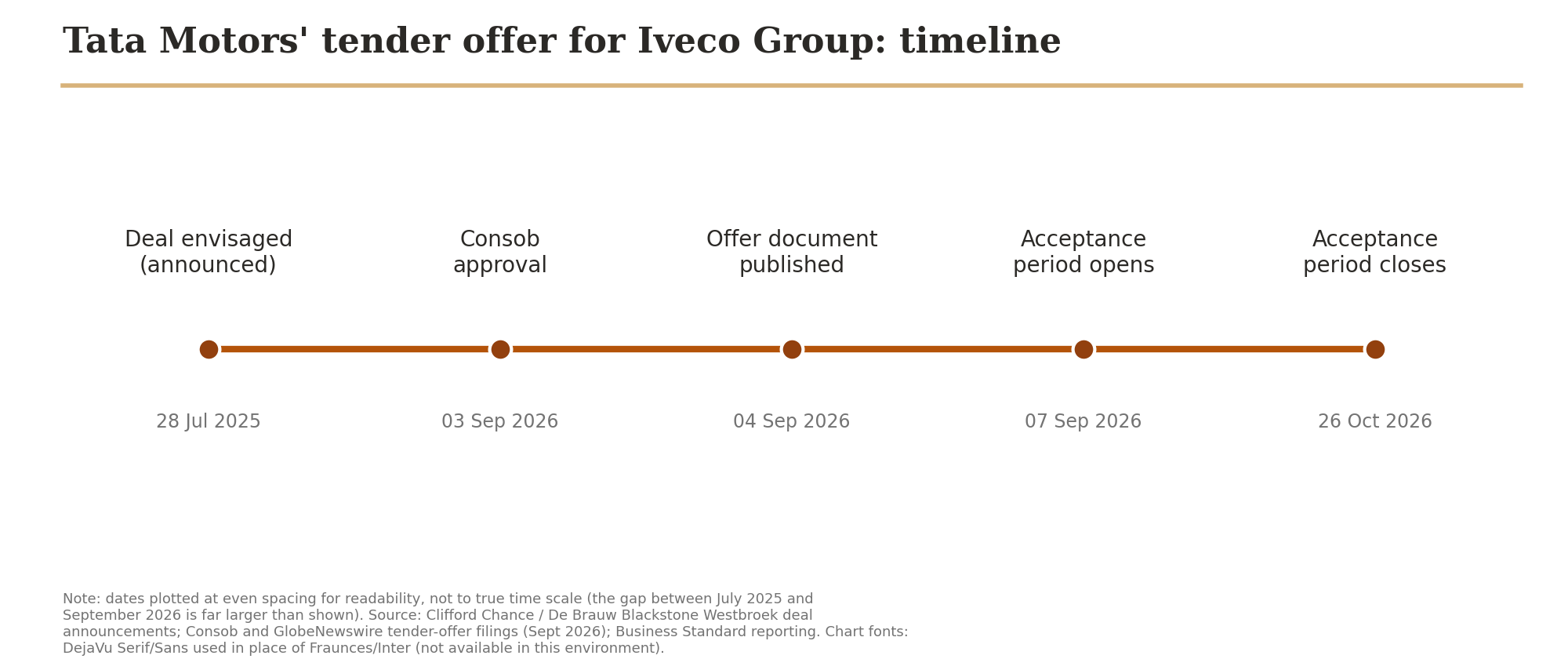
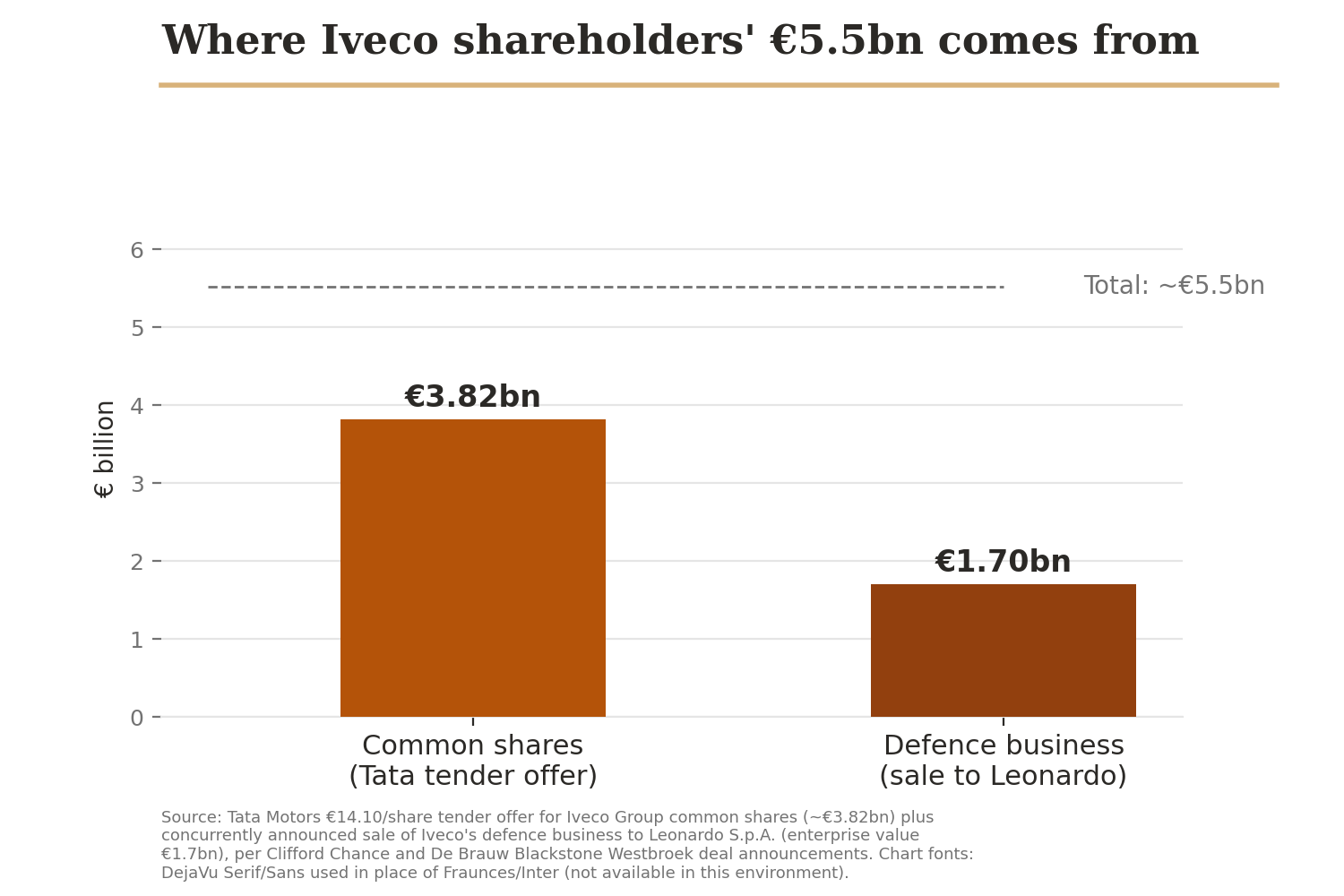
Share on LinkedInTata Motors Limited, via its subsidiary TML CV Holdings B.V, launched the acceptance period for its recommended, all-cash voluntary tender offer (a public offer to shareholders to sell their shares, as opposed to a scheme of arrangement), for all common shares of Iveco Group N.V. on 7 September 2026, at €14.10 per share cum dividend, valuing Iveco's common shares at approximately €3.82 billion. The wider transaction, including a linked sale of Iveco's defence business, is valued at approximately €5.5 billion in total consideration to Iveco shareholders.
The Parties
Tata Motors is a major Indian automotive manufacturer producing commercial vehicles (such as trucks and buses) and passenger veicles, and is part of the Tata Group conglomerate. Iveco Group N.V. is an Italy-headquartered, Amsterdam-incorporated manufacturer of commercial vehicles and also owns a defence vehicles business, and was previously spun off from CNH Industrial in 2022.
Structure & Process
This is a recommended (board supported) voluntary tender offer under Dutch and Italian takeover rules, since Iveco is incorporated in the Netherlands but listed in Italy, hence approval from Italy's market regulator, Consob, was required before the offer document could be published. Completion is conditional on the separation of Iveco's defence business, which is being carried out either via a sale to Italian defence group Leonardo S.p.A (announced concurrently, at an enterprise value of €1.7 billion) or a spin-off if that sale does not proceed. The combination also triggers a change of control at Iveco's captive financial-services entities in France and Spain (IC Financial SA, CNH Industrial Capital, and Transolver Finance), requiring separate approval from the European Central Bank and the Bank of Spain.
The Financing Angle
This is an all-cash offer. The sourcing of Tata Motor's cash consideration was not detailed. Iveco's largest shareholder, Exor N.V. (the Agnelli family's holding company), has irrevocably committed to tender its approximately 27.06% stake, which meaningfully de-risks the offer's chances of success. Goldman Sachs is the financial adviser to Iveco, and Rothschild & Co Italia, are financial advisers to Iveco's independent directors. Clifford Chance is confirmed as legal adviser for Tata Motors, and De Brauw Blackstone Westbroek (Dutch law) and PedersoliGattai (Italian law) are confirmed as legal advisers to Iveco Group N.V.
Why it Matters
If completed, this combination would create a global commercial-vehicle player with combined annual sales of more than 590,000 vehicles, combined revenues of around €21–22 billion, and limited geographic overlap with roughly half the combined revenue from Europe, about a third from India, and the rest from the Americas and emerging markets in Asia and Africa. It's also a landmark deal for Indian outbound M&A into Europe, and Clifford Chance's own announcement frames it as a "strategic milestone" for its India cross-border practice.
Real-World Impact
Iveco makes trucks and buses used across Europe's freight and public transport networks, so a Tata-Iveco tie-up is ultimately about who builds the vehicles that move goods and people around the continent. This is not something most people think about, but relevant if you've ever driven behind a delivery truck or ridden a city bus in Europe. The deal is conditional on carving out Iveco's defence business first, which is itself being sold to Italian defence group Leonardo, a detail with its own real-world edge, since it comes at a moment when European governments are under pressure to boost domestic defence manufacturing capacity, and keeping Iveco's defence arm under Italian ownership (rather than folding it into an India-controlled group) is likely politically easier to wave through regulators. On jobs, no layoffs have been announced, and the companies emphasise "substantially no overlap" in their industrial footprints, which is often (though not always) a sign that a deal is less likely to trigger factory-closure headlines seen in more overlapping mergers, but this is the companies' own framing, not an independent guarantee.