Spire Healthcare Group plc to be acquired by private consortium
Hussain Jeddy · 8 September 2026
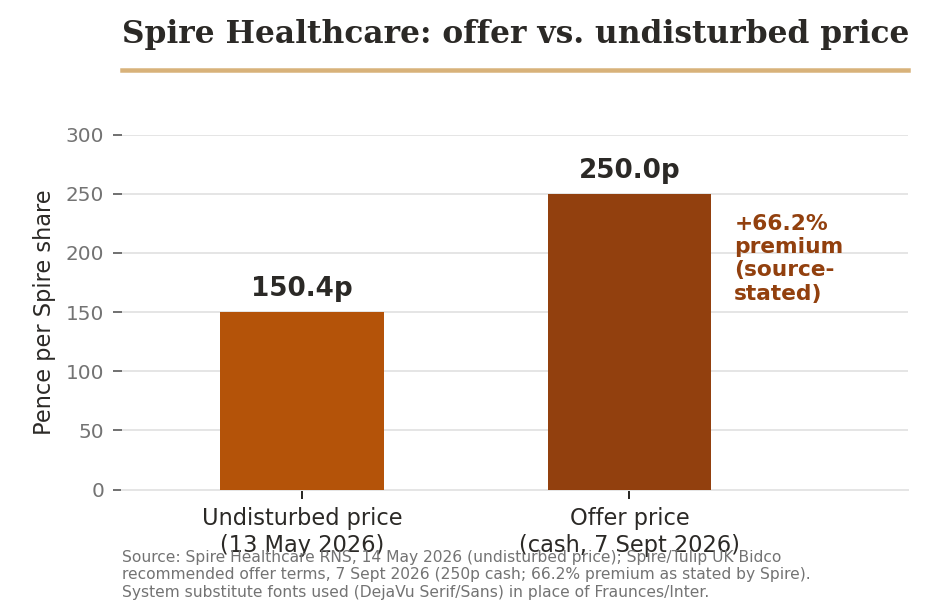
Share on LinkedInOn 7 September 2026, the board of Spire Healthcare Group plc, the UK's second-largest private hospital operator and a FTSE 250 constituent, agreed to a recommended cash takeover by Tulip UK Bidco Limited, a new vehicle backed by a consortium of Toscafund Asset Management (already Spire's second-largest shareholder), UK private equity firm Three Hills, and US investment manager Ares Management. Spire shareholders will receive 250p in cash per share, valuing the company's fully diluted equity at approximately £1.03 billion and implying an enterprise value (a company's total value including its debt, not just what shareholders receive for their shares) of around £2.31 billion. That's a 66.2% premium to the 150.4p closing price on 13 May 2026, the last trading day before Toscafund's interest became public.
The Parties
Spire Healthcare runs 38 hospitals and more than 60 clinics across England, Wales and Scotland, working with over 8,800 consultants and treating more than 1.36 million patients in 2025. It is the UK's leading private provider by volume of knee and hip replacements, and also runs a network of private GPs, workplace health services for 1,400+ employers, and is the largest independent provider of NHS talking-therapies (mental health) services in England. Toscafund Asset Management is a London-based investment manager and Spire's second-largest existing shareholder; Three Hills is a UK private equity firm; Ares Management is a US-listed global alternative asset manager. Together they've formed Tulip UK Bidco specifically as the acquisition vehicle for this deal.
The Structure
The deal follows the classic UK public-takeover path: it will be implemented via a scheme of arrangement (a court-approved procedure under the UK Companies Act 2006 that lets a bidder buy 100% of a public company in one go, provided a set majority of shareholders vote in favour and a judge signs off. This is the most common route for "friendly," board-recommended UK takeovers, as opposed to a contractual offer where the bidder has to chase individual acceptances).
This followed a lengthy formal sale process. Spire's board ran a strategic review that involved discussions with more than 60 potential buyers over roughly eight months before settling on Toscafund's proposal. Under the UK's Takeover Code, Toscafund first had to clear a Rule 2.6 "put up or shut up" deadline (the point by which a possible bidder must either commit to a firm offer or walk away), the 14 May statement set that deadline at 11 June 2026, before the firm recommended offer was announced on 7 September. The deal is subject to shareholder approval, court sanction of the scheme, and customary regulatory clearances, and is expected to complete in Q4 2026 or Q1 2027. Alongside the deal, Spire is reshuffling its board: CEO Justin Ash will retire (interim CEO: current vice-chair David Sloman), and chair Ian Cheshire will step down (interim chair: Debbie White), with Tulip UK Bidco planning to install Paolo Pieri, former CEO of rival operator Circle Health Group, as chair once the deal completes.
The Financing Angle
Financial terms of the consortium's own funding (debt vs. equity mix, lenders) have not been disclosed in the sources. What is confirmed is that Spire's board was advised by three financial advisers/brokers including Rothschild & Co as lead adviser, plus Gleacher Shacklock and J.P. Morgan Cazenove as joint advisers, with Berenberg as joint corporate broker, while Bidco's financial adviser is reported to be Darblay Capital. No legal advisers are named in any source.
Why it Matters
This is the latest in a wave of UK take-privates this year. As stated in yesterday's issue, Bloomberg reported UK takeover activity passing $100 billion for 2026 even before this deal, and Spire joins Gamma Communications, Bodycote, Harworth and easyJet as London-listed businesses drawing private capital in the past few months.
For the UK private healthcare sector specifically, it signals continued consolidation and PE interest in providers that blend NHS-funded, insurer-funded and self-pay work, a model regulators and NHS commissioners watch closely given the sector's role as a release valve for NHS waiting lists.
Real-World Impact
If you or a family member has ever paid for a private hip replacement, an MRI scan, or used private mental-health therapy in the UK, there's a reasonable chance it went through a Spire hospital or clinic. They're the country's second-biggest private hospital group. A change of ownership to a private-equity-backed consortium doesn't automatically mean higher prices or different care, but it's the kind of event that's worth watching as new owners sometimes push for higher returns through price rises, cost-cutting, or focusing investment on the most profitable treatments, and sometimes instead pump in fresh capital for new facilities and equipment.
Because Spire also does a lot of NHS-funded work (it's the largest independent provider of NHS talking therapies in England, for instance), any strategic shift here could ripple into NHS waiting-list capacity too. Nothing concrete has been announced about price or service changes as this is speculation about a plausible future pattern, and should be read as such.