KKR to take Integer Holdings private for $5.7bn
Hussain Jeddy · 2 September 2026
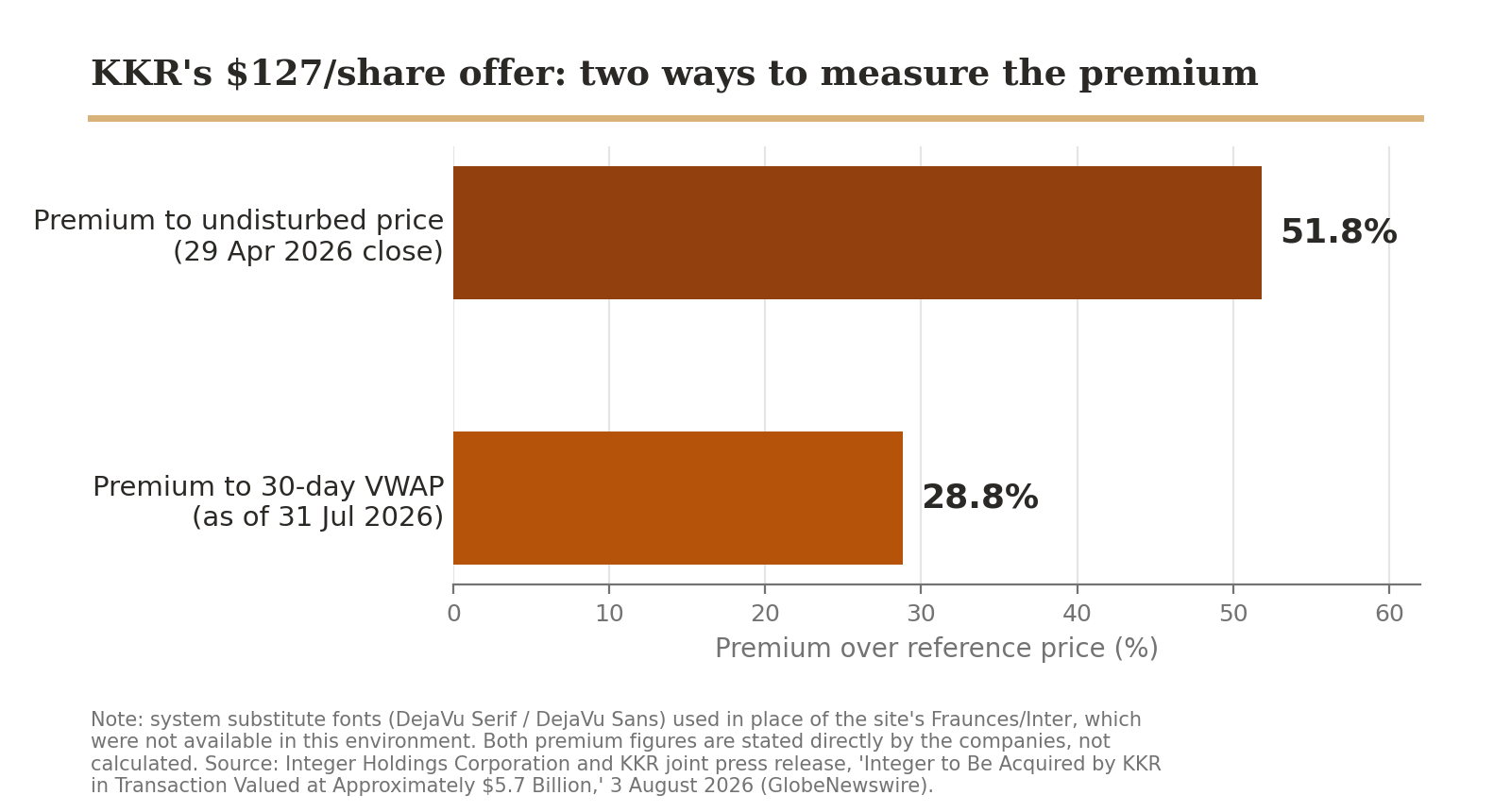
Share on LinkedInOn 3 August 2026, Integer Holdings Corporation, a Texas-based medical device manufacturer, agreed to be acquired by the private equity firm KKR in an all-cash deal valuing the company at approximately $5.7bn on an enterprise value basis (a company's total value including debt, not just what shareholders receive). Integer's stockholders will get $127.00 for every share they hold, a premium of roughly 51.8% over where the stock was trading the day before Integer first announced it was exploring strategic alternatives.
The Parties
Integer (headquartered in Plano, Texas) is one of the largest medical device CDMOs (contract development and manufacturing organisations; companies that design and build medical devices on behalf of the brands that sell them) in the world. It serves the cardio and vascular, neuromodulation, and cardiac rhythm management markets, and its brands include Greatbatch Medical and Lake Region Medical. It employs around 11,000 people, referred to in its own materials as "associates."
KKR is one of the largest global private equity and alternative asset managers, investing across private equity, credit, real assets, and insurance. It is making this investment through its "core private equity" strategy, a KKR fund structure aimed at longer-hold, lower-risk investments than a traditional buyout fund.
Structure and Process
This is a straightforward take-private merger. An affiliate of KKR's funds (named in the merger agreement as Armstrong Parent, Inc., with a merger subsidiary called Armstrong Bidco, Inc.) will acquire all of Integer's outstanding shares for cash, after which Integer's common stock will be delisted from the NYSE and the company will become privately held.
The deal follows a board-led strategic review that Integer publicly announced on 30 April 2026, meaning the board and its advisers spent roughly three months examining alternatives (which could have included a sale, a recapitalisation, or staying independent) before settling on the KKR transaction. Integer's board has unanimously approved the merger agreement and is recommending that stockholders vote in favour of it.
Because Integer is a US public company, completion requires Integer to file a proxy statement (a disclosure document, filed on SEC Schedule 14A, that gives stockholders the information they need to vote) and to hold a stockholder vote approving the merger. The companies have also flagged "required regulatory approvals" as a closing condition without specifying which regime; for a US transaction of this size, that would typically include antitrust clearance under the Hart-Scott-Rodino Act.
The Financing Angle
KKR is funding the deal through a mix of equity from its own managed funds and committed debt financing, meaning the debt piece is already locked in with lenders, and not "expected." The release states explicitly that the transaction is "not subject to any financing contingency," which matters because it signals to Integer's board and stockholders that the deal is very unlikely to fall apart for lack of funding. This is a meaningfully stronger commitment than a deal where financing still needs to be arranged after signing.
Five banks: Citi, KKR Capital Markets, Barclays, UBS, and Jefferies, are named as lead arrangers for that debt financing. On the advisory side, Goldman Sachs acted as Integer's sole financial adviser, while KKR brought a larger financial advisory bench of Centerview Partners, Barclays, Citi, and Raymond James.
On the legal side, Davis Polk & Wardwell LLP is advising Integer, while Kirkland & Ellis LLP is advising KKR.
Why it matters
This is a large, clean take-private of a mid-cap public company by a private equity major, in a sector (medical device manufacturing) that generally offers PE firms defensive, recession-resistant cash flows tied to healthcare demand rather than consumer spending cycles. The absence of a financing contingency and the unanimous board recommendation both point to a deal negotiated from a position of relative confidence.
It's also a useful example of how takeover premiums get measured two different ways in the same release: against the "undisturbed" price (the share price before the market knew a deal was even being explored, here 29 April 2026, the day before the strategic review was announced) and against the 30-day VWAP (volume-weighted average price, an average of the trading price over the prior month, weighted by how many shares traded at each price). The undisturbed-price premium (51.8%) is usually the bigger number; the VWAP premium (28.8%) is often seen as the more "honest" measure, since it strips out any speculative run-up in the stock once rumours of a deal start circulating. Both are stated directly by the companies here, not calculated after the fact.
Real-World Impact:
If you or someone you know has a pacemaker, a neurostimulator, or another implanted cardiac or neurological device, there's a reasonable chance a component of it was made by Integer. Its business sits deep in the supply chain for cardio-vascular, neuromodulation, and cardiac rhythm devices, even though most patients will never have heard the company's name. A change of ownership at a manufacturer like this doesn't usually show up in the news the way a consumer brand takeover would, but continuity of manufacturing quality and supply matters directly to patients relying on those devices.
For Integer's roughly 11,000 employees, KKR has said it "intends to establish a broad-based employee ownership and engagement program" after the deal closes. KKR points to a track record of extending equity value to over 200,000 non-management employees across more than 90 of its portfolio companies since 2011.
Because Integer will delist from the NYSE once the deal closes, ordinary retail investors who hold ITGR shares will be cashed out at $127 rather than being able to keep a stake in the company's future performance. This is a common trade-off in take-private deals that's worth understanding if you or your family hold shares in a company that gets acquired this way.