Victory Capital acquire First Eagle Investments for $7.0bn
Hussain Jeddy · 27 August 2026
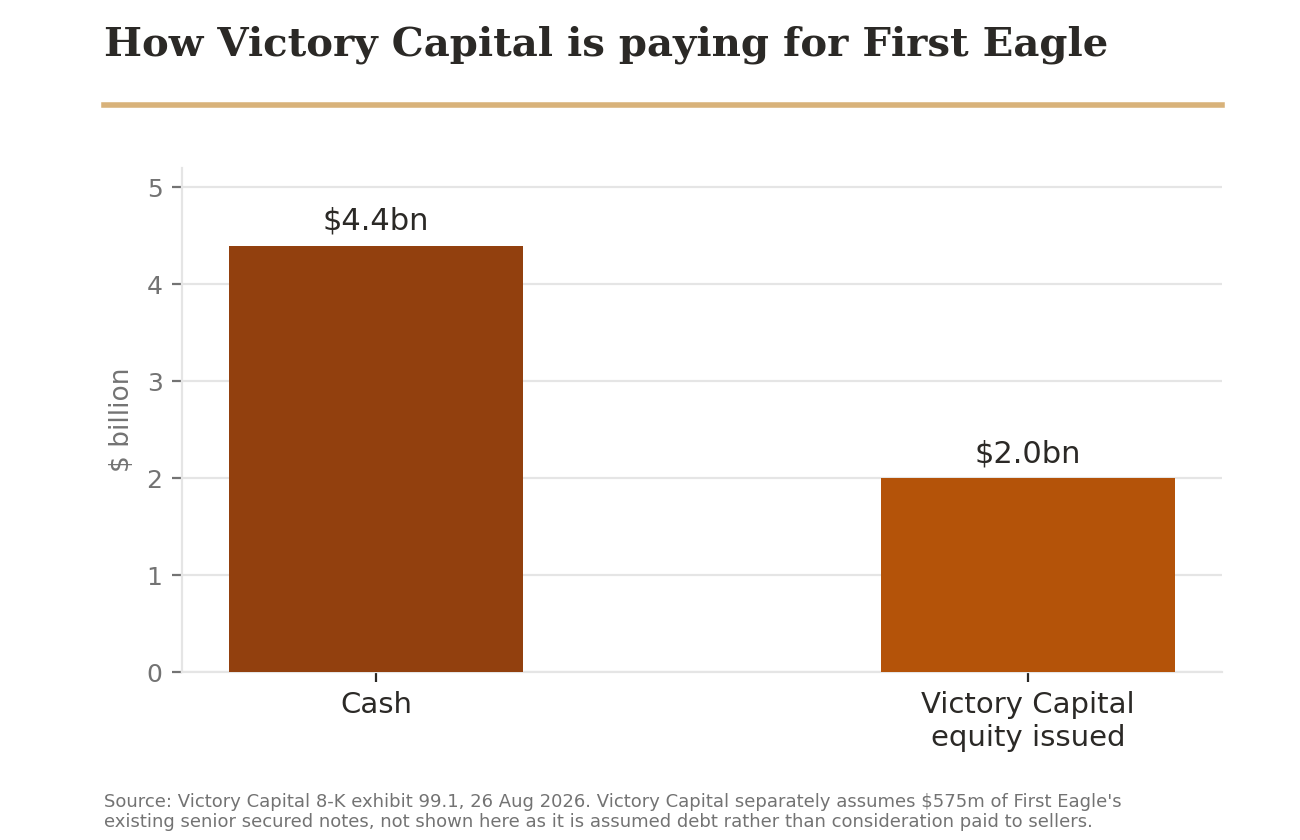
Share on LinkedInOn 26 August 2026, Victory Capital Holdings, Inc. announced a definite agreement to acquire 100% of First Eagle Investments, an independent, privately held global asset manager, from Genstar Capital and First Eagle's own employees. The deal values First Eagle at approximately $7.0bn, split between roughly $4.4bn in cash and $2.0bn of newly issued Victory Capital shares. Victory Capital will also take on $575 million of First Eagle's existing debt. It's expected to close by the end of the first quarter of 2027.
Victory Capital is a publicly traded, San Antonio-based asset manager that runs money for institutional, intermediary and individual clients through a collection of semi-independent investment teams it calls "Investment Franchises", alongside a broader distribution and operations platform, a model it has built up through a series of similar bolt-on acquisitions (when a company buys a smaller, complementary business to add new products, customers, capabilities, or geographic reach to its existing operations). First Eagle Investments is a much older, privately held New York firm, tracing its roots to 1864, known for its value-oriented, capital-preservation-focused investing across global multi-asset, equity and fixed income strategies. Additionally, more recently, it is knows for a $41 billion CLO (collateralised loan obligation, which is essentially a fund that pools together corporate loans and sells investors slices of the resulting cash flows, sliced by risk level) and alternative credit platform (an investment business that provides or invests in non-traditional lending, such as private credit, direct loans and other debt outside conventional bank lending and public bond markets). Genstar Capital, the private equity firm currently controlling First Eagle, is a San Francisco-based buyout shop that took its majority stake in First Eagle in 2025.
This is a private, negotiated acquisition of a privately held target by a public acquirer, not a public takeover bid, since First Eagle isn't listed. Because part of the consideration is newly issued Victory Capital stock, the deal requires a Victory Capital shareholder vote to approve that share issuance under NASDAQ listing rules, alongside the more usual conditions such as antitrust and other regulatory clearances, and consents from clients and fund boards. Asset managers typically need consents from clients and fund investors before control of the manager can change hands). Victory Capital will file a proxy statement (the formal document a public company sends shareholders explaining a vote they're being asked to cast) with the SEC before that vote takes place.
Unusually for a deal this size, there's very little third-party acquisition debt involved. The $4.4 billion cash portion is essentially cash and stock consideration rather than a leveraged buyout. The $575 million of assumed notes is First Eagle's own pre-existing debt, which Victory capital will keep on the books rather than refinance.
Genstar, the selling private equity owner, isn't walking away entirely. It is rolling roughly 14.6% of the combined company into its stake, mostly as non-voting convertible preferred stock, subject to a three-year lock up, and gets to appoint two directors to Victory Capital's board. That's a structure PE sponsors increasingly use when they want to keep some upside in a business they still believe in, rather than a clean exit.
This is a straightforward scale play in a consolidating industry. Traditional asset managers have spent the past few years fighting fee compression and losing flows to index funds and private markets, and the standard response has been to get bigger and more diversified, adding capabilities a firm doesn't already have. Here, First Eagle's value-investing and alternative credit strengths adds to Victory Capital's strengths, and avoids the need to build them in-house. At $571 billion in combined client assets, the deal pushes Victory Capital into the top tier of publicly traded U.S. asset managers and gives it a genuine alternative-credit platform, which is where a lot of institutional money has been heading.
What does this mean for you? If you have money in a workplace pension, a 401(k)-style retirement account, or a mutual fund, there is a decent chance it's managed by a firm you've never heard of that answers to one of these two companies. Deals like this are how the asset management industry quietly consolidates around you. First Eagle says it plans to keep operating "autonomously", under its own brand, with the same investment teams, which is a common promise in these deals, meant to reassure both employees and the people whose money they manage that nothing changes day-to-day. Whether that holds is worth watching. Mergers like this create real pressure to cut overlapping "back office" jobs, like compliance, marketing and operations, even when the investment teams themselves are left alone, and Victory Capital has explicitly told investors it expects about $280 million a year in cost savings from combining the two firms. These savings historically come partly from headcount. No layoffs have been announced. Because part of the price is being paid in new Victory Capital shares rather than all cash, existing Victory Capital shareholders will also see their ownership diluted. This is a trade-off management is betting will pay off through the deal's promised boost to earnings per share.
The legal advisers are Wilkie Farr & Gallagher LLP for Victory Capital, Ropes & Gray LLP for First Eagle, and Davis Polk & Wardwell LLP for First Eagle management. The financial advisers are PJT Partners and RBC Capital Markets for Victory Capital and UBS Investment Bank and BofA Securities for First Eagle.