CrossCountry Mortgage completes acquisition of Two Harbors Investment Corp
Hussain Jeddy · 26 August 2026
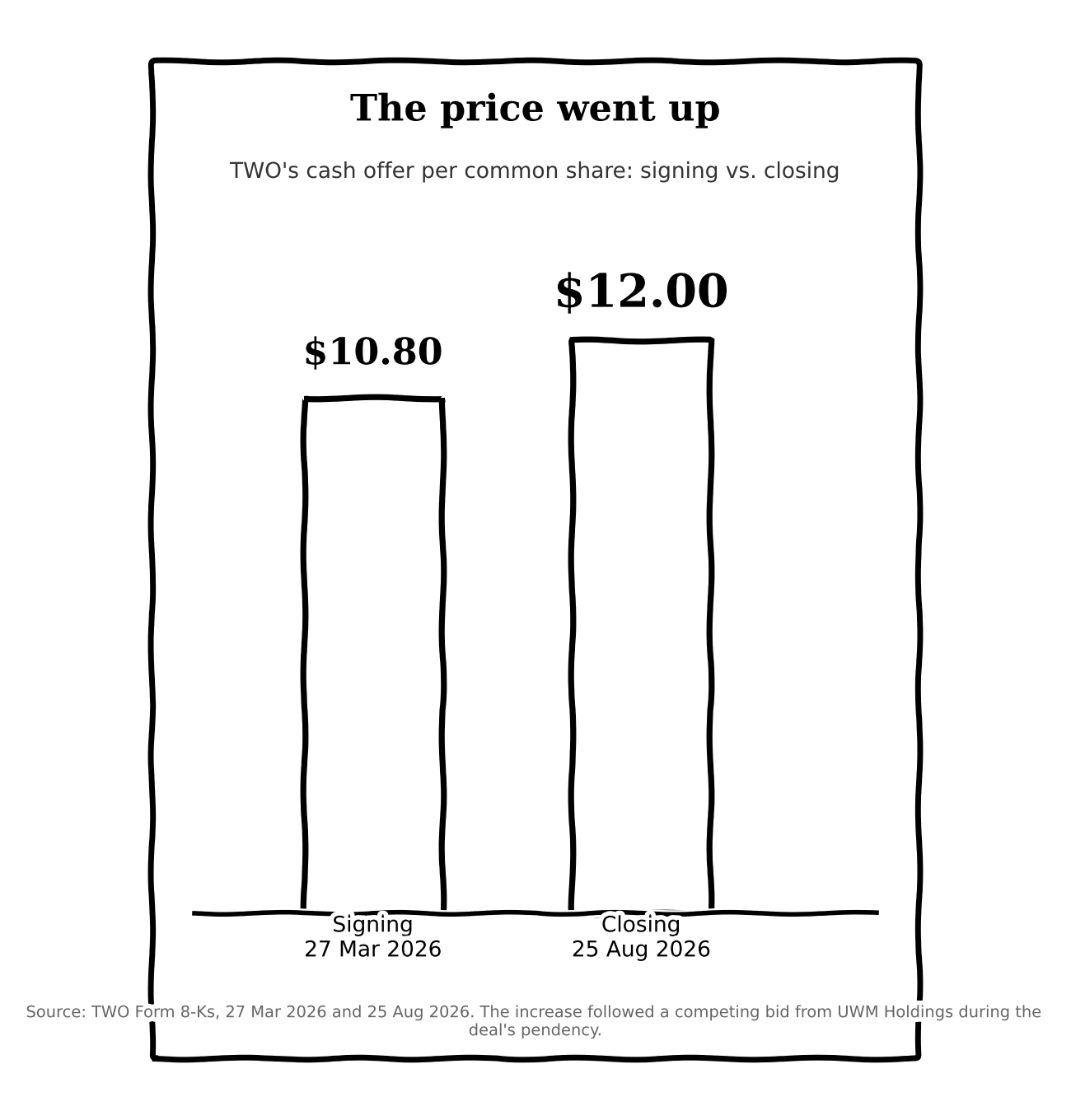
Share on LinkedInOn 25 August 2026, CrossCountry Mortgage LLC, the United States' largest distributed retail mortgage lender, completed its acquisition of Two Harbors Investment Corp, a New York Stock Exchange-listed REIT (Real Estate Investment Trust - a company that owns or finances income-producing real estate or, as here, mortgage-related assets, and gets favourable tax treatment if it pays out most of its income as dividends). Shareholders of Two Harbors Investment Corp received $12.00 in cash for each share, plus a small stub dividend, up from the $10.80 per share CCM originally agreed to pay when the deal was signed on 27 March 2026.
Two Harbors Investment Corp is a Maryland-incorporated REIT that invests in mortgage servicing rights (MSRs - the contractual right to collect mortgage payments and escrow amounts on behalf of a loan's actual owner, in exchange for a fee) and residential mortgage-backed securities, and owns RoundPoint Mortgage Servicing LLC, one of the larger servicers of conventional mortgages in the country. CCM is a privately held, non-bank mortgage originator. It says it is the number one distributed retail mortgage lender in the US, operating over 1,000 branches and more than 9,000 employees.
The deal was carried out as a reverse triangular merger, which means that a CCM subsidiary merged into Two Harbors Investment Corp, with Two Harbors surviving as a wholly owned subsidiary of CCM's parent, CrossCountry Intermediate HoldCo LLC. That structure lets the target keep its existing contracts and licences, which is useful for a heavily regulated mortgage servicer. Two Harbors Investment Corp's common stock is now delisted from the New York Stock Exchange, and they intend to redeem its Series A, B and C preferred stock at $25.00 per share plus accrued dividends (expected to cost roughly $622 million in total) and to repurchase its $115 million of 9.375% senior notes due 2030 at 104% of face value. Put simply, this means Two Harbors also plans to buy back its preferred shares (a type of equity with priority over common shares for dividends) for about $622m and repay its $115m of bonds early at 104% of their face value, effectively cashing out these investors and simplifying its capital structure.
This deal process is significant because Two Harbors had originally agreed, in December 2025, to merge with UWM Holdings Corporation. CCM came in afterwards with an unsolicited proposal that Two Harbors' board decided was a superior proposal (a standard merger-agreement concept where a rival bid is so much better than the signed deal, that the target's board is contractually permitted to switch, usually after paying a break fee). CCM funded Two Harbors' $25.4 million termination fee to UWM as part of switching sides. The price then moved again during the deal's pendency, from $10.80 to $12.00 per share, which the financial press reported as reflecting a competing bid from UWM re-entering the picture before CCM's final terms prevailed.
Per Two Harbors' own closing disclosure, "the source of the funds for the Merger Consideration was a combination of cash on hand and borrowings under existing financing facilities of CCM and its affiliates," and the deal was never subject to a financing condition. CCM's obligation to close did not depend on it successfully raising money. Neither company's SEC filings break out the debt/equity split of CCM's financing.
Houlihan Lokey is the financial adviser to Two Harbors, while PJT Partners are the named strategic adviser. Jones Day are their named legal counsel. Citi are the financial adviser to CCM, with Simpson Thacher & Bartlett LLP acting as legal counsel.
This is a vertical-integration story. CCM is the country's largest retail mortgage originator (a company or lender that creates new mortgages by processing, approving and funding home loans for borrowers), and Two Harbors brings a large MSR portfolio and RoundPoint's servicing infrastructure. Put together, CCM now spans the full mortgage lifecycle from origination through servicing, which, per CCM's own framing, should mean higher customer retention and lower customer acquisition costs than a pure originator can achieve. It's also a useful example of a competitive bidding process, where a 'topping bid' displaced a signed deal, followed by a further price increase.